






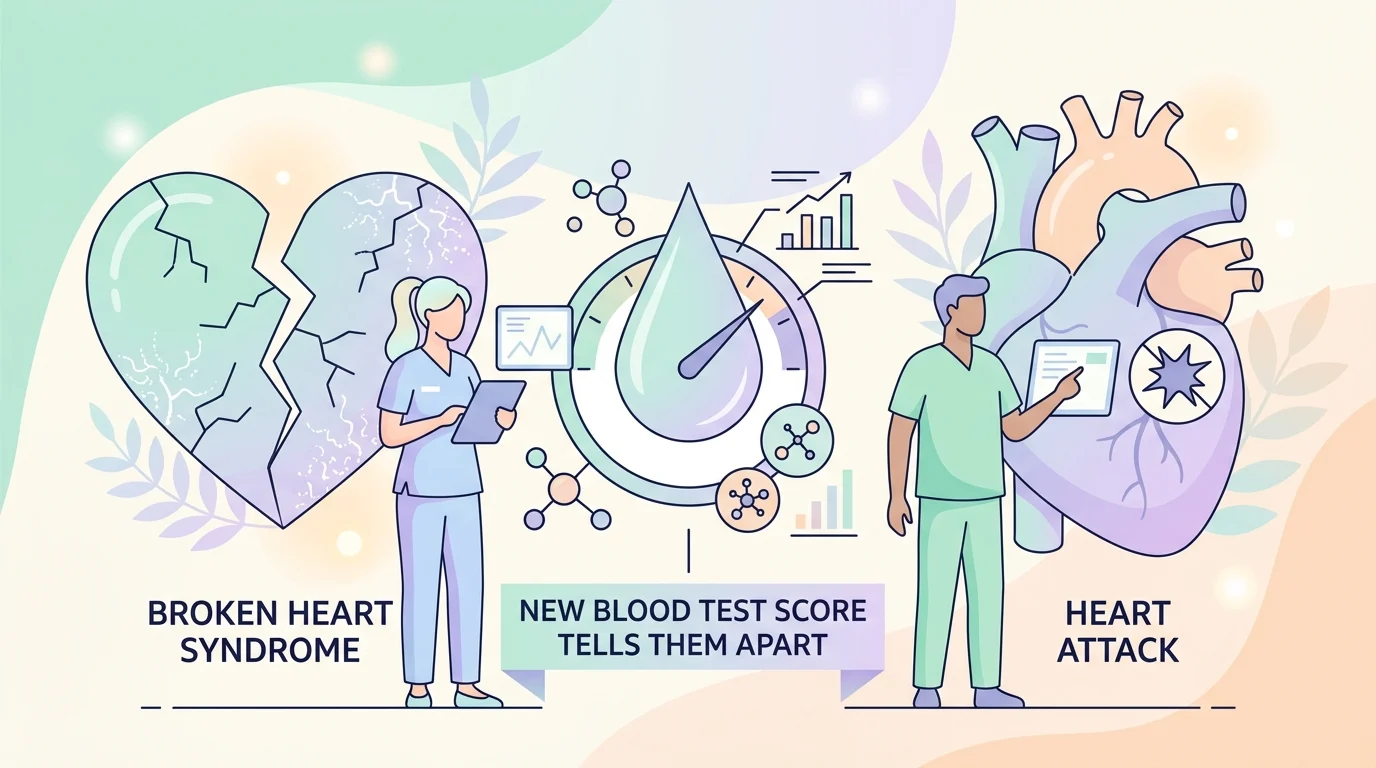
Broken heart syndrome sends thousands of people to emergency rooms every year with crushing chest pain, an alarming electrocardiogram and raised cardiac blood markers, yet no blocked artery to explain any of it. Telling it apart from a real heart attack has always required an invasive procedure. On 31 August 2026, a team working with the universities of Zurich and Greifswald published a diagnostic score in the European Heart Journal that uses only blood markers and biological sex to separate the two conditions before that procedure. In this article you will learn what the new score measures, why standard cardiac blood tests struggle to make the distinction, and what this changes for anyone who has had chest pain investigated.
The news: a blood-marker score that separates two look-alike emergencies
The tool is called the BioTAK score. Researchers built it from two large patient groups drawn from Swiss records and the International Takotsubo Registry: 1,823 patients in the development group and 1,792 in a separate validation group. In each group, the vast majority had a genuine acute coronary syndrome and a small minority had takotsubo syndrome, which is the medical name for broken heart syndrome.
Using machine learning, the team narrowed dozens of candidate markers down to five items available at the bedside before any imaging: four blood measurements plus biological sex. Applied with predefined thresholds, the score placed almost nine patients in ten into a likely diagnosis before invasive coronary angiography, the catheter-based examination that has until now been the only reliable way to settle the question.
What this means for you: if the approach holds up in routine practice, some patients arriving with suspected heart attack could be spared an invasive test they never needed. It does not replace that test when doctors judge it necessary.
Why troponin alone cannot tell the two apart
Both conditions damage heart muscle cells, and both therefore push cardiac markers up. Emergency teams order a cardiac markers panel within minutes of arrival, and the result rarely settles the diagnosis on its own. Troponin rises in a heart attack and in broken heart syndrome alike; some hospitals still report the CK-MB cardiac marker alongside it, with the same limitation.
There is a pattern, though. In takotsubo syndrome the heart muscle is stunned rather than starved, so troponin tends to stay comparatively modest while the stretched, poorly contracting ventricle floods the blood with natriuretic peptides. Clinicians already exploit that contrast when they run a BNP blood test in parallel. The trouble is that the overlap between individual patients is wide, which is why a single ratio has never been enough.
What the five ingredients of the score actually measure
The strength of the new score is that it combines signals from four different biological systems rather than relying on heart-muscle damage alone.
| Item in the score | What it reflects, in plain terms |
|---|---|
| NT-proBNP | How much the heart muscle is being stretched and strained; typically much higher in broken heart syndrome |
| Peptidylglycine alpha-amidating monooxygenase (PAM) | An enzyme that switches on messengers governing stress response, anxiety and blood-vessel tone, pointing to the brain-heart link |
| Soluble LOX-1 | Instability of fatty plaque inside the arteries, which is the mechanism behind a true heart attack |
| LDL cholesterol | Long-term exposure to artery-clogging particles, a background risk factor for coronary disease |
| Biological sex | Broken heart syndrome overwhelmingly affects women, most often after the age of 50 |
Two of those markers are new to this field, and they carry a message beyond diagnosis: they suggest broken heart syndrome runs through stress-signalling pathways rather than through clogged arteries. That is also why the score borrows from ordinary cardiovascular risk testing, including LDL cholesterol levels.
Who is affected, and what triggers it
Broken heart syndrome accounts for roughly 2 percent of people initially thought to be having a heart attack, and up to one woman in ten presenting with an acute coronary syndrome, according to the Zurich team. The American Heart Association describes it as a temporary weakening of part of the heart muscle, usually triggered by a surge of stress hormones.
Triggers include bereavement, divorce, a serious argument, financial shock, a major operation, a severe asthma attack, or even good news such as a surprise party. Cleveland Clinic lists a history of psychiatric or neurological illness among the risk factors, which is why a medical file often already mentions anxiety. One explanation for the female predominance is the loss of the protective hormonal environment that follows menopause. Stress physiology is also why clinicians sometimes investigate high cortisol levels in people under sustained strain.
Most people recover within days to a few weeks. A minority develop complications, and lasting breathlessness afterwards can signal heart failure that needs follow-up.
When to seek emergency help
No score, and no article, can be used to decide at home which condition you are having. Call emergency services immediately if you or someone near you has:
- Sudden, intense chest pain or a crushing sensation, whether or not it spreads to the arm, jaw or back
- Shortness of breath that comes on abruptly
- Fainting, or repeated near-fainting
- A very fast, very slow or irregular heartbeat with discomfort
- Chest symptoms appearing shortly after a severe emotional or physical shock
Both conditions are treated as emergencies until proven otherwise, and both can be serious in their acute phase.
Latest scientific advances
The new score arrives after several years of work on the same question, and reading them together shows how the field moved.
A 2023 meta-analysis pooling more than 5,600 patients confirmed the underlying pattern: troponin is markedly lower in broken heart syndrome than in acute coronary syndrome, while natriuretic peptides are higher. It also showed the limit of that pattern, since combining the two markers did not improve accuracy much. What this means for you: the contrast is real but too blurred at the individual level to rely on by itself.
Also in 2023, a Greek team reported that the ratio of NT-proBNP to troponin measured on the second day of admission separated the two conditions with high accuracy in a small group of 152 patients. Promising, but the timing requirement, on day two, is precisely what a doctor facing a patient in the first hour does not have.
In 2024, researchers from the International Takotsubo Registry compared the available biomarker ratios and scores head to head across the largest population assembled to date, and found each of them useful but imperfect. The same year, a Finnish group took a different route, measuring how the troponin molecule is broken into fragments; in a small study of 108 patients, the fragmentation profile discriminated better than the troponin level itself. That work remains preliminary and needs confirmation in larger groups.
Seen against that background, the value of the 2026 score is less that it is more accurate than that it works from a single early blood draw plus one piece of information the emergency team already has.
Glossary
| Term | Definition |
|---|---|
| Takotsubo syndrome | The medical name for broken heart syndrome. Takotsubo is a Japanese octopus trap whose shape the affected heart resembles. |
| Acute coronary syndrome | The umbrella term for emergencies caused by a sudden drop in blood supply to the heart, including heart attack. |
| Troponin | A protein released into the blood when heart muscle cells are injured. It signals damage but not its cause. |
| NT-proBNP | A fragment released when the heart chambers are stretched. It is a marker of strain rather than of blockage. |
| Coronary angiography | An examination in which a catheter and a dye reveal whether the heart arteries are blocked. |
| Rule-in and rule-out thresholds | Two cut-off values set in advance: above one, a diagnosis becomes likely; below the other, it becomes unlikely. |
| Apical ballooning | The bulging of the lower tip of the heart seen during an episode, while the base keeps contracting. |
| Left ventricle | The main pumping chamber of the heart, which sends blood to the whole body. |
Frequently asked questions
Can you die from broken heart syndrome?
Rarely, but it is possible. During the acute phase, the risk of serious complications such as cardiogenic shock or dangerous rhythm disturbances is comparable to that of a heart attack, which is why hospital monitoring is standard. Most people recover fully within days or weeks and have no permanent heart damage.
What are the early signs of broken heart syndrome?
Sudden chest pain and shortness of breath, most often appearing within minutes to hours after a severe emotional or physical shock. Fainting, palpitations and low blood pressure can accompany them. Because these signs are indistinguishable from a heart attack without testing, they always warrant emergency care.
How do doctors tell it apart from a heart attack?
Today, mainly by coronary angiography: if the arteries are clear and the left ventricle shows the characteristic bulging, the diagnosis points to takotsubo syndrome. Electrocardiograms and standard blood tests narrow the field but rarely settle it. The blood-marker score published in 2026 aims to make that first orientation possible before the catheter.
Does broken heart syndrome go away?
In most cases, yes. Heart function usually returns to normal within a few days to a few weeks, and doctors often repeat an ultrasound scan several weeks later to confirm recovery. Some people report low energy for months afterwards and should mention it at follow-up.
Can it happen again?
Recurrence is uncommon but documented, affecting a small share of patients in the years after a first episode. Long-term treatment, most often with medicines that relax blood vessels and reduce the workload on the heart, is prescribed partly for that reason.
Is there a blood test I can ask for?
Not as a routine screening test. The score described here is designed for the emergency setting, in someone already presenting with acute symptoms, and it is not yet part of standard practice. There is no blood test that predicts who will develop broken heart syndrome.
Sources
- American Heart Association — Is Broken Heart Syndrome Real? — heart.org
- Mayo Clinic — Broken heart syndrome: symptoms and causes, 2026 — mayoclinic.org
- Cleveland Clinic — Broken Heart Syndrome, 2026 — my.clevelandclinic.org
- Wenzl FA, Schweiger V, Smolle MA, et al. — Takotsubo syndrome diagnosis: the biomarker-based BioTAK score — European Heart Journal, 2026 — doi.org/10.1093/eurheartj/ehag597
- Schweiger V, Di Vece D, Cammann VL, et al. — Cardiac biomarkers for diagnosing Takotsubo syndrome — European Heart Journal, 2024 — PubMed 38717630
- Airaksinen KEJ, Tuominen H, Paana T, et al. — Novel troponin fragmentation assay to discriminate between Takotsubo syndrome and acute myocardial infarction — European Heart Journal: Acute Cardiovascular Care, 2024 — PubMed 39422200
- Couch LS, et al. — Comparison of troponin and natriuretic peptides in Takotsubo syndrome and acute coronary syndrome: a meta-analysis — Open Heart, 2023 — consensus.app
- Rallidis LS, et al. — NT-proBNP/cardiac troponin T ratio above 7.5 on the second day of admission can differentiate Takotsubo from acute coronary syndrome — Hellenic Journal of Cardiology, 2023 — consensus.app
Further reading
- How to read your blood test results
- Abnormal blood test results explained
- Lipid panel explained
- Blood pressure guidelines and the tests behind them
- Complete blood count results
Understand your lab results with AI DiagMe
A cardiac scare usually leaves you holding a printout full of numbers: troponin, natriuretic peptides, cholesterol, kidney and liver values measured on the same sample. AI DiagMe turns those results into clear language, explains which values sit outside their reference range and why that might be, and helps you arrive at your follow-up appointment with the right questions. It helps you understand your results; it does not diagnose you and does not replace your doctor.
Get your results interpreted in minutes