





Learning to read blood test results can feel like decoding a foreign language. Rows of abbreviations, numbers, and reference ranges, sometimes with an “H” or “L” beside them, can leave anyone unsure about what is normal and what needs attention. The good news is that every lab report follows the same basic structure. Once you understand that structure, the numbers become far less intimidating.
This guide explains, in plain language, how to make sense of your report step by step. You will learn what each column means, what the most common panels actually measure, why a value flagged “high” or “low” is not the same as a diagnosis, how long results usually take, and when an abnormal value is worth a conversation with your doctor.
How to read blood test results: start with the layout
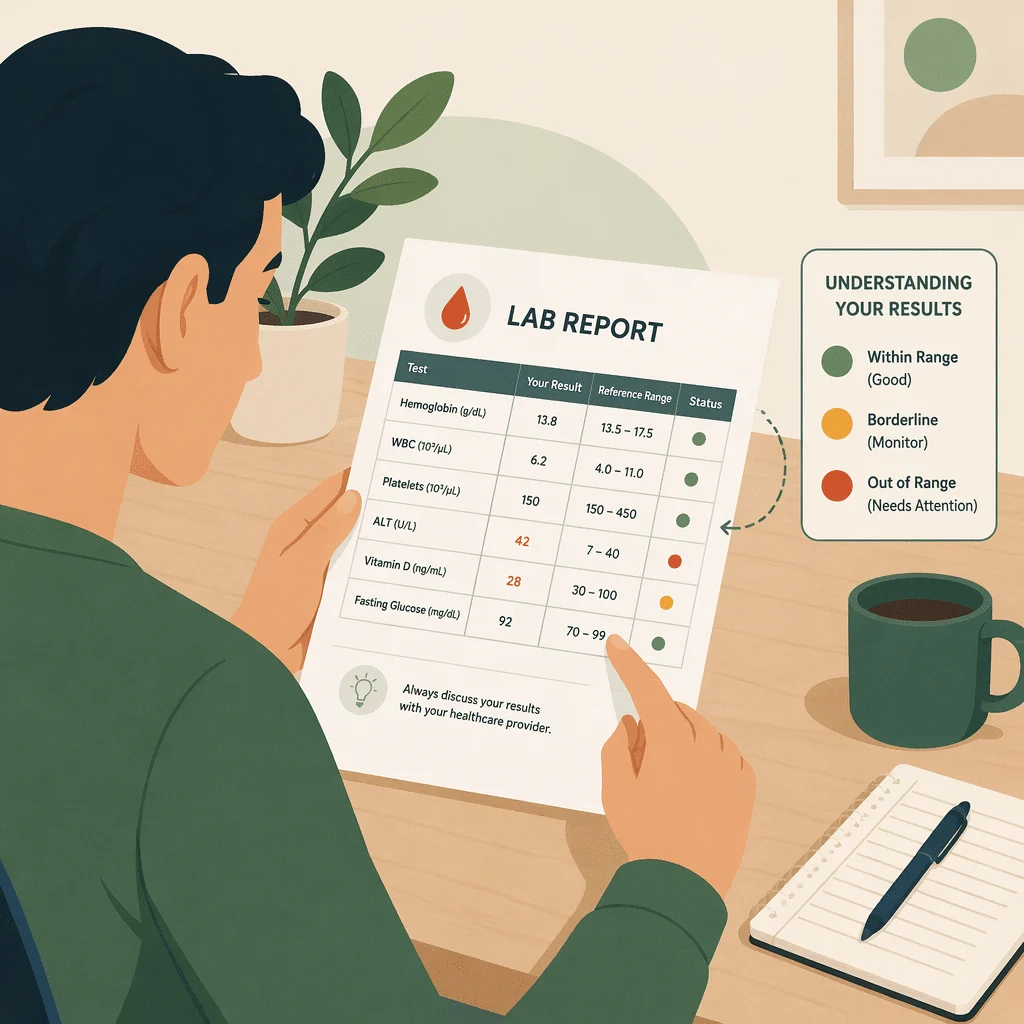
Almost every lab report, whether printed or shown in a patient portal, is built the same way. Reading it is mostly about knowing which column does what.
A typical row contains five pieces of information:
- Test name: the substance being measured, such as “Hemoglobin” or “Glucose.” Many appear as abbreviations like HbA1c or eGFR.
- Your result: the number measured in your sample. This is what you compare against the range.
- Units: the scale used, such as mg/dL or mmol/L. The same marker can be reported in different units depending on the country or laboratory.
- Reference range: the values expected in a healthy person.
- Flag: a letter or symbol (often “H,” “L,” or “*”) shown only when a result sits outside the range.
Before you even reach the numbers, glance at the top of the report. Check that your name, date of birth, and the sample collection date are correct. Note that date, because every result is a snapshot of one moment, not a permanent statement about your health. This quick check also rules out the rare mix-up of reading someone else’s report.
The single most useful habit is to read your results as a group rather than one line at a time. A single number rarely tells the whole story; patterns across several markers, combined with your symptoms and history, are far more meaningful.
What a reference range actually means
A reference range is not a strict line between “healthy” and “sick.” Laboratories build each range by testing large groups of healthy people and keeping the middle portion of their results, usually the central 95%. By definition, that leaves about 1 in 20 perfectly healthy people with at least one value outside the range.
Ranges also shift with age, sex, pregnancy, and even the equipment a lab uses. That is why the range printed on your report is the one that matters, and why comparing your number to a friend’s report or a figure found online can be misleading.
It works both ways, too. A set of results that all fall within range does not guarantee perfect health, and a single value outside the range does not prove that something is wrong. The range is a guide for interpretation, not a pass-or-fail score.
The main blood test panels, explained
Doctors rarely order a single marker. Instead, they request a panel, a bundle of related tests that gives a picture of one part of your body. Understanding the common panels helps you see why your report has so many lines. If you are unsure whether you had a blood-count or a chemistry test, our guide comparing the CBC and the CMP breaks down the difference.
Complete blood count (CBC)
The complete blood count (CBC) looks at the cells in your blood: red cells, white cells, and platelets. It is one of the most common tests and can hint at anemia, infection, or clotting problems. Beyond the cell counts, it reports “indices” that describe your red cells, such as the mean corpuscular volume (MCV), which measures their average size. In practice, red cells and hemoglobin reflect how well oxygen is carried around the body, white cells show the immune system responding to infection or inflammation, and platelets help the blood to clot. A low red-cell or hemoglobin reading is the classic sign of anemia, while shifts in white cells often track an infection.
Comprehensive and basic metabolic panels
A basic metabolic panel (BMP) checks your blood sugar, kidney function, and the salts (electrolytes) that keep your body balanced. Electrolytes such as sodium and potassium can seem like minor details, but large swings affect the heart and nervous system, which is why they appear on so many panels. A comprehensive metabolic panel (CMP) adds liver markers and proteins for a broader view. Kidney function is judged partly through blood urea nitrogen (BUN) and the estimated glomerular filtration rate (eGFR), which estimates how well your kidneys filter waste. If long-term blood sugar is being tracked, you may also see glycated hemoglobin (HbA1c).
Lipid panel
A lipid panel measures the fats in your blood and helps estimate heart-disease risk. It usually reports total cholesterol, triglycerides, HDL (“good” cholesterol), and LDL cholesterol, the type most closely linked to clogged arteries.
Liver and thyroid checks
Liver health is often assessed through two enzymes: ALT and AST. Both rise when liver cells are irritated, though AST also appears in muscle. The thyroid gland is screened with thyroid-stimulating hormone (TSH), which can explain symptoms such as fatigue or unexpected weight changes.
The table below summarizes how these panels compare.
| Panel | What it mainly checks | Example markers | Often ordered to |
|---|---|---|---|
| Complete blood count (CBC) | Blood cells | Red cells, white cells, platelets, hemoglobin, MCV | Look for anemia, infection, or clotting issues |
| Basic metabolic panel (BMP) | Sugar, kidneys, salts | Glucose, BUN, creatinine, sodium, potassium | Check kidney function and fluid balance |
| Comprehensive metabolic panel (CMP) | Sugar, kidneys, liver, salts | BMP markers plus ALT, AST, albumin, bilirubin | Give a broad picture of organ health |
| Lipid panel | Blood fats | Total cholesterol, LDL, HDL, triglycerides | Estimate heart-disease risk |
| Thyroid panel | Thyroid gland | TSH, free T4 | Investigate fatigue, weight, or mood changes |
Decoding the abbreviations on your report
Abbreviations are the part most people find confusing. The codes are simply shorthand for the substance being measured. The quick-reference table below covers the ones you are most likely to meet; for a fuller list, see our guide to common lab test abbreviations.
| Abbreviation | Full name | What it relates to |
|---|---|---|
| Hb / HGB | Hemoglobin | Oxygen-carrying protein in red cells |
| HCT | Hematocrit | Share of blood made up of red cells |
| MCV | Mean corpuscular volume | Average size of red cells |
| WBC | White blood cell count | Immune cells that fight infection |
| PLT | Platelet count | Cells that help blood clot |
| BUN | Blood urea nitrogen | Waste linked to kidney function |
| eGFR | Estimated glomerular filtration rate | How well kidneys filter blood |
| ALT / AST | Liver enzymes | Released when the liver is irritated |
| TSH | Thyroid-stimulating hormone | Controls the thyroid gland |
What “high” and “low” flags really mean
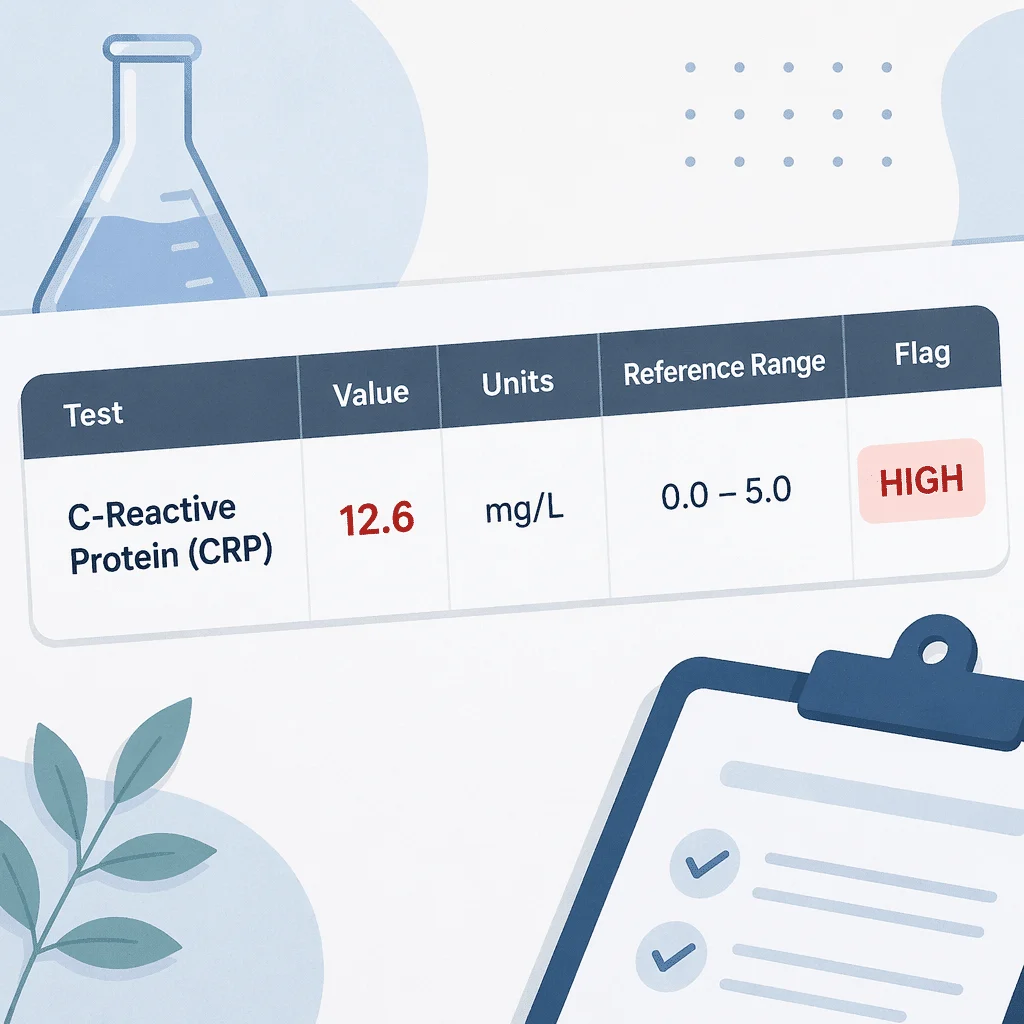
A flag beside a result tells you the value sits outside the reference range. It does not tell you that something is wrong. As noted earlier, mild variations are common, and many healthy people see one or two flagged values on a routine test.
What matters is the size and pattern of the change. A result that is only slightly above or below the range, with no symptoms, is rarely a concern and is often rechecked weeks later. A value that is markedly outside the range, or several related markers that are off at once, deserves more attention.
Context is everything. A raised white cell count in a child with a fever usually reflects an ordinary infection, while the same finding in an adult with no symptoms may simply need a repeat test. A short-term marker of inflammation such as C-reactive protein (CRP) rises with many everyday conditions, so it is interpreted alongside your overall picture rather than on its own. Trends over time are also more telling than any single snapshot.
It also helps to know that not every flag carries equal weight. Some reports use color as well as letters, and laboratories reserve their fastest alerts for a small number of dangerously abnormal “critical” values. The large majority of flagged results are mild and simply prompt a closer look or a repeat test rather than any immediate action.
What can skew your results before you panic
Many everyday factors can nudge a result outside its range without signalling any disease. Knowing them can save you unnecessary worry.
Common influences include:
- Eating before a fasting test: glucose and cholesterol can read higher if you did not fast when asked to.
- Dehydration: too little water can concentrate your blood and shift several values at once.
- Time of day: some markers, such as iron and certain hormones, naturally vary between morning and evening.
- Recent exercise: strenuous activity can temporarily raise muscle and liver enzymes.
- Alcohol and smoking: both can affect liver markers and other results in the day or two before a test.
- Medications and supplements: many can alter specific values, which is why your clinician may ask what you take.
- Menstrual cycle and pregnancy: these change the expected range for several markers.
If a single value looks off after one of these situations, it is often a temporary fluctuation rather than a sign of illness.
How soon will you get your results?
One of the most common questions is simply how long the wait will be. The honest answer is that it depends on the test and where it is processed.
Routine tests run on a hospital or laboratory’s own analyzers, such as a complete blood count or a basic chemistry panel, are often ready within hours to a couple of days. More specialized tests, including some hormone, antibody, or genetic analyses, may be sent to a dedicated laboratory and can take a week or more. Part of the reason is biology rather than backlog: some tests, such as cultures that check for bacteria, simply need days for organisms to grow before they can be read.
How you hear about the results also varies. Many practices contact you only if something needs discussion and otherwise post results to an app or patient portal. If a value is dangerously abnormal, known as a “critical” result, the laboratory usually alerts your clinician quickly so they can reach you without waiting for the next appointment. If you have not heard anything after the expected window, it is reasonable to ask rather than assume no news means good news.
When to see a doctor about your results
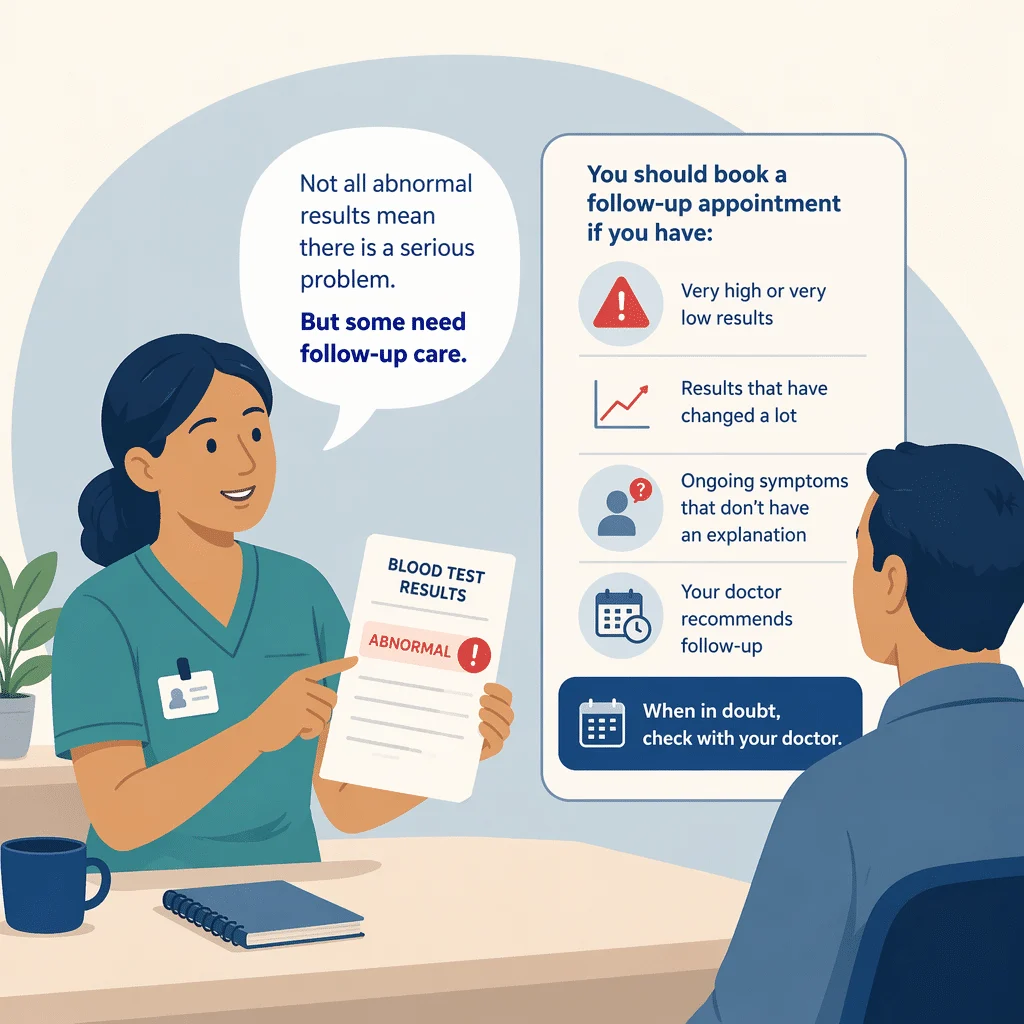
Your report is a tool for a conversation, not a verdict. Most results are best interpreted with a professional, but some situations call for more prompt attention than others.
Consider contacting your doctor sooner if:
- A result is markedly outside the range, not just slightly.
- Several related markers are abnormal at the same time (for example, several liver or kidney values together).
- An abnormal value comes alongside symptoms such as unexplained weight loss, persistent fever, severe fatigue, breathlessness, or unusual bleeding or bruising.
- A previously stable marker has changed sharply from your earlier results.
- The report itself carries a comment from the laboratory advising follow-up.
By contrast, a single value that sits just outside the range, with no symptoms and no concerning trend, often needs nothing more than a recheck at a later date. When in doubt, ask: a brief question to your clinician is always more reliable than guesswork. Seek urgent care if you feel acutely unwell, regardless of what the numbers say.
Glossary
- ALT (alanine aminotransferase): a liver enzyme that rises when liver cells are irritated or damaged.
- AST (aspartate aminotransferase): a liver enzyme also found in muscle; interpreted alongside ALT.
- BUN (blood urea nitrogen): a waste product used, with creatinine, to assess kidney function and hydration.
- Complete blood count (CBC): a common test that counts red cells, white cells, and platelets.
- Comprehensive metabolic panel (CMP): a chemistry panel covering sugar, kidneys, liver, and salts.
- eGFR (estimated glomerular filtration rate): an estimate of how well the kidneys filter blood.
- Hematocrit (HCT): the proportion of your blood volume made up of red cells.
- Hemoglobin (HGB): the protein in red cells that carries oxygen around the body.
- MCV (mean corpuscular volume): the average size of your red blood cells.
- Reference range: the span of values expected in most healthy people for a given test.
Frequently asked questions
Can I read my own blood test results before my doctor explains them?
Yes. You have a right to see your own results, and many people now view them in an app or portal before their appointment. Reading them in advance can help you prepare useful questions. Keep in mind that your report is only part of the picture: it does not include your symptoms, history, or examination. Use it to understand the basics and to note anything you want to ask, but rely on a qualified professional to confirm what the numbers mean for you specifically.
How long are blood test results valid?
There is no single expiry date. How current a result needs to be depends on the marker and your situation. Stable, long-term measures may stay relevant for months, while values that change quickly, or that are being used to guide treatment, may need to be repeated within weeks. If your health, symptoms, or medications have changed since the test, older results may no longer reflect your current state. Your clinician can tell you whether a result is still useful or should be redone.
Can my blood test results be normal even though I feel unwell?
Yes, this can happen. A standard panel checks only the markers it was designed to measure, so it can miss conditions that those particular tests do not detect. Results can also be normal early in an illness before changes appear. Normal numbers are reassuring, but they do not rule everything out. If you continue to feel unwell despite a normal report, tell your doctor; they may suggest different tests or look more closely at your symptoms over time.
Why are the reference ranges on my report different from someone else’s?
Ranges differ for good reasons. Each laboratory sets its own ranges based on its equipment and the population it serves, so two labs can list slightly different numbers for the same test. Many markers also have separate ranges for men and women, for different age groups, and during pregnancy. This is why you should always compare your result to the range printed on your own report rather than to a friend’s results or a generic figure found online.
Should I get retested if one value is slightly outside the range?
Often, a mild, isolated abnormality is simply rechecked rather than acted on immediately. Because everyday factors and natural variation can push a single value just outside its range, doctors frequently repeat the test after a period to see whether it returns to normal on its own. Whether and when to retest depends on the specific marker, how far it is from the range, and whether you have symptoms. Your clinician will advise on the right timing for your situation.
Can an app or website interpret my blood test results?
Digital tools can help you understand what your markers mean and put your numbers into plain language, which can make your report far less confusing. They are useful for learning and for preparing questions. However, such tools provide general information, not a personal diagnosis, and they cannot weigh your full medical history the way a clinician can. Treat them as a way to become better informed, and have a qualified professional confirm anything that concerns you.
Sources
- How to Understand Your Lab Results — MedlinePlus, National Library of Medicine
- Blood tests — NHS
- Blood Tests: Types, Results & How They Work — Cleveland Clinic
Further reading
- CBC vs CMP: Understanding the Tests
- Common Medical Lab Test Abbreviations: Guide
- Blood Markers: A Comprehensive Glossary
- Ferritin: Understanding This Blood Marker for Your Health
- Fasting Blood Glucose: Your Complete Guide to Interpretation
Understand your lab results with AI DiagMe
Once you know how a report is built, the natural next step is understanding what your own numbers mean. AI DiagMe turns the figures from a complete blood count, liver enzymes (such as ALT and AST), kidney markers (such as BUN and eGFR), or a cholesterol panel into clear, plain-language explanations. It is designed to help you understand your results and prepare better questions, not to diagnose you or replace your doctor. If your latest report left you with questions, let AI DiagMe walk you through it.
➡️ Get your results interpreted in minutes