





High cortisol levels are one of the most searched health topics of the moment, and one of the most misunderstood. Cortisol is the hormone your adrenal glands release to help you handle stress, keep blood sugar steady and damp down inflammation. When a result comes back above the reference range, the word most people reach for is Cushing’s. In practice, that is rarely the answer.
The commonest reason anyone develops the picture of cortisol excess is a steroid medicine, not a tumor. And a single raised reading, on its own, almost never means Cushing’s syndrome.
In this article you’ll learn which medicines and situations genuinely push cortisol up, which signs really point toward Cushing’s syndrome and which do not, how it is confirmed, and how to think about “cortisol face”, cortisol detoxes and at-home saliva panels.
Steroid medicines: by far the commonest cause
Glucocorticoids are man-made copies of cortisol: prednisone, prednisolone, dexamethasone, budesonide, fluticasone, triamcinolone and their relatives. They treat asthma, eczema, rheumatoid arthritis, inflammatory bowel disease, lupus and joint pain.
Taken for long enough, or at a high enough dose, they can produce the full picture of cortisol excess: a rounder face, fat gathering at the base of the neck and between the shoulders, thinning skin, easy bruising, raised blood sugar and raised blood pressure. Doctors call this exogenous or iatrogenic Cushing’s syndrome, meaning it comes from treatment rather than from the body.
The National Institute of Diabetes and Digestive and Kidney Diseases describes this as the most common cause of Cushing’s syndrome overall, and notes that more than 10 million Americans take glucocorticoids each year. The kind caused by a tumor is estimated at roughly 40 to 70 people per million.
The route matters less than people expect. Tablets are the usual culprit, but inhaled steroids, potent creams used over large areas, joint injections, nasal sprays and eye drops can all be absorbed enough to matter, especially in combination.
The pharmacological irony: your cortisol result may look low
Here is the part that confuses almost everyone. Most assays measure cortisol itself. Synthetic steroids such as dexamethasone and prednisolone are different molecules, so they are largely invisible to those assays, yet they act on the same receptors and switch off the brain’s signal to the adrenals.
The result is a mismatch: the person looks like they have too much cortisol, but the number is normal or low. That is not a laboratory error, and it is why your doctor asks about every steroid you have taken, creams and injections included. Our guide to low morning cortisol covers the other side of that suppression.
Never stop or reduce a steroid on your own
This is the single most important safety point on this page. Long-term glucocorticoids suppress your own adrenal production. If they are stopped suddenly, the body can be left unable to make the cortisol it needs, triggering an adrenal crisis. That is a medical emergency and it can be fatal.
Tapering is always physician-directed. If you recognize yourself in the description above, book an appointment rather than skipping a dose. Your prescriber can review whether the dose can be lowered safely, whether a non-steroid alternative exists, and how to monitor blood sugar, blood pressure and bone health.
Situations and conditions that raise cortisol without any disease of the gland
Cortisol is a stress-response hormone, so it does what you would expect: it rises when the body is under load. A raised result is often an accurate reading of a temporary state rather than a hormonal disorder.
It commonly runs high during acute illness, after surgery, with significant pain and in hospital. It also runs high in longer-lasting situations, once labelled pseudo-Cushing’s and now called non-neoplastic or physiological hypercortisolism:
- Major depression and severe anxiety
- Alcohol use disorder
- Poorly controlled diabetes, where fasting glucose and glycated hemoglobin stay above target
- Obesity and metabolic syndrome
- Obstructive sleep apnea, which blunts the normal overnight dip
- Eating disorders, very heavy training loads, shift work and chronic sleep restriction
Pregnancy and estrogen cause a different kind of false alarm. Estrogen, whether from pregnancy, the combined pill or hormone therapy, raises a carrier protein called cortisol-binding globulin. Total cortisol rises with it, but the free, active fraction does not. The number is genuinely higher; the hormone exposure is not. This is one of the most frequent reasons a healthy person is told their cortisol is high.
Physiological hypercortisolism is far more common than true Cushing’s syndrome, and it usually settles once the underlying situation is treated. That is why an endocrinologist often asks you to repeat testing later.
What genuinely points toward Cushing’s syndrome
Endogenous Cushing’s syndrome is rare. It comes from one of three places: a benign pituitary tumor producing too much adrenocorticotropic hormone, called Cushing’s disease and accounting for most cases; a tumor of the adrenal gland making cortisol directly; or a tumor elsewhere, most often in the lung, producing ACTH where it should not, known as ectopic ACTH syndrome.
The signs that actually discriminate
Doctors pay most attention to features that are hard to explain any other way, because these reflect the breakdown of muscle, skin and bone caused by sustained cortisol excess:
- Proximal muscle weakness: difficulty rising from a low chair, climbing stairs or lifting arms above the head, because the large muscles of the thighs and shoulders go first
- Wide purple or red stretch marks, more than a centimeter across, on the abdomen, upper arms or thighs
- Easy bruising with visibly thin, fragile skin
- Facial plethora: a persistently flushed, ruddy face
- A fracture from a minor knock, or unexplained bone thinning at a young age
- New diabetes or high blood pressure that is unusually hard to control in someone young
The signs that overlap with everything else
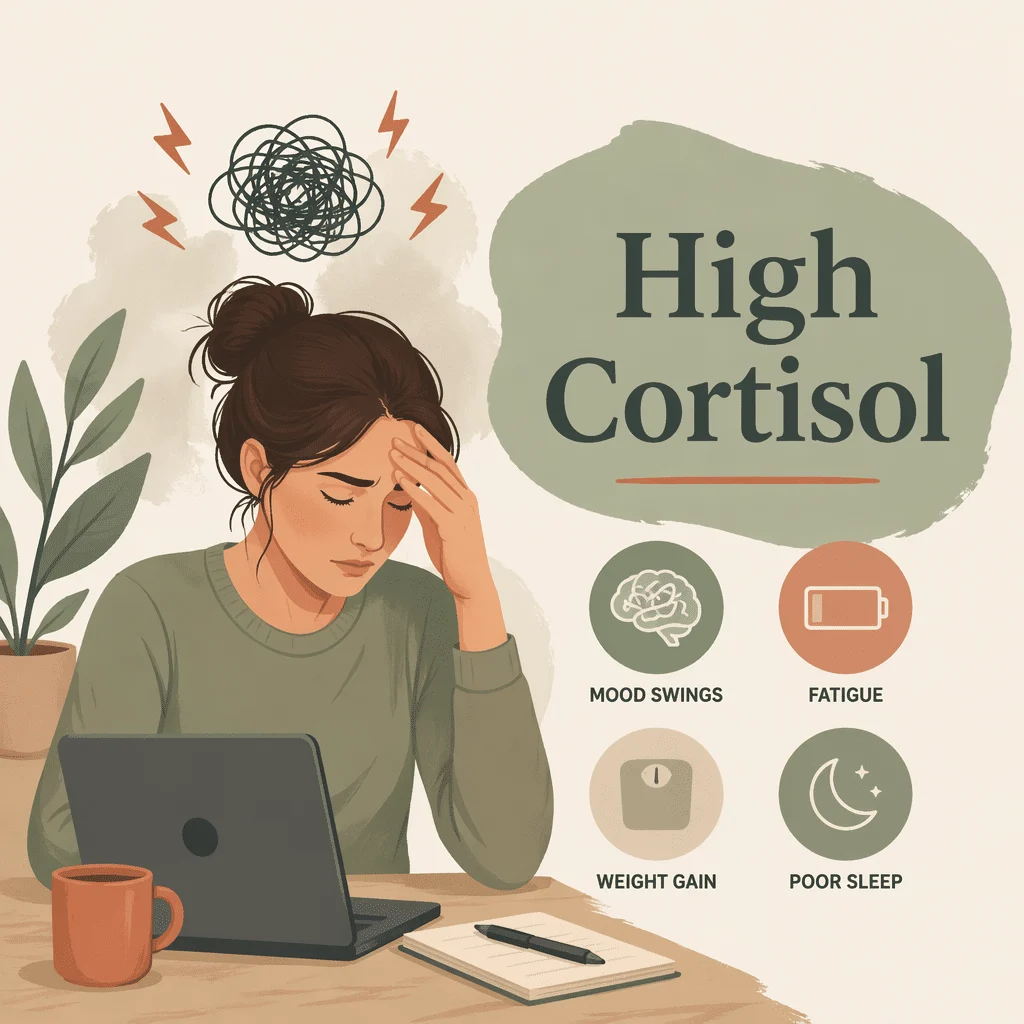
Weight gain, tiredness, low mood, poor sleep, irregular periods and a rounder face are real symptoms that deserve attention. They are also extremely common in people who do not have Cushing’s syndrome, and on their own they cannot separate a hormonal disorder from stress, thyroid disease, depression, perimenopause or weight change. That is not a dismissal; it is why assessment looks at the whole picture rather than one number.
Other results are checked alongside cortisol when the picture is unclear, including TSH, prolactin and, in women with unwanted hair growth, androgens. Low potassium alongside difficult high blood pressure prompts further adrenal testing, including aldosterone.
How high cortisol is actually confirmed
Confirmation is staged, not a single test. Screening usually starts with late-night salivary cortisol, a 24-hour collection for urinary free cortisol, or an overnight low-dose dexamethasone suppression test. Our guide to the cortisol blood test explains what each measures and why timing changes the answer.
No single screening test is good enough on its own. The Endocrine Society’s clinical practice guideline on diagnosing Cushing’s syndrome recommends confirming an abnormal result with a second, different test, because false positives are common and a wrong label carries real consequences.
Only once excess cortisol is established does the second stage begin. Measuring ACTH separates the possibilities: a suppressed ACTH points to the adrenal gland, a normal or high ACTH to the pituitary or an ectopic tumor. Imaging follows, usually a CT of the adrenals or an MRI of the pituitary.
A quick guide to what a raised cortisol usually means
| Your situation | What it usually means | What to do |
|---|---|---|
| You take steroid tablets, inhalers, creams or injections | Any cortisol-excess features most likely come from the medicine, even if measured cortisol is normal or low | List every steroid for your prescriber. Never adjust the dose yourself |
| Cortisol was measured during illness, after surgery or in hospital | A normal stress response, not a gland problem | Ask whether to simply repeat the test after recovery |
| Tiredness and weight gain only, with no skin, muscle or bone changes | Cushing’s syndrome is unlikely; other causes are far more probable | Ask for a broad workup: thyroid, blood sugar, sleep, iron, mood |
| You are pregnant, on the combined pill or on estrogen therapy | Total cortisol is raised by a carrier protein; free cortisol is usually normal | Tell whoever ordered the test so the right method is used |
| Proximal weakness with wide purple striae, thin skin, easy bruising | A pattern that warrants serious consideration of Cushing’s syndrome | Ask for referral to an endocrinologist |
“Cortisol face”, cortisol detoxes and at-home saliva panels
Cortisol has become a social media diagnosis. “Cortisol face”, “cortisol belly” and “cortisol detox” now attract hundreds of thousands of searches a month, alongside the supplements and test kits sold against them.
What is true: chronic stress is not harmless. Poor sleep, relentless work pressure and untreated anxiety genuinely affect blood pressure, blood sugar, appetite and how you feel. If you are exhausted, gaining weight you cannot explain and looking for an answer, you are noticing something real.
Why “cortisol face” is not a diagnosis
The rounded face of genuine cortisol excess, sometimes called moon facies, is a clinical sign that appears alongside thin skin, purple striae, proximal weakness and a fat pad at the base of the neck. It is not something you can self-assess in a mirror, and a before-and-after photograph cannot establish it.
Faces change for many ordinary reasons: fluid retention, salt, alcohol, poor sleep, weight change, allergy, dental problems, the menstrual cycle, age. None of these is “cortisol face”, because “cortisol face” is not a recognized medical entity. If your face has changed and it bothers you, raise it with a doctor. It is not a reason to buy a protocol.
At-home saliva panels sold direct to consumers
Late-night salivary cortisol is a legitimate clinical test, but its value comes from the context around it: the right indication, the right timing, a validated assay, a laboratory-specific cut-off and a clinician who confirms an abnormal result. A kit bought online supplies the sample and none of the rest.
The problem is not that the number is meaningless. It is that an isolated abnormal result in someone without discriminating signs is far more likely to be a false alarm than a diagnosis, while a normal result in someone who does have signs offers false reassurance. Either way, the kit tends to lead to a product rather than an assessment.
Supplements marketed to lower cortisol
Ashwagandha, phosphatidylserine, rhodiola and other adaptogens are widely sold with cortisol-lowering claims. The honest summary is narrower than the marketing.
Randomized trials of ashwagandha do show measurable reductions in blood cortisol versus placebo. What they have not shown is that this reliably translates into people feeling less stressed, and none of it relates to treating a cortisol disorder.
Two further points deserve honesty. Supplements in the United States are not approved by the Food and Drug Administration before sale, so strength and content vary. And “natural” does not mean inert: the National Center for Complementary and Integrative Health notes rare reports of liver injury with ashwagandha, advises against it in pregnancy and breastfeeding, and lists interactions with thyroid, diabetes, blood pressure and immune-suppressing medicines. A supplement cannot shrink a pituitary adenoma, and there is no such thing as a cortisol detox.
What actually helps when stress is the real issue
If your assessment finds no cortisol disorder, that is good news, and it does not mean nothing can be done. The measures that help are unglamorous and nobody markets them.
Sleep comes first: a regular schedule, enough hours, and treatment for anything that fragments the night. Diagnosing and treating obstructive sleep apnea improves daytime fatigue, blood pressure and blood sugar in ways no supplement matches. Reducing alcohol matters more than most people expect, since heavy intake both raises cortisol and disrupts sleep. Treating depression and anxiety properly addresses a recognized cause of physiological hypercortisolism directly, and getting blood sugar under control does the same.
This describes where the evidence sits rather than what you personally should do, and is a starting point for a conversation with your own doctor.
Red flags that need proper assessment, not a supplement
Arrange a medical appointment, and ask about endocrine assessment, if you have any of the following:
- Rapidly progressive weakness in the thighs or shoulders, such as struggling to stand from a chair without your arms
- Wide purple stretch marks appearing on the abdomen, arms or thighs
- Easy bruising with thin, fragile skin
- New diabetes, or blood sugar and blood pressure that are hard to control
- A fracture after a minor knock, or unexplained bone thinning
- Severe mood disturbance, psychotic symptoms or rapid personality change
If you take a steroid medicine and feel unwell, faint or develop vomiting or severe weakness, seek urgent care and do not stop the medicine yourself.
Latest scientific advances in assessing high cortisol
Research published between 2023 and 2026 has focused on two questions that matter directly to readers: who should be screened at all, and how to tell true Cushing’s syndrome apart from the far commoner physiological kind.
The Italian Society of Endocrinology published a position statement in 2025 setting out who should be screened and which first-line test to use, covering people with type 2 diabetes or obesity, high blood pressure, osteoporosis, mood disorders, menstrual irregularity and incidental findings on imaging. What this means for you: screening is targeted, not universal. Being tired or carrying extra weight is not by itself an indication for cortisol testing, and a doctor declining to test is often following the evidence rather than dismissing you.
A systematic review and meta-analysis in Pituitary compared the second-line tests used to separate Cushing’s syndrome from non-neoplastic hypercortisolism: the dexamethasone-CRH test, the desmopressin test, midnight serum cortisol and late-night salivary cortisol. They performed broadly similarly, with salivary cortisol the least consistent, largely because assays and cut-offs differ between laboratories. What this means for you: even in specialist hands, telling these two apart takes more than one test, and salivary results are laboratory-dependent, which is exactly why a home kit cannot settle the question.
The European Society of Endocrinology’s 2023 guideline on adrenal incidentalomas, the masses found by chance on scans done for another reason, formalized the term mild autonomous cortisol secretion for excess that is real but too subtle to produce the classic picture. It recommends an overnight dexamethasone suppression test in most patients, then screening for related conditions such as high blood pressure and type 2 diabetes. What this means for you: cortisol excess is a spectrum rather than a yes-or-no, and mild forms are usually found through imaging done for another purpose, not symptom-led self-testing.
A 2025 systematic review and meta-analysis in Nutrition and Health pooled randomized trials of ashwagandha and found a fall in blood cortisol but no significant improvement in perceived stress. A 2026 meta-analysis in Planta Medica likewise found reduced cortisol, plus effects on other hormones including testosterone in men and a small change in thyroxine. What this means for you: a supplement can move a hormone number without making you feel better, and moving hormone numbers is not automatically a good thing. Neither finding supports using ashwagandha to treat a cortisol disorder, and the broader hormonal effects are a reason to tell your doctor if you take it.
Glossary of key terms
| Term | Definition |
|---|---|
| Cortisol | The main glucocorticoid hormone made by the adrenal glands, involved in the stress response, blood sugar control, blood pressure and inflammation |
| Glucocorticoid | The class of steroid that includes cortisol and its synthetic copies such as prednisone and dexamethasone |
| Hypercortisolism | The general term for too much cortisol activity, whatever the underlying reason |
| Cushing’s syndrome | The clinical condition caused by prolonged cortisol excess, whether from medicine or from a tumor |
| Cushing’s disease | The specific form caused by a pituitary tumor producing too much ACTH; it is one cause of Cushing’s syndrome, not a synonym for it |
| Iatrogenic | Caused by medical treatment; iatrogenic Cushing’s syndrome comes from steroid medicines rather than from the body |
| ACTH | Adrenocorticotropic hormone, the pituitary signal that tells the adrenal glands to release cortisol |
| Dexamethasone suppression test | A test in which a synthetic steroid is taken and cortisol measured afterwards; a level that fails to fall suggests cortisol excess |
| Proximal muscle weakness | Weakness affecting the large muscles closest to the trunk, such as the thighs and shoulders, rather than the hands and feet |
| Cortisol-binding globulin | The carrier protein that transports cortisol in blood; estrogen raises it, which raises total cortisol without raising the active free fraction |
Frequently asked questions
Is “cortisol face” real?
Not as a diagnosis. Genuine cortisol excess can round the face, but that sign appears alongside others such as thin skin, wide purple stretch marks and weakness in the thighs and shoulders, and it is assessed by a clinician rather than from a photograph. “Cortisol face” as used online is a marketing term, not a medical one. That said, if your face has visibly changed and it worries you, the change itself is worth discussing with a doctor. Faces alter with fluid balance, salt, alcohol, sleep, allergy, dental problems, weight and age, and several of those are treatable.
Do cortisol-lowering supplements work?
The most-studied one, ashwagandha, does lower measured blood cortisol in randomized trials compared with placebo. What has not been shown is that people consistently feel less stressed as a result, and none of this evidence relates to treating a cortisol disorder. Supplements in the United States are not reviewed by the Food and Drug Administration before sale, so potency varies, and ashwagandha has recognized cautions including rare liver injury and interactions with thyroid, diabetes and blood pressure medicines. If you are taking one, tell your doctor, particularly before any hormone testing.
Does stress cause Cushing’s syndrome?
No. Cushing’s syndrome is caused by steroid medicines or by a tumor of the pituitary gland, adrenal gland or elsewhere. Stress raises cortisol, and sustained stress, depression, alcohol misuse or poor sleep can keep it raised enough to show up on a test. That state has its own name, physiological or non-neoplastic hypercortisolism, and it is far more common than Cushing’s syndrome. It matters, and it deserves attention, but it does not turn into Cushing’s syndrome and it is not treated the same way.
Can high cortisol cause weight gain around the belly?
Sustained cortisol excess does redistribute fat toward the trunk, face and the base of the neck, while the arms and legs often become thinner. But central weight gain is one of the least specific findings in medicine, and the overwhelming majority of people with it do not have a cortisol problem. What makes doctors take it seriously is the company it keeps: thinning limbs, fragile skin, wide purple striae and difficulty rising from a chair. Weight gain alone is worth investigating; it is simply rarely a cortisol story.
I feel exhausted all the time. Should I ask for a cortisol test?
Ask for an assessment rather than a specific test. Persistent fatigue deserves to be taken seriously, and a sensible first workup usually looks at thyroid function, blood count and iron, blood glucose, kidney and liver function, sleep quality and mood. Cortisol testing is added when something in your history or examination points that way, such as steroid use, difficult-to-control diabetes or high blood pressure, or the skin and muscle changes described above. Testing without an indication produces confusing results more often than useful ones.
If my cortisol is high, will it come back down?
Usually, yes, once the cause is addressed. Cortisol raised by acute illness, surgery or pain settles as you recover. Cortisol raised by alcohol, untreated sleep apnea, depression or poorly controlled diabetes improves as those are treated. Cortisol raised by a steroid medicine follows whatever plan your prescriber sets, on a schedule they control. Where a tumor is the cause, treatment is usually surgery, sometimes with radiotherapy or cortisol-lowering medicines, and recovery of the body’s own rhythm can take many months afterwards.
Sources
- National Institute of Diabetes and Digestive and Kidney Diseases. Cushing’s Syndrome
- MedlinePlus, National Library of Medicine. Cushing syndrome
- National Cancer Institute. Pituitary Tumors Treatment
- National Center for Complementary and Integrative Health. Ashwagandha: Usefulness and Safety
- Ceccato F, Terzolo M, Gatto F, et al. Who and how to screen for Cushing’s syndrome: the position statement of the Italian Society of Endocrinology. Journal of Endocrinological Investigation, 2025. https://doi.org/10.1007/s40618-025-02758-3
- Hinojosa-Amaya JM, González-Colmenero FD, Alvarez-Villalobos NA, et al. The conundrum of differentiating Cushing’s syndrome from non-neoplastic hypercortisolism: a systematic review and meta-analysis. Pituitary, 2024. https://doi.org/10.1007/s11102-024-01408-w
- Fassnacht M, Tsagarakis S, Terzolo M, et al. European Society of Endocrinology clinical practice guidelines on the management of adrenal incidentalomas. European Journal of Endocrinology, 2023. https://doi.org/10.1093/ejendo/lvad066
- Albalawi AA. Dual impact of Ashwagandha: significant cortisol reduction but no effects on perceived stress. A systematic review and meta-analysis. Nutrition and Health, 2025. https://doi.org/10.1177/02601060251363647
- Fornalik M, Malkiewicz A, Adamczak D, et al. Hormonal modulation with Withania somnifera: systematic review and meta-analysis of randomized-controlled trials. Planta Medica, 2026. https://doi.org/10.1055/a-2802-8363
Further reading
- 17-OH progesterone blood test: a guide to your result
- High testosterone in women: causes and risks
- Calcium blood test and the bone panel
- High TSH symptoms explained: causes and risks
- Cortisol rhythms and burnout
Understand your lab results with AI DiagMe
A cortisol result rarely stands alone. It is read alongside ACTH, glucose, potassium and the rest of your panel, and alongside what is happening in your life and which medicines you take.
AI DiagMe turns those numbers into plain language so you arrive at your appointment knowing what to ask. It helps you understand your results; it does not diagnose you, and it does not replace your doctor.
Get your results interpreted in minutes