
Menopause symptoms can begin years before your final period and continue well after it, which is one reason this stage of life often feels confusing. Menopause itself is a single point in time — the day you reach 12 months with no period — but the transition around it can last several years and touch your sleep, mood, weight, heart, and bones. In this guide you will learn what menopause is, when it usually starts, why symptoms happen, which hormone tests actually help, and how today’s treatments work, including the 2025–2026 shift in how United States regulators describe hormone therapy. The goal is clear, factual information you can take to your own doctor.
What is menopause?
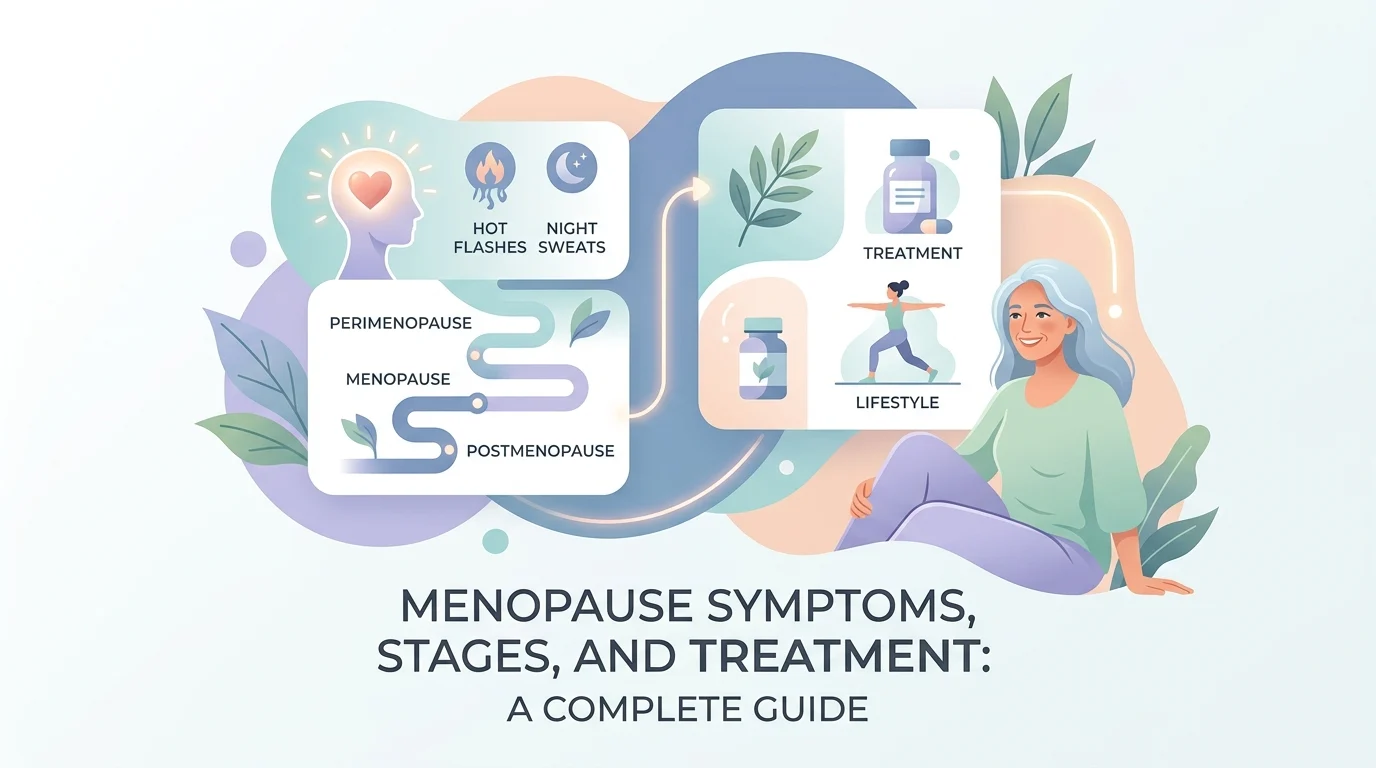
Menopause is the point when your ovaries stop releasing eggs and your menstrual periods end for good. According to the National Institute on Aging, it is confirmed only after a full 12 months without a period, and it is a normal part of aging rather than a disease. The years of hormonal change around it fall into three stages, and knowing which stage you are in helps explain what you feel and what to expect next.
Perimenopause
Perimenopause is the transition that leads up to your last period. Estrogen and progesterone rise and fall unpredictably, so cycles become irregular and symptoms such as hot flashes can start. This phase often begins in your 40s and can last anywhere from a few months to several years. Queasiness is a less-discussed example, and you can read our guide to perimenopause nausea.
Menopause
Menopause is a single moment, defined in hindsight: the 12-month mark after your final menstrual period. You do not stay in this stage. Once you pass that mark, you move into postmenopause, so menopause itself is best thought of as a milestone rather than a phase.
Postmenopause
Postmenopause is the rest of life after that point. Many symptoms ease over time, although some can linger for years. Lower estrogen also raises long-term risks to the heart and bones, which is why this stage shifts the focus toward prevention and regular check-ups.
| Stage | What is happening | Typical timing |
|---|---|---|
| Perimenopause | Hormones fluctuate, periods become irregular, and symptoms may begin | Often starts in the 40s, lasting months to several years |
| Menopause | A full 12 months with no period, confirmed in hindsight | Average age 52 in the United States |
| Postmenopause | Life after menopause, when many symptoms slowly ease | From menopause onward |
When does menopause start, and how long does it last?
Most women move through the menopausal transition between ages 45 and 55, and the average age of menopause in the United States is 52, according to the National Institute on Aging. Timing is highly individual and shaped by genetics, ethnicity, and lifestyle. Smoking, for example, is linked with an earlier onset and more severe symptoms.
When menopause arrives sooner, the words matter. Cleveland Clinic notes that menopause before age 45 is called early menopause, and before age 40 it is considered premature menopause. Symptoms themselves are also long-lasting for many people: the National Institute on Aging reports that menopause-related symptoms can last between two and eight years, and Cleveland Clinic puts the average length of symptoms at about seven years. That long arc is normal, even if it feels surprising.
Common menopause symptoms and why they happen
As estrogen and progesterone decline, they affect far more than the menstrual cycle, because receptors for these hormones sit throughout the brain, blood vessels, bones, skin, and urinary tract. That wide reach explains why menopause symptoms vary so much from one person to the next, and why some people barely notice the change while others find it disruptive.
Hot flashes and night sweats
Hot flashes and night sweats, together called vasomotor symptoms, are among the most common experiences of menopause. A hot flash is a sudden wave of heat in the upper body and face, sometimes with flushing, sweating, and chills. The National Institute on Aging notes that most hot flashes last between 30 seconds and 10 minutes, and they can continue for years after the final period.
Sleep, mood, and thinking
Disrupted sleep is common, partly from night sweats and partly from the hormonal shift itself. Many people also report irritability, low mood, or anxiety, along with brain fog, forgetfulness, and trouble concentrating. These changes can feed one another, since poor sleep worsens mood and focus the next day.
Weight, joints, hair, and libido
Body shape often changes, with more fat settling around the middle and a gradual loss of muscle. Joints can feel stiff, skin and hair may become drier or thinner, and sex drive can fall. Testosterone also declines with age, and you can explore the signs of low testosterone in women.
Vaginal and urinary changes
Lower estrogen thins and dries the vaginal and urinary tissues, a cluster doctors call the genitourinary syndrome of menopause. It can cause vaginal dryness, discomfort during sex, urinary urgency, and more frequent urinary infections. Unlike hot flashes, these changes tend to persist or worsen without treatment, so they are worth raising early.
The hormones behind menopause, and when testing helps
The hormonal story is simpler than it looks. As the ovaries wind down, they make less estrogen — mainly estradiol — and less progesterone. In response, the pituitary gland in the brain releases more follicle-stimulating hormone (FSH) and luteinizing hormone (LH) to try to stimulate them. A high FSH alongside a low estradiol is the classic menopausal pattern.
To understand the main estrogen, you can read our explainer on estradiol, and to see the pituitary side of the loop, explore our guide to the FSH blood test. When several of these are measured together, see how to read a female hormone panel.
Here is the key point about testing: for most women over 45 with typical symptoms and changing periods, blood tests are not needed to diagnose menopause. Cleveland Clinic explains that hormones swing so much during the transition that a single result can mislead. Testing becomes more useful when menopause may be early or premature, or when a doctor wants to rule out a look-alike condition such as thyroid disease, so it helps to see how to read normal thyroid levels.
| Hormone | Where it is made | What happens around menopause |
|---|---|---|
| Estrogen (estradiol) | Ovaries | Falls |
| Progesterone | Ovaries | Falls |
| FSH | Pituitary gland | Rises |
| LH | Pituitary gland | Rises |
How is menopause diagnosed?
In most cases, menopause is a clinical diagnosis based on your age, your symptoms, and the pattern of your periods rather than on a laboratory value. Once you have gone 12 consecutive months without a period, and no other cause explains it, you have reached menopause. A doctor may still order blood work to check for conditions that mimic the transition, or when symptoms appear unusually early. The takeaway is reassuring: you usually do not need a test to confirm what your body is already showing.
Expect a conversation about your cycle history, your symptoms, your medications, and your family history, since these details usually tell the story. One situation is different. When both ovaries are removed by surgery, or when chemotherapy or radiation stops them working, menopause can arrive suddenly rather than gradually, and symptoms may be more abrupt. This is called induced menopause, and the National Institute on Aging notes that it can bring on symptoms right away, which is one reason these situations are often discussed with a specialist and may involve earlier treatment.
How menopause symptoms are treated
Many women need no treatment at all, while others want relief from symptoms that disrupt daily life. Care falls into three broad groups, and the right mix depends on your symptoms, health history, and preferences.
Hormone therapy
Hormone therapy remains the most effective treatment for hot flashes, night sweats, and genitourinary symptoms. Cleveland Clinic describes two main types: estrogen therapy alone, used when the uterus has been removed, and estrogen plus a progestogen for women who still have a uterus. The timing matters. The U.S. Food and Drug Administration notes that women who start hormone therapy within 10 years of menopause, generally before age 60, see a reduction in all-cause mortality and fractures.
The regulatory picture shifted recently. On February 12, 2026, the FDA approved labeling changes to six menopausal hormone therapy products, removing the boxed-warning statements on cardiovascular disease, breast cancer, and probable dementia that had stood since the early 2000s. The agency began that process in November 2025 after reviewing newer evidence, noting that of roughly 41 million U.S. women aged 45 to 64 in 2020, only about 2 million received a hormone-therapy prescription. Hormone therapy is not right for everyone, so the decision still belongs with you and your clinician.
Nonhormonal options
For women who prefer to avoid hormones or cannot take them, several nonhormonal treatments help. Cleveland Clinic lists certain antidepressants (SSRIs and SNRIs), the nerve medicine gabapentin, the bladder drug oxybutynin, and a newer class called neurokinin receptor antagonists, such as fezolinetant, that target hot flashes directly. Cognitive behavioral therapy and trigger management add further support.
Lifestyle and long-term health
Daily habits protect the years ahead. Estrogen helps preserve bone, and Cleveland Clinic notes that women lose about 25% of their bone mass between menopause and age 60, so bone care matters. To support your skeleton, explore the bone and mineral panel, and because vitamin D drives calcium absorption, see what a vitamin D (25-OH) test shows. Heart risk also climbs after menopause, so read our guide to the lipid panel and keep blood pressure in view.
Simple routines help with both symptoms and long-term health. Cleveland Clinic suggests identifying and avoiding personal hot-flash triggers, such as warm rooms, spicy food, and smoking, and adding plant foods rich in phytoestrogens, like soy, chickpeas, lentils, and flaxseed. Regular weight-bearing and strength exercise supports bone, muscle, and mood, while calmer movement such as yoga can ease anxiety and sleep. None of this replaces medical care, but these steps work alongside any treatment you and your doctor choose, and they cost little to try.
Latest scientific advances
Menopause research has moved quickly, and the studies below are recent syntheses indexed in PubMed. They describe directions of evidence, not personal medical advice, and several remain early. Always read them as context for a conversation with your doctor.
The biggest shift is in nonhormonal treatment of hot flashes. A 2026 review in Nature Reviews Endocrinology traces how specialized brain cells (KNDy neurons) drive vasomotor symptoms, which affect roughly 70% of people going through menopause, and how blocking the neurokinin 3 receptor offers the first nonhormonal therapy aimed at that mechanism (DOI). This is a narrative review of mechanism and trials, not a new outcome study.
For hormone therapy and the brain, a 2026 systematic review of MRI studies found that the timing and route of treatment appear to shape structural brain outcomes, with neutral or favorable findings when therapy began near menopause or used transdermal estradiol (DOI). Because these are imaging studies rather than randomized trials, the authors caution against firm conclusions.
On safety, a 2026 systematic review and meta-analysis reported a modest increase in breast cancer risk that was largely confined to estrogen-progestin therapy, while estrogen-only therapy showed no overall increase and, in trials, a possible protective signal (DOI). The findings were heterogeneous, so individual risk depends on the regimen. Finally, a 2026 meta-analysis found that hormone therapy was associated with a small reduction in depressive symptoms during perimenopause, though the effect was modest and the certainty of evidence limited (DOI).
When to see a doctor
Menopause is normal, but some signs deserve prompt medical attention rather than watchful waiting. Contact a healthcare professional if you notice any of the following:
- Any vaginal bleeding or spotting after you have gone 12 months without a period, which always needs evaluation.
- Very heavy bleeding, bleeding that lasts more than a week, or periods closer than 21 days apart.
- Menopause symptoms before age 40, which may point to premature menopause.
- Symptoms that disrupt your sleep, mood, work, or relationships.
- New chest pain, severe headaches, or other symptoms that feel unusual for you.
Glossary
| Term | Definition |
|---|---|
| Perimenopause | The transition years before the final period, when hormones fluctuate and symptoms often begin. |
| Menopause | The point confirmed after 12 months with no menstrual period. |
| Postmenopause | The stage of life after menopause, lasting for the rest of life. |
| Vasomotor symptoms | Hot flashes and night sweats caused by changing estrogen levels. |
| Genitourinary syndrome of menopause | Vaginal, vulvar, and urinary changes from lower estrogen, such as dryness and urgency. |
| Estradiol | The main and most active form of estrogen, made largely by the ovaries. |
| Follicle-stimulating hormone (FSH) | A pituitary hormone that rises as the ovaries wind down. |
| Hormone therapy (HT) | Treatment that replaces estrogen, with or without a progestogen, to ease symptoms. |
| Neurokinin 3 receptor antagonist | A nonhormonal medicine that targets the brain pathway behind hot flashes. |
| Osteoporosis | Thinning, more fragile bones that become more likely after menopause. |
Frequently asked questions
How do I know if I am starting menopause?
The first clue is usually a change in your periods, which may become irregular, lighter, or heavier, often alongside hot flashes or sleep changes. Most people in their mid-40s and beyond can recognize the transition from symptoms and cycle patterns without any test. If your periods stop for 12 months with no other cause, you have reached menopause. Because other conditions can cause similar symptoms, it is worth discussing your experience with a clinician who can confirm what is happening.
What is the average age of menopause?
In the United States, the average age of menopause is 52, although the transition commonly begins in the mid-40s, according to the National Institute on Aging. Reaching menopause anywhere from the late 40s to the mid-50s is considered typical. Menopause before age 45 is called early, and before 40 it is called premature, and both are worth discussing with a doctor because they can affect bone and heart health over time.
How long do menopause symptoms last?
Symptoms vary widely, but they often last several years. The National Institute on Aging reports a typical range of two to eight years, while Cleveland Clinic puts the average at about seven years. Hot flashes in particular can continue well into postmenopause for some people. If symptoms are severe or long-lasting, effective treatments exist, so a long duration is a reason to seek help rather than simply wait it out.
Do I need a blood test to confirm menopause?
Usually not. For women over 45 with typical symptoms and changing periods, doctors diagnose menopause from the clinical picture, because hormone levels fluctuate too much during the transition to be reliable. Blood tests can help when menopause may be early or premature, or when a doctor wants to rule out a condition such as thyroid disease. At-home FSH urine kits only flag a raised hormone and cannot confirm menopause on their own.
Can you get pregnant during menopause?
You can still become pregnant until menopause is complete. During perimenopause, ovulation can happen unpredictably, so pregnancy remains possible even with irregular periods. Doctors generally advise using contraception until you have gone a full 12 months without a period. After that point, natural pregnancy is no longer possible, although you remain at risk for sexually transmitted infections and should still take precautions if relevant.
Is bleeding after menopause something to worry about?
Any bleeding or spotting after you have gone 12 months without a period should always be checked by a doctor. Most causes are not serious, such as thin vaginal tissue, but postmenopausal bleeding can occasionally signal a problem that is far easier to treat when found early. This is not a symptom to monitor at home or assume is normal. Contact your healthcare provider promptly so the cause can be identified.
Sources
- What Is Menopause? — National Institute on Aging (NIH)
- Menopause — Cleveland Clinic
- FDA Approves Labeling Changes to Menopausal Hormone Therapy Products — U.S. Food and Drug Administration
- Torres E, Wall EG, Navarro VM. Neurokinin receptor antagonists for vasomotor symptoms. Nature Reviews Endocrinology, 2026 (via PubMed). DOI
- He Z, et al. Timing and route of menopausal hormone therapy and structural brain outcomes. Neuroscience & Biobehavioral Reviews, 2026 (via PubMed). DOI
- Wu Q, et al. Menopausal hormone therapy and breast cancer risk: systematic review and meta-analysis. Annals of Medicine, 2026 (via PubMed). DOI
- Li Y, et al. Menopausal hormone therapy for depressive symptoms in perimenopause: meta-analysis. Journal of Affective Disorders, 2026 (via PubMed). DOI
Further reading
- Luteinizing hormone (LH): understanding your blood results
- Understanding sex hormone-binding globulin levels
- High cholesterol: understand, prevent, and act
- High blood pressure: understanding, treating, and preventing
- Understanding period weight gain: causes and management
Understand your lab results with AI DiagMe
Menopause brings a wave of new numbers, from estradiol and FSH on a female hormone panel to thyroid, cholesterol, and bone markers your doctor may check along the way. AI DiagMe reads those results and explains them in plain language, so you walk into your next appointment knowing what each value describes and which questions to ask. It is built to help you understand your results, not to diagnose you or replace your doctor.
➡ Get your results interpreted in minutes