











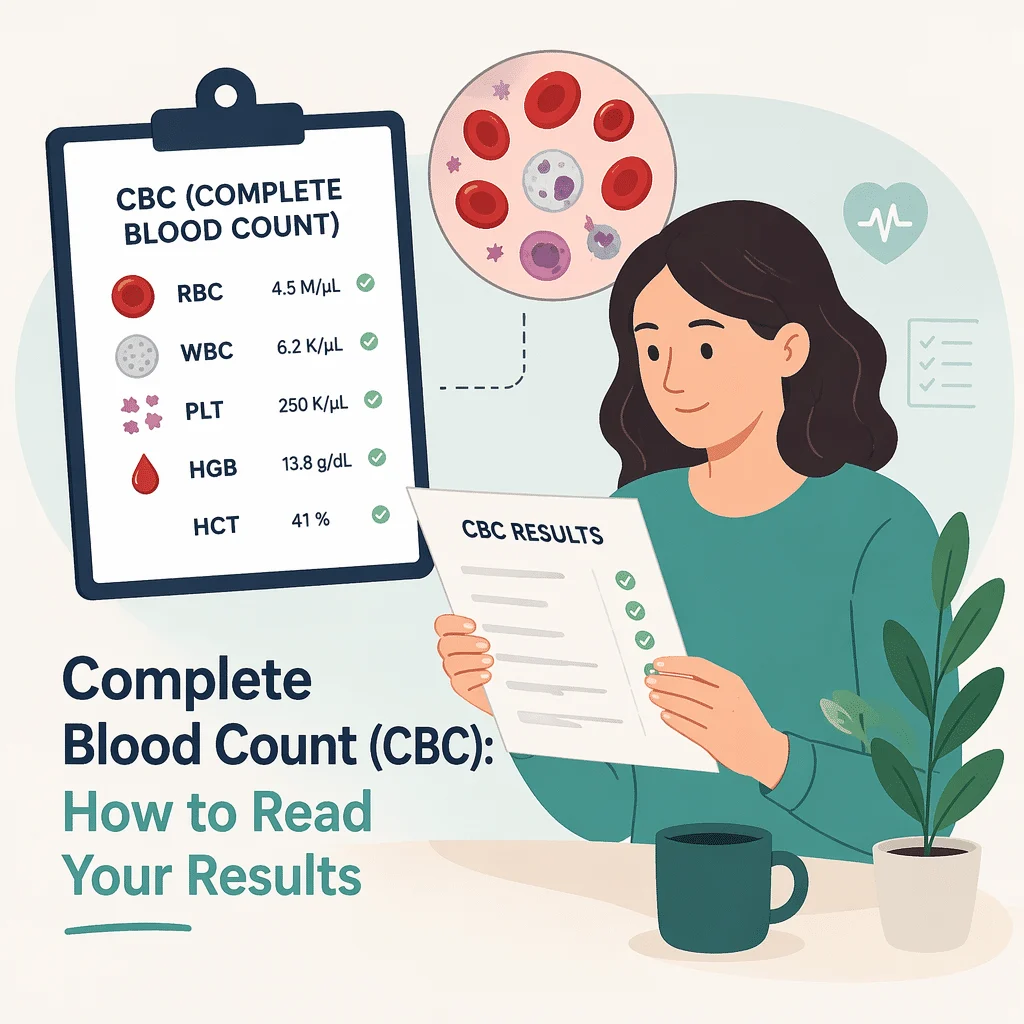
A complete blood count is one of the most common blood tests your doctor can order, yet the report it produces can look like a wall of abbreviations and numbers. This guide explains how to read your complete blood count (often shortened to CBC) in plain language. You will learn what each part of the test measures, what the reference ranges mean, what high or low values may suggest, and when a result is worth discussing with your doctor. The goal is to help you understand your own results with more confidence, not to replace medical advice. A CBC gives a snapshot of the cells in your blood, and reading it well starts with knowing what those cells do.
What is a complete blood count?
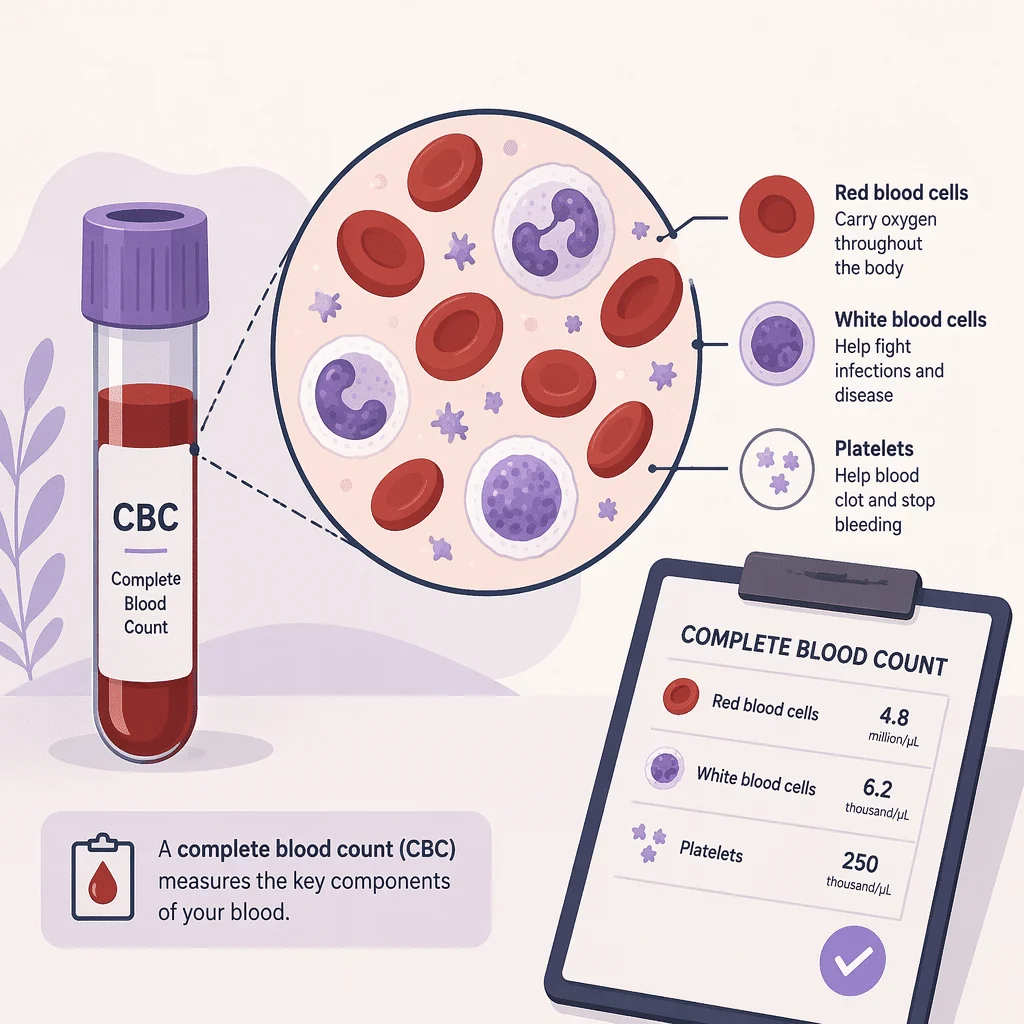
A complete blood count is a routine blood test that counts and describes the three main types of cells in your blood: red blood cells, white blood cells, and platelets. It is one of the first tests doctors order when symptoms are unclear, because blood cells respond quickly to many changes in the body.
Your doctor may request a CBC as part of a general check-up, to look into symptoms such as tiredness, fever, or unexplained bruising, or to monitor a known condition or a treatment over time. A single drop of blood holds millions of these cells, and their numbers, size, and proportions can hint at infection, anemia, inflammation, clotting problems, and more.
A CBC does not diagnose a specific disease on its own. Instead, it points your doctor toward what to check next. If you also had a metabolic panel done at the same time, you may want to read our explainer on the difference between a CBC and a CMP, since the two are often ordered together but measure very different things.
What a complete blood count measures
A standard complete blood count reports around ten to fifteen values. They fall into three groups: red blood cell measures, white blood cell measures, and platelet measures. Here is what each group tells you.
Red blood cells, hemoglobin, and hematocrit
Red blood cells carry oxygen from your lungs to the rest of your body. A CBC reports several related values for them.
The red blood cell (RBC) count is the number of red cells in a set volume of blood. Hemoglobin (Hb) is the iron-rich protein inside red cells that actually holds the oxygen. Hematocrit (Hct) is the percentage of your blood made up of red cells. These three move together and are the main values used to check for anemia, which means too few healthy red cells or too little hemoglobin. You can read more in our guides to the red blood cell count and hematocrit.
Red blood cell indices: MCV, MCH, MCHC, and RDW
These four values describe the size and hemoglobin content of your red cells. They help explain the cause of an abnormal result.
- MCV (mean corpuscular volume) is the average size of your red cells. Larger-than-usual cells can point to low vitamin B12 or folate; smaller cells often suggest iron deficiency. See our guide to the MCV blood test.
- MCH (mean corpuscular hemoglobin) is the average amount of hemoglobin per red cell, explained in our MCH article.
- MCHC (mean corpuscular hemoglobin concentration) is how concentrated the hemoglobin is inside the cells; learn more in our MCHC guide.
- RDW (red cell distribution width) measures how much your red cells vary in size. A high value means a wide mix of small and large cells, which can be an early clue to certain anemias. Our RDW explainer covers this in detail.
White blood cells and the differential
White blood cells are your body’s defence against infection. The white blood cell (WBC) count is the total number of these cells. A high count often signals infection or inflammation; a low count can follow some viral infections or certain medications.
Many CBCs also include a differential, which breaks the white cells into five types, each with its own job. Neutrophils are the front-line responders to bacterial infection. Lymphocytes handle viruses and longer-term immune memory. Monocytes clear debris and help coordinate the response. Eosinophils rise with allergies and some parasitic infections, and basophils play a smaller role in allergic reactions. The pattern matters. A rise in neutrophils often points to a bacterial infection, while changes in lymphocytes more often accompany viral illness. The differential is what turns a single number into a more useful picture.
Platelets and MPV
Platelets are tiny cell fragments that help your blood clot and stop bleeding. The platelet count is their total number, explained in our guide to the platelet count. A low count can raise the risk of easy bruising or bleeding, while a high count sometimes follows inflammation or iron deficiency.
Some reports add the MPV (mean platelet volume), the average size of your platelets, which can give extra information about how they are being produced. Our MPV article explains what high and low values may mean.
How to read your complete blood count results
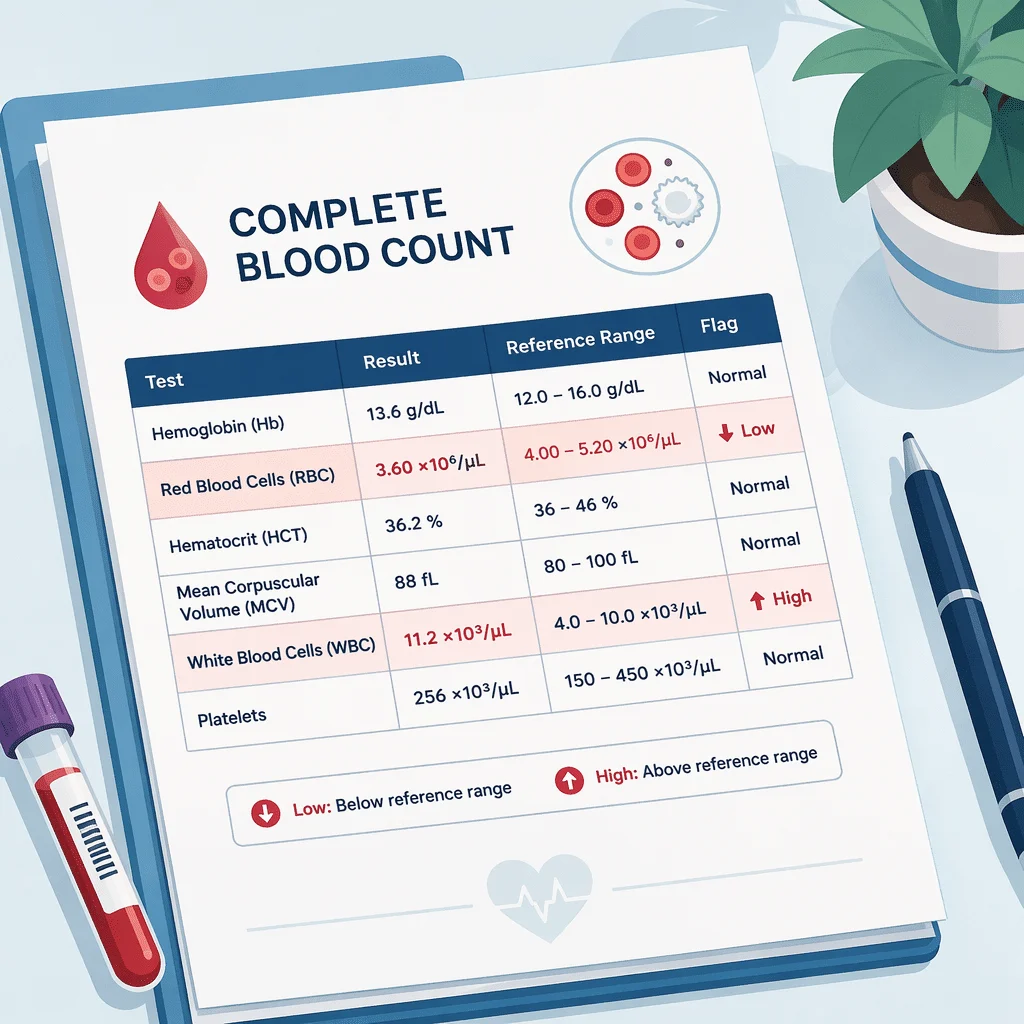
When you open your report, you will usually see your value in one column and a reference range in another. The reference range is the span of values considered typical for a healthy population. If your result falls inside that range, it is generally reported as normal.
Three points make reading a CBC much easier:
- Units matter. The same marker can be written in different units depending on the lab (for example, platelets as 250 or as 250,000). Always read your number next to its own reference range, not against a number you saw somewhere else.
- Reference ranges vary. Normal values depend on age, sex, pregnancy, altitude, and even the analyser the lab uses. This is why your lab’s printed range is the one that counts, and why ranges in online tables are only a guide.
- A flagged value is not a diagnosis. A result marked “high” or “low” is simply outside the average band. It can be caused by everyday factors such as a recent infection, dehydration, a menstrual period, or normal variation between people.
Here is how this works in practice. Suppose your report lists a hemoglobin of 11.8 g/dL with a reference range of 12.0–15.5 g/dL. The value is flagged because it sits just below the lower limit. On its own, that small gap may mean very little, but a doctor would look at it alongside your MCV, your iron-related markers, and how you feel. A number close to the edge of its range usually carries far less weight than a number that is well outside it.
The table below shows typical adult reference ranges for the main CBC values. Treat them as approximate. Your own report’s range, read together with your symptoms and history, is what your doctor will use.
| CBC value | Typical adult reference range |
|---|---|
| Red blood cells (RBC) | Men 4.7–6.1 million/µL · Women 4.2–5.4 million/µL |
| Hemoglobin (Hb) | Men 13.5–17.5 g/dL · Women 12.0–15.5 g/dL |
| Hematocrit (Hct) | Men 41–50% · Women 36–44% |
| MCV | 80–100 fL |
| MCH | 27–33 pg |
| MCHC | 32–36 g/dL |
| RDW | 11.5–14.5% |
| White blood cells (WBC) | 4,500–11,000 /µL |
| Platelets | 150,000–450,000 /µL |
| MPV | 7.5–11.5 fL |
Why your CBC results can change over time
It is normal for a complete blood count to shift from one test to the next, even in healthy people. Your body is constantly making and replacing blood cells, so a result is a snapshot of a single moment rather than a fixed number. A recent infection, a course of medication, pregnancy, dehydration, hard exercise, or even the time of day can all move your counts slightly. This is one reason doctors often value a trend across several tests more than any single reading. If a value has changed since your last CBC, the size and direction of that change, and whether it fits your symptoms, usually matter more than the number alone.
What high and low values can mean
A single out-of-range value rarely tells the whole story. Doctors read the pattern across several values, then add your symptoms and, if needed, further tests. The table below shows common combinations and what they may point to. These are possibilities, not conclusions.
| What the report often shows | What it may point to |
|---|---|
| Low hemoglobin with small red cells (low MCV) | Iron deficiency anemia, often from low iron stores |
| Low hemoglobin with large red cells (high MCV) | Vitamin B12 or folate deficiency |
| High white cells with high neutrophils | Bacterial infection or inflammation |
| High white cells with high lymphocytes | Viral infection, among other causes |
| Low platelet count | Many causes, from medications to immune or viral conditions |
| All values within range | No abnormality detected in these cells |
A few general rules help interpret the direction of a change. Low red cells, hemoglobin, or hematocrit usually mean anemia, which can stem from iron, vitamin B12, or folate deficiency, blood loss, or a long-term illness. High values in these can follow dehydration, smoking, or living at high altitude. A high white cell count commonly reflects infection or inflammation, while a low count can follow viral infections, autoimmune conditions, or treatments such as chemotherapy.
Only a doctor can confirm what your pattern means, because the same numbers can have very different explanations depending on your situation. This is exactly where a clear, structured reading of the whole report adds value.
CBC with or without a differential
You may see your test written as a plain CBC or as a CBC with differential (sometimes “CBC with diff”). The difference is straightforward.
A CBC without a differential gives the total white blood cell count as a single number. A CBC with differential goes further and reports how many of each white cell type you have, shown as a percentage or an absolute count. This extra detail helps separate, for example, a bacterial infection from a viral one, so doctors often request it when they are investigating symptoms rather than running a basic check. If your report lists neutrophils, lymphocytes, monocytes, eosinophils, and basophils, you have had the differential version.
How the test is done and how to prepare
The sample is simple to collect. A healthcare professional draws a small amount of blood from a vein in your arm into a tube, usually one with a lavender or purple top that contains an anticoagulant to stop the sample clotting before it is analysed. The draw itself takes only a few minutes.
For a CBC on its own, you usually do not need to fast. Eating and drinking normally will not change the cell counts in a meaningful way. The exception is when your CBC is bundled with other tests, such as a fasting glucose or a cholesterol panel, which may require you to skip food for several hours. Always follow the specific instructions your doctor or laboratory gives you.
Results are often available within a day, and sometimes within a few hours, because most laboratories run CBC samples on automated analysers. Your doctor will then interpret the numbers in the context of your health.
When to see a doctor about your results
A CBC is a screening tool, so most mildly abnormal results are not emergencies. Still, some situations are worth medical attention.
- Any value your doctor has flagged or asked you to discuss, especially a result that is very high or very low.
- Ongoing tiredness, breathlessness, or unusually pale skin, which can accompany anemia.
- Frequent or persistent infections, or an unexplained fever that does not settle.
- Easy bruising, tiny red or purple spots on the skin, or bleeding that is hard to stop, which can relate to low platelets.
- Unexplained weight loss, drenching night sweats, or swollen lymph nodes alongside abnormal counts.
If you have one of these signs, contact your doctor rather than trying to interpret the numbers alone. This article is for general information and does not replace a medical consultation.
Glossary
| Term | Meaning |
|---|---|
| CBC (complete blood count) | A blood test that counts and describes red blood cells, white blood cells, and platelets. |
| Differential | The breakdown of white blood cells into their five types, used to refine interpretation. |
| Hematocrit (Hct) | The percentage of your blood volume made up of red blood cells. |
| Hemoglobin (Hb) | The iron-rich protein in red blood cells that carries oxygen. |
| MCH (mean corpuscular hemoglobin) | The average amount of hemoglobin contained in a single red blood cell. |
| MCHC (mean corpuscular hemoglobin concentration) | How concentrated the hemoglobin is inside red blood cells. |
| MCV (mean corpuscular volume) | The average size of your red blood cells. |
| MPV (mean platelet volume) | The average size of your platelets, which can reflect how they are produced. |
| RDW (red cell distribution width) | A measure of how much your red blood cells vary in size. |
| Reference range | The span of values considered typical for a healthy population, set by each lab. |
Frequently asked questions
Does a complete blood count require fasting?
For a complete blood count on its own, you usually do not need to fast. Food and drink do not meaningfully change your blood cell counts, so you can eat normally before the test. Fasting only becomes necessary when the CBC is combined with other tests that do require it, such as a fasting blood glucose or a cholesterol (lipid) panel. Because labs and doctors set their own instructions, the safest approach is to follow the guidance you were given when the test was ordered. If you are unsure whether your appointment includes a fasting test, ask the laboratory before you go.
Can a complete blood count detect cancer?
A complete blood count cannot diagnose cancer on its own. It can, however, reveal patterns that prompt a doctor to investigate further. Very high or very low cell counts, or unusual combinations such as many abnormal white cells, can be early clues to blood cancers like leukemia or lymphoma. In those cases the doctor orders additional, more specific tests to reach a diagnosis. It is important to keep perspective: most abnormal CBC results are not caused by cancer and have far more common explanations, such as infection, inflammation, or a vitamin or iron deficiency.
Can a CBC diagnose an infection like HIV?
A CBC does not test for HIV or any specific virus, and it cannot diagnose an infection by itself. It may show non-specific changes, such as a lower white cell or platelet count, that simply tell your doctor something is going on. Diagnosing HIV requires a dedicated HIV screening test that looks for the virus or the antibodies your body makes against it. The same is true for most infections: a CBC may raise suspicion and guide the next step, but a specific test confirms the cause.
How much does a complete blood count cost?
The cost of a complete blood count varies widely depending on the country, the laboratory, and whether you have insurance or public health coverage. A CBC is one of the cheaper blood tests because it is highly automated and very common. When a doctor orders it, it is frequently covered or reimbursed. If you pay out of pocket, the price is usually modest on its own but rises when the CBC is part of a larger panel of tests. For an exact figure, ask your laboratory or insurer before the test, as published prices differ from place to place.
How often should you have a complete blood count?
There is no single schedule that fits everyone. A healthy adult with no symptoms may only have a CBC occasionally, often as part of a routine check-up. People with a known condition, those taking certain medications, or anyone being monitored for an ongoing problem may need the test more frequently, sometimes every few weeks or months. Your doctor decides the right interval based on your health, your treatment, and what previous results showed. If you are unsure why a CBC is being repeated, it is reasonable to ask what the result is being used to track.
Are abnormal complete blood count results always serious?
No. Mildly out-of-range values are common and are often harmless. A recent cold, dehydration, a menstrual period, intense exercise, or simple variation between healthy people can all nudge a number outside the reference band. What matters is the bigger picture: how far the value is from normal, whether several values point the same way, and whether you have symptoms. A small deviation with no symptoms is usually nothing to worry about, but it is still worth confirming with your doctor, who can tell you whether the result needs action, monitoring, or nothing at all.
Sources
- Complete Blood Count (CBC) — MedlinePlus (NIH)
- Complete Blood Count (CBC) — Cleveland Clinic
- Normal and Abnormal Complete Blood Count With Differential — StatPearls, NCBI Bookshelf
Further reading
- CBC vs CMP: understanding the tests
- Common medical lab test abbreviations: a guide
- MCV blood test: ranges, causes, and meaning
- Platelet count: how to read your test results
- Low vitamin B12: symptoms, causes, and treatments
Understand your lab results with AI DiagMe
Reading a complete blood count is much easier when each value is explained next to your own reference range. AI DiagMe helps you make sense of results such as your red and white blood cell counts, hemoglobin, and platelet count, putting the numbers into plain language so you arrive at your appointment better informed. It is built to help you understand your results, not to diagnose you, and it does not replace your doctor’s judgement. If you have a recent CBC in hand, you can use AI DiagMe to understand what each line means.
➡️ Get your results interpreted in minutes