Normal LDL levels are among the most searched numbers in laboratory medicine, and among the most misunderstood. The honest starting point is uncomfortable: there is no single normal LDL that applies to everyone. The same figure that is unremarkable in a healthy 30-year-old can be an active treatment target in someone who has already had a heart attack. In this article you’ll learn what the LDL test actually measures, what the conventional bands say and where they came from, why your personal target depends on your overall cardiovascular risk rather than a universal cutoff, why non-HDL cholesterol and apolipoprotein B often describe risk better than LDL alone, why a reading of 190 mg/dL or above raises a question that matters for your blood relatives, and what to do with the result you are holding.
What LDL cholesterol is, and what the test measures
Cholesterol is a waxy, fat-like substance your body needs to build cell membranes and make hormones. It does not dissolve in blood, so it travels inside particles called lipoproteins. Low-density lipoprotein, or LDL, is the main carrier that delivers cholesterol out to tissues.
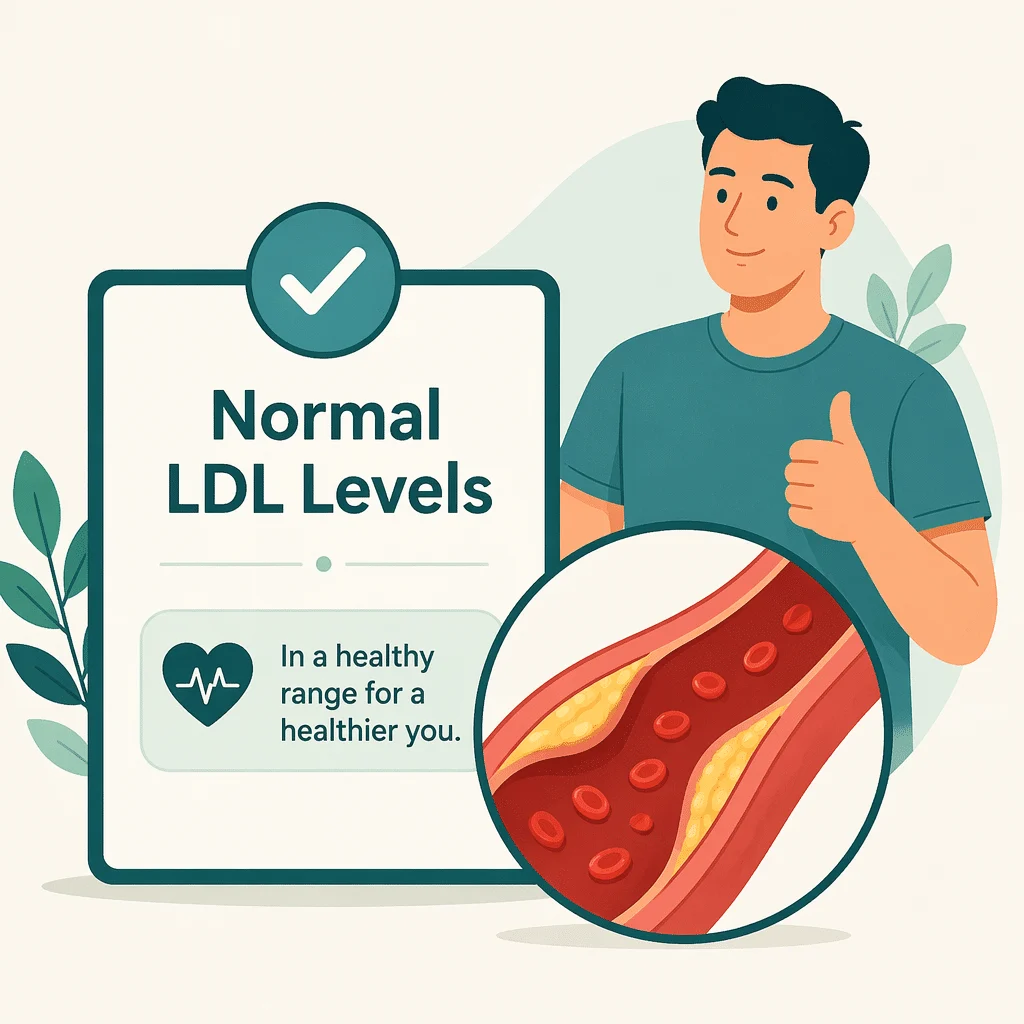
When there is more LDL in circulation than the body needs, some of those particles lodge in artery walls. Over years, the deposits become plaque, and plaque is the underlying process behind most heart attacks and many strokes. That is why LDL is described, loosely, as the “bad” cholesterol.
The number on your report is not a count of particles. “LDL cholesterol” is a measure of how much cholesterol is being carried inside your LDL particles, reported in milligrams per deciliter (mg/dL) in the United States. Most countries outside the US report in millimoles per liter (mmol/L); to convert, divide the mg/dL figure by roughly 38.7. So 100 mg/dL is about 2.6 mmol/L, and 190 mg/dL is about 4.9 mmol/L.
LDL almost never arrives alone. It comes as part of a lipid panel, alongside total cholesterol, HDL cholesterol and triglycerides. Those companions are not decoration. As you will see, they change what your LDL figure actually means.
The conventional LDL bands, and where they come from
The bands most laboratories print alongside your result trace back to the National Cholesterol Education Program and are carried forward in current ACC/AHA cholesterol guidance. The National Library of Medicine, drawing on NHLBI material, sets them out as follows.
| LDL band (mg/dL) | What it is called | What it usually means | What it does NOT mean on its own |
|---|---|---|---|
| Below 100 | Optimal | Low atherogenic burden for most adults at average risk | Does not mean you are in the clear; people with existing heart disease are often given targets well below this |
| 100 to 129 | Near optimal / above optimal | Common in the general population | Does not mean “fine for you”; the same value carries different weight at 25 and at 65 |
| 130 to 159 | Borderline high | A prompt to look at your whole risk picture | Does not by itself indicate disease, and does not by itself indicate that any treatment is needed |
| 160 to 189 | High | Warrants a proper clinical assessment | Does not tell you the cause, which may be genetic, thyroid-related, kidney-related or lifestyle-related |
| 190 and above | Very high | Raises the question of an inherited cholesterol disorder and needs prompt medical review | Is not a diagnosis in itself; confirming or excluding an inherited condition requires a clinician |
Read that table as a population map, not a personal verdict. These labels were designed to describe how cholesterol is distributed across a population and to give clinicians shared vocabulary. They were never intended as individual goals. Modern guidelines have moved decisively away from a universal cutoff and now frame LDL management around absolute cardiovascular risk and a list of risk-enhancing factors. The band your number falls into is the beginning of the conversation, not the end of it.
Why your LDL target depends on your overall risk
Two people can walk out of the same laboratory with an identical LDL of 135 mg/dL and receive entirely different advice, and both clinicians can be right.
The first is 32, has never smoked, has normal blood pressure and no family history of early heart disease. For her, 135 mg/dL sits in a band worth watching over time.
The second is 61, has type 2 diabetes, raised blood pressure and a stent placed three years ago. For him, that same 135 mg/dL is a long way above where his clinical team would want it to be.
What separates them is not the cholesterol figure. It is everything else: age, sex, blood pressure, smoking, diabetes, kidney function, inflammation, family history and whether atherosclerotic disease is already established. Clinicians combine these into an estimate of absolute risk over the next decade, and increasingly over a lifetime, then decide what LDL level is appropriate for that specific person.
Risk-enhancing factors sit alongside the main calculators and can shift a borderline decision: a strong family history of premature heart disease, chronic kidney disease, chronic inflammatory conditions, certain ethnic backgrounds, complications of pregnancy such as pre-eclampsia, persistently raised triglycerides, and a raised high-sensitivity CRP. Some causes of raised LDL are also entirely reversible once identified. An underactive thyroid is a classic example, which is why a TSH test is often checked when cholesterol is unexpectedly high.
This is precisely why turning the bands into a self-scoring exercise is a mistake. Your number cannot be interpreted without the rest of you.
Why the LDL number alone is incomplete
Even setting risk aside, LDL cholesterol is an imperfect summary of the danger circulating in your blood. Three things are worth understanding.
Non-HDL cholesterol captures more of the picture
Non-HDL cholesterol is simple arithmetic: total cholesterol minus HDL cholesterol. What is left is the cholesterol carried in every atherogenic particle, not just LDL, including the remnants of triglyceride-rich lipoproteins. When triglycerides are high, those remnants carry real risk that an LDL figure quietly omits. Non-HDL cholesterol needs no extra blood test and appears on many modern reports already.
ApoB counts the particles
Every atherogenic lipoprotein particle carries exactly one apolipoprotein B molecule. So measuring ApoB effectively counts how many such particles you have, rather than how much cholesterol is packed inside them. Two people with the same LDL cholesterol can have quite different particle counts, and the one with more particles generally carries more risk. This matters most when triglycerides are raised, in diabetes, and in metabolic syndrome. ApoB is increasingly available as part of an advanced lipid panel.
Your LDL may have been calculated, not measured
This is the part almost no one is told. For decades, most laboratories did not measure LDL directly. They estimated it from total cholesterol, HDL and triglycerides using the Friedewald equation, a formula from the 1970s. It works reasonably well in the middle of the range and becomes unreliable in exactly the situations that matter most: when triglycerides are high, and when LDL is genuinely low. Modern laboratories increasingly use direct measurement or newer equations such as Martin-Hopkins or Sampson. If your result looks surprising, asking how your LDL was calculated is a legitimate question.
An LDL of 190 mg/dL or above: the inherited cholesterol question
An LDL at or above 190 mg/dL (roughly 4.9 mmol/L) in an adult is different in kind, not just in degree. Diet and lifestyle rarely produce numbers that high on their own. This level raises the question of familial hypercholesterolemia, an inherited condition that impairs the body’s ability to clear LDL from the blood.
Familial hypercholesterolemia is not rare. It affects roughly 1 in 250 people, which makes it one of the more common serious genetic conditions in medicine. Because cholesterol has been high since birth rather than since middle age, the cumulative exposure of the arteries is far greater, and untreated it carries a markedly raised lifetime risk of early heart disease. It is also substantially underdiagnosed. Research published in Implementation Science Communications notes that up to 80% of people with the condition remain undiagnosed, and most of those who are diagnosed are undertreated.
Physical signs can accompany it, though many people have none: thickened tendons at the Achilles or knuckles (tendon xanthomas), cholesterol deposits in the eyelids, or a pale ring around the cornea in someone under 45.
Why this matters for your relatives
This is the most actionable thing on this page. Familial hypercholesterolemia is passed down in an autosomal dominant pattern, which means each first-degree relative of an affected person, that is each parent, sibling and child, has about a one-in-two chance of carrying it too.
For that reason, a confirmed diagnosis triggers a process called cascade screening: relatives are systematically offered a cholesterol test, and sometimes genetic testing, working outwards through the family tree. It is one of the few situations in adult medicine where one person’s blood test result directly changes what should happen to their family. If a clinician raises familial hypercholesterolemia with you, the question “who else in my family should be tested?” is the right one to ask.
Lipoprotein(a): the measurement you only need once
Lipoprotein(a), usually written Lp(a), is an LDL-like particle with an extra protein attached. It is not part of a standard lipid panel, and it behaves differently from everything else in this article: your level is set almost entirely by the genes you inherited, stays broadly stable across your life, and barely responds to diet, exercise or the medicines that lower LDL.
Because it is genetically determined and stable, professional bodies increasingly recommend measuring it once in a lifetime rather than repeatedly. A raised Lp(a) is common, affecting a substantial minority of people, and it can mean that conventional risk calculators understate someone’s true lifetime risk. Even though there is currently no approved treatment aimed specifically at lowering it, a European Atherosclerosis Society consensus review makes the practical case for knowing your level: it changes how aggressively every other modifiable risk factor should be managed. Whether the test is appropriate for you is a discussion to have with your clinician.
Fasting or non-fasting: does it matter?
For most purposes, no. Non-fasting lipid testing is now accepted by major guidelines for routine risk assessment, and it is considerably easier for patients. Total cholesterol, HDL and non-HDL cholesterol change very little after a meal.
Triglycerides do rise after eating, and because many laboratories still calculate LDL from triglycerides, a non-fasting sample can nudge a calculated LDL figure slightly. A fasting sample may therefore be requested when triglycerides are markedly raised, when a precise LDL value will drive a treatment decision, or when an inherited lipid disorder is being investigated. Follow the instruction your laboratory or clinician gives you, and note on the form whether you ate.
What happens next, and when to see a doctor
A single lipid panel is a snapshot. Cholesterol varies with recent illness, pregnancy, thyroid function, alcohol, weight change and laboratory method, so an unexpected result is usually repeated before conclusions are drawn.
What a clinician will typically do is confirm the result, take a careful family history, check for conditions that raise LDL secondarily such as thyroid, kidney or liver problems, look at the whole panel including triglycerides and non-HDL cholesterol, screen for diabetes with a HbA1c test, and only then estimate your overall risk and discuss what, if anything, should change.
One point deserves stating plainly. Decisions about starting, stopping or changing any lipid-lowering medication, including statins, belong to the prescriber who knows your full history. Nothing you read online, here or elsewhere, is a reason to alter a prescription. If you have concerns about a medicine you are taking, raise them with the clinician who prescribed it rather than acting on them alone.
Seek medical attention promptly, regardless of what your LDL number says:
- Chest pain or pressure, pain spreading to the arm, neck or jaw, or breathlessness on exertion. Call emergency services if symptoms are severe, new or persistent.
- Sudden weakness, facial drooping, difficulty speaking or loss of balance.
- An LDL of 190 mg/dL or above, or a total cholesterol that is very high, warrants a prompt medical review rather than a wait-and-see approach.
- A family history of heart attack or stroke before age 55 in men or 65 in women, or a relative diagnosed with familial hypercholesterolemia.
- Thickened Achilles tendons or knuckle tendons, cholesterol deposits in the eyelids, or a pale ring around the cornea in someone under 45. These are physical signs that can point to familial hypercholesterolemia.
- Cramping pain in the calves when walking that eases with rest.
Latest scientific advances in LDL testing
Research published between 2023 and 2026 has sharpened several of the points above.
How LDL is calculated changes who gets classified as low
A systematic comparison of 23 different LDL equations against the laboratory reference method, using clinical lipid results from more than five million patients, found that the Martin-Hopkins equation classified results into the correct category most often, while the long-standing Friedewald equation performed less well. Strikingly, around one in five patients whose Friedewald LDL fell below 70 mg/dL were reclassified upwards by the more accurate equation. What this means for you: if your LDL was calculated rather than measured, and particularly if your triglycerides are raised, the figure on your report carries a margin of uncertainty that is worth mentioning to your clinician.
ApoB outperforms both LDL and non-HDL cholesterol
A 2025 systematic review in the Journal of Clinical Lipidology pooled 15 discordance studies covering more than 590,000 participants, using statistical methods designed specifically to separate markers that normally move together. ApoB was the more accurate marker of atherosclerotic risk than LDL cholesterol in every study that compared them, and more accurate than non-HDL cholesterol in most. What this means for you: LDL is a reasonable starting point, but it is not the last word, and asking whether ApoB would add anything in your situation is a reasonable question.
The same LDL can hide very different particle counts
An analysis of nearly 294,000 adults in the UK Biobank, followed for a median of 11 years, found wide variation in ApoB among people sharing the same LDL cholesterol value, and meaningful differences in 10-year cardiovascular event rates between those at the top and bottom of that spread. What this means for you: two identical LDL results do not guarantee identical risk, which is another reason a number in isolation is not enough.
Familial hypercholesterolemia is still a missed diagnosis
Interviews with 21 patients and 17 clinicians, published in 2024, found widespread confusion about what makes the condition distinct from ordinary high cholesterol, and identified family cascade screening as a step that frequently does not happen. A 2026 trial protocol in Public Health Genomics is now testing structured family communication strategies in primary care specifically to close that gap. What this means for you: if inherited high cholesterol is raised as a possibility, do not assume your relatives will be contacted automatically. Ask.
Lipoprotein(a) has moved into routine consideration
A consensus review from the European Atherosclerosis Society addressed the common objection, “why measure it if I can’t lower it?”, and set out how knowing an Lp(a) level should change the management of every other risk factor, together with a risk calculator reflecting its effect on lifetime risk. What this means for you: a one-off Lp(a) measurement may be worth discussing, particularly if heart disease has struck young in your family.
Glossary
| Term | Definition |
|---|---|
| LDL cholesterol | The cholesterol carried inside low-density lipoprotein particles, the main carrier that deposits cholesterol in artery walls. |
| Non-HDL cholesterol | Total cholesterol minus HDL cholesterol; captures the cholesterol in all artery-damaging particles, not just LDL. |
| Apolipoprotein B (ApoB) | A protein present once on every artery-damaging lipoprotein particle, so measuring it effectively counts those particles. |
| Friedewald equation | A 1970s formula that estimates LDL from total cholesterol, HDL and triglycerides; less reliable when triglycerides are high or LDL is low. |
| Martin-Hopkins equation | A newer method of estimating LDL that adjusts the calculation to the individual lipid profile and is more accurate than Friedewald. |
| Familial hypercholesterolemia | An inherited condition affecting roughly 1 in 250 people, causing lifelong very high LDL and raised lifetime cardiovascular risk. |
| Cascade screening | Systematically testing the blood relatives of someone diagnosed with an inherited condition, working outwards through the family. |
| Lipoprotein(a) | An LDL-like particle whose level is genetically determined and stable through life; usually measured once rather than repeatedly. |
| Tendon xanthoma | Cholesterol deposits that thicken tendons, classically at the Achilles or knuckles; a physical sign of inherited high cholesterol. |
| Atherosclerosis | The gradual build-up of fatty plaque inside artery walls that narrows arteries and underlies heart attack and stroke. |
Frequently asked questions
What is a good LDL level for me specifically?
There is no single answer, and any source that gives you one without knowing your history is oversimplifying. Your appropriate LDL depends on your overall cardiovascular risk: your age, blood pressure, smoking status, diabetes, kidney function, family history, and above all whether you already have established artery disease. Someone who has had a heart attack will typically be given a much lower target than someone the same age with no risk factors at all. The bands printed on your lab report describe a population; your target is a clinical judgement made with someone who knows your full picture. Bring the result to that person rather than trying to score yourself against a table.
Is my LDL level dangerous?
A number on its own is not dangerous or safe; it is one input into a risk estimate. That said, some results deserve faster attention than others. An LDL of 190 mg/dL or above in an adult, or a strong family history of heart attack or stroke before 55 in men or 65 in women, warrants a prompt medical review rather than watchful waiting. Symptoms always outrank numbers: chest pain, breathlessness on exertion or stroke-like symptoms need assessment immediately, whatever your cholesterol says. Outside those situations, the useful next step is a conversation, not a verdict.
Should I take a supplement to lower my LDL?
This is worth approaching soberly. Supplements marketed for cholesterol are not regulated to the standard of medicines, and their evidence varies widely in quality. One deserves a specific safety warning: red yeast rice contains monacolin K, a compound chemically identical to the prescription statin lovastatin. The amount present varies unpredictably between products and is not reliably stated on the label, which means you can be taking an unknown dose of a drug without medical supervision or monitoring, including alongside a prescribed statin. Discuss anything you are taking or considering with your clinician or pharmacist, and mention supplements at appointments even if you do not think of them as medication.
Can my LDL be too low?
Very low LDL is not usually a problem in itself, and people on intensive lipid-lowering treatment routinely reach levels well below the “optimal” band without harm. Unexpectedly low LDL in someone not on treatment is a different matter and occasionally reflects an underlying issue such as overactive thyroid, malnutrition, malabsorption, liver disease or a rare inherited condition. It is worth mentioning to a clinician rather than assuming lower is always better by default.
How often should I have my cholesterol checked?
Frequency depends on your age and risk rather than a single universal interval. General US guidance suggests a first check in childhood, then every four to six years for low-risk adults, with more frequent testing for people who have diabetes, established heart disease, a family history of high cholesterol, or who are on lipid-lowering treatment. After any change in treatment, retesting usually happens within a few months. Your clinician will set an interval that fits your situation.
Why does my LDL result differ between two labs?
Several reasons, and none of them necessarily indicate an error. Laboratories may use different methods, some measuring LDL directly and others calculating it from other values using different equations. Biological variation between one day and the next is real. Whether you had eaten, a recent illness, weight change or a change in medication can all shift the figure. This is one reason clinicians look at trends across several results rather than reacting to a single number, and why comparing values from different laboratories needs care.
Sources
- National Heart, Lung, and Blood Institute (NIH) — What is Blood Cholesterol?
- MedlinePlus, National Library of Medicine — LDL: The “Bad” Cholesterol
- MedlinePlus Medical Encyclopedia — Familial hypercholesterolemia
- Centers for Disease Control and Prevention — About Cholesterol
- Samuel C, Park J, Sajja A, et al. Accuracy of 23 Equations for Estimating LDL Cholesterol in a Clinical Laboratory Database of 5,051,467 Patients. Global Heart, 2023. https://doi.org/10.5334/gh.1214
- Sehayek D, Cole J, Björnson E, et al. ApoB, LDL-C, and non-HDL-C as markers of cardiovascular risk. Journal of Clinical Lipidology, 2025. https://doi.org/10.1016/j.jacl.2025.05.024
- Sniderman AD, Dufresne L, Pencina KM, et al. Discordance among apoB, non-high-density lipoprotein cholesterol, and triglycerides: implications for cardiovascular prevention. European Heart Journal, 2024. https://doi.org/10.1093/eurheartj/ehae258
- Pettit AR, Klaiman T, Kersting RC, et al. A qualitative study of perceptions of the care pathway for familial hypercholesterolemia: screening, diagnosis, treatment, and family cascade screening. Implementation Science Communications, 2024. https://doi.org/10.1186/s43058-024-00670-0
- Morgan KM, Walters NL, Gabriel J, et al. The IMPACT-FH Renewal Protocol: Evaluating FH Cascade Testing Implementation in Primary Care. Public Health Genomics, 2026. https://doi.org/10.1159/000552982
- Kronenberg F, Mora S, Stroes ESG, et al. Frequent questions and responses on the 2022 lipoprotein(a) consensus statement of the European Atherosclerosis Society. Atherosclerosis, 2023. https://doi.org/10.1016/j.atherosclerosis.2023.04.012
Further reading
- LDL cholesterol: definition, levels and blood test
- HDL cholesterol test: understanding “good” cholesterol
- Understanding normal triglyceride levels and ranges
- ApoB blood test and heart disease risk
- Cholesterol ratio explained: meaning and risks
Understand your lab results with AI DiagMe
An LDL figure makes far more sense next to your HDL, your triglycerides and your non-HDL cholesterol. AI DiagMe turns those numbers into plain language so you can see how they fit together and arrive at your appointment with better questions. It helps you understand your results; it does not diagnose anything and does not replace your doctor.
Get your results interpreted in minutes