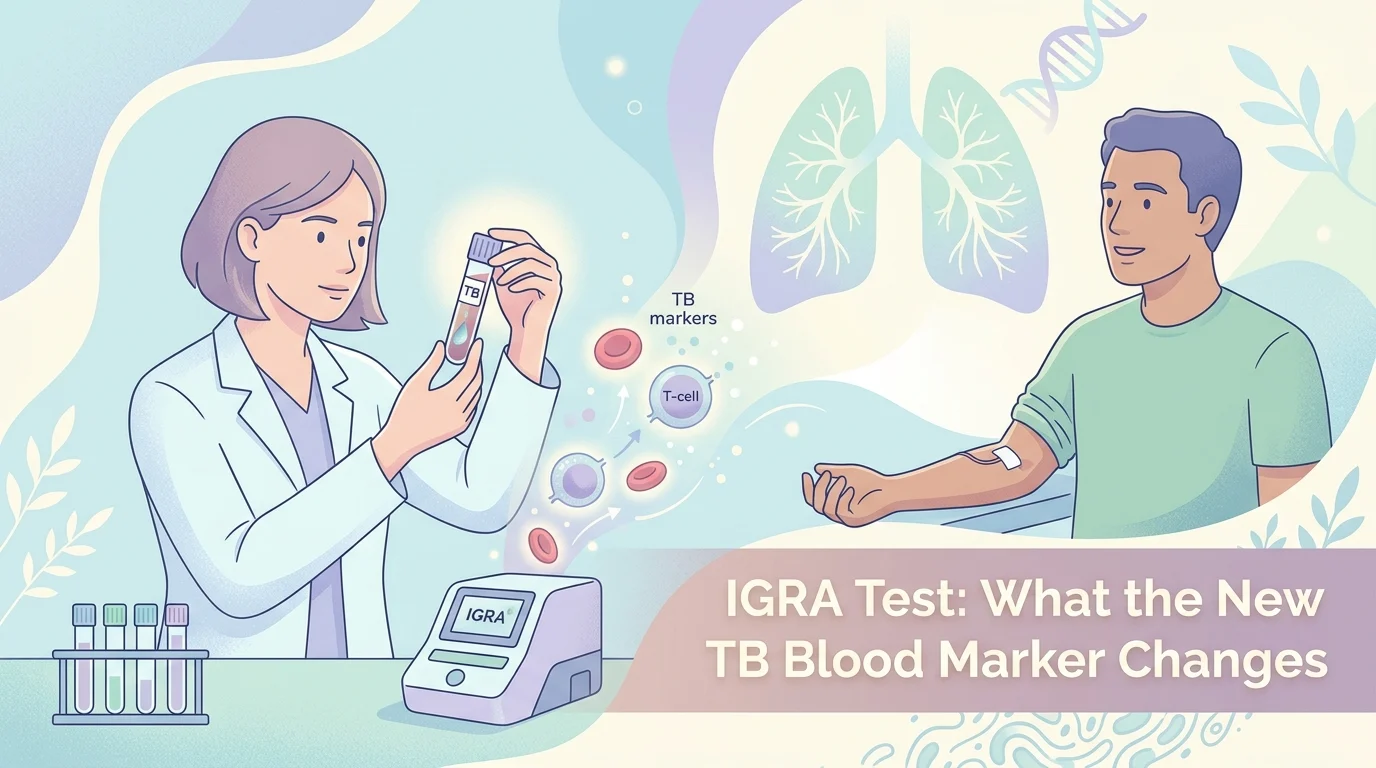
What an IGRA test actually measures
IGRA stands for interferon-gamma release assay. Two versions are approved in the United States: QuantiFERON-TB Gold Plus and T-SPOT.TB. Both work the same way. A technician mixes your blood with synthetic fragments of proteins found in tuberculosis bacteria, then measures how much interferon-gamma your white blood cells release in response.
The key point is that the test never looks for the bacterium itself. It looks at your immune memory. The reaction depends entirely on your lymphocytes, the white cells that remember past encounters with a germ. A strong response means those cells have met tuberculosis proteins before.
That design has real advantages. Unlike the skin test, an IGRA test is not confused by a previous BCG vaccination, which is why the CDC recommends it for people who received BCG. It also spares you the second appointment the skin test requires.
Why a positive IGRA test does not mean active TB
Immune memory lasts. Once your cells have learned to recognise tuberculosis proteins, they keep reacting, whether the bacteria are multiplying in your lungs, sitting dormant and harmless, or long gone after treatment. This is why a positive result usually stays positive for life.
Roughly a quarter of the world population carries the bacterium without being ill. Only 5 to 10 percent of those people will ever develop active disease. So a positive IGRA test opens a question rather than closing one, and your clinician then orders further steps: a chest X-ray, a look at your symptoms, and a sputum sample sent for culture. Our full guide covers the different tuberculosis tests and what each result means.
The sputum step is where things stall. Not everyone can cough up a usable sample, especially early in the disease or in people carrying few bacteria. That is the practical problem researchers have been trying to solve.
The blood marker presented at ADLM 2026
The Taipei team studied a protein called ESAT-6, short for 6-kDa early secreted antigenic target. Unlike interferon-gamma, ESAT-6 is not made by you. It is secreted by the tuberculosis bacterium itself, which means finding it in blood points to bacteria that are currently active rather than to a memory of past exposure.
ESAT-6 is not new to science. What was new is the sensitivity. Earlier sensors could not detect the tiny quantities that circulate in blood, so they could not reliably separate active disease from dormant infection. The researchers used a high-sensitivity biosensor and measured ESAT-6 in 217 people, comparing patients with confirmed active lung tuberculosis against several control groups: people with dormant infection, people merely exposed to a contact, healthy volunteers, people with lung cancer, and people with lung infections caused by related but different mycobacteria.
The pattern followed a ladder. Levels were lowest in exposed but uninfected people, higher in dormant infection, and highest in active disease. The association held after accounting for age, sex and diabetes, and the marker separated the groups better than two commonly used blood markers. Lead author Dr Sheng-Wei Pan framed the stakes plainly, noting that every week of delay in diagnosing tuberculosis matters for the patient and for the people around them.
Two limits deserve emphasis. The study was designed so that each patient’s status was already known, which flatters any marker; a prospective study is now being planned. And sputum culture remains essential, because it is the step that reveals which antibiotics will work.
Three ways to look for tuberculosis in the body
The three approaches answer different questions, which is why they are used together rather than in competition.
| Approach | What it detects | What it can tell you | What it cannot tell you |
|---|---|---|---|
| IGRA blood test (QuantiFERON, T-SPOT) | Your immune response to TB proteins | Whether your immune system has met TB bacteria | Whether the infection is dormant, active, or already treated |
| Sputum culture and molecular tests | The living bacterium in your phlegm | Confirmed active disease and which drugs will work | Anything, if you cannot produce a sample |
| ESAT-6 in blood (research stage) | A protein released by the bacterium itself | A signal that scales with how active the infection is | Drug resistance; and it is not yet available to patients |
What this changes for you today
Nothing changes in the short term. ESAT-6 testing is a research tool, not something you can request at a laboratory. If you have an appointment coming up, you will still be offered an IGRA test or a skin test.
What does change is how you should read a positive result. It is a signal to investigate, not a diagnosis, and it does not mean you are contagious. Treatment for dormant infection exists and is very different from treatment for active disease, so the distinction your clinician is working to establish genuinely matters.
You may also see other markers on the same report. Doctors frequently order a C-reactive protein test to gauge overall inflammation, and most work-ups begin with a complete blood count. Older inflammation measures still in use include the erythrocyte sedimentation rate, while severe bacterial infection is sometimes assessed with procalcitonin. None of these confirms tuberculosis on its own. Because immune status changes the picture, testing also differs for people living with HIV, and our guide explains HIV screening results. If the numbers on your report look opaque, we walk through how to read blood test results.
Latest scientific advances
ESAT-6 sits in a wider effort to build a tuberculosis test that works from a blood draw alone. Three findings from the past three years help place the Anaheim results in context.
First, the limitation is real and documented. A 2023 review in Military Medical Research states plainly that both the skin test and the IGRA test can separate infected from uninfected people but cannot tell dormant infection apart from active disease. That is not a flaw in your laboratory’s work; it is inherent to measuring an immune memory that does not fade.
Second, markers made by your own body have been tested extensively and fall short. A 2024 systematic review pooling 65 studies and 16,010 participants assessed 156 different blood proteins against the World Health Organization’s benchmark for a screening test. C-reactive protein, the best studied, correctly identified about 86 of every 100 people with tuberculosis but wrongly flagged roughly a third of people without it. Useful for sorting who needs further testing, not accurate enough to diagnose. What this means for you is that a raised CRP on your report is a prompt to look further, never an answer in itself.
Third, detecting the bacterium’s own proteins is moving fast. A 2025 study in Biosensors and Bioelectronics tested a plasma method on 86 patient samples and reported that it correctly identified about 97 of every 100 infected people while correctly clearing about 98 of every 100 uninfected people. A 2025 paper in Mikrochimica Acta described a sensor that separated 14 tuberculosis patients from 14 healthy donors and outperformed a standard laboratory immunoassay. A 2026 paper in the same journal extended the approach to urine as well as blood plasma, which matters for settings where drawing blood is difficult.
These are small, early studies from specialised laboratories, using equipment that is not in routine hospital use. They point in a consistent direction, which is encouraging, but none has yet been tested the way a real clinic works: on people whose diagnosis is unknown at the moment the sample is taken. That is the step that turns a promising signal into a usable test, and it has not happened yet.
Glossary
| Term | Definition |
|---|---|
| IGRA | Interferon-gamma release assay. A blood test that measures your immune reaction to tuberculosis proteins. |
| Interferon-gamma | A messenger substance released by immune cells when they recognise a germ they have met before. |
| ESAT-6 | A small protein secreted by the tuberculosis bacterium itself, currently studied as a blood marker. |
| Latent TB infection | Also called inactive TB. The bacteria are present but dormant. You have no symptoms and are not contagious. |
| Active TB disease | The bacteria are multiplying and causing symptoms such as a lasting cough, fever or weight loss. Treatment is urgent. |
| Sputum | Phlegm coughed up from the lungs, used to grow and identify the bacteria in a laboratory. |
| Biosensor | A device that converts the presence of a specific molecule into a measurable electrical or optical signal. |
| Sensitivity | How well a test finds the people who do have the condition, expressed as a percentage. |
| Specificity | How well a test clears the people who do not have the condition, expressed as a percentage. |
| BCG | A tuberculosis vaccine given to children in many countries. It can cause a false positive skin test but does not affect an IGRA. |
Frequently asked questions
Does a positive IGRA test mean I am contagious?
Not by itself. A positive result means tuberculosis bacteria are somewhere in your body, but most people who test positive have the dormant form, which causes no symptoms and cannot be passed to anyone. Contagiousness is linked to active disease in the lungs or airways. Your clinician will use a chest X-ray, your symptoms and a sputum sample to establish which situation applies to you.
Do I need to fast before an IGRA test?
No. An interferon-gamma release assay does not require fasting, and you can eat and drink normally beforehand. It is a standard blood draw from a vein in the arm. Tell the laboratory if you take medicines that suppress the immune system, since these can affect the result and may need to be noted on the request form.
Why did my IGRA test come back indeterminate?
An indeterminate result means the laboratory could not interpret the sample reliably, usually because the control readings fell outside the expected range. Common reasons include a weakened immune system, medicines that dampen immune responses, a very young age, or a problem with sample handling and transport. It is not a positive or a negative. In practice the test is repeated, sometimes alongside a skin test.
Can an IGRA test tell whether treatment worked?
No, and this is a frequent source of confusion. The test tracks immune memory, which usually persists for life. Most people stay positive after finishing treatment for either dormant or active tuberculosis. Recovery is judged on symptoms, imaging and sputum results instead. Ask for a written record of your positive result, so future employers or clinics do not repeat the test unnecessarily.
When will a test like ESAT-6 be available at my laboratory?
There is no timeline. The Anaheim work was a research presentation on 217 people, and the team has said a prospective study is the next step. Beyond that, an assay has to be standardised, validated in several countries and cleared by regulators before laboratories can offer it. That process usually takes several years, and some promising markers never complete it.
Should I ask my doctor for a TB test?
Testing is targeted rather than universal. It is offered to people with a known exposure, those born or living in countries where tuberculosis is common, people whose immune system is weakened, and workers in certain healthcare and community settings. Many people also need one for a job or a visa. If you have a cough lasting more than three weeks, unexplained weight loss, night sweats or fever, see a clinician promptly rather than waiting for a screening appointment.
Sources
- Centers for Disease Control and Prevention — Testing for Tuberculosis: Blood Test, 2025 — cdc.gov
- MedlinePlus, National Library of Medicine — Tuberculosis Screening — medlineplus.gov
- Association for Diagnostics & Laboratory Medicine — New blood test could save millions through early tuberculosis detection, ADLM 2026 meeting, 28 July 2026 — news-medical.net
- Li L et al. — From immunology to artificial intelligence: revolutionizing latent tuberculosis infection diagnosis with machine learning — Military Medical Research, 2023 — consensus.app
- Gaeddert M et al. — Host blood protein biomarkers to screen for tuberculosis disease: a systematic review and meta-analysis — Journal of Clinical Microbiology, 2024 — consensus.app
- Dong H et al. — Identification of novel antigens for distinguishing between active tuberculosis and latent tuberculosis infection in interferon-gamma release assays — Enfermedades Infecciosas y Microbiologia Clinica, 2024 — consensus.app
- Liu S et al. — Plasma-based ultrasensitive detection of Mycobacterium tuberculosis ESAT6/CFP10 fusion antigen using a CRISPR-driven aptamer fluorescence testing (CRAFT) — Biosensors and Bioelectronics, 2025 (PubMed) — doi.org
- Zhang Q et al. — Self-reduced Pd nanoparticles on NiMn-LDHs for signal amplification in electrochemical aptasensing of Mycobacterium tuberculosis ESAT-6 antigen — Mikrochimica Acta, 2025 (PubMed) — doi.org
- Chiang PH et al. — (Cu-S)MOF-polyaniline based dual-platform biosensing for blood plasma and urine detection of ESAT-6 toward early tuberculosis diagnosis — Mikrochimica Acta, 2026 (PubMed) — doi.org
Further reading
- Abnormal blood test results: what they mean
- How long blood test results take
- High lymphocytes: causes and next steps
- High CRP levels and what they signal
- The diabetes blood test explained
Understand your lab results with AI DiagMe
A tuberculosis work-up rarely comes back as a single line. Alongside an IGRA result you may find a complete blood count, a C-reactive protein value, a sedimentation rate and liver enzymes checked before treatment, each with its own reference range. AI DiagMe reads that report with you, in plain language, so you arrive at your appointment knowing which numbers stand out and which questions to ask. It helps you understand your results; it does not make a diagnosis and does not replace your doctor.
Get your results interpreted in minutes
]]>