


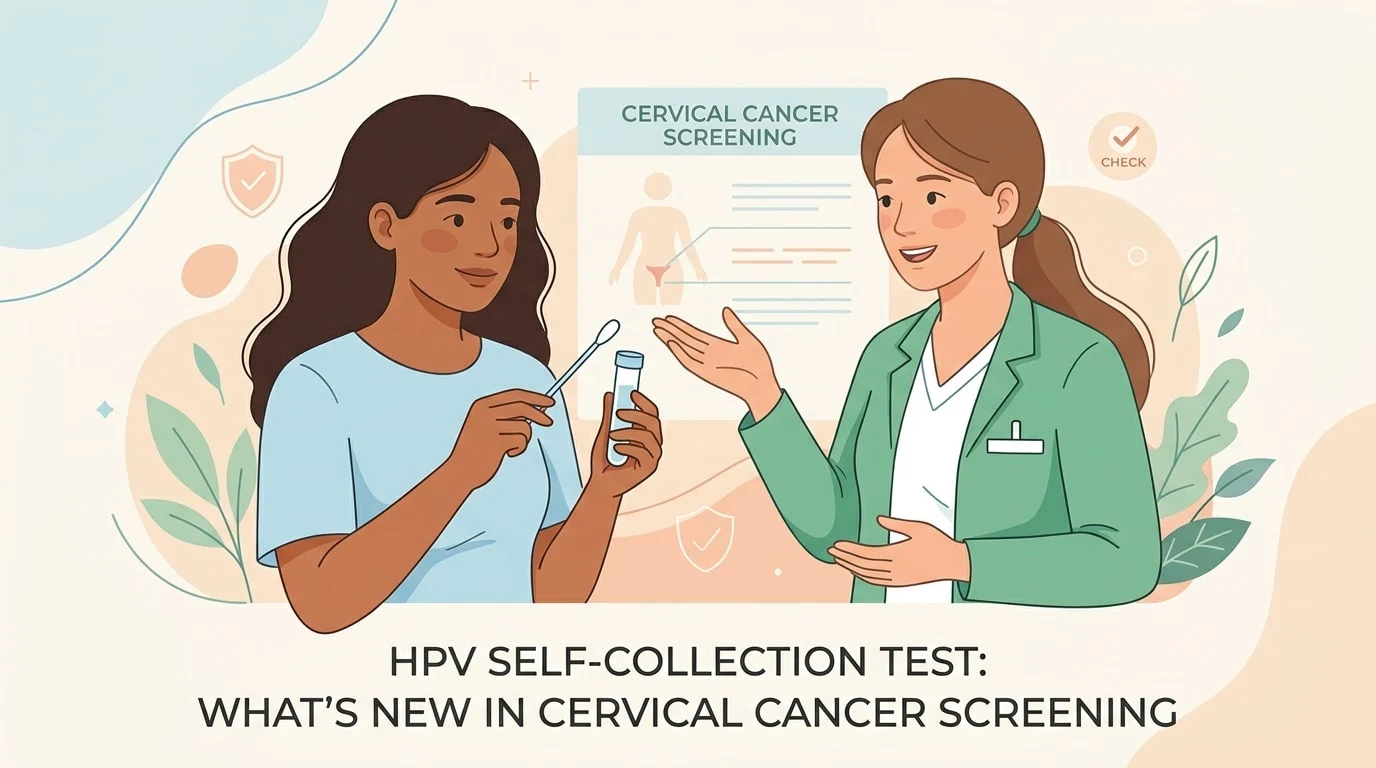
Ett HPV-självprovtagningstest låter dig ta ett eget vaginalprov för cellprovskontroll, antingen på en klinik eller, från och med 2026, hemifrån. Det här alternativet har vuxit snabbt: federala riktlinjer som uppdaterades i januari 2026 listar nu självprovtagning som en föredragen screeningmetod för kvinnor med genomsnittlig risk i åldrarna 30 till 65 år, och två FDA-godkända kit kan nu skickas direkt hem till dig. I den här artikeln får du lära dig vad som förändrades 2026, hur hemtestet fungerar, hur det jämförs med ett vanligt klinikbesök och vad ny forskning säger om dess noggrannhet. Du hittar också svar på vanliga frågor och en kort ordlista.
Vad är ett HPV-självprovtagningstest?
Ett HPV-självprovtagningstest innebär att du själv samlar in celler från slidan med hjälp av en mjuk tops eller borste, i stället för att en vårdgivare utför provtagningen under en gynekologisk undersökning. Provet testas sedan för högrisktyper av humant papillomvirus – det virus som orsakar nästan all livmoderhalscancer. Självprovtagning är inte nytt: kliniker har erbjudit det som ett alternativ till det traditionella cellprovet i ett par år. Det som förändrades 2026 är var du kan göra det.
För mer information om hur HPV orsakar cellförändringar i livmoderhalsen finns en separat guide från vårt team som tar upp humant papillomvirus, dess symtom och behandlingsalternativ. En relaterad guide förklarar ett normalt cellprovsresultat kombinerat med ett positivt HPV-test. Den här kombinationen förvirrar många patienter, eftersom HPV-test och cellprov letar efter olika saker.
Vad förändrades 2026
Två händelser gjorde att HPV-självprovtagning gick från att vara ett alternativ enbart på klinik till något du nu kan göra hemma.
Den 5 januari 2026 uppdaterade Health Resources and Services Administration sina riktlinjer för förebyggande hälsovård för kvinnor. Uppdateringen listar HPV-testning för högrisktyper – oavsett om provet tas av en vårdgivare eller av patienten själv – som den föredragna screeningmetoden för kvinnor med genomsnittlig risk i åldrarna 30 till 65 år, medan cellprov fortfarande är ett alternativ för yngre kvinnor. Riktlinjerna kräver också att de flesta försäkringsplaner täcker uppföljningstester som behövs för att slutföra screeningen, med start den 1 januari 2027. HRSA-administratören Tom Engels sade att förändringen är avsedd att utöka alternativen och ta bort kostnadshinder för screening.
För det andra fick två tillverkare FDA-godkännande för att sälja självprovtagningskit för hemmabruk, inte bara inom sjukvården. I maj 2025 godkände FDA Teal Wand, ett receptbelagt hjälpmedel som skickas hem till dig; du tar ett prov utan spekulum och skickar det med post till ett certifierat laboratorium, där det analyseras med samma test som används på kliniker. I april 2026 meddelade Waters Corporation att FDA godkänt Onclarity HPV Self-Collection Kit, kopplat till BD Onclarity HPV Assay, som förväntas bli tillgängligt på recept och täckas av privat sjukförsäkring, Medicaid och Medicare.
Innan dessa godkännanden var självprovtagning bara tillåten inne på en läkarmottagning – en skillnad som återspeglas i riktlinjer publicerade av Mayo Clinic så sent som i februari 2025, som beskrev hemmabruk som något man förväntade sig i framtiden snarare än något som redan var tillgängligt.
Så fungerar hemmatestning
Båda hemmakit följer ett liknande förlopp, även om de exakta stegen varierar beroende på märke och din läkares instruktioner.
- En läkare bedömer om du är lämplig kandidat och skriver ut ett recept, eftersom båda kiten kräver det.
- Kitet skickas hem till dig i diskret förpackning.
- Du tar ett vaginalt prov själv med den svabb eller det instrument som ingår i kitet, enligt de medföljande instruktionerna.
- Du försluter provet och skickar det med post till tillverkarens certifierade laboratorium, vanligtvis samma dag.
- Laboratoriet utför samma HPV-test som används på kliniker och skickar resultaten till din förskrivande läkare.
- Din läkare kontaktar dig med resultatet och nästa steg, vilket kan innebära ett uppföljningsbesök om testet är positivt.
Ett positivt resultat betyder inte att du har cancer. Det innebär att testet hittade en högrisk-HPV-stam, och din läkare rekommenderar vanligtvis uppföljning, till exempel kolposkopi, för att kontrollera om det finns cellförändringar.
Jämförelse av dina alternativ för livmoderhalscancerscreening
Självprovtagning är ett av flera sätt att genomföra HPV-testning. Tabellen nedan jämför de viktigaste alternativen som finns tillgängliga 2026.
| Alternativ | Vem tar provet | Var | Tillgänglighet 2026 |
|---|---|---|---|
| Standard cellprov eller HPV-test | Läkare/barnmorska | Läkarmottagning eller klinik | Allmänt tillgängligt |
| Självprovtagning på klinik | Du, med personal i närheten | Läkarmottagning eller klinik | Tillgängligt på många kliniker sedan 2024 |
| Teal Wand hemmakit | Du | Hemma, provet skickas till ett laboratorium | Receptbelagt, tillgängligheten ökar sedan juni 2025 |
| Onclarity Self-Collection Kit | Du | Hemma, provet skickas till ett laboratorium | Godkänt april 2026, lanseras på recept |
Vad forskningen säger
Oberoende forskning stöder denna övergång till självprovtagning, och bevisen har vuxit snabbt.
En systematisk genomgång och metaanalys från 2025 publicerad i International Journal of Gynecology & Obstetrics sammanställde 15 studier med över 3 600 kvinnor och visade att självtagna vaginala prover upptäcker högrisk-HPV ungefär lika tillförlitligt som prover tagna av vårdpersonal – med till och med högre träffsäkerhet för att fånga upp mer avancerade cellförändringar. En sådan sammanställd analys, som kombinerar resultat från många mindre studier, räknas som en av de starkare formerna av vetenskaplig evidens, och den talar konsekvent för att självprovtagning är ett giltigt alternativ.
En studie från Belgien 2026, inom ett forskningsramverk kallat VALHUDES, jämförde två självprovtagningsenheter med prover tagna av vårdpersonal hos över 500 kvinnor och fann jämförbar – och i vissa mått högre – träffsäkerhet för att upptäcka förstadier till cancer. Vad detta betyder för dig: nyare självprovtagningsenheter presterar minst lika bra som ett prov taget av vårdpersonal, förutsatt att de analyseras med samma PCR-baserade laboratorietest som redan används inom vården.
En amerikansk studie från 2025, genomförd i Washington D.C. och Florida, jämförde parade självtagna och kliniktagna prover från 294 kvinnor och fann god överensstämmelse mellan de två metoderna. Vad detta betyder för dig: den här typen av jämförelse – där samma patient bidrar med båda proverna – är precis vad tillsynsmyndigheter efterfrågar innan en enhet godkänns för bredare användning.
Också under 2025 publicerade en nationell expertkommitté för cellprovscreening de första detaljerade amerikanska kliniska rekommendationerna för att använda självtagna prover i rutinsjukvård, inklusive hur man följer upp resultat beroende på HPV-typ. Vad detta betyder för dig: din läkare har nu tydliga, gemensamt framtagna riktlinjer för vad som bör göras efter ditt specifika provsvar, vilket minskar osäkerheten för er båda.
En pilotstudie som nu planeras vid Mayo Clinic avser att erbjuda självprovtagning till kvinnor som besöker en akutmottagning i Florida och som kanske inte annars har en fast läkare – rekryteringen förväntas börja i september 2026. Eftersom studien ännu inte har startat återstår resultaten, men den pekar på hur självprovtagning kan nå personer som historiskt sett haft svårare att ta del av screeningprogram.
Vem bör ändå söka läkare omgående
Självprovtagning fungerar bra för rutinscreening av personer utan symtom. Sök vård snabbt, i stället för att vänta på att beställa ett rutinscreeningkit, om du märker ovanlig vaginal blödning – till exempel efter samlag eller efter klimakteriet – ovanliga flytningar eller bäckensmärta. Dessa symtom kräver direkt undersökning och bör inte utredas enbart med ett screeningtest.
Självprovtagningskit är också avsedda för kvinnor med genomsnittlig risk inom den rekommenderade åldersgruppen. Om du har tidigare onormala provsvar, ett försvagat immunförsvar eller andra riskfaktorer bör du fråga din läkare om självprovtagning eller ett besök på mottagningen passar dig bättre. Det är också värt att komma ihåg att ett cellprov och ett HPV-test kontrollerar olika saker jämfört med andra screeningmetoder. Vår guide tar upp symtom på äggstockscancer och de tester som faktiskt hjälper. Den förklarar varför ett normalt cellprovsresultat inte utesluter andra gynekologiska tillstånd.
Hur självprovtagning passar in i bredare screentrender
HPV-självprovtagning är en del av en bredare rörelse mot tester du kan genomföra utanför ett traditionellt mottagningsbesök. Vårt team har skrivit om testet för tidig upptäckt av flera cancerformer och dess studieresultat från 2026, ett enda blodprov som studerats som ett sätt att upptäcka flera cancerformer samtidigt. En separat guide tar upp noggrannheten hos graviditetstester och hur du tolkar ett hemresultat, ytterligare ett exempel på självtestning som senare bekräftas via en klinisk process. Vår översikt förklarar blodprovsprocessen från provtagning till laboratoriesvar, användbar bakgrundsinformation även om HPV-självprovtagning använder ett tops i stället för en nål.
HPV-infektion är inte begränsad till livmoderhalsen. En relaterad guide beskriver HPV-symtom i mun och svalg. Det är en påminnelse om att virusfamiljen bakom cellförändringar i livmoderhalsen även kan förekomma i andra delar av kroppen.
Ordlista
| Kalla | Definition |
|---|---|
| HPV (humant papillomvirus) | Ett vanligt virus som sprids via sexuell kontakt; vissa typer kan orsaka cellförändringar som med tiden kan leda till livmoderhalscancer. |
| Högrisk-HPV | Den grupp av HPV-typer som är starkast kopplade till livmoderhalscancer, skilda från de typer som orsakar könsvårtor. |
| Självprovtagning | Att ta ett eget vaginalt prov med en tops eller pinne för HPV-testning, antingen på en klinik eller hemma. |
| Cervixcytologi (cellprov, Papanicolaou-test) | Ett test som undersöker celler från livmoderhalsen i mikroskop för att leta efter onormala förändringar, skilt från ett HPV-test. |
| Kolposkopi | En uppföljningsundersökning med ett förstoringsinstrument för att noggrant undersöka livmoderhalsen efter ett onormalt screeningresultat. |
| PCR-baserat test | En laboratoriemetod som påvisar genetiskt material från ett virus, används för att identifiera HPV i ett insamlat prov. |
| Positiv procentuell överensstämmelse | Ett mått på hur ofta två testmetoder ger samma resultat när ett sant positivt resultat föreligger. |
| FDA-godkännande | En amerikansk regulatorisk process som visar att en medicinteknisk produkt är säker och effektiv, ofta baserat på likhet med en redan godkänd produkt. |
| HRSA | Health Resources and Services Administration, den federala myndighet som fastställer riktlinjer för förebyggande hälsovård i USA. |
| Riktlinjer för förebyggande hälsovård | Federala rekommendationer som avgör vilka screeningundersökningar försäkringsplaner måste täcka utan extra kostnad för patienten. |
Vanliga frågor
Är ett HPV-självtest hemma lika tillförlitligt som ett test på en klinik?
Forskning som jämför självtagna och kliniktagna prover – inklusive nyliga valideringsstudier – har visat god överensstämmelse mellan de två metoderna när proverna analyseras med ett FDA-godkänt PCR-baserat test. Tillförlitligheten beror på att du följer kitinstruktionerna noga, bland annat att du samlar tillräckligt med celler och skickar in provet i tid. Om du är osäker på om provet togs på rätt sätt, kontakta din förskrivande läkare i stället för att själv dra slutsatser om resultatet.
Behöver jag recept för ett HPV-självtest hemma?
Ja. Båda FDA-godkända hemtestkiten som finns tillgängliga 2026 – Teal Wand och Onclarity HPV Self-Collection Kit – kräver recept. En läkare granskar vanligtvis ett kort frågeformulär om din ålder, screeninghistorik och eventuella symtom innan kitet godkänns och skickas direkt hem till dig.
Vad händer om mitt självtest visar positivt resultat?
Ett positivt resultat betyder att testet har hittat högrisk-HPV – inte att du har livmoderhalscancer. Din förskrivande läkare rekommenderar vanligtvis ett uppföljningsbesök, som kan inkludera en kolposkopi för att undersöka livmoderhalsen närmare och, vid behov, ett litet vävnadsprov. De flesta HPV-infektioner, även högrisktyper, läker av sig själva, men uppföljningstester är det sätt på vilket läkare utesluter eller fångar upp tidiga cellförändringar.
Täcker försäkringen HPV-självtest hemma?
Täckningen utökas. Januariuppdateringen 2026 av de federala riktlinjerna för förebyggande hälsovård kräver att de flesta försäkringsplaner täcker uppföljningstester som behövs för att slutföra screening för livmoderhalscancer från och med den 1 januari 2027. Onclarity HPV Self-Collection Kit förväntas täckas av privat försäkring, Medicaid och Medicare när det blir allmänt tillgängligt. Kontrollera med ditt försäkringsbolag och din förskrivande läkare om din specifika plan innan du beställer ett kit.
Kan jag använda ett självprovtagningskit om jag aldrig har screenats tidigare?
Självprovtagning kan vara ett bra alternativ om du har skjutit upp eller hoppat över screening, eftersom forskning tyder på att det faktum att man slipper besöka en klinik hjälper vissa personer att genomföra ett test som de annars kanske skulle undvika. Det sagt beror behörigheten på din ålder, dina riskfaktorer och din screeninghistorik, så en läkare bör bekräfta att kitet är lämpligt innan du beställer ett.
Vad är skillnaden mellan HPV-självprovtagning och ett cellprov (Pap-test)?
Ett cellprov, eller cervikal cytologi, undersöker celler från livmoderhalsen i mikroskop för att leta efter onormala förändringar. Ett HPV-test – oavsett om det är självtaget eller taget av en läkare – letar i stället efter själva viruset med en PCR-baserad metod. Nuvarande federala riktlinjer anger HPV-testning, inklusive självprovtagning, som det föredragna alternativet för de flesta kvinnor i åldrarna 30 till 65 år, medan cellprov fortfarande rekommenderas för yngre kvinnor och finns kvar som ett alternativ i alla åldrar.
Källor
- Centers for Disease Control and Prevention — Screening för livmoderhalscancer — cdc.gov
- U.S. Food and Drug Administration, Office of Women’s Health — Livmoderhalscancer 101, 2025 — fda.gov
- Health Resources and Services Administration — Nya riktlinjer för screening av livmoderhalscancer stärker kvinnors förebyggande hälsa, 5 januari 2026 — hrsa.gov
- Mayo Clinic Comprehensive Cancer Center Blog — Förbättrad screening för livmoderhalscancer med HPV-självprovtagningstest, februari 2025 — mayoclinic.org
- Dong-mei Li m.fl., 2025, International Journal of Gynecology & Obstetrics — Noggrannhetsanalys av screening för livmoderhalscancer med urin- och vaginal självprovtagning jämfört med kliniker-tagna prover: en systematisk översikt och metaanalys — consensus.app
- Latsuzbaia m.fl., 2026, Journal of Medical Virology — Noggrannhet hos Allplex HPV HR Detection Full Genotyping Assay på cervikala prover jämfört med vaginala självprover (VALHUDES) — consensus.app
- Tsegaye et al., 2025, Journal of Clinical Virology — Performance of the Alinity m HR HPV assay on self-collected vaginal samples compared to clinician-collected cervical samples — consensus.app
- Wentzensen et al., 2025, Journal of Lower Genital Tract Disease — Self-Collected Vaginal Specimens for HPV Testing: Recommendations From the Enduring Consensus Cervical Cancer Screening and Management Guidelines Committee — consensus.app
- ClinicalTrials.gov, NCT06607874 — Self-Collection for Cervical Cancer Screening and HPV Vaccination for Cancer Prevention Among Women in Emergency Care in Northeast Florida (Mayo Clinic) — clinicaltrials.gov
- Teal Health (PR Newswire) — FDA Approves Teal Health’s Teal Wand, the First and Only At-Home Self-Collection Device for Cervical Cancer Screening, May 2025 — prnewswire.com
- Waters Corporation (PR Newswire) — Waters Announces FDA Clearance of the Onclarity HPV Self-Collection Kit and FDA-Approved HPV Assay, April 2026 — prnewswire.com
Vidare läsning
- Vad ett normalt cellprovssvar med positivt HPV-test innebär
- Humant papillomvirus: orsaker, symtom och behandling
- Äggstockscancer – symtom och hur man testar
- Test för tidig upptäckt av flera cancerformer: vad 2026 års studie visade
- Vad som händer vid ett blodprov: hela processen steg för steg
Förstå dina labresultat med AI DiagMe
Provsvar – oavsett om det gäller ett cellprov, ett HPV-test eller vanliga blodprover – kan väcka frågor som är svåra att ta reda på på egen hand. AI DiagMe hjälper dig att förstå vanliga laboratorievärden, från hormonpaneler till tumörmarkörer, på ett enkelt och begripligt sätt, så att du kan gå till ditt nästa läkarbesök med tydligare frågor. Tjänsten är till för att hjälpa dig förstå dina provsvar – inte för att ställa diagnoser eller ersätta din läkares bedömning.
Få dina resultat tolkade på några minuter