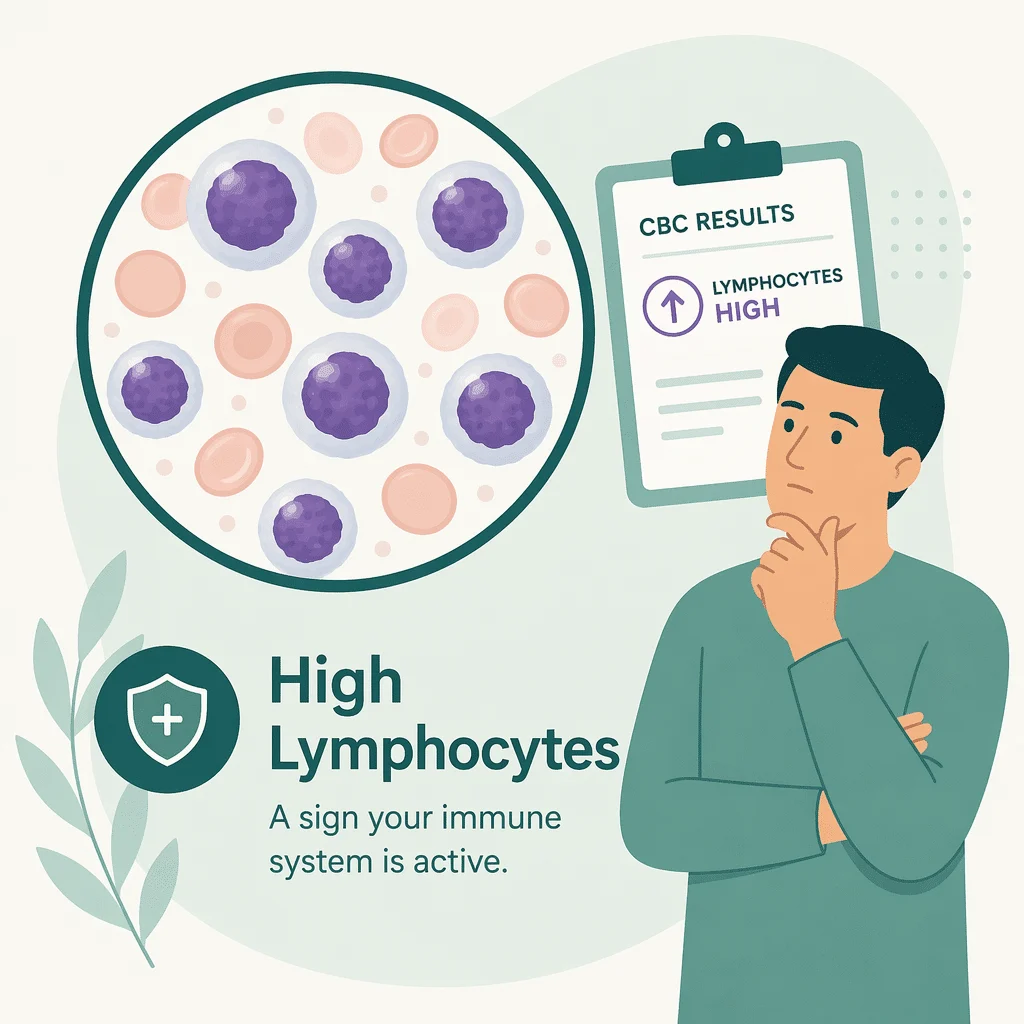
If a laboratory report has flagged high lymphocytes, the first thing worth knowing is the most reassuring: the overwhelming majority of raised lymphocyte counts are reactive. That means the immune system is responding to something — most often an ordinary virus — and the count settles by itself. A lymphocyte count is a measurement, not a diagnosis, and one number on one day rarely decides anything.
In this article you’ll learn what lymphocytes do, why a raised count is usually temporary, which infections and situations push it up, what the word “atypical” means on a report, when a doctor looks further, and how chronic lymphocytic leukemia and its common precursor state fit into the picture — honestly, and in proportion.
What lymphocytes do, and what a high lymphocyte count means
Lymphocytes are one of the five types of white blood cell counted on a routine complete blood count (also called a full blood count). They are the memory and precision arm of the immune system. B lymphocytes make antibodies; T lymphocytes kill infected cells and coordinate the response; natural killer cells attack abnormal cells directly. Our companion guide to what lymphocytes are and how they work covers this biology in more depth.
Lymphocytosis is simply the medical word for more lymphocytes in the blood than the laboratory’s reference range allows. It sits alongside its opposite, a low lymphocyte count, and alongside changes in the other white cell lines such as raised neutrophils.
Percentage versus absolute count
Reports usually give lymphocytes twice: as a percentage of all white cells, and as an absolute count. The absolute count is the one clinicians act on. A percentage can look high purely because another cell type has fallen — if neutrophils drop during a viral illness, lymphocytes automatically make up a bigger share of the total without a single extra lymphocyte having been produced. This is called a relative lymphocytosis, and it is a common reason for an alarming-looking report that turns out to mean very little.
Reference ranges also shift with age. Healthy infants and young children run far higher lymphocyte counts than adults, so a value flagged as high on an adult scale may be entirely normal for a toddler. Age, recent illness and the rest of the blood count all change how a number is read.
Why most high lymphocyte counts are reactive — and why the repeat test matters
A reactive lymphocytosis is the immune system doing its job. Lymphocytes multiply in response to a trigger, circulate in larger numbers while the response is running, then return to baseline once it is over. Nothing about that process is abnormal, and nothing about it needs treating.
This leads to the single most useful practical point in the whole subject: a repeat count several weeks later is what separates a reactive lymphocytosis from a persistent one. A reactive rise falls back. A rise that is still there weeks later gets investigated. This is exactly what a doctor does next, and it is why an unexpected result is so often followed by “let’s recheck it in a month or two” rather than an urgent referral.
That single step defuses a great deal of anxiety without dismissing anything. It takes the finding seriously — the count is genuinely being tracked — while giving the far more likely explanation a fair chance to declare itself. Timing matters more than the exact number on the first report.
The infections and situations that raise lymphocytes
Viral infections, above all
Viruses are the commonest cause of a high lymphocyte count at any age. Epstein-Barr virus, which causes infectious mononucleosis or glandular fever, is the classic example: the CDC notes that most people are infected at some point and that symptomatic illness typically clears in two to four weeks, though fatigue can linger. Cytomegalovirus produces a very similar picture. Viral hepatitis is another recognized trigger, which is why an unexplained rise sometimes prompts hepatitis C antibody testing or an HBs antigen test for hepatitis B. COVID-19 more often lowers lymphocytes in the acute phase, but counts can rebound above the reference range during recovery.
One practical aside on glandular fever: people given amoxicillin or ampicillin for a presumed bacterial sore throat while actually carrying Epstein-Barr virus frequently develop a widespread rash. It is a well-known interaction rather than a true drug allergy, and our guide to amoxicillin rashes and allergy explains the difference.
Whooping cough, toxoplasmosis and vaccination
Pertussis deserves a special mention because it behaves differently from most bacterial infections. Rather than raising neutrophils, whooping cough classically produces a marked lymphocytosis, particularly in children. CDC guidance on whooping cough describes an illness that can start like a common cold but leaves a cough lasting weeks or months. A child with a long cough and a strikingly high lymphocyte count is a combination clinicians recognize immediately.
Toxoplasmosis, usually caught from undercooked meat or cat feces, can also raise lymphocytes and produce swollen neck glands; toxoplasmosis IgG and IgM results are how it is confirmed. Recent vaccination can produce a modest, short-lived rise as well, for the same reason any immune stimulus can.
Benign and mechanical causes worth naming
Not every raised count reflects an infection. Acute stress lymphocytosis follows major physical stress — serious trauma, surgery, a heart attack or a seizure. Lymphocytes are pushed out of tissues into the circulation within minutes and the count usually normalizes within hours. It is transient by definition and needs no action.
After surgical removal of the spleen, lymphocyte counts often settle at a permanently higher baseline, because the spleen normally holds a large pool of these cells. Persistent polyclonal B-cell lymphocytosis is an uncommon but benign condition classically described in women who smoke, in which lymphocyte numbers stay mildly raised for years without progressing. Certain drug reactions can raise counts too. None of these are dangerous in themselves, but all of them can look worrying on a first report until the context is known.
What “atypical lymphocytes” on your report actually means
Few phrases on a blood report cause more alarm than “atypical lymphocytes” — and few are more routinely benign. When lymphocytes are actively responding to a virus, they enlarge, their nucleus changes shape and their cytoplasm takes up more stain. Under the microscope they no longer look like resting lymphocytes, so the laboratory scientist describes them as atypical or reactive.
Atypical here means activated, not abnormal in the cancerous sense. It is the expected appearance in glandular fever and other viral illnesses, and it is often the clue that points towards a viral cause in the first place. Some laboratories use the term “reactive lymphocytes” precisely to avoid the misunderstanding.
What matters is the pattern. A mixed population of variably sized reactive cells alongside a recent viral illness reads very differently from a uniform population of identical small lymphocytes in someone who feels perfectly well. The laboratory comment is written for the requesting clinician, who reads it together with your symptoms, your age and the rest of the count.
When a high lymphocyte count needs more than a repeat test
Several features shift a result from “recheck it later” towards “look into this now”: a count that is markedly rather than mildly raised, a count that stays up or keeps climbing across repeated tests, an adult over about sixty with no infection to explain it, abnormalities in the other blood cell lines, and any of the red flags described below. The table sets out the situations people most often ask about.
| Situation | What it usually means | Usual next step |
|---|---|---|
| Mildly raised during or just after a viral illness | Reactive lymphocytosis — the immune system responding as expected | No immediate action; repeat the count once you have recovered |
| Markedly raised in a child with a cough lasting weeks | Suggestive of whooping cough, which classically drives lymphocytes up | Testing for pertussis and treatment of the infection itself |
| Raised once, then normal on repeat | A transient rise that has already resolved | Usually nothing further; routine monitoring only |
| Persistently raised in an adult over sixty who feels well | Needs a cause identified; a clonal condition is one of several possibilities | Blood film and flow cytometry, with hematology review if clonal |
| Raised with swollen lymph nodes and night sweats | Requires prompt assessment; infection and lymphoid disease both possible | Same-week medical review, examination and targeted testing |
Chronic lymphocytic leukemia and monoclonal B-cell lymphocytosis, in proportion
Chronic lymphocytic leukemia, or CLL, is the most common leukemia in adults, and it deserves an honest place in any discussion of raised lymphocytes. It is also, very often, found by accident — picked up on a routine blood count in someone who feels completely well and came in for something unrelated. It is more likely when a count is persistently rather than briefly raised, when the rise is marked, and with increasing age. It is not what a single mildly raised result in a person recovering from a sore throat usually means.
Our overview of blood tests in leukemia covers that condition in its own right. Lymphoid cells from lymphoma can also spill into the blood and show up as lymphocytosis, and in children an acute leukemia usually announces itself with several other abnormalities on the count rather than a raised lymphocyte number alone.
Monoclonal B-cell lymphocytosis: the precursor state nobody mentions
Between a normal blood count and CLL sits a state called monoclonal B-cell lymphocytosis, or MBL. It means a small population of identical B lymphocytes can be detected in the blood, without the cell numbers, symptoms or examination findings that would define leukemia. It is common in older adults, it causes no symptoms, and in most people it never progresses. Where the clone is small, progression is unusual; where it is larger, the yearly chance of moving on to CLL that needs treatment is still low, which is why the standard response is monitoring rather than intervention.
Naming MBL matters, because “you have a small B-cell clone that we will keep an eye on” is both more accurate and far less frightening than “leukemia” for the many people whose findings sit in this category.
Why watchful waiting is the standard, not a delay
Something almost nobody says out loud: early-stage CLL is normally managed with watchful waiting. Many people are monitored for years — sometimes decades — with regular blood counts and reviews, and never need treatment at all. This is not rationing or hesitation. Trials that gave treatment early to people with asymptomatic disease did not improve how long they lived, so observation remains the recommended approach. The National Cancer Institute’s patient guidance on CLL lists watchful waiting first among the options for asymptomatic disease.
What your doctor does next: blood film, examination and flow cytometry
The pathway is more orderly than most people expect. It starts with the repeat count, then adds a blood film — a drop of blood spread on a slide and examined by a scientist, who describes what the lymphocytes actually look like and whether they are uniform or varied.
Where the picture warrants it, the next test is flow cytometry, also called immunophenotyping. Blood cells are passed one at a time through a laser, and the proteins on their surface are read like a barcode. This answers one question extremely well: is this a mixed population of many different lymphocytes reacting to something, or one identical population descended from a single cell? The first is reactive; the second is clonal, and clonal populations are what lymphoid conditions such as CLL are made of. A related principle underlies the kappa-lambda light chain ratio, which also distinguishes a balanced immune response from a single dominant clone.
Alongside these, your doctor will examine you for enlarged lymph nodes, liver or spleen, and may add other blood tests — viral serology, immunoglobulins, and sometimes lactate dehydrogenase (LDH), a general marker of cell turnover. On the question people often ask about supplements: no vitamin, herbal product or “immune-boosting” supplement has been shown to raise or normalize a lymphocyte count, and taking one does not change what the number means.
Red flags that need prompt medical attention
Contact a doctor promptly — do not simply wait for the repeat count — if a raised lymphocyte count comes with any of the following:
- Drenching night sweats that soak nightclothes or bedding
- Unexplained weight loss without dieting
- Fevers with no infection to account for them
- Painless swollen lymph nodes lasting more than a few weeks
- Easy bruising, or bleeding that is unusual for you
- Recurrent or unusually severe infections
- Extreme fatigue, or breathlessness on ordinary activity
- Abdominal fullness, or feeling full very quickly when eating, which can reflect an enlarged spleen
The first three are the classic pattern clinicians call B symptoms. Any of these makes the finding worth assessing sooner rather than later.
Latest scientific advances in assessing a high lymphocyte count
Research over the past three years has changed the tone of this subject more than the tests themselves, and most of the movement has been towards doing less, earlier, and explaining more.
An international expert panel published a consensus report on monoclonal B-cell lymphocytosis, pulling together what is known about how the condition behaves and how it should be managed. What was found: MBL is a distinct precursor state, most people who have it never develop leukemia, and the panel set out agreed recommendations for monitoring rather than treating it. What this means for you: if flow cytometry (the laser-based test that identifies a cell population by its surface proteins) finds a small clone, being placed on a monitoring schedule is the recommended standard, not a compromise.
The CLL12 trial, a randomized placebo-controlled study, tested whether starting a targeted drug early in people with asymptomatic early-stage CLL was better than observing them. What was found: early treatment delayed disease progression, but people did not live longer, and watch-and-wait remained the standard of care. What this means for you: if you or a relative is told that a diagnosis will be monitored rather than treated, that reflects the best available evidence, not a decision to hold something back.
A 2025 review of hematology referrals for unexplained lymphocytosis looked at what actually happens to people sent to a specialist. What was found: only a small minority turned out to need treatment for a newly diagnosed lymphoid disorder, most of the non-clonal cases were smoking-related, and the great majority of patients felt reassured after their first consultation — although half had been anxious about attending a cancer center beforehand. What this means for you: a referral is a step in the pathway, not a verdict, and the appointment itself is usually where the worry ends.
Two further papers refined the benign end of the spectrum. A 2026 case study of persistent polyclonal B-cell lymphocytosis set out the features that distinguish this harmless condition from a malignant one — a polyclonal (mixed, not single-clone) B-cell population, characteristic double-nucleated lymphocytes on the film, and raised IgM without a monoclonal protein. It also noted that the picture can stabilize or reverse after stopping smoking.
A 2025 review of monoclonal B-cell lymphocytosis separated the low-count from the high-count form. What was found: the higher-count type carries a modestly increased risk of infections and of second cancers, so routine cancer screening, vaccination and stopping smoking are worth attending to. What this means for you: even when a raised count is not going to become leukemia, it can still be a reason to look after the basics.
Frequently asked questions
Does a high lymphocyte count mean leukemia?
Usually not. Most raised lymphocyte counts are reactive — the immune system responding to an infection or another stimulus — and they return to normal on their own. Leukemia is one possible explanation among several, and it becomes a more serious consideration when the count is markedly raised, when it stays raised across repeated tests over weeks or months, and in older adults. No single number can confirm or exclude it. That decision comes from the pattern over time, the blood film, flow cytometry, examination and your symptoms, interpreted by your doctor. Being told to repeat the test is a normal and appropriate first step, not a sign that something is being missed.
How long do lymphocytes stay high after a virus?
It varies with the virus. After a common respiratory infection, counts often settle within one to two weeks. After glandular fever caused by Epstein-Barr virus, lymphocytes can stay raised for several weeks and occasionally for a couple of months, which is one reason fatigue lingers too. Cytomegalovirus behaves similarly. Because of this, doctors usually leave a gap of several weeks before repeating the count, so that a genuinely reactive rise has time to fall. If you are rechecked too soon and the count is still high, that on its own does not mean anything is wrong.
What are atypical lymphocytes?
They are ordinary lymphocytes that have been activated by an immune response and therefore look different under the microscope — larger, with a changed nuclear shape and more deeply staining cytoplasm. “Atypical” describes their appearance, not a cancer diagnosis, and many laboratories now prefer the clearer term “reactive lymphocytes”. They are the expected finding in glandular fever and other viral illnesses. What a laboratory scientist looks for is whether the cells are varied, as in a reactive response, or uniform and identical, which prompts further testing. If the comment appears on your report, ask your doctor to explain it in the context of your other results.
What is considered a high lymphocyte count?
Each laboratory sets its own reference range, and the figure printed beside your result is the one that applies to your sample. Broadly, adults are flagged above roughly three thousand lymphocytes per microliter, while children — especially infants — normally run considerably higher and are judged against age-specific ranges. Two practical points matter more than the exact threshold: the absolute count is more meaningful than the percentage, and the degree of elevation matters. A count a little above the range in someone who has just had an infection is read very differently from a count several times the upper limit.
Can stress cause a high lymphocyte count?
Severe physical stress can, briefly. Acute stress lymphocytosis follows events such as major trauma, surgery, a heart attack or a seizure, when lymphocytes are rapidly released from tissues into the circulation. The rise appears within minutes and typically resolves within hours, so it is mainly seen on blood taken during or just after such an event. Everyday psychological stress — work pressure, poor sleep, worry — is not an established cause of a persistently raised lymphocyte count. If your count is high and stays high, stress is not a sufficient explanation and the usual assessment still applies.
Can supplements or diet lower a high lymphocyte count?
No. There is no vitamin, mineral, herbal product or “immune-boosting” supplement that has been shown to raise, lower or normalize a lymphocyte count, and none should be taken with that aim. The count reflects whatever is driving it, so it changes when the underlying cause changes — a virus clears, a drug is stopped, an infection is treated. The same applies to vaccination: a small, short-lived rise afterwards is a normal immune response and needs no correction. Stopping smoking is the one lifestyle change with a genuine link to lymphocyte counts, in smoking-related polyclonal lymphocytosis.
Glossary of key terms
| Term | Definition |
|---|---|
| Lymphocyte | A white blood cell of the immune system, including B cells, T cells and natural killer cells |
| Lymphocytosis | A lymphocyte count above the laboratory’s reference range for your age |
| Absolute lymphocyte count | The actual number of lymphocytes per unit of blood, as opposed to their percentage of all white cells |
| Reactive (atypical) lymphocyte | A lymphocyte enlarged and altered in appearance because it is actively responding to an infection |
| Blood film | A drop of blood spread on a slide, stained and examined under a microscope |
| Flow cytometry | A test that identifies cells one by one from the proteins on their surface; also called immunophenotyping |
| Clonal | Describing a population of identical cells all descended from one original cell |
| Polyclonal | Describing a mixed population of cells from many different origins, typical of a normal immune response |
| Monoclonal B-cell lymphocytosis (MBL) | A small clonal B-cell population in the blood without the features of leukemia; usually monitored, and most often never progresses |
| Watchful waiting | Planned monitoring with regular reviews, used when treatment would not improve outcomes |
Sources
- National Cancer Institute — Chronic Lymphocytic Leukemia Treatment (PDQ), Patient Version
- Centers for Disease Control and Prevention — About Epstein-Barr Virus (EBV)
- Centers for Disease Control and Prevention — About Whooping Cough
- MedlinePlus, U.S. National Library of Medicine — Blood differential test
- Ryan CE, Ahn IE, Sekar A, et al. State of the art biology, progression, and clinical management of monoclonal B-cell lymphocytosis (MBL): consensus report from the Intercepting Blood Cancers Workshop Committee. Blood Cancer Journal, 2025. Retrieved from PubMed. https://doi.org/10.1038/s41408-025-01341-6
- Langerbeins P, Robrecht S, Nieper P, et al. Ibrutinib in early-stage chronic lymphocytic leukemia: the randomized, placebo-controlled, double-blind, phase III CLL12 trial. Journal of Clinical Oncology, 2025. Retrieved from PubMed. https://doi.org/10.1200/JCO.24.00975
- Dawd D, Benjamin M, Gerard L, Kotchetkov R. Patterns and experiences of patients with undifferentiated lymphocytosis referred by primary care physicians in Canada. Journal of Family and Community Medicine, 2025. Retrieved from PubMed. https://doi.org/10.4103/jfcm.jfcm_50_25
- Parkes E, Martin-Cabrera P, Creasey H, Bloxham D, Follows G. Polyclonal B-cell lymphocytosis: a rare, benign condition that mimics a chronic lymphoproliferative disorder. Hematology, 2026. Retrieved from PubMed. https://doi.org/10.1080/16078454.2026.2704266
- Serafin A, Sant’Antonio E, Mavilia F, et al. Monoclonal B-cell lymphocytosis: the silent clone the haematologists should not neglect. Hematological Oncology, 2025. Retrieved from PubMed. https://doi.org/10.1002/hon.70084
Further reading
- Neutrophils explained: making sense of your blood work
- Monocytes: a guide to understanding your blood test results
- Eosinophils: understanding these key blood cells
- High CRP levels: causes, symptoms and treatments
- HIV screening: understanding your test results
Understand your lab results with AI DiagMe
A lymphocyte result rarely stands alone. AI DiagMe reads the numbers on your full blood count — lymphocytes included — alongside related findings such as a blood film comment or an LDH result, and explains in plain language what each one measures and what a laboratory comment means. It is built to help you understand your report and arrive at your appointment with better questions. It does not diagnose any condition, and it does not replace your doctor.
Get your results interpreted in minutes