









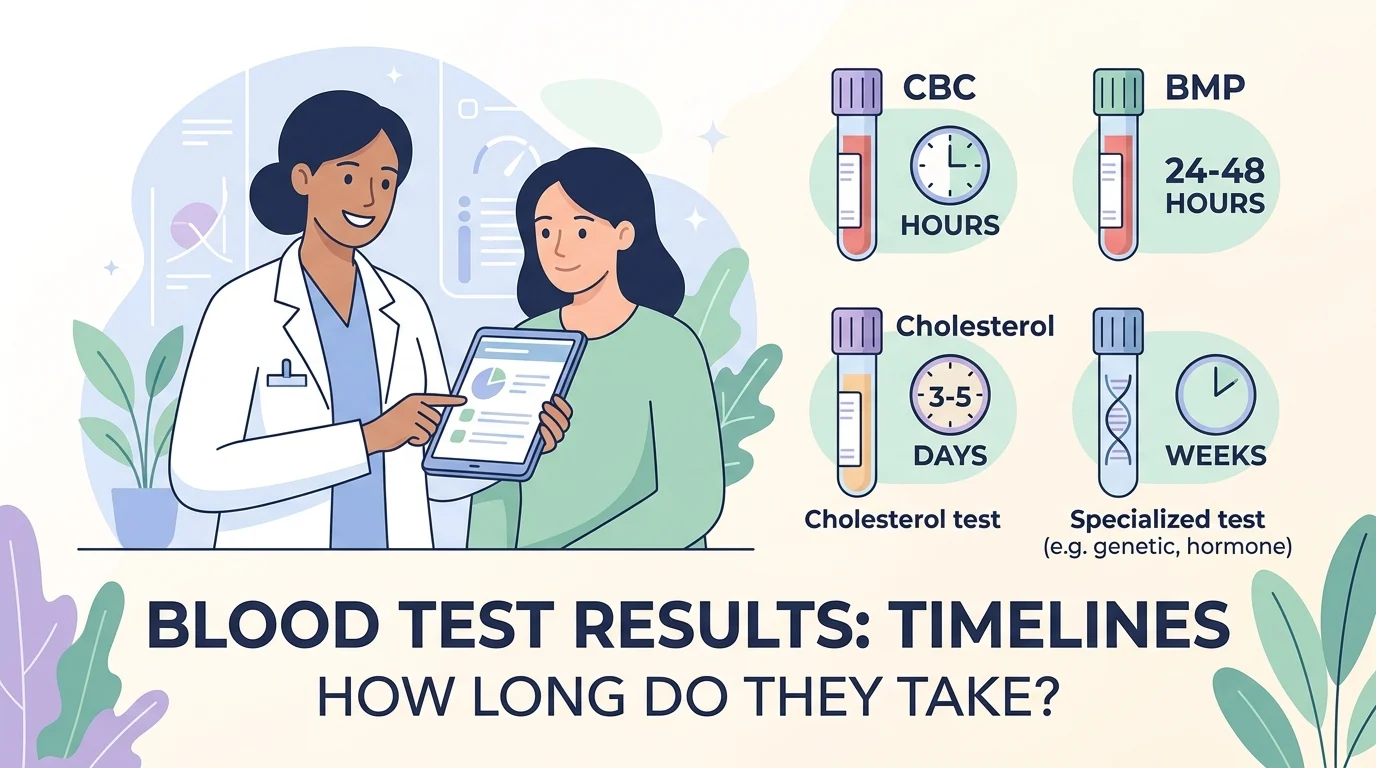
How long do blood test results take? For most routine tests, results are ready within a few hours to a few days, but the honest answer depends on the test, the laboratory, and how your results reach you. A complete blood count can be back the same day, while a genetic screen or a blood culture may take one to two weeks. This guide gives clear, realistic timelines for common blood tests, organised by test type and by where you have your sample taken, from a doctor’s office to a hospital emergency room. You will also learn why some results take longer than others, how to find them, and when a delay is normal versus when it is worth following up with your doctor.
How long do blood test results take? A quick answer
For everyday blood tests, most results are finalised within the same day to about three days. Cleveland Clinic notes that routine bloodwork is often available the same day once it is finalised, while a complete blood count with differential typically appears about two business days after it is completed, and tissue studies such as cytology and pathology can take around five days. The NHS frames the patient experience a little more broadly, explaining that you may get your blood test results after a few days and usually within a few weeks, and advising you to contact your surgery or specialist if you have heard nothing after a few weeks.
Those two views are not in conflict. They describe two different clocks, and confusing them is the single biggest reason people feel their results are “late.”
Lab turnaround time versus when you actually see your results
Turnaround time is the lab’s clock: the time from when your sample reaches the laboratory to when a verified result is produced. For common tests this is often hours.
The time until you see the result is usually longer. After the lab finishes, a clinician may need to review the result, add a comment, and release it to you. Weekends, the type of test, and your clinic’s policy all add to this second clock. So a sample can be “done” in the lab on Monday afternoon yet land in your portal on Wednesday.
Why blood test results take different amounts of time
No two tests move at the same speed. Understanding the journey your sample takes makes the wait far less mysterious.
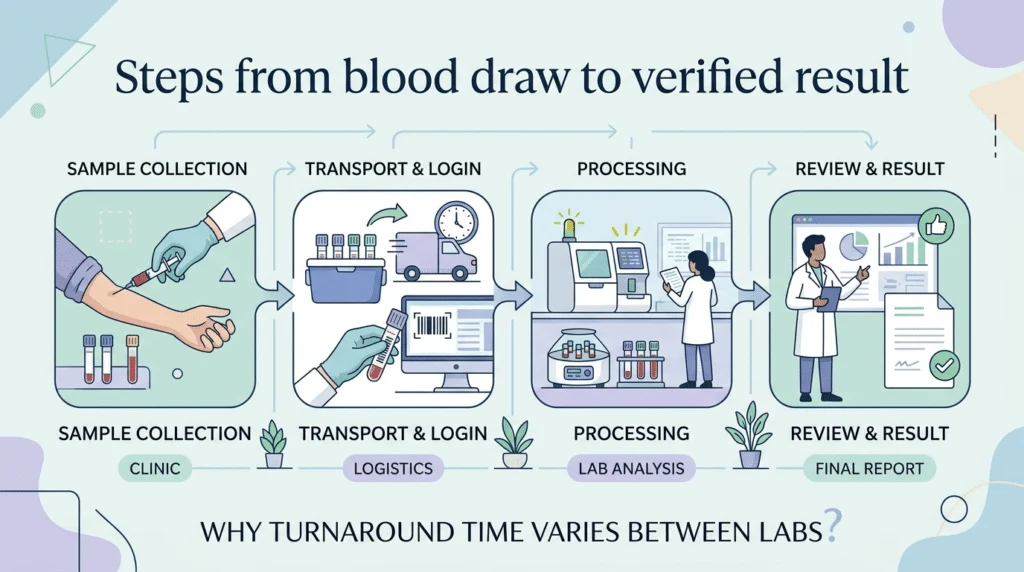
From blood draw to verified result: the lab workflow
Your sample passes through several stages, and each one adds time:
- Collection. A healthcare professional draws your blood, usually from the inside of your elbow. The draw itself takes only a few minutes.
- Transport. Many clinics send samples to a central laboratory, sometimes by daily courier. A sample taken near a lab arrives faster than one from a remote clinic.
- Analysis. The lab runs your sample, often grouping similar tests into batches that run at set times. If your sample just misses a batch, it waits for the next run.
- Verification. Results are checked for quality, and unusual values may be repeated or confirmed before release.
- Release. The result reaches your doctor and then you, often through an online portal.
What speeds up or slows down your results
Several factors push your timeline in either direction:
- Test complexity. Simple counts are fast. Tests that need cells to grow, special equipment, or a send-out to a specialised lab take longer.
- Batching. Routine, non-urgent samples are run in scheduled groups rather than one by one.
- Urgency. A sample marked urgent or “STAT” jumps the queue.
- Abnormal values. A surprising result may be re-run to confirm it, which adds a step.
- Weekends and holidays. Many labs and clinics release routine results only on working days.
- Lab workload. During busy periods, even routine results can drift toward the slower end of their range.
Blood test turnaround times by test type
The table below gives typical, plain-language timelines for common blood tests. Treat these as general ranges rather than promises: your laboratory and clinic set the real timing, and the figures describe how quickly a result is usually produced, not always how quickly it reaches you. If you want help making sense of the values once they arrive, see our guide on how to read blood test results.
| Blood test or panel | What it looks at | Typical time to result* |
|---|---|---|
| Complete blood count (CBC) | Red cells, white cells, platelets | Same day to ~2 days |
| Metabolic panel (basic or comprehensive) | Salts, sugar, kidney and liver markers | Same day to ~2 days |
| Pregnancy test (hCG) | The pregnancy hormone | A few hours to ~2 days |
| Cholesterol (lipid panel) | Cholesterol and triglycerides | ~1 to 3 days |
| HbA1c (average blood sugar) | Blood sugar over ~3 months | ~2 to 4 days |
| C-reactive protein (CRP) | Inflammation | ~1 to 3 days |
| Thyroid (TSH, T4) | Thyroid hormones | ~2 to 5 days |
| Iron and ferritin | Iron stores | ~2 to 5 days |
| Vitamin D, B12, folate | Vitamin levels | ~3 to 7 days |
| Hormones (testosterone, oestrogen, cortisol) | Hormone levels | ~3 to 7 days |
| Infection or STI serology (HIV, hepatitis, syphilis, herpes) | Antibodies to infections | A few days to ~2 weeks |
| Autoimmune antibodies (such as ANA) | Autoimmune markers | ~3 days to 2 weeks |
| Blood culture | Bacteria growing in the blood | ~1 to 5 days |
| Genetic or prenatal (NIPT) screening | DNA-based screening | ~1 to 2 weeks |
*Approximate ranges; your lab and clinic decide the actual timing.
Fast, everyday tests
Routine panels are the quickest. A complete blood count and a comprehensive metabolic panel are run on automated analysers and are often ready within a day or two. If you are not sure which of these your doctor ordered, our comparison of CBC versus CMP explains what each one checks. A cholesterol panel and an HbA1c, used to track diabetes risk, usually follow within a few days.
Tests that take a little longer
Some markers need extra steps. A thyroid (TSH) test, an iron and ferritin check, and vitamin or hormone levels often take several days, partly because they may be batched or sent to a specialised lab.
Pregnancy and infection tests
A pregnancy (hCG) blood test is usually fast, often back within a day, and many of the routine blood tests during pregnancy follow within a few days. Infection and sexually transmitted infection (STI) tests vary more widely. An HIV screening test and tests for hepatitis, syphilis, or herpes can take from a few days up to about two weeks, and they are often handled with extra privacy.
The slowest: cultures and genetic tests
The longest waits usually involve biology that simply takes time. A blood culture must give any bacteria time to grow before it can be read, so a final result can take up to five days. Genetic and prenatal screens analyse DNA in detail and commonly take one to two weeks.
How long do blood test results take in the ER, hospital, and clinic?
Where your blood is drawn changes the timeline as much as the test itself. The same CBC can be ready in under an hour in one setting and in two days in another.
Emergency room and hospital
In an emergency room or hospital, blood is often tested on-site and marked urgent, so essential results can be ready within roughly an hour. Speed matters here because doctors use the numbers to make immediate decisions. A clot-screening test called D-dimer, for example, is frequently run urgently when a blood clot is suspected. Even in hospital, more specialised tests still follow their usual, slower timelines.
Doctor’s office, clinic, and commercial labs
When your sample is collected at a doctor’s office or clinic and sent to an outside laboratory, routine results commonly take a few working days. Commercial labs are efficient but still batch routine samples and release results on working days. If your test was arranged by a hospital or specialist rather than your usual doctor, the result generally goes back to whoever ordered it, who is then responsible for sharing it with you. It is always reasonable to ask the clinic or lab what its typical turnaround is for your specific test, so your expectations match their schedule.
Where to find your results and how they reach you
Most people now receive results through an online patient portal or app, often before a clinician has discussed them. In fact, Cleveland Clinic explains that federal rules in the United States require healthcare organisations to release most results to you as soon as they are completed, whether they are normal or abnormal.
There are sensible exceptions. Cleveland Clinic notes that certain sensitive results, including genetic tests and some STI and HIV results, are not released automatically so that a provider can share them with you directly. As the NIH’s MedlinePlus service explains, a lab test checks a sample of your blood, urine, or other fluid to learn about your health, and your provider should help you understand what the numbers mean for you. Seeing a result before that conversation is normal, not a cause for alarm.
What you can do while you wait
A short wait is easier to manage with a few practical habits:
- Register for your clinic’s online portal or app before you expect results, so they appear the moment they are released rather than waiting for a letter or phone call.
- Write down the date and the timeframe you were given. Knowing you were told “about a week” makes it clear when a follow-up call becomes reasonable.
- Keep a copy of your results. Comparing a value with your previous tests often tells you and your doctor more than a single reading on its own.
- Note any questions as they come to mind, so you are ready to discuss the results at your appointment.
- Avoid diagnosing yourself from one number. A value flagged high or low is a prompt for a conversation, not a verdict, and it is best understood in the context of your whole panel and your symptoms.
When a delay is normal, and when to follow up
A wait of a few days for routine bloodwork, or a few extra days across a weekend, is expected. Use the guide below to decide when patience is the right response and when to make contact.
A delay is usually normal when:
- It has been only a few working days since a routine test.
- A weekend or public holiday falls within the wait.
- You had several tests at once and some have returned while others have not. Results rarely all arrive together.
- You were told at the appointment that a particular test takes longer.
Consider following up when:
- The time you were quoted has clearly passed.
- A few weeks have gone by with no result and no contact. The NHS specifically advises contacting your GP surgery or specialist if you have heard nothing after a few weeks.
- You have new or worsening symptoms while you wait. In that case, your symptoms, not the pending result, should guide whether you seek care.
A reassuring point for urgent situations: results that suggest a serious or time-sensitive problem are typically flagged and communicated quickly, rather than left to sit in a queue.
One myth is worth retiring. “No news is good news” is not a safe assumption. A result can be delayed, misfiled, or waiting for you to log in. If you were told to expect a result and it has not appeared, it is always reasonable to ask.
Glossary
| Term | What it means |
|---|---|
| Blood culture | A test that places a blood sample in conditions where bacteria can grow, used to detect infection in the blood. Because growth takes time, results can take up to five days. |
| CBC (complete blood count) | A common test that measures red cells, white cells, and platelets. |
| CMP (comprehensive metabolic panel) | A panel of about 14 results covering salts, blood sugar, and kidney and liver markers. |
| HbA1c (glycated hemoglobin) | A blood test that reflects your average blood sugar over roughly the past three months. |
| hCG (human chorionic gonadotropin) | The hormone measured by a pregnancy blood test. |
| Reference range | The range of values considered typical for a test; results outside it are flagged high or low. |
| Serology | Blood testing that looks for antibodies, often used to detect past or present infection. |
| STAT test | A test marked urgent so the lab processes it ahead of routine samples. |
| Turnaround time (TAT) | The time from when a sample reaches the lab to when a verified result is produced. |
Frequently asked questions
How long do blood test results take if they are abnormal?
An abnormal result does not automatically take longer. In some cases it is faster, because results that suggest a serious or urgent problem are typically flagged and communicated to your doctor promptly. A borderline or surprising value may be re-run to confirm it, which can add a day. Either way, an out-of-range number is information your provider will interpret alongside your symptoms and history, so try to wait for that conversation rather than drawing conclusions from a single figure.
How long do pregnancy (hCG) blood test results take?
A pregnancy blood test, which measures the hormone hCG, is usually one of the faster tests. Results are often available within a few hours to about two days, depending on the lab and whether the test was ordered urgently. In an emergency department, where testing is done on-site, results can come back much faster. If your test was done through a clinic that sends samples to an outside lab, expect to wait a little longer, and ask the clinic when to check.
Does “no news” mean my blood test results are normal?
Not necessarily. It is safer not to assume that no contact means everything is fine. Results can be delayed, sent to the wrong place, or simply waiting for you to view them in your portal. Many clinics only contact you when something needs action, but a quiet inbox is not proof of a normal result. If you were told to expect results and have not received them within the time you were given, contact your clinic and ask.
Do weekends and holidays delay blood test results?
Often, yes. Many laboratories and clinics release routine results only on working days, so a test finished late on a Friday may not reach you until the following week. Urgent and hospital tests are an exception and are processed around the clock. If your wait includes a weekend or public holiday, add those non-working days to your expected timeline before assuming something has gone wrong.
Can I get my blood test results faster?
Sometimes. You can ask whether a test can be marked urgent if it is clinically appropriate, sign up for your clinic’s online portal so results appear as soon as they are released, and confirm at the appointment when and how you will be told. Beyond that, much of the timeline, such as how long a culture needs to grow or how often a specialised test is run, is fixed by biology and lab scheduling and cannot safely be rushed.
Why are my results taking longer than I was told?
Estimates are averages, not guarantees. A heavier-than-usual lab workload, a sample that missed a scheduled batch, a value being re-checked, or a test sent to a specialised laboratory can all push your wait toward the longer end. If several tests were ordered, some may return before others. If the quoted time has clearly passed, it is reasonable to call your clinic to confirm the result is on its way.
Sources
- Blood tests — NHS
- How to Understand Your Lab Results — MedlinePlus (NIH)
- Test Results Procedures — Cleveland Clinic
Further reading
- How to read blood test results: a simple guide
- Complete blood count (CBC): how to read your results
- Comprehensive metabolic panel (CMP): how to read your results
- Blood tests during pregnancy: what is checked
- CBC vs CMP: understanding the tests
Understand your lab results with AI DiagMe
Waiting is only half the story. Once your results land, a page of numbers for a complete blood count (CBC), a metabolic panel, a thyroid test (TSH), or a cholesterol (lipid) panel can be hard to make sense of on your own. AI DiagMe helps you understand what each value means in plain language, so you can ask better questions at your appointment. It is designed to support your understanding, not to diagnose you or replace your doctor.
➡️ Get your results interpreted in minutes