



























A tuberculosis test is the first step in finding out whether the bacteria that cause TB are living quietly inside your body. Because tuberculosis can stay silent for years before it ever makes you feel sick, a test is often the only way to catch an infection early. This article explains how the two main tuberculosis tests work, what a positive or negative result really means, how doctors confirm active disease, and which blood markers help complete the picture. You will also find a plain-language results table, a glossary, and clear answers to the questions people ask most.
What a tuberculosis test actually measures
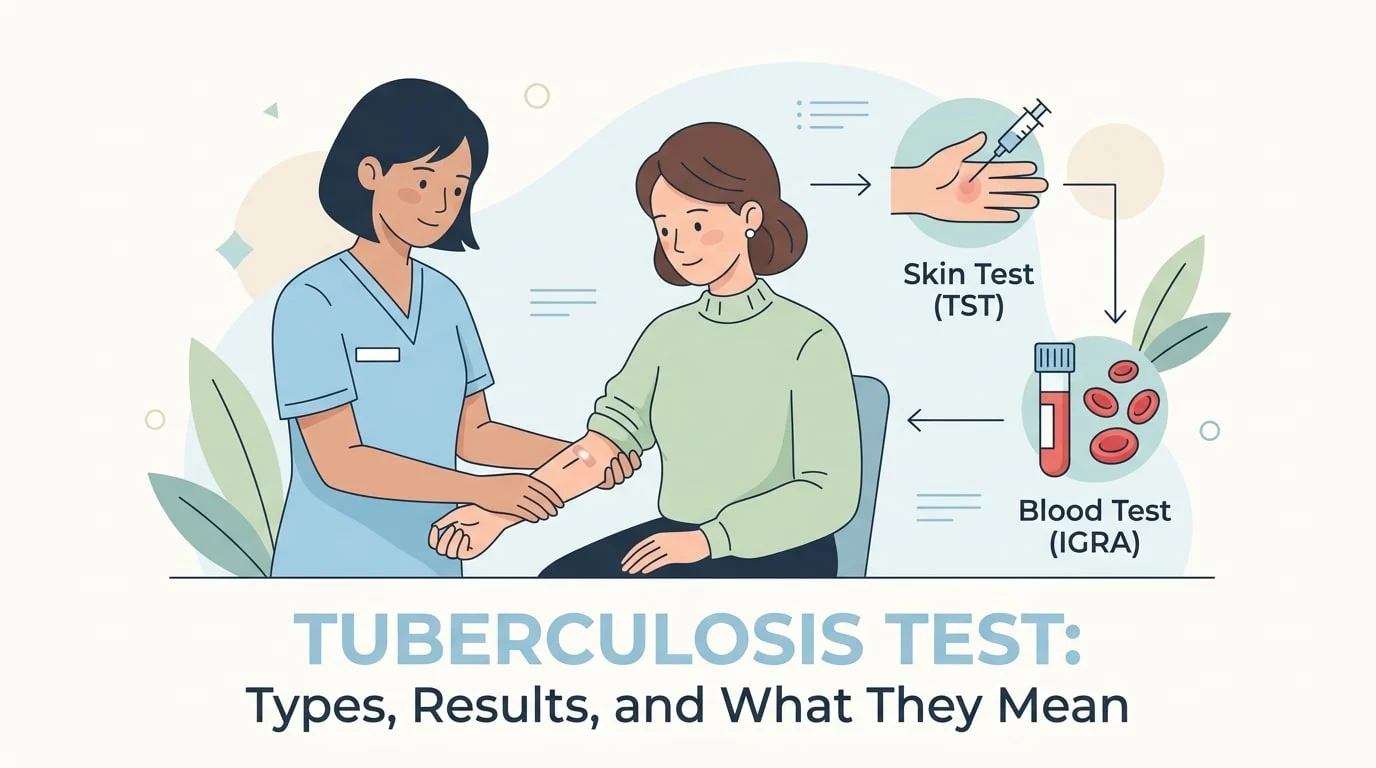
There are two approved ways to check for a TB infection, and both look at how your immune system reacts to the germ rather than hunting for the bacteria directly.
- The TB skin test, also called the Mantoux or tuberculin skin test, uses a tiny injection of testing fluid under the skin of the forearm. A nurse measures the raised bump 48 to 72 hours later.
- The TB blood test, known as an interferon-gamma release assay (IGRA), measures how immune cells in a blood sample respond to TB proteins. Common versions include QuantiFERON-TB Gold Plus and T-SPOT.TB.
Neither test can tell on its own whether an infection is dormant or actively making you ill. A positive tuberculosis test simply means the germs are present; further checks decide what happens next. According to the CDC, blood tests are preferred for people who have had the BCG vaccine, because the vaccine can trigger a false positive on the skin test.
Latent TB infection versus active TB disease
Reading your result means understanding the two forms tuberculosis can take.
- Latent (inactive) TB infection: the bacteria live in the body but are walled off by the immune system. You feel well, have no symptoms, and cannot infect anyone. A test is positive, yet a chest X-ray and sputum samples look normal.
- Active TB disease: the bacteria multiply and cause illness, most often in the lungs. Symptoms appear, and lung cases can spread to other people.
The distinction matters because the numbers are large. The CDC estimates that up to 13 million people in the United States live with latent TB, and without treatment about 1 in 10 will eventually develop active disease. In 2023, 9,633 cases of active TB were reported nationwide. Catching a quiet infection through a tuberculosis test is exactly what allows treatment to stop that progression before it starts.
Tuberculosis symptoms that should prompt a test
Latent infection produces no symptoms, so testing is based on risk rather than how you feel. Active disease in the lungs, by contrast, tends to build gradually over several weeks. Common warning signs include:
- A cough that lasts three weeks or longer
- Coughing up blood or thick mucus (sputum)
- Chest pain, or pain when breathing or coughing
- Fever, chills and night sweats
- Unintended weight loss and loss of appetite
- Fatigue and a general sense of being unwell
TB can also settle outside the lungs — in the kidneys, spine, brain or lymph nodes — where it may cause swelling or pain near the affected area. Symptoms that linger and do not improve with a few days of rest deserve medical attention. Because these signs overlap with many other illnesses, doctors usually combine a tuberculosis test with broader blood work, and they often measure the C-reactive protein (CRP) blood test.
How to read your tuberculosis test results
The table below summarises what each result usually means and what typically follows. Your clinician interprets the result alongside your symptoms, exposure history and personal risk factors.
| Test and result | What it usually suggests | Typical next step |
|---|---|---|
| Skin test: bump below the threshold for your risk group | Infection unlikely | No further action unless recent exposure |
| Skin test: bump at or above the threshold | Possible TB infection | Chest X-ray; a blood test may be added |
| Blood test (IGRA): negative | Infection unlikely | Repeat only if recent exposure |
| Blood test (IGRA): positive | TB infection present (latent or active) | Chest X-ray and symptom review |
| Any positive test with symptoms or an abnormal X-ray | Possible active disease | Sputum testing and molecular confirmation |
| Indeterminate or borderline | The test could not be read reliably | Repeat the test |
Confirming active TB beyond the first test
A positive skin or blood test is a starting point, not a diagnosis of active disease. To find out whether TB is multiplying, doctors add:
- A chest X-ray to look for changes in the lungs.
- Sputum samples examined under a microscope and grown in culture.
- A molecular test (nucleic acid amplification) that detects TB DNA and can flag drug resistance within hours.
Supporting blood work helps gauge how the body is responding. Alongside a tuberculosis test, clinicians may track the erythrocyte sedimentation rate, check the procalcitonin infection marker, and review a low lymphocyte count, since active infection can shift these values. Interpreting them together, rather than one at a time, gives a far clearer picture than any single number.
Who should consider a tuberculosis test
The CDC recommends testing for people at higher risk rather than the general public. A test may be worthwhile if you:
- Have spent time with someone who has active TB disease
- Were born in, or often travel to, countries where TB is common
- Live or work in congregate settings such as shelters, prisons or nursing homes
- Have a weakened immune system from HIV, diabetes, cancer treatment or immune-suppressing medicines
- Work in healthcare or other higher-exposure jobs
A weakened immune system also raises the chance that a quiet infection turns active, which is why people with diabetes are screened with particular care. Nutrition plays a role too, and some clinicians review a vitamin D blood test when assessing overall immune resilience.
After a positive result: what treatment involves
TB is treatable and, in most cases, curable. The plan depends on whether the infection is latent or active.
- Latent TB is treated with preventive medicine, often a rifamycin-based regimen taken for three to four months, to stop active disease developing later.
- Active TB disease requires a combination of antibiotics taken for four, six or nine months. Finishing the full course exactly as prescribed is essential.
Stopping treatment early or taking it irregularly can let drug-resistant strains take hold, and these are far harder to cure. It also helps to remember that other illnesses can mimic TB. A productive cough that lingers can also signal a sinus infection, and in older adults a persistent cough sometimes calls for ruling out lung cancer. Either way, a clinician rather than guesswork should guide the diagnosis.
Latest advances in tuberculosis testing
Research from the past three years is sharpening how TB infection is detected and predicted. The findings below are promising but still being woven into everyday practice, so they complement rather than replace today’s standard tests.
- A large United States study in JAMA Network Open followed more than 22,000 people and found that blood-based IGRAs predicted who would go on to develop active TB more accurately than the older skin test, supporting wider use of the blood test in higher-risk groups. (Ayers and colleagues, 2024)
- Engineers reported in Nature Biomedical Engineering a microfluidic chip test that reads the immune response to TB in about four hours instead of one to two days, with stronger sensitivity in people living with HIV. (Ning and colleagues, 2025)
- A 2024 analysis in Clinical Chemistry showed that certain blood patterns, such as a very low lymphocyte count or high neutrophils, can produce false-negative IGRA results — a reminder that a test number is best read alongside a full blood picture. (Song and colleagues, 2024)
None of these tools diagnoses TB on its own, and none should change a treatment plan without a clinician’s review. They do, however, point toward faster and more personalised testing in the years ahead.
Glossary of tuberculosis terms
| Term | Definition |
|---|---|
| BCG vaccine | A tuberculosis vaccine given to infants in countries where TB is common; it can cause a false positive on the skin test. |
| IGRA | Interferon-gamma release assay, the blood test that measures the immune response to TB proteins. |
| Latent TB infection | A dormant infection with no symptoms that cannot spread, but may become active later. |
| Mantoux (tuberculin skin test) | The skin test in which fluid is injected under the forearm and read 48 to 72 hours later. |
| Mycobacterium tuberculosis | The bacterium that causes tuberculosis. |
| Nucleic acid amplification test (NAAT) | A molecular test that detects TB DNA quickly and can identify drug resistance. |
| Sputum | Thick mucus coughed up from deep in the lungs, used to test for active TB. |
| Extrapulmonary TB | Tuberculosis affecting parts of the body outside the lungs. |
Frequently asked questions
Is tuberculosis contagious?
Only active TB disease in the lungs or throat can spread, and it travels through the air when a person coughs, speaks or sings. Latent TB cannot be passed to anyone. People on effective treatment for active disease usually stop being contagious after two to three weeks, though they must still finish the full course of medicine.
Is tuberculosis curable?
Yes. Both latent infection and active disease can almost always be cured with antibiotics when the full treatment is completed. Drug-resistant TB is harder to treat and may need longer or specialised regimens, which is why following the prescription exactly is so important.
How long do tuberculosis test results take?
A skin test is read 48 to 72 hours after the injection, so you return for a second visit. A blood test (IGRA) is processed in a laboratory and results are usually available within a few days. A positive result then leads to a chest X-ray and, if needed, sputum tests.
Does the BCG vaccine affect a tuberculosis test?
The BCG vaccine can cause a false positive on the skin test, which is why the blood test is preferred for people who have been vaccinated. The IGRA blood test is not affected by prior BCG vaccination.
Can you have TB with a negative test?
It is possible. A test can read negative very soon after exposure or when the immune system is weakened, so a repeat test may be advised. If symptoms strongly suggest TB, doctors will look further with imaging and sputum testing even after a negative result.
How is latent TB treated?
Latent TB is treated with preventive medicine, commonly a rifamycin-based regimen taken for three to four months. The goal is to clear the dormant bacteria so they never have the chance to cause active disease.
Sources
- Centers for Disease Control and Prevention — About Tuberculosis
- MedlinePlus (U.S. National Library of Medicine) — Tuberculosis
- Mayo Clinic — Tuberculosis: Symptoms and causes
Further reading
- Lymphoma: symptoms, causes and treatments
- Pneumonia and back pain: symptoms and causes
- High CRP levels: causes, symptoms and treatments
- Autoimmune disease: symptoms, causes and treatments
- High lymphocytes: causes, symptoms and treatments
Understand your lab results with AI DiagMe
A tuberculosis test rarely travels alone — it usually arrives with chest imaging and a panel of blood markers that can be hard to interpret on your own. AI DiagMe helps you make sense of results such as inflammation markers, lymphocyte counts and a full blood count in plain language. It is designed to help you understand your numbers and prepare for your next appointment, not to diagnose disease or replace your doctor.
Get your results interpreted in minutes