
































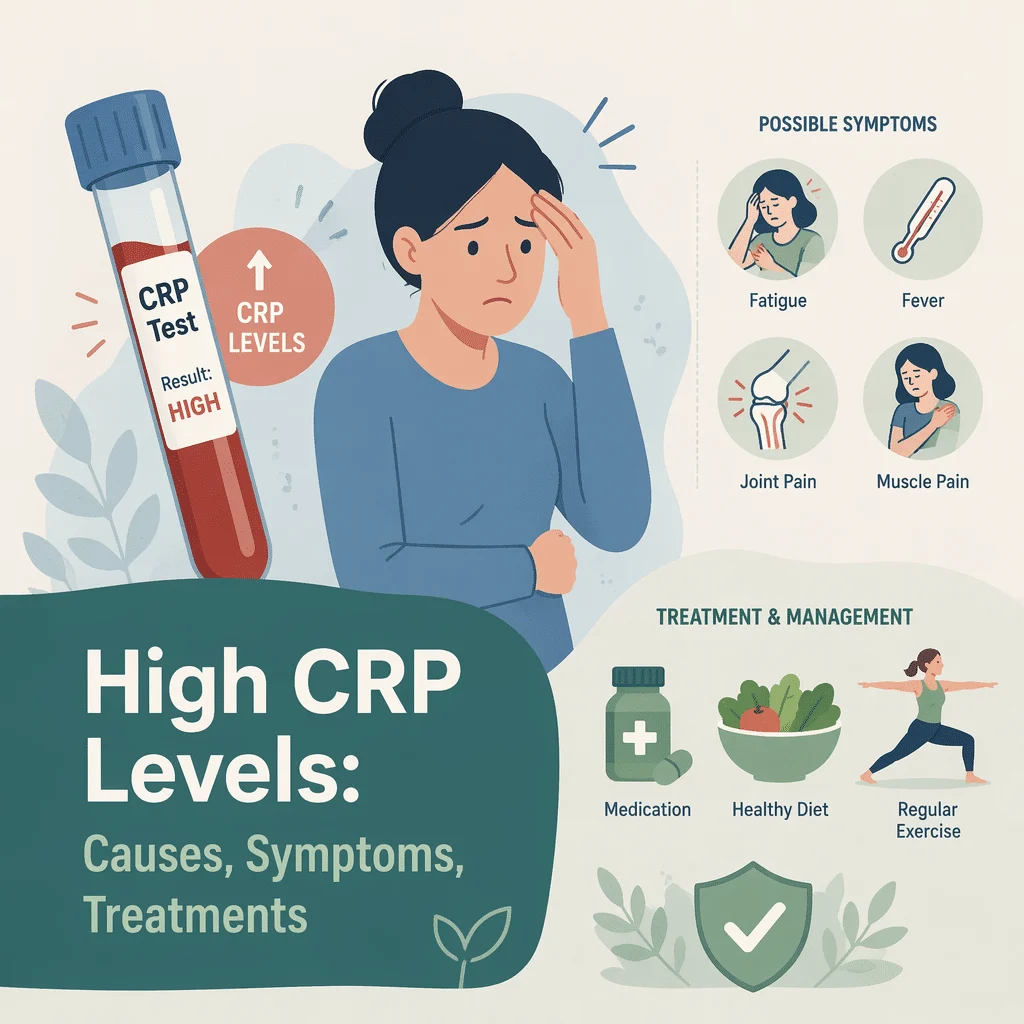
Seeing high CRP levels on a blood test report is unsettling, mostly because the number arrives with almost no explanation attached. C-reactive protein is one of the most sensitive markers in routine medicine and one of the least specific. It reliably tells your doctor that inflammation is present somewhere in the body, and almost nothing about where it is, what caused it, or how serious it is.
A mildly raised value is extremely common and usually reflects something temporary: a cold you are getting over, a recent injury, a dental problem, or simply carrying extra weight. In this article you’ll learn what CRP actually measures, why standard CRP and high-sensitivity CRP are not interchangeable, what a normal result does and does not rule out, why the trend matters more than any single value, and when a raised result genuinely needs prompt attention.
What C-reactive protein is and how fast it moves
C-reactive protein is made by the liver in response to a signaling molecule called interleukin-6, which immune cells release whenever tissue is inflamed, injured or infected. It belongs to a family of proteins known as acute-phase reactants, whose blood concentration changes sharply when the body mounts an inflammatory response.
What makes CRP so useful in day-to-day medicine is its speed. Levels begin climbing within about four to six hours of an inflammatory trigger and can peak inside two days. Once the trigger resolves, CRP falls just as briskly, with a half-life measured in hours rather than days.
That speed has a practical consequence that patients rarely hear about: timing matters enormously. A sample taken on the first morning of an illness can look almost normal, while the same illness measured 36 hours later produces a striking number. A sample taken a week after a chest infection has settled may already be back in range. Two very different results can therefore describe exactly the same episode, simply because the blood was drawn at different points on the curve. For more on the underlying biology, our companion guide to CRP as an inflammation marker covers how the protein behaves in the body.
Sensitive but not specific: what that means for reading your result
Clinicians describe CRP as highly sensitive and almost completely non-specific. Sensitivity means that if significant inflammation is present, CRP will usually detect it. Non-specificity means the test cannot tell you which of the dozens of possible causes is responsible.
An identical result of, say, 40 mg/L could reflect a chest infection, an inflamed gallbladder, a flare of arthritis, the normal healing response three days after an operation, or a bad dental abscess. The number alone does not discriminate between them. This is why no responsible clinician diagnoses anything from a CRP value in isolation, and why online charts that assign a disease to a number are misleading.
What CRP does well is act as a signal to look further, and as a way to follow something already identified. The diagnostic work is done by your symptoms, your examination, your history and other tests. CRP tells the clinician how loudly the inflammation is shouting; it never says what is shouting. A raised value in someone who feels entirely well carries very different weight from the same value in someone feverish and breathless.
Standard CRP versus high-sensitivity CRP: the distinction that causes the most confusion
This is the single most common source of misreading, and it trips up patients, health articles and occasionally clinicians too. Standard CRP and high-sensitivity CRP measure exactly the same protein. They are not different substances. What differs is the analytical sensitivity of the assay and, crucially, the clinical question each one is designed to answer.
Standard CRP is the test used to detect and monitor meaningful inflammation or infection. It is ordered when someone is unwell, recovering from surgery, or being followed for an inflammatory condition. The values that carry clinical weight here typically sit in the tens or hundreds of milligrams per liter.
High-sensitivity CRP is the same measurement performed with an assay precise enough to resolve very low concentrations. It exists to stratify long-term cardiovascular risk in people who are otherwise well, and the entire informative range sits below about 3 mg/L. As the StatPearls review of CRP interpretation puts it, the term high-sensitivity refers to the laboratory technique, not to a different clinical meaning.
The practical failure mode is straightforward. If you read an hs-CRP threshold against a standard CRP result, a perfectly ordinary post-viral value of 8 mg/L looks like catastrophic cardiovascular risk, which it is not. Conversely, ordering hs-CRP in someone who is acutely unwell produces a number well off the top of the scale that says nothing useful about their heart. An hs-CRP is also uninterpretable for risk purposes if taken during or soon after any infection, injury or flare, because the acute signal swamps the low-level baseline the test is trying to read.
| Standard CRP | High-sensitivity CRP (hs-CRP) | |
|---|---|---|
| What it is for | Detecting and following significant inflammation, infection or tissue injury in someone who is unwell or being monitored | Estimating long-term cardiovascular risk in people who are otherwise well and free of current illness |
| Range of interest | Clinically meaningful values often run into the tens or hundreds of mg/L | The whole informative range sits below roughly 3 mg/L |
| What a result means | Inflammation is present and can be tracked over time as treatment takes effect | One statistical input among several into a long-term risk estimate for a population, not a diagnosis |
| What it does not mean | It never identifies the cause, the site, or the severity of the underlying problem | It does not predict whether any individual will have a cardiac event, and it is uninterpretable during illness |
If your report simply says CRP, it is almost certainly the standard assay. If it says hs-CRP, cardiac CRP or high-sensitivity CRP, it was ordered with cardiovascular risk in mind, often alongside a lipid panel and LDL cholesterol. If you are unsure which you had, that is a good and entirely reasonable question for the clinician who ordered it.
What raises CRP
The list of causes is long, which is precisely the point about non-specificity. Grouping them helps.
Infection, injury and surgery
Bacterial infections typically raise CRP far more than viral ones, and the highest values seen in routine practice usually accompany serious bacterial illness. Viral infections often produce a modest rise, sometimes barely above the reference range, which is one reason CRP alone cannot reliably separate the two. Any tissue injury does the same: a fracture, a burn, a road accident, or a planned operation. Rising CRP for a few days after surgery is expected healing biology, not a complication, though a value that climbs again after starting to fall may prompt a check for infection. Everyday infections such as a sinus infection or a dental abscess sit at the mild end of this spectrum.
Long-term conditions and everyday factors
Autoimmune and inflammatory diseases keep CRP raised while they are active, which is why it is used to follow conditions such as rheumatoid arthritis, inflammatory bowel disease and vasculitis. Obesity is a frequent and under-explained cause of a mildly raised value: adipose tissue itself produces interleukin-6, so a modest elevation is common in people carrying extra weight and is not in itself a disease. Smoking, poor sleep, gum disease and a sedentary pattern nudge the number up in the same low-grade way.
Pregnancy raises CRP, particularly in the second half, as does the combined oral contraceptive pill. Older age and female sex are associated with slightly higher baselines, and chronic kidney disease and diabetes often come with low-grade elevation. Malignancy can raise CRP, but so can everything above, which is why a single raised value is a very poor cancer test.
What a normal CRP does and does not exclude
A normal CRP is reassuring in a specific and limited way: it makes significant, active, widespread inflammation less likely at the moment the blood was taken. That is a genuinely useful piece of information when someone is being assessed for a possible infection.
It is not, however, an all-clear. A normal CRP does not rule out cancer. Many tumors produce no measurable acute-phase response, and people are diagnosed with malignancy every day having had entirely normal inflammatory markers. It does not rule out a localized problem walled off from the circulation, and it can be normal in some serious conditions. Notably, MedlinePlus points out that CRP may fail to rise in some people with rheumatoid arthritis or lupus, for reasons that are still not understood.
Timing matters here too. A CRP drawn in the first hours of an illness may not have had time to climb. If symptoms persist or worsen after a normal result, that result does not override what your body is telling you.
CRP alongside ESR and procalcitonin
CRP is rarely read alone. Two companions behave quite differently in time, and understanding that difference explains why doctors sometimes order more than one.
The erythrocyte sedimentation rate, or ESR, is an indirect measure influenced by plasma proteins and red cell behavior. It rises more slowly than CRP, often over days, and falls more slowly still, sometimes taking weeks to normalize after the inflammation has gone. A high ESR with a normal CRP therefore often means an inflammatory episode that has already passed its peak.
Procalcitonin rises particularly in bacterial infection and is more specific for it than CRP, which is why it has been studied so heavily as a guide to antibiotic decisions. Other proteins in the same family, including serum amyloid A and complement C3, move in similar circumstances. CRP is also routinely read next to a full blood count, where the pattern of white cells, particularly neutrophils, adds context that CRP cannot supply on its own. Iron studies, including ferritin, are also affected by inflammation and are interpreted with that in mind.
Why the trend matters more than a single value
When a cause is already known, the direction of travel is far more informative than any individual number. A CRP falling steadily over three days in someone being treated for pneumonia is good news, whatever the starting figure. A CRP that plateaus or climbs while on treatment prompts a rethink: wrong diagnosis, wrong antibiotic, or a collection of pus that needs draining.
The same logic applies to long-term inflammatory disease. Rheumatology and gastroenterology teams follow CRP across months to judge whether disease activity is controlled, and a stable low value over repeated tests carries far more meaning than one reading in isolation.
For that reason, a repeat test is often the most sensible next step after an unexplained mild elevation in someone who feels well. Retesting a few weeks later, once any minor illness has cleared, frequently shows the value has already returned to normal.
Treating the cause, not the number
This is the honest core of the subject. CRP is a readout, not a disease. Nothing good happens by pushing the number down for its own sake, and nothing bad is fixed by doing so. If a CRP is raised by a bacterial infection, the infection is treated and CRP follows. If by an autoimmune flare, the flare is treated and CRP follows. If it is mildly raised because of excess weight, smoking or poor sleep, addressing those things improves health in ways that matter, and the CRP happens to drift down as a by-product.
What about diets and supplements marketed to lower CRP
A large marketing industry sells the idea of lowering CRP directly, most visibly around turmeric and curcumin, omega-3 fatty acids and various anti-inflammatory eating plans. Some of these have been studied and some do produce small average reductions in measured CRP in trial settings. What has not been shown is that lowering the marker by these means changes the outcomes that people actually care about. Reducing a number is not the same as treating a cause, and a supplement that shifts a laboratory value while an underlying problem goes unexamined is not a good trade.
Several prescribed medicines, including statins and some anti-inflammatory and immune-modifying drugs, also lower CRP. That is a well-documented pharmacological effect, and it is one reason a CRP result should always be read alongside your current medication list. It is not a reason to start, stop or change anything on your own; those decisions belong with the doctor who knows your full picture.
When a raised CRP needs urgent attention
Most raised CRP results are explained by something obvious and settle on their own. A small number sit alongside symptoms that should not wait.
Seek urgent medical assessment if a raised CRP occurs together with any of the following:
- High fever with confusion, drowsiness or disorientation
- Breathlessness, chest pain or a racing heartbeat
- Severe or rapidly worsening pain anywhere, including the abdomen
- A rash that is spreading quickly, or one that does not fade under pressure
- A stiff neck with headache and discomfort in bright light
- A sense of feeling profoundly and unusually unwell
Separately, a CRP that stays raised over weeks with no explanation, or one that keeps climbing despite treatment, warrants proper review rather than watchful waiting. Book an appointment to have it worked up.
Latest scientific advances in CRP testing
Recent research has done more to define the limits of CRP than to expand its uses, which is arguably more valuable for patients.
The largest recent test came from the ADAPT-Sepsis randomized trial, published in JAMA in 2025, which enrolled 2,760 critically ill adults across 41 UK intensive care units. Patients were assigned to a daily protocol guided by procalcitonin, one guided by CRP, or standard care, to see whether either marker could safely shorten antibiotic courses. What was found: the procalcitonin protocol modestly shortened antibiotic treatment without increasing deaths, while the CRP protocol did not shorten treatment at all. What this means for you: CRP is good at telling clinicians that inflammation exists, but it is not precise enough to make treatment decisions on its own, even in the highly monitored setting of intensive care.
A systematic review with network meta-analysis in Critical Care Medicine in 2024 pooled 18 randomized trials covering 5,023 patients with sepsis and compared the same two strategies. What was found: both approaches shortened antibiotic courses on average, but only the procalcitonin-guided strategy was associated with lower mortality, and the certainty of the evidence overall was low to moderate. What this means for you: the two markers are not interchangeable, and CRP is best understood as one input among several rather than a decision-maker.
In children, a systematic review and meta-analysis in The Lancet Child and Adolescent Health in 2024 examined 14 studies covering 7,755 febrile infants under three months old. What was found: procalcitonin outperformed CRP for identifying invasive bacterial infection, and where procalcitonin is unavailable, the authors suggested CRP should be used cautiously and with a lower threshold than the conventional one. What this means for you: a reassuring CRP in a very young baby with fever is not enough on its own, and clinical assessment remains the priority.
On the cardiovascular side, a cohort study of 15,494 statin-treated patients undergoing coronary stenting, published in the European Heart Journal in 2025, compared residual cholesterol risk with residual inflammatory risk defined by hs-CRP. What was found: patients with raised hs-CRP but well-controlled cholesterol had a higher rate of adverse cardiovascular events over the following year than those with the opposite pattern. Notably, the investigators excluded anyone with an hs-CRP above 10 mg/L, precisely because such values reflect acute illness rather than background vascular inflammation. What this means for you: hs-CRP is being taken seriously as a long-term risk marker, and that exclusion rule is a clean illustration of why an hs-CRP measured during an infection cannot be interpreted.
Glossary of key terms
| Term | Definition |
|---|---|
| C-reactive protein (CRP) | A protein made by the liver whose blood level rises quickly when inflammation, infection or tissue injury is present |
| Acute-phase reactant | Any blood protein whose concentration changes markedly during an inflammatory response; CRP is the best known |
| High-sensitivity CRP (hs-CRP) | The same protein measured with a more precise assay, used to assess long-term cardiovascular risk in people who are well |
| Sensitivity | How reliably a test detects a condition when it is genuinely present |
| Specificity | How reliably a test points to one particular cause rather than many; CRP has very little of it |
| Interleukin-6 (IL-6) | An immune signaling molecule that instructs the liver to produce CRP; also released by fat tissue |
| ESR | Erythrocyte sedimentation rate, an indirect inflammation measure that rises and falls more slowly than CRP |
| Procalcitonin | A blood marker that rises particularly in bacterial infection and is more specific for it than CRP |
| Reference range | The span of values a given laboratory considers typical; ranges and units differ between laboratories |
| mg/L | Milligrams per liter, the usual unit for CRP; some laboratories report in mg/dL instead, which is ten times smaller a number |
Frequently asked questions
Does a high CRP mean cancer?
Almost always, no. CRP is raised by infections, injuries, recent surgery, autoimmune flares, dental problems, smoking, pregnancy and excess weight far more often than by malignancy. Some cancers can raise it, but so can a heavy cold, and the marker cannot distinguish between them. A raised CRP on its own is not a reason to assume cancer, and a normal CRP is not a reason to rule it out. What prompts investigation for cancer is a combination of symptoms, examination findings, age and history, not an isolated inflammatory marker. If your CRP stays raised over weeks without an explanation, that pattern deserves proper assessment, and your doctor will decide what, if anything, needs looking into.
How do I lower my CRP?
By treating whatever is raising it, rather than by targeting the number. If the cause is an infection, treating the infection lowers CRP. If it is an autoimmune condition, controlling disease activity lowers CRP. If it is mildly raised in the context of excess weight, smoking, poor sleep or inactivity, then addressing those improves health broadly and the marker tends to follow. Supplements and eating plans marketed specifically to lower CRP may shift the figure a little in trials, but reducing a measurement is not the same as treating a cause. The useful question to bring to your doctor is not how to lower CRP, but why it is raised.
What is a dangerously high CRP?
There is no single threshold that makes a CRP dangerous, and self-scoring against a number is the wrong approach. Very high values are more often seen with serious bacterial infection or major tissue injury, but people recover routinely from illnesses that produce them, and the same figure can turn up after uncomplicated surgery. What determines urgency is how you are: fever with confusion, breathlessness, severe pain, a rapidly spreading rash, a stiff neck or feeling profoundly unwell all need assessment regardless of what the CRP says. Conversely, a modestly raised CRP in someone who feels fine rarely signals anything acute. The clinical picture drives the decision; the number supports it.
Can a viral infection raise CRP?
Yes, though usually less than a bacterial one. Common viral illnesses often produce a mild to moderate rise, while serious bacterial infections tend to produce the largest values. The overlap between the two is wide enough that CRP alone cannot reliably tell you which you have, which is exactly why procalcitonin has been studied as a more specific alternative. Timing complicates it further: a viral infection measured at its peak can generate a higher figure than a bacterial one caught early. Your symptoms, examination and any other tests carry more weight than the CRP in deciding whether antibiotics are appropriate.
Do I need to fast before a CRP test?
No. CRP does not require fasting and no special preparation is needed. It is worth mentioning to whoever ordered the test if you have had a recent infection, injury, operation, vaccination or dental work in the preceding couple of weeks, and if you are pregnant, since all of these can raise the value. Your current medications matter too, because several common drugs lower CRP. If the test was ordered as an hs-CRP for cardiovascular risk, it is best taken when you are well, since any current illness makes the result impossible to interpret for that purpose.
How long does CRP take to come down after an infection?
Faster than most people expect. Once the trigger is resolving, CRP falls quickly, often halving roughly every 19 hours, so a value can drop substantially within two or three days and return to normal within about a week. That rapid clearance is what makes CRP useful for tracking response to treatment. It also means a normal CRP taken a week or two after an illness tells you little about how unwell you were at the time. If your CRP is not falling as expected while you are being treated, that is a signal worth raising with your doctor rather than waiting it out.
Sources
- MedlinePlus, US National Library of Medicine. C-reactive protein
- Singh B, Goyal A, Patel BC. C-Reactive Protein: Clinical Relevance and Interpretation. StatPearls, NCBI Bookshelf, updated 2025
- National Institute of Arthritis and Musculoskeletal and Skin Diseases (NIAMS). Rheumatoid Arthritis
- Dark P, Hossain A, McAuley DF, et al. Biomarker-Guided Antibiotic Duration for Hospitalized Patients With Suspected Sepsis: The ADAPT-Sepsis Randomized Clinical Trial. JAMA. 2025;333(8):682-693
- Kubo K, Sakuraya M, Sugimoto H, et al. Benefits and Harms of Procalcitonin- or C-Reactive Protein-Guided Antimicrobial Discontinuation in Critically Ill Adults With Sepsis: A Systematic Review and Network Meta-Analysis. Crit Care Med. 2024;52(10):e522-e534
- Norman-Bruce H, Umana E, Mills C, et al. Diagnostic test accuracy of procalcitonin and C-reactive protein for predicting invasive and serious bacterial infections in young febrile infants: a systematic review and meta-analysis. Lancet Child Adolesc Health. 2024;8(5):358-368
- Bay B, Tanner R, Gao M, et al. Residual cholesterol and inflammatory risk in statin-treated patients undergoing percutaneous coronary intervention. Eur Heart J. 2025;46(32):3167-3177
Study records above were identified via PubMed, US National Library of Medicine.
Further reading
- Erythrocyte sedimentation rate (ESR): what the test measures
- Procalcitonin (PCT): the infection marker explained
- Complete blood count: reading your full blood count
- Serum amyloid A (SAA): a guide to the blood test
- Gamma globulins: what high and low levels mean
Understand your lab results with AI DiagMe
A CRP result makes far more sense when you can see it next to the other lines on the same report, such as ESR, your full blood count and ferritin. AI DiagMe reads your lab report and explains, in plain language, what each marker measures and what your values may reflect. It helps you understand your results and prepare better questions for your appointment. It does not diagnose anything and it does not replace your doctor.
Get your results interpreted in minutes