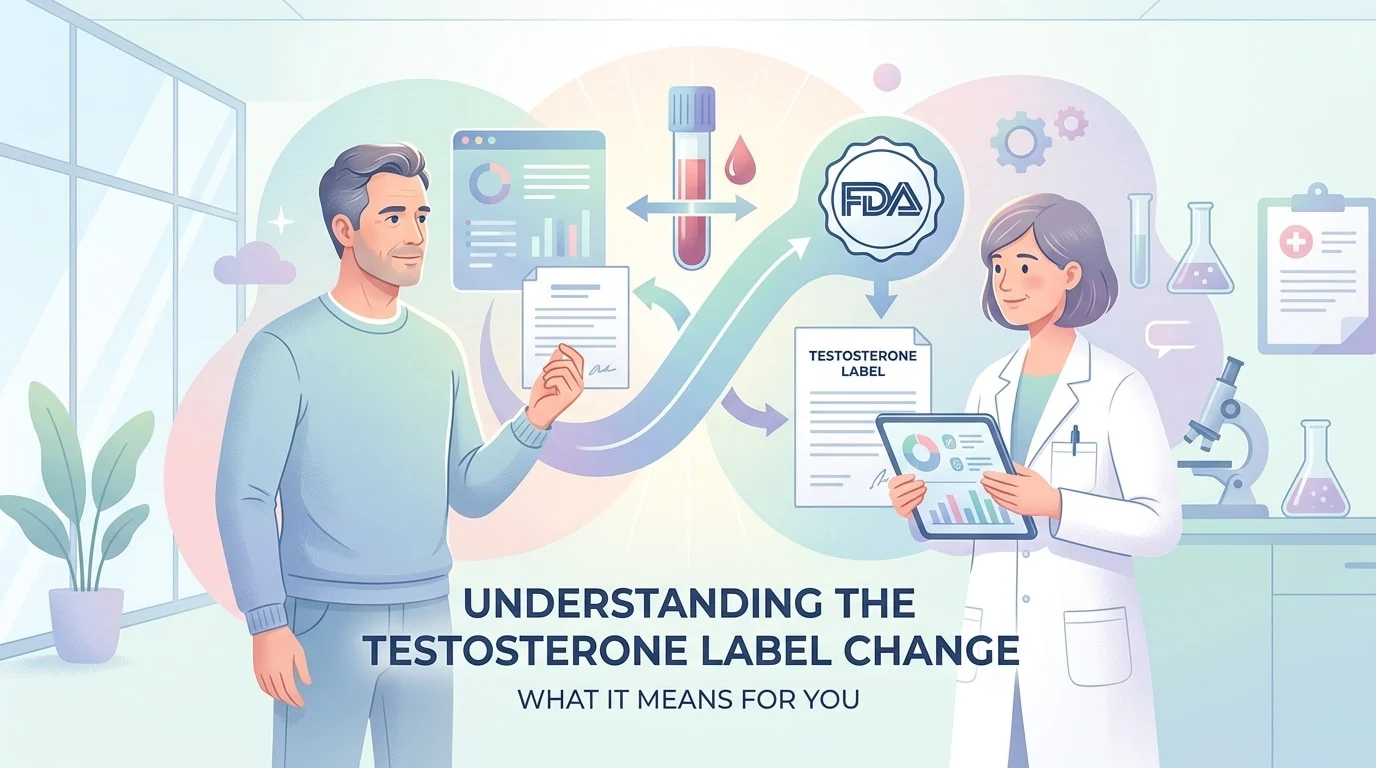
A testosterone blood test is the single measurement that decides whether a man is treated for low testosterone, and in June 2026 the rules around that treatment changed while the rules around the test did not. The US Food and Drug Administration asked manufacturers to rewrite the prescribing information on every testosterone replacement therapy product, dropping the long-standing statement that treatment was unproven in men with age-related low testosterone. Easier access to therapy, however, does not lower the bar for diagnosis. In this article you will learn what the FDA actually changed, what a laboratory report still has to show before treatment makes sense, why one sample is rarely enough, and which markers need watching once therapy begins.
What the FDA changed in June 2026
On 18 June 2026 the Department of Health and Human Services announced that the FDA was requesting updates to testosterone therapy product labels. Three changes were proposed. The first removes the limitation of use stating that safety and effectiveness had not been established in men with age-related hypogonadism, language added in 2015 when evidence of benefit was thin and cardiovascular questions were unresolved. The second narrows the prostate cancer contraindication so that it applies only to men with metastatic disease. The third eases the warning on benign prostatic hyperplasia, an enlarged prostate, for men with mild to moderate symptoms.
These requests followed the TRAVERSE trial, a randomised study of more than 5,200 men that found no meaningful increase in heart attack or stroke among participants receiving testosterone. An earlier round of class-wide label changes had already removed the cardiovascular language from the boxed warning and added product-specific information on treatment-related rises in blood pressure. Regulators kept the instruction that clinicians assess risk, screen patients before treatment and monitor them during therapy.
Why the diagnosis still rests on a testosterone blood test
None of this changes what has to appear on a laboratory report. Male hypogonadism remains a clinical syndrome: symptoms of testosterone deficiency together with consistently low morning serum testosterone. Symptoms alone do not qualify, and a number alone does not either. The findings most consistently linked to the condition are reduced libido, fewer spontaneous erections and small testes. Fatigue, low mood or poor sleep on their own point in many other directions.
Two morning samples, not one
Testosterone follows a daily rhythm, peaking in the early morning and drifting down across the day, and it also varies from week to week. A 2026 review in JAMA states the standard plainly: hypogonadism is confirmed when serum testosterone falls below roughly 264 to 300 ng/dL in at least two fasting samples drawn between 7 and 10 am and measured with an accurate, externally quality-controlled assay. An afternoon draw after lunch can read low in a man whose morning value is entirely normal. Testing is also reserved for men who already have signs of androgen deficiency rather than offered as routine screening.
Total testosterone, free testosterone and the role of SHBG
Most reports lead with total testosterone, which includes the portion bound to sex hormone-binding globulin and therefore unavailable to tissues. When SHBG runs low, which is common in obesity, type 2 diabetes and insulin resistance, total testosterone can look deficient while the active fraction is adequate. In those situations calculated free testosterone, derived from total testosterone and SHBG, is the more informative figure. Once low testosterone is confirmed, luteinising hormone and follicle-stimulating hormone separate a testicular problem from a pituitary or hypothalamic one. One page decodes the male hormone panel. Another explains sex hormone-binding globulin levels.
What a low result does and does not establish
A testosterone blood test is read in context, never in isolation. The same number carries very different weight depending on when the blood was drawn and what sits beside it on the report. This table sets out the difference.
| Finding on the report | What it can support | What it cannot establish alone |
|---|---|---|
| One total testosterone below 300 ng/dL, drawn in the afternoon | A reason to repeat the test under proper conditions | A diagnosis of hypogonadism |
| Two fasting morning samples below 264 to 300 ng/dL, with symptoms | Confirmed hypogonadism | The cause of the deficiency |
| Low total testosterone alongside low SHBG | A reason to calculate free testosterone | That tissue exposure is genuinely low |
| Low testosterone with raised LH and FSH | A testicular origin, called primary hypogonadism | Whether the cause is reversible |
| Low testosterone with low or inappropriately normal LH and FSH | A pituitary or hypothalamic origin, called secondary hypogonadism | That hormone replacement is the right answer |
The markers to watch once therapy starts
Testosterone therapy increases red blood cell production. That helps men who are anaemic and becomes a problem when it goes too far, because thickened blood raises circulatory risk. Monitoring therefore covers serum testosterone, haematocrit and, in most protocols, prostate-specific antigen. A European expert panel reviewing TRAVERSE and later evidence concluded that therapy is cardiovascularly safe in appropriately selected and regularly monitored patients, and singled out haematocrit as the value needing the closest attention. Testosterone can also push PSA up slightly, which is why a rising result during treatment triggers assessment rather than reassurance.
One guide breaks down the complete blood count. A separate page covers the PSA blood test. We also describe prostate cancer.
When low testosterone is not the real problem
A large share of low readings reflect something other than a failing testicle or pituitary gland. Hypogonadism caused by disease of the hypothalamus, pituitary or testes affects fewer than 1 percent of men, while cases driven by obesity run at 2 to 8 percent. Severe illness, opioids, corticosteroids and medicines that raise prolactin produce the same picture. These causes are potentially reversible, and weight loss of at least 5 percent typically raises total testosterone measurably while improving physical function, libido and erectile function. For obesity-related cases, weight loss is the recommended first-line management rather than hormone replacement.
Other pages cover erectile dysfunction causes, high prolactin levels and sleep apnea. One article explains insulin resistance without obesity.
Latest scientific advances
Three recent publications explain why regulators moved and what still deserves caution. Each is summarised in plain language below.
A 2026 review of adult male hypogonadism in JAMA gathered the diagnostic rules in one place. What it found: the condition is far less common than testosterone prescribing volumes suggest, and obesity accounts for most cases. What this means for you: if your reading is low and your weight is high, the useful first question is whether the low number is a consequence rather than a cause, because that changes the treatment entirely.
A European expert panel published a position statement in 2025 on the cardiovascular safety of testosterone therapy after TRAVERSE. What it found: across the trial and later analyses, testosterone did not increase major cardiovascular events in men who were correctly selected and properly followed. What this means for you: the old heart warning has genuinely weakened, but the reassurance is tied to monitoring, particularly of haematocrit, which measures the proportion of your blood made up of red cells. Untreated, an excessive rise is the main hazard of therapy.
A 2024 review in The Lancet Diabetes and Endocrinology looked at men with low testosterone but no identifiable disease of the hormone axis, a situation called functional hypogonadism. What it found: therapy produces modest but real improvements in sexual function, without raising short-term to medium-term cardiovascular or prostate cancer risk. Evidence remains insufficient to say it prevents fractures or type 2 diabetes. What this means for you: expect a measured benefit in a specific area rather than a broad rejuvenation, and treat wider claims with scepticism.
A 2026 joint position statement from Brazilian endocrinology and urology societies reached the same practical conclusion as its North American and European counterparts: confirm with morning total testosterone, look for reversible causes first, and monitor closely once treatment starts. These findings are recent and consistent, though several rest on observational data rather than randomised trials.
When to see a doctor
Book an appointment if reduced libido, fewer spontaneous erections, persistent fatigue or low mood have lasted several weeks, and bring any previous laboratory reports with you. Ask for the testosterone blood test to be scheduled in the morning, fasting, and expect a second confirmatory sample before any treatment decision. Seek prompt advice if you are already on testosterone and develop headaches, unusual flushing, breathlessness, leg swelling or a rising PSA, and tell your doctor about opioids, corticosteroids or any medicine started recently, since several lower testosterone on their own.
Glossary
| Term | Definition |
|---|---|
| Hypogonadism | A clinical syndrome combining symptoms of testosterone deficiency with consistently low morning testosterone in the blood. |
| Total testosterone | All the testosterone circulating in a blood sample, including the portion bound to carrier proteins and unavailable to tissues. |
| Free testosterone | The unbound fraction available to tissues, usually calculated from total testosterone and SHBG rather than measured directly. |
| SHBG | Sex hormone-binding globulin, the carrier protein that transports testosterone. Low levels distort the total testosterone figure. |
| Haematocrit | The proportion of blood volume made up of red cells. It rises on testosterone therapy and is monitored for that reason. |
| PSA | Prostate-specific antigen, a protein measured in blood as part of prostate assessment and monitored during testosterone therapy. |
| LH and FSH | Luteinising hormone and follicle-stimulating hormone, pituitary signals that indicate whether low testosterone comes from the testes or higher up. |
| Functional hypogonadism | Low testosterone with symptoms but no identifiable disease of the hormone axis, often linked to obesity, ageing or other illness. |
| Limitation of use | A statement on a drug label restricting the situations in which benefit has been demonstrated. |
| TRAVERSE trial | A randomised study in more than 5,200 men that assessed cardiovascular outcomes on testosterone therapy. |
Frequently asked questions
Can one blood test confirm low testosterone?
Not on its own. A diagnosis requires symptoms plus consistently low levels, and current practice calls for at least two fasting samples drawn in the morning, between 7 and 10 am, before the result is treated as confirmed. A single low value taken later in the day is a reason to repeat the test properly, not a diagnosis.
Why does the time of day matter so much?
Testosterone follows a daily cycle, running highest in the early morning and falling through the afternoon. A sample taken at 4 pm can land below the reference range in a man whose morning level is normal, which is why laboratories and guidelines specify a morning draw.
Do I need to fast before a testosterone test?
Yes, fasting samples are what the diagnostic thresholds are based on, so the request will usually be for a morning appointment before breakfast. If you have eaten, mention it, because it may affect how the result should be read.
Does the FDA change mean testosterone therapy is now considered safe?
It means the label no longer states that benefit is unproven in age-related low testosterone, and that the cardiovascular warning has been withdrawn from the boxed warning after the TRAVERSE results. Safety conclusions still assume careful patient selection and regular monitoring of testosterone, haematocrit and, in most protocols, PSA. Atrial fibrillation, acute kidney injury and clots in the lungs were reported more often in treated men in TRAVERSE.
My testosterone is low and I carry extra weight. What now?
Discuss weight before hormones. Obesity is the most common reason for a low reading, and losing at least 5 percent of body weight usually raises total testosterone while improving physical function, libido and erectile function. For obesity-related cases, weight loss is the recommended first step.
Should I ask for free testosterone as well as total?
It is worth asking if you have obesity, type 2 diabetes or another condition that lowers SHBG, because total testosterone can read low while the active fraction is adequate. Calculated free testosterone, derived from total testosterone and SHBG, is the figure that clarifies those cases.
Sources
- US Department of Health and Human Services. HHS Announces Requested Updates to Testosterone Therapy Product Labels, 18 June 2026. hhs.gov
- US Food and Drug Administration. FDA issues class-wide labeling changes for testosterone products. fda.gov
- Schmidt CW, reviewed by Garnick MB. What men should know about proposed changes for testosterone therapy. Harvard Health Publishing, 10 August 2026. health.harvard.edu
- Anawalt BD, O’Connor KM, Grossmann M. Adult Male Hypogonadism: A Review. JAMA, 2026;335(24):2146-2159. doi.org/10.1001/jama.2026.8526
- De Silva NL, Papanikolaou N, Grossmann M, Antonio L, Quinton R, Anawalt BD, Jayasena CN. Male hypogonadism: pathogenesis, diagnosis, and management. The Lancet Diabetes and Endocrinology, 2024;12(10):761-774. doi.org/10.1016/S2213-8587(24)00199-2
- Zitzmann M, et al. Cardiovascular safety of testosterone therapy, insights from the TRAVERSE trial and beyond: a position statement of the European Expert Panel for Testosterone Research. Andrology, 2025. consensus.app
- Hohl A, Lopes L, Ronsoni MF, Miranda EP, Fighera TM, Facio FN, Marchesan LB, Torres LO. Care of Patients with Male Hypogonadism: A Joint Position Statement from SBEM, SBU and ABEMSS. International Brazilian Journal of Urology, 2026;52(3). doi.org/10.1590/S1677-5538.IBJU.2025.0610
Further reading
- Our marker page explains low testosterone in men
- A companion page covers high testosterone in men
- One guide details luteinising hormone and its results
- Another decodes the FSH blood test
- A separate page addresses low testosterone in women
Understand your lab results with AI DiagMe
A testosterone blood test rarely travels alone. It usually arrives beside SHBG, LH, FSH, a blood count and sometimes PSA, and the meaning sits in how those figures relate to each other and to the time your blood was drawn. AI DiagMe reads your laboratory results together and explains, in plain language, what each value suggests and what it does not. It helps you understand your report and prepare better questions. It does not diagnose, and it does not replace your doctor.
Get your results interpreted in minutes