
If your lab report carries a lipoprotein(a) result, you have probably been told that anything above 125 nmol/L counts as high. On 10 August 2026, an analysis of 20,070 adults added a second, much higher line to that picture, and it changes how a very large number should be read.
The findings were presented as late-breaking science at the Society for Cardiovascular Angiography and Interventions 2026 Scientific Sessions in Montreal. They do not replace the screening advice covered in our guide to lipoprotein(a) screening and the 2026 guideline. They answer a different question: once you know your number is high, how high is high enough to matter, and what exactly does it predict?
What the new analysis found
Researchers went back to stored plasma samples from three completed National Institutes of Health trials, ACCORD, PEACE and SPRINT, and measured Lp(a) with a single standardised assay. That detail matters, because Lp(a) results notoriously vary between laboratory methods. Participants averaged 65 years of age, and were sorted into four bands: under 75, 75 to 125, 125 to 175, and 175 nmol/L or above.
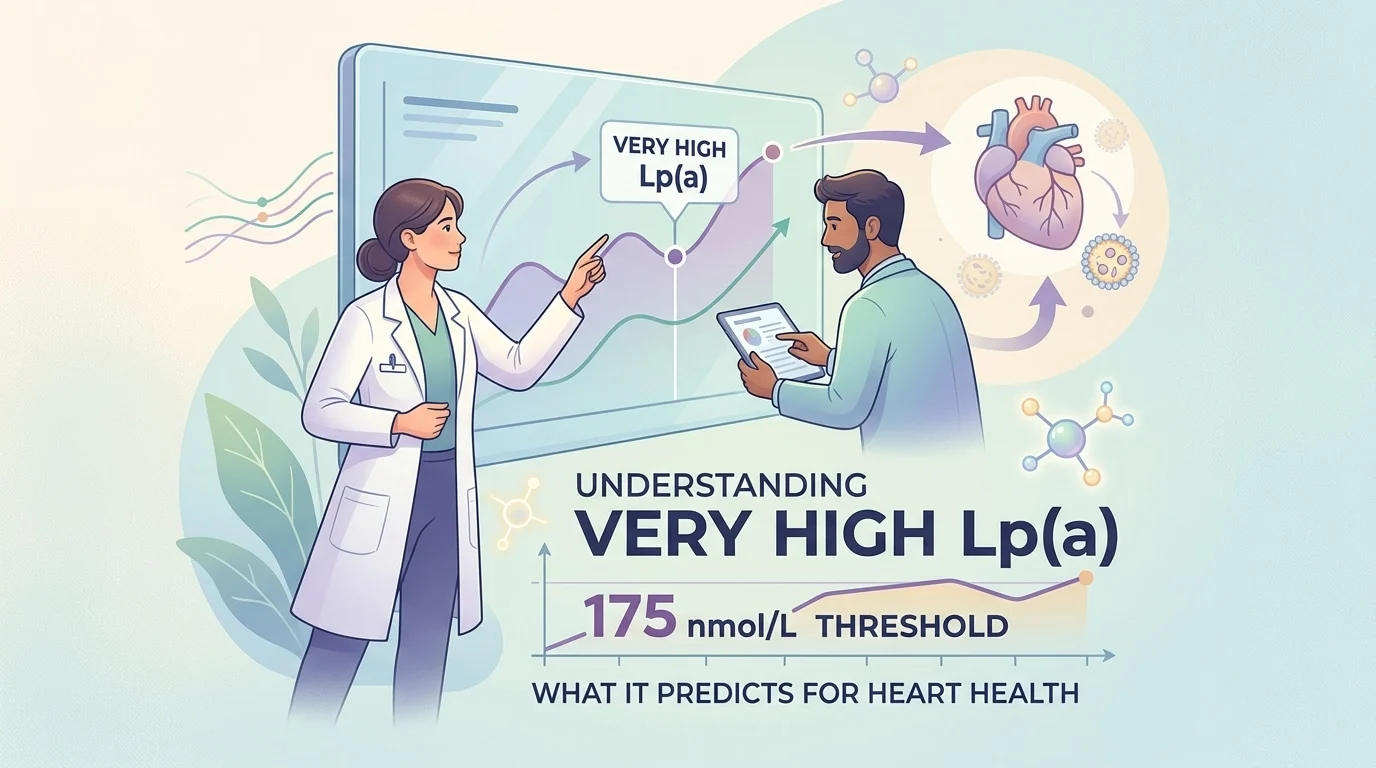
Over roughly four years of follow-up, 7.3 percent had a major cardiovascular event. The signal appeared only in the top band. An Lp(a) at or above 175 nmol/L was independently associated with a 31 percent higher rate of major events, a 49 percent higher rate of cardiovascular death, and a 64 percent higher rate of stroke.
The association was also stronger in people who already had known heart disease than in those who did not, which points at Lp(a) as a driver of the risk that remains after conventional treatment rather than a starting-line risk factor.
A second threshold, not a new one
The 125 nmol/L mark has not moved. What the new work adds is a tier above it, where the numbers behave differently. Reading your own result now means placing it on a longer ladder.
| Lp(a) result | How it is usually read | What the new data adds |
|---|---|---|
| Below 75 nmol/L | Desirable range | Reference group in the analysis |
| 75 to 125 nmol/L | Borderline | No separate excess risk detected here |
| 125 to 175 nmol/L | High, and the usual action threshold | Still high, but below the level that stood out |
| 175 nmol/L or above | Very high | Higher rates of stroke and cardiovascular death |
Two practical cautions. First, units. Many older reports print Lp(a) in mg/dL, and the two scales do not convert with a clean multiplier, so a number without its unit is unreadable. Second, assay. Because methods differ, a result close to a threshold is a reason to ask which method your laboratory used, not to assume the boundary is exact.
The finding people find hardest to believe
At 175 nmol/L and above, the excess risk showed up as stroke and cardiovascular death. It did not show up as heart attack.
That runs against the intuition most people have about a cholesterol-like particle, and it is worth understanding why it is plausible. Lp(a) is not only atherogenic. The extra protein wrapped around it resembles plasminogen, the molecule the body uses to dissolve clots, which is thought to make Lp(a) interfere with clot breakdown. A particle that both builds plaque and discourages clots from clearing fits an event profile weighted toward the brain. Our overview of stroke, its warning signs and its causes sets out what that event actually looks like.
Do not read this as reassurance about your heart. It means that in this particular population, at this particular level, the clearest signal was cerebrovascular. Other cohorts have found the opposite pattern, which brings us to the more honest part of the story.
Why studies disagree about what Lp(a) predicts
According to research indexed in PubMed and in the Consensus literature database, the last three years have produced results that do not line up neatly, and a reader with a lab report deserves to know that.
A 2025 analysis in the Journal of the American College of Cardiology followed 16,117 Hispanic and Latino adults. Above 125 nmol/L it found a clearly raised risk of heart attack and of death from any cause, but not of stroke. A 2026 meta-analysis of Mendelian randomisation studies in Frontiers in Neurology, which uses genetics to test causality, concluded that the link between Lp(a) and ischaemic stroke was not statistically significant, while LDL and apolipoprotein B were.
Set against that, a 2024 case-control study of 394 people found that those in the top quartile, above 117 nmol/L, had roughly twice the odds of ischaemic stroke, with the association strongest for the large-artery type. And a 2024 meta-analysis of 11,958 stroke patients found that a high Lp(a) at admission roughly doubled the odds of a poor recovery.
The reasonable summary is not that one study is right. It is that Lp(a) reliably marks elevated cardiovascular risk, while which event it lands on varies with the population studied, the level measured and the method used. That is a normal stage in the life of a biomarker, and it is a good argument for reading your number alongside the rest of your panel rather than on its own.
Latest scientific advances, in plain terms
Three threads from recent literature are worth knowing, none of which require a statistics table.
The first is that lowering LDL does not cancel Lp(a) risk. A participant-level meta-analysis of 27,658 people in six statin trials found that those above roughly 125 nmol/L stayed at higher risk even when their LDL had been driven into the lowest quartile achieved. If you are on treatment and your LDL looks excellent, that is real progress, and it does not erase this particular number. Our guide explains why there is no single healthy LDL range, and a related piece covers the LDL particle count your standard panel never prints.
The second is that the harm may begin lower than the guidelines say. A 2026 study of 17,376 statin-treated UK Biobank participants reported measurably higher event rates in the upper third of Lp(a), starting under 50 nmol/L, well below any official cutoff. Interestingly, that study found the effect more pronounced in people without established heart disease, the mirror image of the SCAI result. Thresholds are administrative conveniences drawn across what is really a continuous gradient.
The third is that inflammation and Lp(a) stack. Among 50,450 UK Biobank participants who had none of the standard risk factors, no smoking, no obesity, no hypertension, no diabetes, no dyslipidaemia, having both a high Lp(a) and a high-sensitivity CRP at or above 2.0 mg/L carried more risk than either alone. If your Lp(a) is very high, asking about hs-CRP is a sensible follow-up question, and our page on what a high CRP means explains the marker.
What to do if your result is very high
No approved medicine lowers Lp(a) specifically today, and several are in late-stage trials. That sounds discouraging until you notice what the new analysis actually recommends, which is to attack everything around it harder. The investigators were explicit: people with a very high Lp(a) should work with their clinician to lower LDL cholesterol aggressively and manage every other modifiable risk factor.
Practically, that means bringing the full picture to the appointment rather than the single line. Take your complete lipid panel, since the decision depends on the total risk your treatment is offsetting, and note that the way LDL itself is calculated recently changed on lab reports. Ask whether apolipoprotein B and hs-CRP would add anything. Mention blood pressure, blood sugar, smoking and family history, all of which are covered in our overview of high cholesterol, targets and treatment.
One more thing. Lp(a) is inherited, so a very high result is information about your siblings, parents and children as well as you. Raising it with them is arguably the highest-value action available today.
Frequently asked questions
Is 175 nmol/L the new cutoff for treatment?
No. It is the level at which this particular analysis detected a clear excess of stroke and cardiovascular death. The 125 nmol/L mark remains the usual reference for calling a result high. Think of 175 as a marker of greater urgency in controlling everything else, not as a new switch that turns treatment on.
My result is in mg/dL. How do I compare it?
Not with a simple multiplication, because the two units measure different things about the particle and the conversion depends on the assay. As a rough orientation, 125 nmol/L corresponds to roughly 50 mg/dL. If your value sits near a threshold, ask your laboratory or clinician which method and which reference range applied.
Does a very high Lp(a) mean I will have a stroke?
No. These are group-level rates over about four years, not individual forecasts, and most people in the highest band had no event during the study. A raised rate means the odds shift, not that an outcome is scheduled.
Should I have the test repeated?
Usually not. Lp(a) is largely genetically set and stays fairly stable across life, so one good measurement is generally enough. A repeat is sometimes considered after a major physiological change, or when the first result landed close to a decision threshold.
Can diet or exercise bring it down?
Barely, and that is not a failure on your part. Lifestyle changes move Lp(a) very little, but they meaningfully lower the other risks that combine with it, which is the part you can actually influence while Lp(a)-lowering drugs remain in trials.
Glossary
- Lipoprotein(a), or Lp(a): an LDL-like blood particle carrying an extra protein, largely inherited, that raises cardiovascular risk.
- nmol/L: nanomoles per litre, the modern unit for Lp(a), which counts particles rather than weighing cholesterol.
- MACE: major adverse cardiovascular events, a composite of heart attack, stroke, revascularisation and cardiac death.
- Residual risk: the cardiovascular risk that remains after LDL cholesterol and other standard targets have been treated.
- Plasminogen: the protein the body converts into an enzyme that dissolves clots, structurally similar to the apo(a) attached to Lp(a).
- hs-CRP: high-sensitivity C-reactive protein, a blood marker of low-grade inflammation.
- Mendelian randomisation: a method that uses inherited gene variants to test whether an association is likely to be causal.
- Assay: the specific laboratory method used to measure a substance, which can shift the numbers reported.
Understand your own results
An Lp(a) value means very little on its own. It becomes useful next to your LDL and HDL cholesterol, your triglycerides, your apolipoprotein B, your hs-CRP and the treatment you are already on, and those numbers arrive in a mix of units and reference ranges that rarely explain themselves. AI DiagMe reads your complete lab report and explains, line by line, what each result means in your situation, including where a very high Lp(a) sits relative to everything else on the page. Upload your report at aidiagme.com to get a clear reading before your next appointment.
Further reading
- Advanced lipid panel: ApoB, Lp(a) and deeper heart-risk testing
- The blood tests that decide whether you need blood pressure medication
- Full-fat dairy and your cholesterol: what the new trial found
- Cardiac markers panel: what each test measures
- Apolipoprotein A1: the protective side of your lipid profile
Sources
- Society for Cardiovascular Angiography and Interventions. 1 in 5 people may carry this hidden genetic heart risk. ScienceDaily, 10 August 2026. sciencedaily.com
- Danilov A, Duran-Luciano P, Yuan Y, et al. Association of Lp(a) With Cardiovascular Disease and All-Cause Mortality in U.S. Hispanics and Latinos. Journal of the American College of Cardiology. 2025;86(23):2292-2310. DOI
- Oftadeh SL, Pütz A, Jacobsen M, et al. Lipoprotein(a) and residual cardiovascular risk in statin-treated patients. European Journal of Preventive Cardiology. 2026. DOI
- Kazibwe R, Schaich CL, Kingsley JA, et al. Lipoprotein(a), High-Sensitivity C-Reactive Protein, and Incident ASCVD Risk in Individuals Without Standard Modifiable Risk Factors. European Journal of Preventive Cardiology. 2026. DOI
- Bhatia H, et al. Independence of Lipoprotein(a) and Low-Density Lipoprotein Cholesterol-Mediated Cardiovascular Risk: A Participant-Level Meta-Analysis. Circulation. 2024. Reference
- Guo Y, et al. Associations between lipoproteins and risk of ischemic stroke: a systematic review and meta-analysis of Mendelian randomization studies. Frontiers in Neurology. 2026. Reference
- Lackova A, et al. Lipoprotein(a) concentration as a risk factor for ischaemic stroke and its subtypes. Neurologia i Neurochirurgia Polska. 2024. Reference
- Liu H, et al. Impact of elevated lipoprotein(a) levels on the functional outcomes of ischemic stroke patients: a systematic review and meta-analysis. European Journal of Neurology. 2024. Reference
- González-Aguado N, et al. Impact of Lipoprotein(a) on Residual Cardiovascular Risk After an Acute Coronary Syndrome. Journal of Clinical Medicine. 2026. Reference