

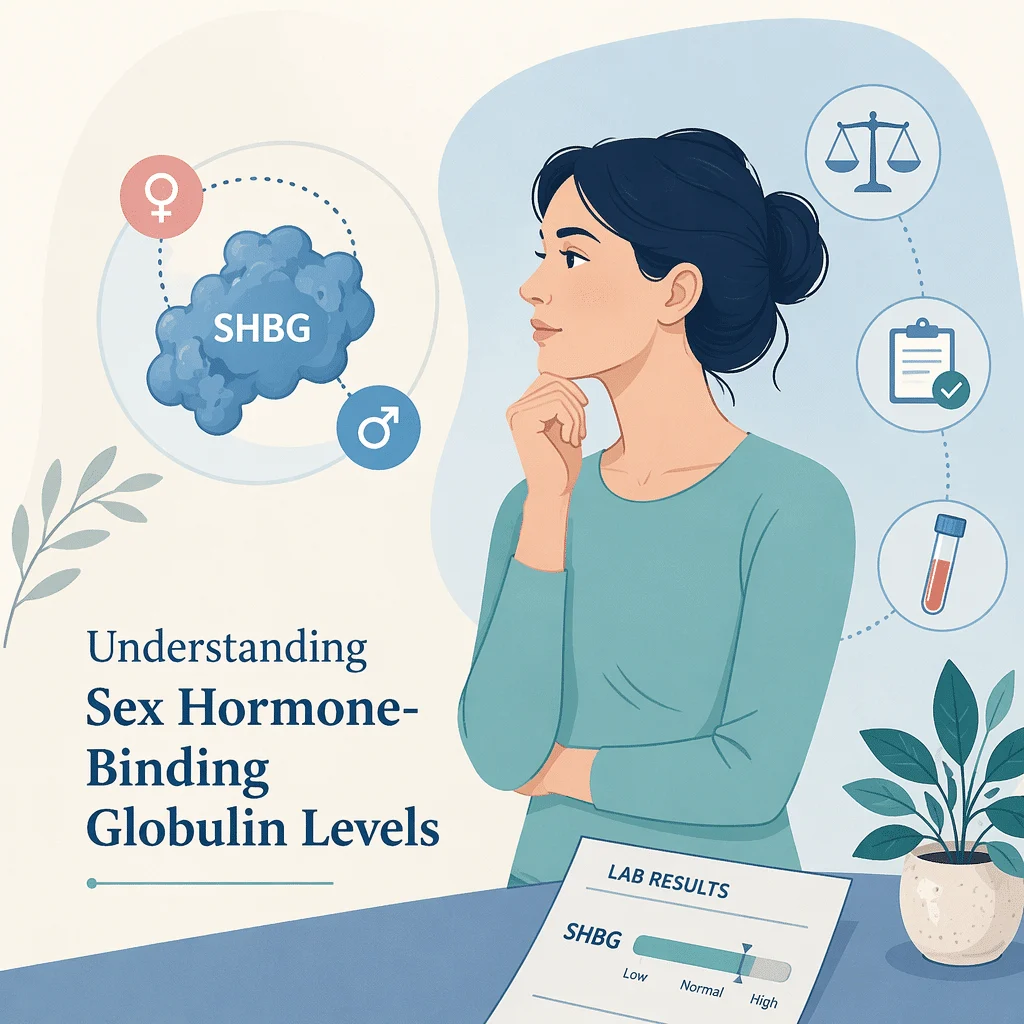
SHBG levels tell you how much of your testosterone and estrogen is actually available to your tissues, which is why a hormone panel that looks reassuring at first glance can still leave symptoms unexplained. Sex hormone-binding globulin, or SHBG, is a transport protein made mainly by the liver. It grips sex hormones as they circulate and holds them in reserve. When it rises, less hormone is free to act; when it falls, more is. That single mechanism explains most of what confuses people about their results.
In this article you’ll learn what sex hormone-binding globulin does, what pushes it up or down, how to read a high or low result next to testosterone and estradiol, which tests are normally ordered alongside it, and what recent research says about the links between SHBG, metabolism and liver health.
What sex hormone-binding globulin actually does
Sex hormones do not float freely through the bloodstream. Most of your testosterone and estradiol travels attached to proteins, and SHBG is the one that binds them most tightly. A smaller share rides loosely on albumin, the most abundant protein in blood, and only a small fraction circulates completely unattached.
That distinction matters because only the unattached hormone, plus the loosely bound portion that can detach easily, can enter cells and produce an effect. Hormone bound firmly to SHBG is effectively parked. It is not lost, and it is not wasted, but at any given moment it is not doing anything.
Bound, bioavailable and free hormone
Laboratories describe this in three overlapping ways. Total testosterone counts everything in the sample. Bioavailable testosterone counts the free portion plus the albumin-bound portion. Free testosterone counts only the unattached fraction. In a typical adult man, roughly half of total testosterone is held by SHBG, most of the rest sits on albumin, and only about one to two percent is genuinely free.
Because SHBG sets the size of the parked fraction, it behaves like a dial on hormone availability rather than a hormone in its own right. This is why clinicians almost never interpret it alone. On its own, an SHBG number says very little. Read beside a total hormone measurement, it often explains the whole picture.
Why normal total testosterone can hide a low free testosterone
This is the single most useful thing SHBG explains, and it is the reason the test exists. Imagine two men with an identical total testosterone result sitting comfortably inside the reference range. One has a high SHBG, the other a low one. The first man has most of that testosterone locked up, so the amount reaching his tissues is modest and he may well have symptoms of deficiency. The second has far less binding protein, so more hormone is active and he may feel entirely well.
The same logic runs in reverse. A woman with insulin resistance often has a low SHBG. Her total testosterone can read as normal while her free testosterone is genuinely elevated, which can show up as acne, unwanted hair growth or irregular cycles. Total testosterone alone would have missed it. AI DiagMe publishes a dedicated guide to the testosterone blood test if you want the marker itself explained in full.
Calculated free testosterone and the free androgen index
Rather than measuring free hormone directly, most laboratories calculate it. The widely used approach feeds total testosterone, SHBG and albumin into an equation that estimates how much hormone should be unbound. It is an estimate, not a direct reading, and different laboratories use different equations, so results are not always interchangeable between reports.
The free androgen index is a simpler ratio used mainly in women: total testosterone divided by SHBG, expressed as a percentage. It is a rough screening figure rather than a precise measurement, and it becomes unreliable when SHBG is at either extreme. Direct measurement by equilibrium dialysis, a reference laboratory method that physically separates free hormone from bound hormone, is the most accurate option but is not widely available.
The practical takeaway is simple. If your total hormone result and your symptoms disagree, SHBG is usually the missing variable, and a calculated free value gives a more honest answer than the total alone.
What raises and lowers SHBG levels
SHBG responds to hormones, metabolism, thyroid activity, liver health and several medications. Almost every cause acts on the liver’s production of the protein. The table below groups the common influences by direction, states what happens to free hormone, and gives the test a clinician would usually look at next.
| Influence | Direction of SHBG | Effect on free hormone | Usual next test |
|---|---|---|---|
| Estrogen, including combined oral contraceptives and oral estrogen therapy | Higher | Less free testosterone | Calculated free testosterone alongside estradiol |
| Overactive thyroid | Higher | Less free hormone | TSH with free T4 |
| Chronic liver disease and cirrhosis | Higher | Less free hormone | Liver enzymes with albumin |
| Aging in men | Gradually higher | Free testosterone falls faster than total | Total plus calculated free testosterone |
| Marked calorie restriction, low body weight, endurance overtraining | Higher | Less free hormone | LH and FSH with weight history |
| Certain anticonvulsant medications | Higher | Less free hormone | Medication review with the prescriber |
| Insulin resistance and excess weight | Lower | More free hormone relative to total | Fasting insulin, HOMA-IR, HbA1c |
| Type 2 diabetes | Lower | More free hormone relative to total | HbA1c with fasting glucose |
| Underactive thyroid | Lower | More free hormone relative to total | TSH with free T4 |
| Polycystic ovary syndrome | Often lower | More free testosterone | Total testosterone with free androgen index |
| Androgens and anabolic steroid use | Lower | More free hormone | Full hormone panel with LH and FSH |
| Growth hormone excess | Lower | More free hormone | Endocrinology referral |
| Protein loss through the kidneys | Lower | Variable | Urine protein with serum albumin |
Two lines in that table deserve emphasis. Thyroid activity moves SHBG in both directions, so an unexplained result is a reason to check thyroid function before anything else. Read our guide to the TSH thyroid test for what those numbers mean. And oral estrogen raises SHBG substantially, which is why a woman taking the combined pill frequently shows a high SHBG with a low free testosterone on paper.
How to read your SHBG result
Reference ranges differ by laboratory, sex and age
There is no universal reference range for SHBG levels. Values depend on the assay the laboratory uses, and they differ substantially by sex and by age. Women generally run higher than men, levels rise in later life in men, and pregnancy raises them dramatically. Always compare your figure with the range printed on your own report rather than one you found online, and if you are tracking a change over time, try to use the same laboratory each time.
What high SHBG levels can point to
A high SHBG means more hormone is bound and less is available. Common explanations include an overactive thyroid, oral estrogen or the combined contraceptive pill, chronic liver disease, significant weight loss or restrictive eating, and normal aging in men. Some people simply run high for genetic reasons with no illness at all.
The clinical question is always the same: what is the free hormone doing? A man with a high SHBG and a mid-range total testosterone may have a genuinely low free testosterone and matching symptoms such as low libido, fatigue or reduced morning erections. Read our guide to hypogonadism testing to see how that assessment is put together.
What low SHBG levels can point to
A low SHBG is the more common finding in routine practice, and it is most often a metabolic signal. Insulin resistance suppresses the liver’s production of SHBG, so low values cluster with excess abdominal weight, type 2 diabetes, fatty liver and polycystic ovary syndrome. An underactive thyroid, androgen or anabolic steroid use, and growth hormone excess also lower it.
Treated as an isolated number, a low SHBG is not a disease. Treated as a clue, it is one of the earliest laboratory hints that insulin handling deserves a closer look, which is why clinicians often add a fasting insulin measurement. Our site also explains the HOMA-IR insulin resistance score.
What SHBG cannot tell you
SHBG does not diagnose anything by itself. It does not measure hormone production, it does not indicate cancer risk, and there is no meaningful sense in which it can be interpreted without a total hormone result beside it. It is an interpretive companion test, and almost never the answer on its own.
Tests usually read alongside SHBG
SHBG levels are rarely ordered in isolation. Which companions appear on the request form depends on the question being asked.
- Total testosterone, drawn in the morning, is the anchor measurement in men. A calculated free testosterone is derived from it together with SHBG and albumin.
- Estradiol matters in both sexes, and estrogen is itself one of the strongest drivers of SHBG. Read our overview of the estradiol blood test for its role in a panel.
- Albumin is needed for the free hormone calculation to work at all, so it usually appears on the same request. See our explainer on the albumin blood test for what an abnormal value implies.
- Thyroid tests are frequently added because thyroid activity shifts SHBG in either direction.
- Markers of glucose handling such as fasting glucose, HbA1c and fasting insulin are added when SHBG is low.
- Luteinizing hormone and follicle-stimulating hormone help distinguish a testicular or ovarian cause from a pituitary one.
In practice these arrive as a bundle. If you want to see what a complete request typically contains, review our summary of the male hormone panel or the equivalent guide to the female hormone panel. When liver disease is suspected as the reason for a high SHBG, clinicians add our guide to liver function tests to the same draw.
Preparation and timing
SHBG itself is stable enough that fasting is not usually required, but the tests it travels with may have their own rules, and testosterone in particular is best drawn in the morning. Follow the instructions your laboratory gives you, and read our article on fasting before a blood test if you are unsure what applies. Mention every medication and supplement, especially hormonal contraception, thyroid medication and any form of testosterone, because several of them change the result directly.
When to talk to a doctor
An SHBG result outside the printed range is not an emergency, and on its own it does not require treatment. Book an appointment to have it interpreted properly when any of the following apply.
- Your total testosterone or estradiol reads as normal but you have persistent symptoms such as fatigue, low libido, cycle changes, hair loss or unwanted hair growth.
- Your SHBG is low and you also have abdominal weight gain, a raised HbA1c, a fatty liver finding on imaging or a family history of type 2 diabetes.
- Your SHBG is high alongside weight loss you did not intend, tremor, heat intolerance or palpitations, which can point toward thyroid overactivity.
- You are taking hormonal contraception, estrogen therapy, thyroid medication or an anticonvulsant and no one has factored that into the interpretation.
- You have known liver or kidney disease, both of which alter binding proteins independently of your hormones.
Bring the full report, not a single line from it. SHBG only makes sense in context, and the pattern across several markers is what guides the next step. Consult our overview of PCOS symptoms and diagnosis if a low SHBG appears alongside irregular cycles.
Latest scientific advances
Research over the past three years has shifted how clinicians think about low SHBG levels. It is increasingly read as a window onto metabolic and liver health rather than as a hormone problem. Here is what the strongest recent work found, and what it means in practice.
A low SHBG mostly reflects where your fat is stored
A 2024 study in the journal Diabetes followed several thousand middle-aged adults and asked why low SHBG predicts type 2 diabetes. The answer was largely fat location: visceral fat, the fat packed around the internal organs, and fat inside the liver accounted for most of the connection, more so in men than in women. What this means for you is that a low SHBG is best treated as a prompt to look at waist measurement, liver markers and glucose handling, not as a hormone abnormality to correct in itself.
Higher SHBG appears genuinely protective for the liver
A 2023 analysis used Mendelian randomization, a genetic technique that uses inherited differences between people to test whether an association is likely to be cause and effect rather than coincidence, and found that a naturally higher SHBG was linked to a lower risk of fatty liver disease. A 2024 review in Endocrine reinforced the same point from the other side: because the liver manufactures SHBG, liver conditions show up in the result. Fatty liver disease is common in adults, which makes this one of the more practically relevant findings for anyone reviewing a routine panel. See our guide to the fatty liver blood test for the markers involved.
Age and body weight dominate calculated free testosterone
A 2024 pooled analysis in the European Journal of Endocrinology combined individual data from more than twenty thousand men and looked at what actually moves calculated free testosterone in everyday life. Age and body weight came out well ahead of other factors. What this means for you is that a borderline free testosterone value should be read against your age and current weight before anyone concludes a gland is failing.
In PCOS, a low SHBG persists longer than expected
A 2023 systematic review in Human Reproduction Update pooled studies of women with polycystic ovary syndrome and found that the characteristic pattern of a reduced SHBG with a raised free androgen index tends to persist through the menopause transition rather than resolving with it. A separate 2024 systematic review in the Journal of Clinical Endocrinology and Metabolism confirmed that combined oral contraceptive pills raise SHBG, which is the mechanism behind the fall in free testosterone often seen on those prescriptions. Practically, this explains two frequent sources of confusion on a report: a high SHBG in a woman taking the pill, and a low SHBG that does not normalize after menopause.
Measurement method still matters
Work published in 2022, slightly older than the rest of this section, established reference intervals for free testosterone measured by a standardized equilibrium dialysis procedure in adult men. It is worth knowing because it underlines a limitation of everyday practice: a calculated free testosterone and a directly measured one are not the same number, and comparing results produced by different methods can mislead.
One caveat applies across all of this. These are population-level findings from observational studies, genetic analyses and pooled reviews. They describe patterns across large groups, not verdicts about any individual result, and none of them establishes SHBG as something to treat directly.
Glossary
| Term | Definition |
|---|---|
| Sex hormone-binding globulin (SHBG) | A protein made mainly by the liver that binds testosterone and estradiol in the bloodstream and controls how much of them is available to tissues. |
| Free testosterone | The small fraction of testosterone circulating unattached to any protein. It is the portion that can immediately enter cells. |
| Bioavailable testosterone | Free testosterone plus the portion loosely bound to albumin, which can detach easily and become active. |
| Calculated free testosterone | An estimate of free testosterone derived by equation from total testosterone, SHBG and albumin, rather than measured directly. |
| Free androgen index | A screening ratio of total testosterone to SHBG, used mainly in women. It is approximate and unreliable when SHBG is very high or very low. |
| Equilibrium dialysis | A reference laboratory method that physically separates free hormone from bound hormone. Considered the most accurate approach but not widely available. |
| Albumin | The most abundant protein in blood. It carries many substances, including a loosely bound share of sex hormones. |
| Insulin resistance | A state in which cells respond poorly to insulin, so the body produces more of it. It lowers the liver’s output of SHBG. |
| Visceral fat | Fat stored deep in the abdomen around the internal organs, as distinct from fat under the skin. |
| Reference range | The span of values a laboratory considers typical for its own method and for your sex and age group. It varies between laboratories. |
Frequently asked questions
Is a high SHBG bad?
Not automatically. A high SHBG simply means more of your sex hormones are bound and fewer are free to act. Whether that matters depends on the total hormone level beside it and on how you feel. A high SHBG with a comfortable free testosterone and no symptoms usually needs nothing more than an explanation. A high SHBG with a low free testosterone and real symptoms is worth investigating, starting with thyroid function, liver health, medications and recent weight change. The number itself is a description of hormone transport, not a diagnosis.
Can you lower SHBG?
SHBG levels generally follow whatever is driving them rather than moving on their own, so they are not a sensible target to treat directly. When a low or high value is explained by an underlying issue, addressing that issue is what shifts the number. For example, SHBG typically rises as insulin sensitivity improves and falls again when it worsens. Discuss any medication that might be involved with the prescriber rather than stopping it yourself, and be skeptical of products marketed as lowering or raising SHBG, as there is no established reason to alter it in isolation.
Do you need to fast for an SHBG test?
SHBG itself does not usually require fasting. However, it is rarely ordered alone, and the companion tests often do have requirements. Glucose and insulin measurements typically need a fasting sample, and testosterone is best drawn in the morning when levels are at their peak. The safest approach is to follow the specific instructions on your laboratory request form. Also tell the phlebotomist about any hormonal contraception, thyroid medication, anticonvulsant or testosterone product you use, since these affect the result regardless of fasting.
Why is my testosterone normal but my free testosterone low?
This is the classic SHBG pattern. Your body is producing an adequate amount of testosterone, which is what the total result reflects, but a high SHBG is binding more of it than usual, so less reaches your tissues. The total looks fine while the active portion does not. Causes worth checking include an overactive thyroid, liver disease, marked weight loss, certain medications and normal aging. A calculated free testosterone or, where available, a directly measured one gives a clearer picture than the total alone.
What symptoms come with a high SHBG?
SHBG produces no symptoms of its own. Anything you notice comes from the resulting shortage of available hormone. In men that can mean reduced libido, fatigue, low mood, poorer concentration and fewer morning erections. In women a high SHBG can contribute to low libido and vaginal dryness. These symptoms are common and have many possible causes, so they point toward a conversation with a clinician and a full panel rather than to a conclusion.
Does SHBG matter for women?
Yes, arguably more than for men in routine practice. A low SHBG in women is one of the most useful early signals of insulin resistance, and it is a characteristic feature of polycystic ovary syndrome, where it drives up free testosterone even when the total looks unremarkable. A high SHBG is common on the combined contraceptive pill and during pregnancy. In both directions, SHBG levels are what make a total testosterone result interpretable in a woman.
Sources
- MedlinePlus, National Library of Medicine — SHBG Blood Test — medlineplus.gov
- National Institute of Diabetes and Digestive and Kidney Diseases — Insulin Resistance and Prediabetes — niddk.nih.gov
- Eunice Kennedy Shriver National Institute of Child Health and Human Development — How do health care providers diagnose PCOS? — nichd.nih.gov
- Nassar GN, Leslie SW — Physiology, Testosterone — StatPearls, NCBI Bookshelf — ncbi.nlm.nih.gov
- Stangl TA, Wiepjes CM, Smit RAJ, et al. — Association Between Low Sex Hormone-Binding Globulin and Increased Risk of Type 2 Diabetes Is Mediated by Increased Visceral and Liver Fat — Diabetes, 2024 — pubmed.ncbi.nlm.nih.gov
- Dong Y, Zhang Y, Chen X, et al. — The relationship between sex hormone-binding protein and non-alcoholic fatty liver disease using Mendelian randomisation — European Journal of Clinical Investigation, 2023 — pubmed.ncbi.nlm.nih.gov
- Papadimitriou K, Mousiolis AC, Mintziori G, et al. — Hypogonadism and nonalcoholic fatty liver disease — Endocrine, 2024 — pubmed.ncbi.nlm.nih.gov
- Narinx N, Antonio L, Marriott RJ, et al. — Sociodemographic, lifestyle, and medical factors associated with calculated free testosterone concentrations in men: individual participant data meta-analyses — European Journal of Endocrinology, 2024 — pubmed.ncbi.nlm.nih.gov
- Millán-de-Meer M, Luque-Ramírez M, Nattero-Chávez L, Escobar-Morreale HF — PCOS during the menopausal transition and after menopause: a systematic review and meta-analysis — Human Reproduction Update, 2023 — pubmed.ncbi.nlm.nih.gov
- Melin J, Forslund M, Alesi S, et al. — Metformin and Combined Oral Contraceptive Pills in the Management of Polycystic Ovary Syndrome: A Systematic Review and Meta-analysis — Journal of Clinical Endocrinology and Metabolism, 2024 — pubmed.ncbi.nlm.nih.gov
- Jasuja R, Pencina KM, Peng L, Bhasin S — Reference intervals for free testosterone in adult men measured using a standardized equilibrium dialysis procedure — Andrology, 2022 — pubmed.ncbi.nlm.nih.gov
Further reading
- Low testosterone in men: symptoms and treatments
- High testosterone in women: causes and risks
- The LH blood test and how to read your results
- The FSH blood test explained
- Thyroxine-binding globulin, the thyroid equivalent of SHBG
Understand your lab results with AI DiagMe
An SHBG value on a hormone panel only becomes useful when it is read next to everything else in the same report. AI DiagMe reviews your results together, so a low SHBG sitting beside a raised HbA1c, or a high SHBG next to a mid-range total testosterone and an abnormal thyroid-stimulating hormone, is explained as a pattern rather than a list of numbers. It also flags which values sit outside your laboratory’s own range and which tests commonly follow. The service helps you understand your results; it does not diagnose, and it does not replace your doctor.
Get your results interpreted in minutes