





A result showing high prolactin levels is one of the most commonly misread findings on a hormone panel. Prolactin is the pituitary hormone behind breast milk production, but it also rises with sleep, stress, exercise and a long list of ordinary medicines. Sometimes it is not truly raised at all, only measured that way. That is why a single mildly elevated reading is very often simply repeated under calmer conditions before anything else is set in motion.
In this article you’ll learn what prolactin actually does, why the blood draw itself can push the number up, how laboratories screen for macroprolactin (a harmless form that fools standard tests), what the opposite trap called the hook effect is, which medicines are involved and why you should never stop them on your own, and which symptoms genuinely need prompt attention.
What prolactin does, and when it is normally high
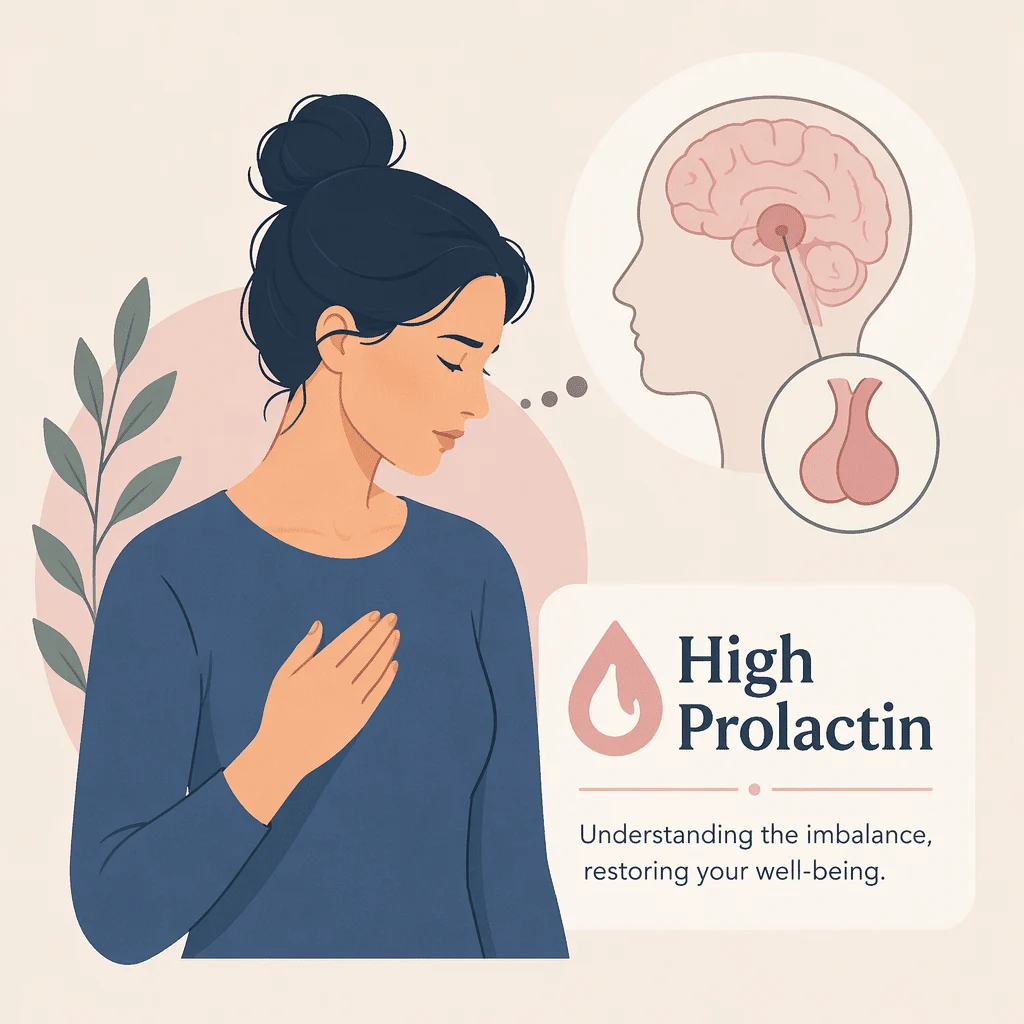
Prolactin is made by cells in the pituitary gland, a pea-sized gland that sits just below the base of the brain. Its best-known job is preparing breast tissue and driving milk production after childbirth.
Unlike most pituitary hormones, prolactin is held down rather than switched on. The brain releases dopamine, which continuously restrains prolactin release. Anything that reduces that dopamine brake, or that damages the stalk carrying dopamine to the pituitary, allows prolactin to drift upward.
Prolactin is high for perfectly normal reasons during pregnancy and breastfeeding. It also peaks during sleep, so a sample drawn shortly after waking can look higher than one drawn mid-morning. Levels rise after a meal, after vigorous exercise, after nipple or breast stimulation, and after a breast examination.
Signs that usually prompt a prolactin test
In women, the common triggers are irregular or absent periods, milk-like nipple discharge when not breastfeeding (galactorrhea), difficulty conceiving, low libido and vaginal dryness. Prolactin is frequently checked alongside luteinizing hormone (LH) and follicle-stimulating hormone (FSH), because raised prolactin suppresses both.
In men, the picture is quieter and often missed for longer: low sex drive, erectile difficulties, reduced body hair, breast tissue enlargement (gynecomastia) and infertility. Because prolactin lowers testosterone, the result frequently sits next to a reading for low testosterone in men. In women being assessed for hormonal imbalance, it may sit alongside a work-up for high testosterone in women.
Headaches and loss of side vision are a different category of symptom entirely, and are covered in the red flags section below.
Why the blood draw itself can raise your prolactin
Prolactin is a stress hormone as much as a reproductive one. Physical or emotional stress lifts it within minutes, and that includes the stress of the needle. Someone who is anxious about blood tests, who rushed to the appointment, or who needed several attempts to find a vein can produce a mildly raised reading with a completely normal pituitary gland.
This is not a rare technicality. It is one of the two leading explanations for a mildly high result, and it is the reason clinicians rarely act on a first borderline value.
A prolactin sample is best taken when you are awake, rested and calm, ideally a couple of hours after waking rather than immediately on rising, without vigorous exercise beforehand and without a breast examination just before. Some laboratories prefer a fasting morning sample. If the first result is only slightly above the reference range, the usual next step is to repeat it under these conditions.
Because the stress response involves the same broad machinery, people often ask whether their cortisol blood test and their prolactin are telling the same story. They can move together, but they are measured and interpreted separately.
Macroprolactin: the most common false alarm
This is the single most useful thing to know about a raised prolactin result, and most consumer health pages leave it out.
Prolactin circulates in more than one form. Most of it is monomeric prolactin, the small, biologically active molecule that does the work. A proportion can be bound to an antibody, forming a large complex called macroprolactin. This complex is too big to leave the bloodstream properly, so it accumulates. Crucially, it is biologically inactive: it does not affect periods, fertility, libido or breast tissue.
The problem is that routine laboratory analyzers cannot tell the two apart. They measure total prolactin, so macroprolactin is counted as if it were the real thing. The result comes back high, the person is symptom-free or has unrelated symptoms, and an investigation begins that was never needed.
Laboratories screen for it with polyethylene glycol precipitation, usually shortened to PEG. The PEG reagent clumps the large macroprolactin complexes out of the sample, and the remaining monomeric prolactin is measured again. If most of the original signal disappears, macroprolactin was the explanation. Gel filtration chromatography is the reference technique, but PEG is the practical screening method used day to day.
Macroprolactin accounts for a substantial minority of raised prolactin results. Without the screen, people have been scanned, followed for years and treated for a laboratory artifact. If your result is high and your symptoms do not fit, asking whether macroprolactin has been excluded is an entirely reasonable question.
The hook effect: the opposite trap
The hook effect is the mirror image of macroprolactin, and it matters far more when it occurs.
Modern prolactin assays use two antibodies that sandwich the hormone between them. When prolactin is extraordinarily high, as it can be with a very large prolactin-secreting tumor, there is so much hormone that it saturates both antibodies separately and the sandwich never forms. The assay therefore reports a value that is falsely low, or even within the normal range, in the person whose prolactin is highest of all.
The clue is a mismatch. If imaging shows a large pituitary mass but the prolactin comes back only modestly raised or normal, that combination should prompt the laboratory to re-run the sample after diluting it. Dilution brings the concentration back into the range the assay can handle, and the true, very high value appears.
You will not encounter this with a borderline result. It is a specific safeguard applied when a large lesion is already visible, and it exists so that a treatable tumor is not misclassified.
Medicines that raise prolactin, and the rule about stopping them
Medication is the most frequent explanation for genuinely raised prolactin in everyday practice, and it is consistently under-appreciated by patients and sometimes by clinicians outside endocrinology.
Anything that blocks dopamine will raise prolactin. The list includes antipsychotics, particularly risperidone, paliperidone and amisulpride; the anti-nausea and gut-motility drugs metoclopramide and domperidone; some antidepressants; opioid painkillers; the blood pressure drug verapamil; estrogen-containing preparations; and certain acid-suppressing medicines.
Here is the part that matters most on this page. If you are taking an antipsychotic and your prolactin is high, do not stop it, reduce it or skip doses on your own. Stopping an antipsychotic abruptly can precipitate a relapse of serious mental illness, and the harm from that relapse is far greater than the harm from a raised prolactin number.
Raised prolactin on medication is a conversation with the prescriber, not a self-directed change. Prescribers have real options: they can confirm the finding, check whether the timing fits the drug, weigh a dose adjustment, consider switching to an agent with less effect on prolactin, add a medicine that offsets it, or decide that the current treatment is worth continuing while monitoring. That balance is a clinical judgment made with you, and it depends on how well your underlying condition is controlled.
The same principle applies to every drug on the list. Bring the result and your full medication list, including anything bought over the counter, to the person who prescribed them.
Hypothyroidism and other reversible causes
An underactive thyroid is a genuinely reversible cause of raised prolactin, and it is easy to miss because it produces no distinctive prolactin-related clue.
When the thyroid underperforms, the brain increases thyrotropin-releasing hormone to drive it. That same signal also stimulates prolactin release, so prolactin drifts up as a side effect of the thyroid problem rather than as a pituitary problem in its own right. Treating the thyroid condition typically normalizes the prolactin.
This is why TSH is checked in essentially every prolactin work-up, often with free T4. If those results point toward hypothyroidism, the thyroid is treated first and prolactin is rechecked afterwards rather than investigated separately.
Advanced kidney disease is another reversible-in-principle cause, because prolactin is cleared by the kidneys and clearance falls as function declines. A creatinine result and an estimated filtration rate usually make this obvious. Chronic liver disease can contribute in the same way.
Chest wall injury, surgery, burns or shingles affecting the chest can raise prolactin through the same nerve pathways that operate during breastfeeding. Pregnancy, of course, raises it physiologically, which is why a pregnancy test is part of the standard assessment in anyone who could be pregnant. Occasionally the opposite question arises, and a reading of low prolactin needs its own explanation.
Prolactinoma and other pituitary causes, in proportion
A prolactinoma is a benign, non-cancerous growth of prolactin-producing cells in the pituitary. It is the most common type of pituitary tumor, and it is also, reassuringly, one of the most treatable conditions in endocrinology.
Most are microprolactinomas, under 10 millimeters across. These do not compress anything; they simply produce too much prolactin, and the symptoms come from that hormonal effect rather than from the mass. Macroprolactinomas are 10 millimeters or larger and can press on neighboring structures, most importantly the optic chiasm, which is why vision is assessed when a large lesion is found.
There is a second, easily confused pituitary pattern. A mass that does not itself make prolactin can still raise it, by compressing the pituitary stalk and interrupting the dopamine supply that normally keeps prolactin suppressed. This stalk effect typically produces a modest rise. A very high prolactin with a small lesion suggests a prolactinoma; a modest prolactin with a large lesion suggests stalk compression, or the hook effect described earlier.
On treatment, the reassuring point is that prolactinomas are usually managed with medication rather than an operation. The National Cancer Institute lists drug therapy first for prolactin-producing pituitary tumors, with surgery reserved for tumors that do not respond to medication or for people who cannot take it. The drug class involved is the dopamine agonists, which restore the brake the pituitary is missing; specific agents and doses are decided by a specialist, and are outside the scope of this article. Some people are eventually able to stop treatment under supervision.
How the work-up usually proceeds
The sequence is deliberately staged, so that the cheap and common explanations are excluded before the expensive and rare ones are pursued.
It typically runs: confirm the result with a repeat sample taken under rested conditions; review every medicine you take; screen for macroprolactin if the elevation persists; check TSH and, where relevant, kidney function; perform a pregnancy test where applicable; and arrange pituitary MRI only when a true, unexplained elevation remains. A visual field test is added when imaging shows a large lesion.
The table below shows how different result patterns are usually interpreted. It is a guide to the logic, not a substitute for your own clinician’s assessment.
| Result pattern | What it usually points to | Typical next step |
|---|---|---|
| Mildly raised on a single stressed or rushed sample | Venipuncture stress, recent sleep, exercise or a meal | Repeat the test rested, before anything else is arranged |
| Persistently raised, macroprolactin screen positive | Macroprolactin, a biologically inactive form | Report the monomeric value; usually no imaging or treatment needed |
| Raised in someone taking an antipsychotic or anti-nausea drug | Drug-induced hyperprolactinemia | Discuss with the prescriber; never adjust or stop the medicine yourself |
| Raised alongside a high TSH | Hypothyroidism driving prolactin upward | Treat the thyroid first, then recheck prolactin |
| Markedly raised with headache or visual change | Possible pituitary mass affecting nearby structures | Prompt clinical assessment, pituitary imaging and visual field testing |
| Only modestly raised, but a large pituitary mass on imaging | Stalk compression, or a hook effect masking a very high value | Ask the laboratory to repeat the assay on a diluted sample |
Red flags that need prompt medical attention
Seek medical assessment without delay if you have a raised prolactin result together with any of the following:
- New or worsening loss of side (peripheral) vision, blurred vision or double vision
- A new persistent headache, or a headache that is clearly different from your usual pattern
- A sudden, severe headache with vision change, drooping eyelid or vomiting, which can indicate bleeding into the pituitary (pituitary apoplexy) and is a medical emergency
- Nipple discharge occurring together with any visual symptom
- Any new neurological symptom in someone already known to have a pituitary lesion
These features are uncommon. They are listed because they change the urgency, not because they are the likely explanation for most raised results.
Latest scientific advances in prolactin testing
Research published since 2023 has reinforced how often a raised prolactin turns out to be something other than a hormone problem, and has sharpened the practical rules for what to check.
A large Spanish cross-sectional study examined why prolactin was raised in women assessed for polycystic ovary syndrome and in comparison groups. Among those with a mildly high value, most were explained either by the stress of the blood draw, with the level normalizing after proper rest, or by macroprolactinemia identified through polyethylene glycol precipitation. What this means for you: in mild elevations, resting before a repeat sample and screening for macroprolactin resolve the majority of cases without imaging.
A clinical review in a reproductive medicine journal set out how macroprolactinemia, an excess of the large antibody-bound form of prolactin, is a recognized and frequent finding among people with elevated prolactin, and argued that anyone with a persistently raised level should be screened for it. Its authors highlighted the risk of unnecessary pituitary imaging and unnecessary drug treatment when the screen is skipped. What this means for you: a macroprolactin screen is a cheap step that can prevent a scan you do not need.
A joint position statement from Brazilian endocrinology and gynecology societies laid out a structured approach to diagnosing hyperprolactinemia in women, explicitly separating physiological, drug-related and pathological causes, and flagging both macroprolactin and the hook effect as laboratory pitfalls that can delay or distort a diagnosis. What this means for you: national specialist bodies now treat these two artifacts as routine checkpoints rather than curiosities.
An expert review of prolactinoma care in a leading endocrinology journal described dopamine agonist therapy as the treatment of choice, capable of controlling the condition, restoring fertility in both sexes and permitting treatment withdrawal in a meaningful proportion of patients, with surgery or radiotherapy reserved for resistant cases. What this means for you: a prolactinoma diagnosis usually leads to tablets and monitoring, not an operation.
Finally, a Korean guideline developed specifically for antipsychotic-induced hyperprolactinemia produced graded recommendations on when to measure prolactin and how to manage a raised level in people taking these medicines. Its recommendations centre on prescriber-led decisions such as reviewing the drug and considering alternatives, monitored over time. What this means for you: there is a recognized clinical pathway for this situation, and it belongs with your prescriber.
Study findings are summarized here in plain terms; the full references, with links, are listed in the Sources section below.
Glossary of key terms
| Term | Definition |
|---|---|
| Prolactin | A hormone made by the pituitary gland, best known for driving breast milk production. |
| Hyperprolactinemia | The medical term for a prolactin level above the laboratory reference range. |
| Monomeric prolactin | The small, biologically active form of prolactin that produces symptoms. |
| Macroprolactin | Prolactin bound to an antibody, forming a large, inactive complex that standard assays still count. |
| PEG precipitation | A laboratory step using polyethylene glycol to remove macroprolactin before re-measuring the sample. |
| Hook effect | A falsely low reading that can occur when prolactin is extremely high and saturates the assay. |
| Prolactinoma | A benign pituitary growth that produces prolactin; usually treated with medication. |
| Pituitary stalk effect | A modest prolactin rise caused by a mass pressing on the stalk and blocking dopamine. |
| Galactorrhea | Milk-like nipple discharge that is not related to pregnancy or breastfeeding. |
| Dopamine agonist | A class of medicine that mimics dopamine and lowers prolactin production. |
Frequently asked questions
Does a high prolactin level mean I have a tumor?
Usually not. Most raised prolactin results are explained by something other than a tumor: the stress of the blood draw, recent sleep or exercise, pregnancy, a medicine you are taking, an underactive thyroid, or macroprolactin, which is a laboratory artifact rather than a disease. A prolactinoma is a real possibility that gets ruled in or out with imaging, but it is not the first assumption, and when one is found it is benign and usually responds well to tablets. The staged work-up exists precisely so that people are not scanned or worried unnecessarily.
Can stress raise prolactin levels?
Yes, and this includes the stress of the blood test itself. Prolactin climbs within minutes of physical or emotional stress, so a difficult venipuncture, a rushed arrival or simple needle anxiety can lift the number in someone whose pituitary is entirely normal. Sleep, exercise, a large meal and nipple stimulation do the same. This is why a mildly raised first result is normally repeated when you are rested and calm before any further step is taken, and why a single borderline value is not treated as a diagnosis.
Can my medication be causing my high prolactin levels?
Very possibly. Medicines are among the most frequent causes of genuinely raised prolactin, especially antipsychotics such as risperidone and paliperidone, the anti-nausea drugs metoclopramide and domperidone, some antidepressants, opioids, verapamil and estrogen-containing preparations. Important: do not stop, reduce or skip a medicine because of a prolactin result. Stopping an antipsychotic on your own can trigger a relapse of serious mental illness. Bring the result and a full list of everything you take to the prescriber, who can weigh alternatives and decide what, if anything, should change.
What causes high prolactin levels in a non-pregnant female?
The common explanations are, roughly in order: the stress of the sample itself, medicines, macroprolactin, an underactive thyroid, and then a prolactinoma or another pituitary lesion. Breastfeeding and recent breast stimulation also count. Symptoms help sort these out. Absent or irregular periods with milk-like nipple discharge point toward a genuine, biologically active elevation, while a high number in someone with no symptoms at all raises the possibility of macroprolactin. A pregnancy test is part of the standard assessment regardless of what you expect.
What are high prolactin levels in males linked to?
In men, raised prolactin suppresses testosterone, so the symptoms are often low sex drive, erectile difficulties, low energy, reduced body and facial hair, breast tissue enlargement and reduced fertility. Because these develop gradually and are easy to attribute to age or stress, men are more likely to be diagnosed later, and more likely than women to have a larger pituitary lesion by the time it is found. That is one reason headaches or any change in side vision should be reported promptly rather than watched.
Can high prolactin levels be treated?
In most cases, yes, and often the treatment is to address the cause rather than the number. If a medicine is responsible, the prescriber may adjust the plan. If an underactive thyroid is driving it, treating the thyroid usually brings prolactin back down. If macroprolactin is the explanation, no treatment is needed at all. For a prolactinoma, dopamine agonist medication is the usual first-line approach and often shrinks the tumor as well as lowering the hormone, with surgery reserved for cases that do not respond.
Sources
- MedlinePlus, U.S. National Library of Medicine. Prolactin blood test. https://medlineplus.gov/ency/article/003718.htm
- National Cancer Institute. Pituitary Tumors Treatment. https://www.cancer.gov/types/pituitary/treatment
- Korbonits M. Pharmacological Causes of Hyperprolactinemia. Endotext, NCBI Bookshelf, 2024. https://www.ncbi.nlm.nih.gov/books/NBK599196/
- Luque-Ramirez M, Quintero-Tobar A, Martinez-Garcia MA, de Lope Quinones S, Insenser M, Nattero-Chavez L, Escobar-Morreale HF. Mild hyperprolactinemia in women with polycystic ovary syndrome. Insights from a large cross-sectional study. Journal of Clinical and Translational Endocrinology, 2025. https://doi.org/10.1016/j.jcte.2025.100412
- Koniares K, Benadiva C, Engmann L, Nulsen J, Grow D. Macroprolactinemia: a mini-review and update on clinical practice. F&S Reports, 2023. https://doi.org/10.1016/j.xfre.2023.05.005
- Glezer A, Mendes Garmes H, Kasuki L, Martins M, Conde Lamparelli Elias P, Dos Santos Nunes Nogueira V, Rosa-e-Silva ACJS, Maciel GAR, Benetti-Pinto CL, Prestes Nacul A. Diagnosis of hyperprolactinemia in women: A Position Statement from the Brazilian Federation of Gynecology and Obstetrics Associations (Febrasgo) and the Brazilian Society of Endocrinology and Metabolism (SBEM). Archives of Endocrinology and Metabolism, 2024. https://doi.org/10.20945/2359-4292-2023-0502
- Auriemma RS, Pirchio R, Pivonello C, Garifalos F, Colao A, Pivonello R. Approach to the Patient With Prolactinoma. The Journal of Clinical Endocrinology and Metabolism, 2023. https://doi.org/10.1210/clinem/dgad174
- Kim HR, Kim SM, Kang WS, Jeon HJ, Jang SH, Jon DI, Hong J, Jeong JH. Development of a Guideline for Antipsychotic-induced Hyperprolactinemia in Korea Using the ADAPTE Process. Clinical Psychopharmacology and Neuroscience, 2023. https://doi.org/10.9758/cpn.22.979
Further reading
- Fertility blood test: which hormones are measured and why
- Normal thyroid levels: understanding the ranges
- Low morning cortisol: causes, symptoms and treatments
- IGF-1: another pituitary-linked blood marker decoded
- Erectile dysfunction: causes worth investigating
Understand your lab results with AI DiagMe
A prolactin result rarely stands alone. It is usually read next to TSH, LH and FSH, and the pattern across those numbers is what gives it meaning. AI DiagMe turns your report into plain language so you can see how the values fit together and arrive at your appointment with better questions. It helps you understand your results; it does not diagnose anything and does not replace your doctor.
Get your results interpreted in minutes