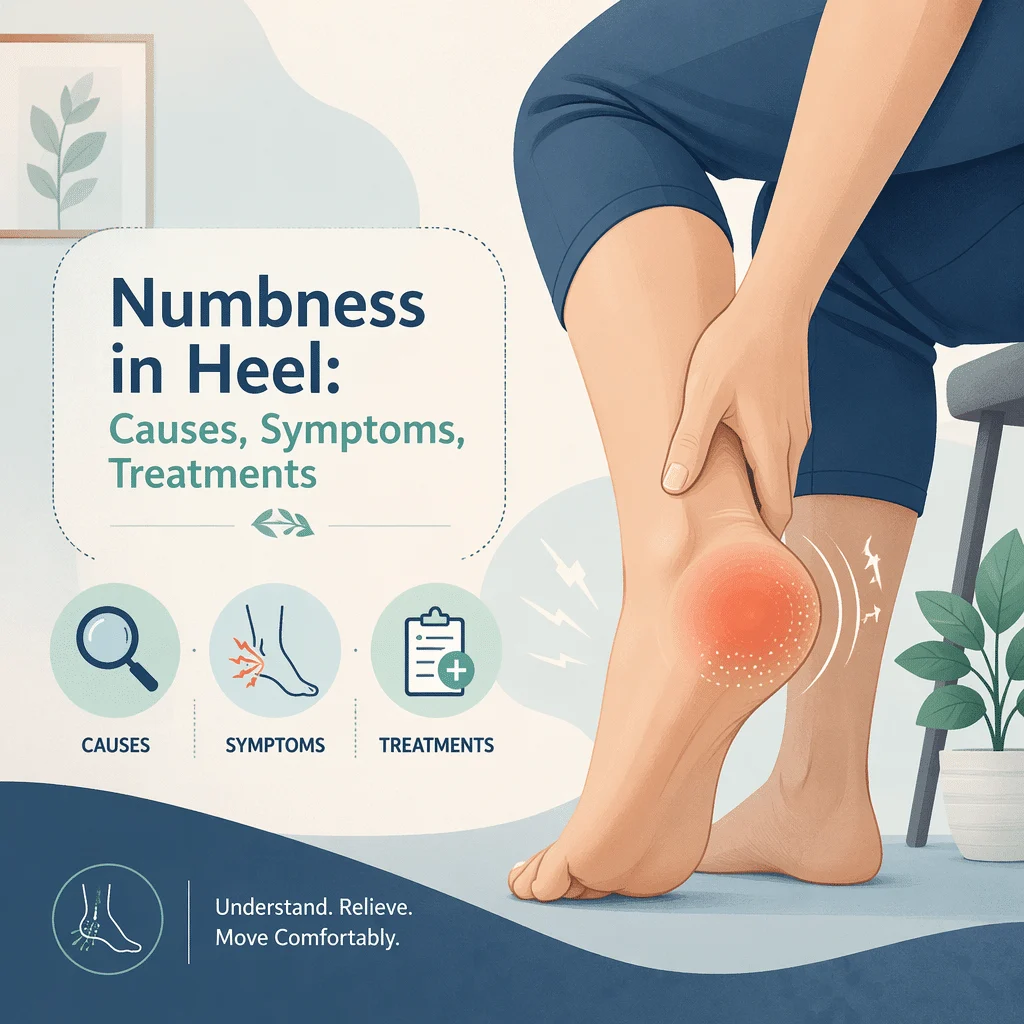
Numbness in the heel is a different signal from heel pain, and that difference matters more than most people expect. Pain in the heel usually means tissue that is inflamed or overloaded. Numbness means a nerve is compressed, irritated, or damaged somewhere along its path — and that path can start in the foot, behind the ankle, or as far away as the lower back.
This distinction changes the questions worth asking. Plantar fasciitis, by far the most common heel complaint, causes pain but does not cause a loss of sensation. So when the heel goes numb, something else is going on.
In this article you will learn which nerves produce numbness in the heel, how the pattern of your symptoms narrows down the cause, which blood tests are standard when both feet are involved, and which warning signs need same-day care.
Numbness in the heel is not the same signal as heel pain
When the plantar fascia — the thick band of tissue running along the sole — is irritated, the nerve endings in and around it fire. The result is pain, classically sharp under the heel with the first steps in the morning. Sensation itself stays intact. You can still feel a light touch on the skin.
Numbness works the other way. It means signals are not getting through. Something is pressing on a nerve, or the nerve fibers themselves are not working properly. The skin feels muffled, distant, or as though there is a layer of padding between the floor and the foot.
The two can overlap. A person can have plantar fasciitis and a separate nerve problem at the same time, and a nerve under long-standing pressure often produces burning or tingling alongside the numbness. But numbness on its own is never explained by plantar fasciitis. That is worth stating plainly, because many people spend months treating a fascia problem while a nerve issue goes unaddressed. Our team also covers the causes of a numb big toe, which follows the same logic in a different part of the foot.
What causes numbness in the heel
Working from the foot upward makes the possibilities easier to sort. Each nerve serves a specific patch of skin, so where the numbness sits is a genuine clue.
Tarsal tunnel syndrome
The posterior tibial nerve runs through a narrow fibrous corridor behind the bony bump on the inside of the ankle. Swelling, a cyst, scar tissue, a flattened arch, or simple crowding can compress it there. The result is numbness, tingling, or burning across the sole and inner heel, often worse at night or after long periods of standing. Tapping over the nerve behind the inner ankle may send an electric tingle into the foot, which clinicians call a positive Tinel sign.
Baxter’s neuropathy
The first branch of the lateral plantar nerve, often called Baxter’s nerve, passes between two muscles deep in the inner heel. Entrapment here is one of the more commonly missed explanations for chronic heel symptoms, partly because it is so easily labeled as stubborn plantar fasciitis. It tends to produce a deep, persistent discomfort or a numb patch on the inner heel that does not settle with the usual fascia treatments.
S1 radiculopathy: when the real source is your back
The S1 nerve root leaves the spine in the lower back and supplies the outer foot and heel. A bulging or herniated lumbar disc can press on it, and the numbness then shows up in the foot even though nothing is wrong with the foot itself. The giveaway is usually pain or numbness traveling from the low back or buttock down the back of the leg. This guide explains the symptoms and red flags of sciatica.
Peripheral neuropathy
Peripheral neuropathy damages the longest nerves first, which is why it starts in the toes and creeps upward over months or years, usually in both feet at once. Diabetes is the leading cause and the one with the highest stakes. Other recognized causes include vitamin B12 deficiency, an underactive thyroid, chronic kidney disease, heavy alcohol use, and certain chemotherapy drugs. Up to half of people with diabetes have peripheral neuropathy, according to the National Institute of Diabetes and Digestive and Kidney Diseases, whose patient page describes the foot symptoms of diabetic peripheral neuropathy.
Sural nerve irritation
The sural nerve travels down the back of the calf to the outer ankle and the outer border of the foot. It sits close to the surface, so it is vulnerable to ankle sprains, boot pressure, casts, and surgical scars. Numbness from this nerve sits on the outer heel rather than across the sole.
Reduced circulation
Nerves need a steady blood supply. When the arteries in the leg narrow, as they do in peripheral artery disease, the foot can feel numb, cold, and pale. A characteristic clue is cramping in the calf that comes on with walking and eases with rest. Smoking, diabetes, high cholesterol, and high blood pressure all raise the risk.
Position and pressure
Sitting cross-legged, kneeling, tight boots, ski boots, and casts can all compress a nerve mechanically. This kind of numbness arrives quickly, often with pins and needles as it recovers, and resolves within minutes of changing position. It is the one category that generally needs no investigation — unless it keeps happening.
Match your symptom pattern to the likely mechanism
No table replaces an examination, but the pattern of numbness is genuinely informative, and arriving at an appointment able to describe it well shortens the path to an answer. Note which part of the heel is affected, whether one or both feet are involved, and what makes it worse.
| Pattern you notice | Likely mechanism | What a clinician usually checks |
|---|---|---|
| Inner heel and sole, worse at night or after standing | Posterior tibial nerve compressed behind the inner ankle (tarsal tunnel syndrome) | Tinel sign at the inner ankle, nerve conduction study, ultrasound or MRI if a cyst is suspected |
| Deep numb patch on the inner heel that persists despite fasciitis treatment | Entrapment of the first branch of the lateral plantar nerve (Baxter’s neuropathy) | Focused examination of the inner heel, electrodiagnostic testing, imaging to exclude other causes |
| Outer heel and outer border of the foot | Sural nerve irritation | Examination along the outer ankle, history of sprain, cast or boot pressure |
| Heel numbness with pain running from the low back or buttock down the leg | S1 nerve root compressed in the lumbar spine (radiculopathy) | Straight-leg raise, reflex and strength testing, lumbar MRI if symptoms persist or weakness appears |
| Both feet, symmetrical, started in the toes and moved upward | Peripheral neuropathy affecting the longest nerves first | Fasting glucose, HbA1c, vitamin B12, TSH, kidney function, complete blood count, sometimes protein electrophoresis |
| Numbness with burning, worse at night, in both feet | Small nerve fibers involved in a peripheral neuropathy | The same blood workup, plus a focused neurologic examination |
| Numb foot that is also cold or pale, with calf cramping when walking | Reduced arterial blood flow (peripheral artery disease) | Pulse check in the foot, ankle-brachial index, vascular imaging |
| Follows sitting cross-legged, kneeling, or tight footwear and clears in minutes | Positional or mechanical compression | Usually no testing; a symptom review if it keeps recurring |
The blood tests behind a numb heel
One pattern above all others points toward blood work: numbness that affects both feet symmetrically, began in the toes, and has slowly moved upward. That is the classic presentation of length-dependent peripheral neuropathy, and it is driven by body-wide causes rather than a local pinch. A nerve squeezed behind one ankle does not produce identical symptoms in both feet.
When that pattern is present, a standard workup usually includes the following tests.
- Fasting glucose and HbA1c, to look for diabetes or for blood sugar that has already drifted above the normal range. Our library details the causes of abnormal glucose levels, and we also published an A1C conversion chart.
- Vitamin B12, with methylmalonic acid added when the B12 result lands in the borderline zone. Our team describes the symptoms and causes of low vitamin B12.
- TSH, since an underactive thyroid is a treatable contributor to nerve symptoms. This article breaks down the normal thyroid hormone ranges.
- Kidney function, because the waste products that build up in chronic kidney disease are toxic to nerves. We explain how to read a kidney function panel.
- A complete blood count, which can flag anemia and the enlarged red blood cells that often accompany B12 deficiency. Our guide covers how to read a complete blood count.
- Serum protein electrophoresis in selected cases, to look for an abnormal antibody protein that can affect nerves. We also explain how to read protein electrophoresis results.
There is a specific reason this matters. Diabetic neuropathy can be the first sign of diabetes that nobody has diagnosed yet. Someone arrives describing numb feet, and the blood test is what reveals the cause. In that situation a lab result genuinely changes the outcome, because treating the blood sugar early protects the nerve fibers that still work. Nerve damage that has already occurred is often only partly reversible, which is why the timing of the test is not a detail.
Warning signs that need urgent care
Most numbness in the heel is not an emergency. A few presentations are, and they are worth knowing by heart.
- Numbness that comes on suddenly alongside weakness, or a foot that drags or slaps against the floor when you walk. New weakness with new numbness needs prompt assessment.
- Numbness in both feet or the inner thighs together with loss of bladder or bowel control, or loss of sensation in the area that would contact a saddle. This combination can indicate cauda equina syndrome, compression of the nerve bundle at the base of the spine, which is treated as a surgical emergency.
- A foot that is numb and also cold, pale, or bluish. That combination points to blood flow rather than nerve compression and should be assessed the same day.
- Any wound, blister, or ulcer on a numb foot in someone with diabetes. Reduced sensation means an injury can go unnoticed and become infected before it is ever felt, which is why daily foot checks are standard advice.
- Numbness that spreads rapidly over hours or days, or that follows a significant fall or injury.
How numbness in the heel is treated
Treatment follows the cause, so an accurate diagnosis does most of the work. Broadly, the options fall into four categories.
Footwear and orthotics
Taking pressure off an irritated nerve is often the first step. That can mean roomier shoes, loosening the lacing over a tender spot, cushioning under the heel, or a custom insert that supports the arch and changes how the foot loads. Where a boot or cast is the source of compression, adjusting the device may be all that is needed.
Physical therapy and nerve gliding
Targeted stretching, strengthening of the muscles that support the arch, and nerve gliding exercises — gentle movements that help a nerve slide freely through the tissue around it — are commonly used for entrapment syndromes. A therapist tailors these to the nerve involved, which is another reason the diagnosis has to come first.
Treating the underlying condition
When the numbness comes from a body-wide cause, the treatment is that cause: bringing blood sugar into range, replacing vitamin B12, correcting thyroid hormone levels, managing kidney disease, or reducing alcohol intake. Progress in this category is slow, but it is the part that protects the nerves you still have.
Injections and surgery
A corticosteroid injection around a compressed nerve can reduce swelling and help confirm where the problem sits. Surgical decompression — releasing the tissue that is squeezing the nerve — is reserved for cases that do not respond to conservative care, or where a cyst or mass is doing the compressing. Outcomes are generally better when the problem is addressed before the nerve has been compressed for years.
Latest scientific advances
Research published over the last three years has sharpened how foot and heel numbness is understood. Here is what stands out, in plain terms.
Foot and ankle nerve entrapments are still being missed
A 2025 review of nerve entrapment syndromes in the foot and ankle concluded that these conditions remain underrecognized and are frequently misdiagnosed, and that an accurate diagnosis depends on a careful history and examination rather than on any single test. A 2024 review of tarsal tunnel syndrome reached a similar conclusion, noting that the lack of a definitive test often delays diagnosis, and that long-standing compression can cause permanent nerve damage.
What this means for you: if a heel problem has been treated as plantar fasciitis for months without improvement and numbness is part of the picture, asking directly about nerve involvement is a reasonable question, not an overreaction.
Tarsal tunnel symptoms overlap with diabetes and back problems
A 2025 clinical review pointed out that tarsal tunnel symptoms closely resemble those of diabetic neuropathy and of lumbar spine disease, that they typically worsen with walking, and that MRI can suggest nerve compression in people who have no symptoms at all — a false positive.
What this means for you: a scan finding on its own does not establish the diagnosis. Your description of the symptoms carries real diagnostic weight, so it is worth describing them precisely.
Borderline vitamin B12 results deserve a second test
A 2025 clinical review of vitamin B12 deficiency confirmed that peripheral neuropathy is among its recognized features, and set out how testing works: a clearly low B12 level is diagnostic on its own, while a borderline result warrants measuring methylmalonic acid — a substance that accumulates when B12 is functionally lacking — to settle the question. A separate small 2025 study followed cancer patients through chemotherapy and found that their vitamin B12 status declined during treatment, alongside nerve symptoms; that finding is preliminary and does not establish cause and effect.
What this means for you: a B12 result described as low normal is not necessarily the end of the investigation if you have nerve symptoms, because a follow-up test exists for exactly this situation. And numbness during chemotherapy is worth mentioning to your oncology team rather than accepting in silence.
Blood sugar below the diabetes threshold
A 2025 systematic review examined whether the small blood vessel complications of diabetes begin before blood sugar crosses the diagnostic line. It found reasonably consistent evidence for early eye changes at prediabetes levels, but concluded that the published evidence on nerve damage at this stage is still too thin to support firm conclusions.
What this means for you: this is an area where honest uncertainty is the right answer. Blood sugar in the prediabetes range is worth knowing about and acting on, but it should not be assumed to explain numbness by itself.
Glossary of key terms
| Term | Definition |
|---|---|
| Tarsal tunnel | A narrow passage behind the bony bump on the inside of the ankle, through which a nerve, an artery, and several tendons travel. |
| Posterior tibial nerve | The main nerve supplying sensation to the sole of the foot. It passes through the tarsal tunnel and branches out beneath the foot. |
| Baxter’s neuropathy | Entrapment of the first branch of the lateral plantar nerve in the inner heel. A commonly overlooked cause of long-standing heel symptoms. |
| Radiculopathy | Irritation or compression of a nerve root where it leaves the spine. Symptoms appear in the area that nerve supplies, which may be far from the back. |
| Peripheral neuropathy | Damage to the nerves outside the brain and spinal cord. It typically affects the longest nerves first, which is why symptoms usually start in the feet. |
| Tinel sign | An electric tingling felt along a nerve when a clinician taps over it. It suggests the nerve is irritated at that spot. |
| Nerve conduction study | A test that measures how quickly and strongly electrical signals travel along a nerve, used to locate and grade nerve damage. |
| Methylmalonic acid | A substance that builds up in the blood when the body lacks usable vitamin B12. It is measured when a B12 result is borderline. |
| Ankle-brachial index | A simple comparison of blood pressure at the ankle and at the arm, used to detect narrowed arteries in the leg. |
Frequently asked questions
Should I be worried if my heel is numb?
Brief numbness that follows sitting or kneeling and clears within minutes is not a concern. Numbness that persists for days, keeps returning, affects both feet, or arrives with weakness, back pain, or a wound deserves medical assessment. The reason is not that numbness is dangerous in itself, but that it is a signal. What matters is the underlying cause, and several of the possible causes are far easier to treat early than late.
Why is my heel numb when I wake up or lie down?
Two explanations are common. The first is simple position: pressure from the mattress or a particular sleeping posture compresses a nerve, and the feeling clears once you move. The second is nerve compression that genuinely worsens at rest, which is typical of tarsal tunnel syndrome and of some peripheral neuropathies. If the numbness reliably wakes you or lasts well past getting up, it is worth investigating rather than adjusting your pillow.
Can a heel be numb with no pain at all?
Yes, and it is a meaningful finding. Painless numbness suggests the sensory fibers are affected without much irritation of the pain fibers, which is common in peripheral neuropathy and in some nerve compressions. It also removes plantar fasciitis from consideration, since that condition causes pain rather than sensory loss. Painless numbness is easy to ignore precisely because it does not hurt, which is why it often goes unmentioned for months.
What nerve causes numbness in the heel?
Most often the posterior tibial nerve or one of its branches, including the first branch of the lateral plantar nerve. The sural nerve supplies the outer heel. The S1 nerve root, which starts in the lower back, also serves the heel region, which is why a spine problem can produce foot numbness. Which nerve is involved is usually deduced from where the numbness sits and what else is happening at the same time.
Why is only one heel numb?
One-sided numbness generally points to a local cause: a nerve compressed at the ankle or in the foot, a nerve root irritated on one side of the lower back, or an old injury. Body-wide causes such as diabetes, thyroid disease, and vitamin B12 deficiency usually affect both feet in a broadly symmetrical way. One numb heel therefore steers the investigation toward the anatomy first, although blood tests may still be checked.
Do exercises help numbness in the heel?
They can, when the cause is nerve compression. Calf and plantar fascia stretching, arch strengthening, and nerve gliding exercises are standard parts of conservative treatment for entrapment syndromes, and a physical therapist selects them based on which nerve is affected. Exercise does not reverse nerve damage caused by diabetes or a vitamin deficiency, though staying active supports circulation and general nerve health. Exercises work best after a diagnosis, not instead of one.
Sources
- National Institute of Diabetes and Digestive and Kidney Diseases — Peripheral Neuropathy — NIDDK, National Institutes of Health — niddk.nih.gov
- MedlinePlus — Peripheral Neuropathy — U.S. National Library of Medicine — medlineplus.gov
- Johns Hopkins Medicine — Tarsal Tunnel Syndrome: What You Need to Know — hopkinsmedicine.org
- Bojovic M, Dimitrijevic S, Olory BCR, et al. — Overview of nerve entrapment syndromes in the foot and ankle — International Orthopaedics, 2025 — doi.org/10.1007/s00264-025-06469-5
- Sha I — Tarsal Tunnel Syndrome: A Comprehensive Review — The Iowa Orthopaedic Journal, 2024 — pubmed.ncbi.nlm.nih.gov/39811161
- Yoshida H, Kim K, Tajiri T, et al. — Tarsal Tunnel Syndrome: A Clinical Review — Journal of Nippon Medical School, 2025 — doi.org/10.1272/jnms.JNMS.2025_92-206
- Patel H, McGuirk R — Vitamin B12 Deficiency: Common Questions and Answers — American Family Physician, 2025 — pubmed.ncbi.nlm.nih.gov/40961307
- Thiab S, Akhal T, Akeblersane M, et al. — Microvascular complications in prediabetes: a systematic review and meta-analysis — Diabetes Research and Clinical Practice, 2025 — doi.org/10.1016/j.diabres.2025.112261
- El-Najjar SE, Naser IA, Al-Wahidi KM — Is Functional Vitamin B12 Deficiency a Risk Factor for the Development of Chemotherapy-Induced Peripheral Neuropathy in Cancer Patients? — Asian Pacific Journal of Cancer Prevention, 2025 — doi.org/10.31557/APJCP.2025.26.2.375
Further reading
- Tingling in the Back: Symptoms and Causes
- Pinched Nerve in Knee: Symptoms, Causes, Treatments
- Itchy Feet at Night: Causes and Treatments
- Vitamin B12 Guide: Benefits, Sources and Levels
- CBC vs CMP: Understanding the Tests
Understand your lab results with AI DiagMe
When numbness affects both feet, the answer often sits in a blood sample rather than in the foot itself. A blood sugar reading, a long-term sugar average, a vitamin B12 level, a thyroid value, and a check of kidney function together cover most of the treatable causes. AI DiagMe reads those results back to you in plain language, so you can see which numbers sit outside their reference range and what they are pointing at. It helps you understand your results; it does not make a diagnosis and does not replace your doctor.
Get your results interpreted in minutes