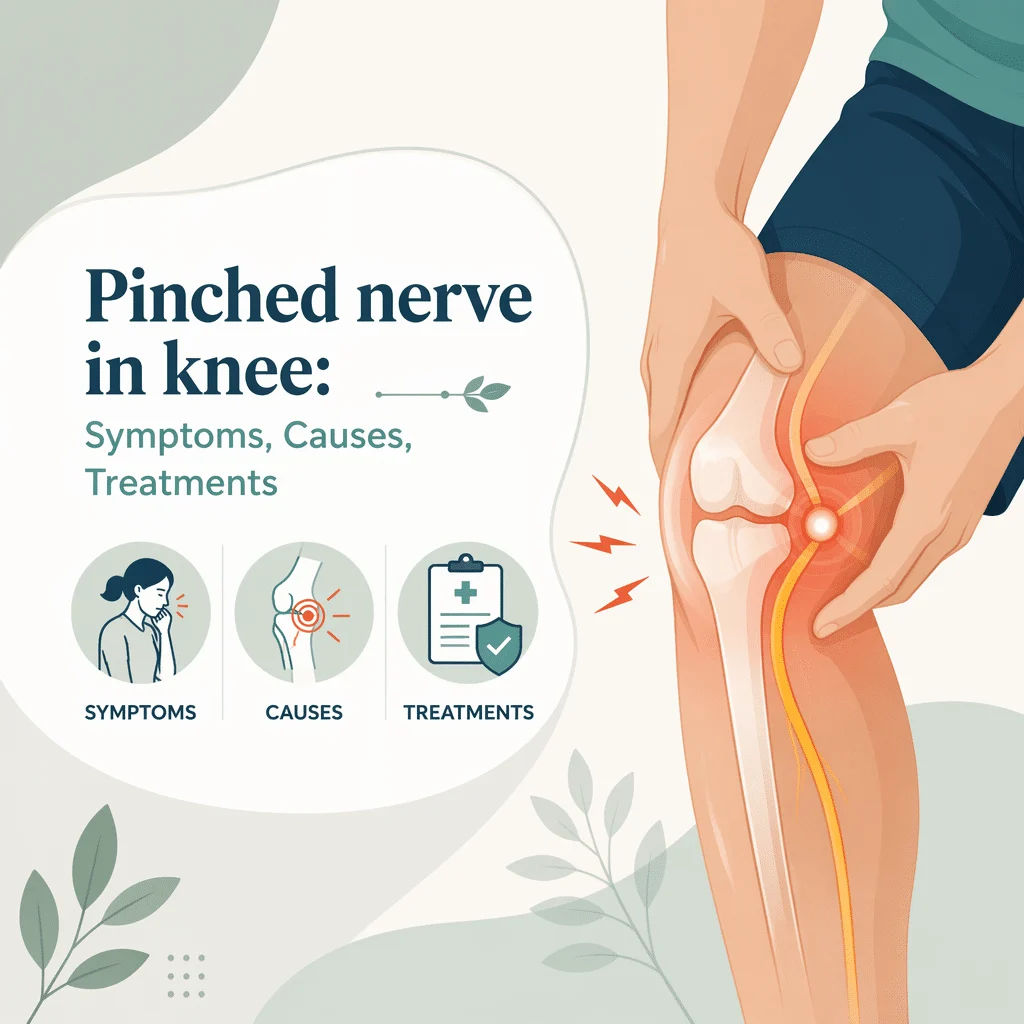
A pinched nerve in the knee happens when nearby tissue presses on one of the nerves that travel around the joint, most often the common peroneal nerve on the outer side of the knee. This pressure interrupts the signals the nerve carries, which can lead to numbness, tingling, burning pain, or muscle weakness in the lower leg and foot. Because this nerve sits just under the skin near the top of the shin bone, it is surprisingly easy to squeeze by crossing your legs, kneeling for long stretches, or wearing a tight brace. In this article you will learn what a pinched nerve in the knee feels like, what causes it, how doctors diagnose it, and which treatments help you recover. You will also learn the warning signs, such as foot drop, that mean you should see a doctor promptly rather than waiting it out.
What is a pinched nerve in the knee?
A nerve is a bit like an electrical cable that carries messages between your brain and your body. When surrounding tissue presses on that cable, the messages get scrambled. This is what people mean by a pinched nerve in the knee: sustained pressure on a nerve near the joint that disturbs sensation, movement, or both. The pressure can come from swollen soft tissue, a cyst, a bony change, an injury, or simply an awkward position held for too long.
The knee is a busy junction where several nerves pass close to bone and joint structures. Not every ache around the knee is a nerve problem, and it helps to review the other common causes of knee pain before assuming a nerve is involved. A pinched nerve stands out because it usually brings numbness, tingling, or weakness rather than pain alone.
The common peroneal (fibular) nerve
The nerve most often affected around the knee is the common peroneal nerve, also called the fibular nerve. It branches off the larger sciatic nerve, then wraps around the outer edge of the knee, right over a bony bump at the top of the shin bone called the fibular head. At that point the nerve is close to the surface with very little padding to protect it. Specialists who review fibular neuropathy note that this superficial position is exactly why the nerve is so vulnerable to pressure, and that hidden cysts inside the nerve are an increasingly recognized cause when the reason is not obvious. This nerve controls the muscles that lift the front of your foot and gives feeling to the outer shin and the top of the foot, which is why problems here show up in those areas.
Common symptoms of a pinched nerve in the knee
Symptoms depend on how much the nerve is compressed and for how long. Mild cases may cause only a passing tingle, while stronger or longer-lasting pressure can affect the muscles the nerve controls. Most people notice one or more of the following:
- Numbness or a pins-and-needles feeling over the outer shin and the top of the foot
- Sharp, shooting, or burning pain around the outer knee
- A weak or heavy feeling in the foot and ankle
- Difficulty lifting the front of the foot, known as foot drop
- Tripping, catching the toes, or a slapping sound when the foot lands while walking
Foot drop is the symptom that worries doctors most. It means the nerve is no longer sending enough signal to the muscles that raise the foot, so the toes drag. If the numbness travels toward your toes as well, you may want to read our guide to a numb big toe. Nerve irritation slightly lower down can also cause numbness in the heel.
Symptoms and what they may point to
The table below links common complaints to the structures that may be involved. It is a guide for understanding, not a way to diagnose yourself.
| Symptom | What it may point to |
|---|---|
| Tingling on the outer shin and top of the foot | Pressure on the common peroneal nerve near the fibular head |
| Burning or sharp pain around the outer knee | Irritation of the peroneal nerve or nearby soft tissue |
| Trouble lifting the front of the foot (foot drop) | More significant peroneal nerve involvement that needs prompt review |
| Weakness when turning the foot outward | Reduced motor signals traveling through the peroneal nerve |
| Pain that starts in the lower back and runs down the leg | A nerve problem higher up, such as sciatica, rather than the knee itself |
| A soft lump or swelling behind the knee | A Baker’s cyst or ganglion cyst pressing on the nerve |
What causes a pinched nerve in the knee?
Most causes fall into a few groups: outside pressure, injury or surgery, a mass such as a cyst, and nerve problems that actually begin somewhere else. Often more than one factor is at play.
Pressure and posture
Because the peroneal nerve lies so close to the surface, everyday pressure can be enough to irritate it. Habitual leg crossing is a classic trigger, since the top knee presses the nerve of the leg underneath against bone. Kneeling or squatting for long periods, a tight cast or leg brace, tight boots, or long surgery and hospital stays where the leg rests against a firm edge can all compress the nerve in the same way.
Injury, surgery, and masses
A direct blow to the outer knee, a fracture near the fibular head, a badly sprained knee, or knee surgery can bruise or stretch the nerve. Scar tissue that forms after an injury or operation may also tether it. A common hidden cause is a fluid-filled sac pressing on the nerve, such as a Baker’s cyst behind the knee or a ganglion cyst that can even grow inside the nerve itself. These masses may build slowly, so the symptoms can creep up over weeks or months.
Weight loss and referred nerve problems
The peroneal nerve is normally cushioned by a small pad of fat. Significant weight loss can thin that padding and leave the nerve more exposed to pressure, which is why some people notice symptoms after losing a lot of weight. Diabetes adds another layer of risk, because high blood sugar can make nerves more fragile and easier to compress; it is worth understanding the basics of diabetes and nerve health. Finally, what feels like a knee nerve problem sometimes starts in the lower back. When a spinal nerve root is squeezed, pain and numbness can travel down the leg and settle near the knee. That referred pattern is sciatica, and you can read more in our guide to sciatica and sciatic nerve pain. A pinched nerve in the knee is really one example of a wider group of conditions, so for the bigger picture you can also see our overview of nerve compression syndrome.
How is a pinched nerve in the knee diagnosed?
Diagnosis usually starts with a conversation and a physical exam. Your clinician will ask when the symptoms began, what makes them better or worse, and whether you recently lost weight, had an injury, or spent time with your leg pressed against something firm. During the exam they may tap over the fibular head to see whether it triggers tingling, test the strength of the muscles that lift your foot, and check sensation on the shin and foot.
Nerve conduction studies and EMG
To confirm that the peroneal nerve is the source and to locate the pinch, doctors often use two linked tests. A nerve conduction study measures how quickly and strongly electrical signals travel along the nerve, while electromyography, or EMG, checks how the muscles respond. Together they can show whether the nerve is compressed at the fibular head and how much it is affected, which helps guide treatment.
Imaging
Imaging looks for a physical cause. Ultrasound and MRI can reveal a cyst, scar tissue, or a mass pressing on the nerve, and reviews of lower-limb nerve entrapment describe both as valuable tools for finding the exact spot and cause of the problem. X-rays may be added to check for a fracture or bony change near the joint. If a whole-body cause such as diabetes is suspected, your doctor may also order blood tests to look at your blood glucose levels.
Treatment options for a pinched nerve in the knee
The right treatment depends on the cause and on how much the nerve is affected. Good news first: most cases that come from simple pressure improve once the pressure is removed and the nerve is given time to heal.
Conservative care
First-line care is usually non-surgical and aims to take pressure off the nerve. Common steps include:
- Changing habits that compress the nerve, such as crossing the legs or kneeling for long periods
- Padding the outer knee or adjusting a cast or brace that presses on the area
- Physical therapy to strengthen the muscles around the ankle and keep the joint moving
- An ankle-foot brace, called an AFO, that holds the foot in a safe position when foot drop is present
- Short-term pain relief and, in some cases, a corticosteroid injection to calm inflammation
- Treating the underlying cause, for example draining a cyst or managing blood sugar
Recovery from a nerve injury is slow because nerves heal gradually. Many people improve over several weeks to a few months once the source of pressure is gone.
When procedures or surgery help
Surgery is considered when a clear structural cause is found, such as a cyst or scar tissue, or when the nerve does not recover on its own and weakness continues. A common operation is decompression, in which a surgeon relieves the pressure squeezing the nerve. Removing a cyst that is pressing on the nerve can also resolve symptoms. Your care team weighs how long the nerve has been compressed and how severe the weakness is when deciding whether an operation is likely to help.
Self-care and prevention
Simple habits protect the peroneal nerve and lower the chance of a repeat problem. Try to avoid sitting with your legs crossed for long periods, and take breaks from prolonged kneeling or squatting. If you wear a brace, cast, or tall boots, make sure they do not dig into the outer knee. Keeping the muscles around your hips, knees, and ankles strong helps support the joint and your walking pattern. If you are losing weight on purpose, aim for a steady pace and mention any new tingling or foot weakness to your doctor. For anyone with diabetes, steady blood sugar control is one of the best ways to keep nerves healthy.
When to see a doctor
Many mild cases settle with rest and small changes, but some symptoms deserve prompt attention. Contact a healthcare professional if you notice any of the following:
- Difficulty lifting the front of your foot, or your toes catching and dragging when you walk
- Weakness in the foot or ankle that is getting worse rather than better
- Numbness or tingling that spreads, persists, or keeps you from daily activities
- Symptoms that follow a significant knee injury, fracture, or surgery
- A growing lump behind or beside the knee
- Numbness, tingling, or weakness in both legs, or loss of bladder or bowel control, which needs urgent care
Foot drop and rapidly worsening weakness are the clearest signals to be seen quickly. The sooner a compressed nerve is relieved, the better the chance of a full recovery.
Latest scientific advances
Research on peroneal nerve problems near the knee is modest but steady, and a few recent findings are worth knowing about. Here is what they mean in everyday terms.
Rapid weight loss and newer weight-loss medicines
A 2025 study from the Mayo Clinic, published in the journal Neurology, looked at people taking GLP-1 receptor agonists, the newer weight-loss and diabetes medicines such as semaglutide. It found that people who lost weight quickly on these drugs were somewhat more likely to develop a common fibular neuropathy, meaning irritation of the nerve that wraps around the outer knee and lifts the foot. What this means for you: losing weight is usually good for your joints, but the fat pad that cushions this nerve can thin out as you slim down, leaving the nerve more exposed. If you notice new tingling or a weak foot while losing weight, mention it to your doctor rather than waiting.
A gentler option between rest and surgery
A 2025 expert review in the journal Muscle and Nerve described a technique called ultrasound-guided hydrodissection, in which a doctor uses ultrasound to guide a small amount of fluid around a trapped nerve to free it from the tissue squeezing it. The authors list fibular neuropathy among the conditions that may respond in selected cases. What this means for you: for some people there may be a middle step between wait-and-see care and an operation, although the evidence is still early and this is not right for everyone.
When surgery is needed, timing matters
A 2024 study in the journal Cureus followed people who had surgery to relieve pressure on the common peroneal nerve. Most regained muscle strength, and those who had the operation sooner and at a lower body weight were more likely to get normal feeling back. What this means for you: if a nerve stays compressed for many months, recovery can be less complete, so it is worth having stubborn symptoms checked early rather than living with them.
Glossary of key terms
| Term | Definition |
|---|---|
| Common peroneal nerve (fibular nerve) | The nerve that wraps around the outer knee, gives feeling to the outer shin and top of the foot, and helps lift the foot. |
| Fibular head | The bony bump at the top of the outer shin bone where the peroneal nerve is close to the surface. |
| Foot drop | Difficulty lifting the front of the foot, causing the toes to drag while walking. |
| Nerve conduction study | A test that measures how fast and strong electrical signals travel along a nerve. |
| Electromyography (EMG) | A test that records the electrical activity of muscles to see how well the nerve is reaching them. |
| Baker’s cyst | A fluid-filled swelling behind the knee that can press on nearby nerves. |
| Ganglion cyst | A fluid-filled lump that can form near a joint or even inside a nerve. |
| Neuropathy | A general term for nerve damage or irritation that affects sensation or movement. |
| Sciatica | Pain, numbness, or weakness that travels down the leg from a pinched nerve in the lower back. |
| Decompression | Surgery that relieves the pressure squeezing a nerve. |
Frequently asked questions
How do I know if my knee pain is from a pinched nerve?
Pain alone is common to many knee problems, but a pinched nerve usually adds numbness, tingling, or a pins-and-needles feeling over the outer shin and top of the foot, and sometimes weakness when lifting the foot. If your main symptom is deep aching or stiffness without those nerve sensations, another cause such as arthritis or a ligament issue may be more likely. A clinician can sort this out with an exam and, if needed, nerve testing.
How long does a pinched nerve in the knee take to heal?
It depends on the cause and how much the nerve was compressed. When the problem comes from simple pressure that is removed early, many people improve over a few weeks to a few months, because nerves recover slowly. If the nerve was tightly squeezed for a long time or a cyst is involved, healing can take longer and may need a procedure. Persistent or worsening weakness should be reviewed rather than waited out.
What are the best home remedies for nerve pain in the knee?
The most useful home steps take pressure off the nerve: avoid crossing your legs, limit long periods of kneeling, and pad the outer knee if it rests against firm surfaces. Gentle stretching, keeping the ankle and leg muscles active, and short-term over-the-counter pain relief can help comfort. Home care works best for mild cases; if you have foot drop or spreading numbness, see a professional instead of relying on self-care.
Can a pinched nerve in the knee happen after a fall or knee replacement?
Yes. A direct fall onto the outer knee, a fracture near the fibular head, or the swelling and positioning involved in knee surgery can all irritate or compress the peroneal nerve. Symptoms may appear soon after the event or build gradually as scar tissue forms. If new numbness or foot weakness follows an injury or operation, tell your care team so the nerve can be checked.
Is a pinched nerve in the knee the same as sciatica?
Not exactly, though they can feel similar. A pinched nerve in the knee involves a nerve near the joint, most often the common peroneal nerve. Sciatica starts higher up, when a nerve root in the lower back is compressed, and the pain then travels down the leg. Because the two can overlap near the knee, doctors examine the whole path of the nerve to find where the pressure really is.
Can a pinched nerve in the knee cause permanent damage?
Most cases recover, especially when the pressure is relieved early. However, a nerve that stays compressed for a long time can lose function, and recovery may then be slower or incomplete. This is why worsening weakness or foot drop should be reviewed promptly. Acting early gives the nerve the best chance to heal fully.
Sources
- Johns Hopkins Medicine — Peroneal Nerve Injury — hopkinsmedicine.org
- Mayo Clinic — Foot drop: Symptoms and causes — mayoclinic.org
- MedlinePlus, U.S. National Library of Medicine — Common peroneal nerve dysfunction — medlineplus.gov
- Benstead TJ — Fibular (peroneal) neuropathy — Handbook of Clinical Neurology, 2024 — doi.org/10.1016/B978-0-323-90108-6.00008-9
- Triplett JD, et al. — GLP-1RA-Associated Diabetic Lumbosacral Radiculoplexus and Common Fibular Neuropathies: A Case-Control Evaluation — Neurology, 2025 — doi.org/10.1212/WNL.0000000000213916
- King JD, et al. — Outcomes of Common Peroneal Nerve Decompression — Cureus, 2024 — doi.org/10.7759/cureus.68526
- Colorado B, et al. — Ultrasound-Guided Nerve Hydrodissection for Peripheral Entrapment Neuropathies — Muscle and Nerve, 2025 — doi.org/10.1002/mus.28471
- Kumar S, et al. — Nerve entrapment syndromes of the lower limb: a pictorial review — Insights into Imaging, 2023 — doi.org/10.1186/s13244-023-01514-6
Further reading
- Sciatica symptoms, causes, and relief
- Nerve compression syndrome explained
- Knee pain causes and treatments
- Pinched nerve in the shoulder blade
- Diabetes causes, symptoms, and treatments
Understand your lab results with AI DiagMe
A pinched nerve in the knee is usually a mechanical problem, but numbness and tingling can also be linked to conditions that show up in your bloodwork, such as diabetes or a vitamin shortage. AI DiagMe helps you read tests like blood glucose levels, your average blood sugar over three months, low vitamin B12, and a complete blood count in plain language. It is built to help you understand your results, not to diagnose you or replace your doctor, so you can ask better questions at your next visit.
Get your results interpreted in minutes