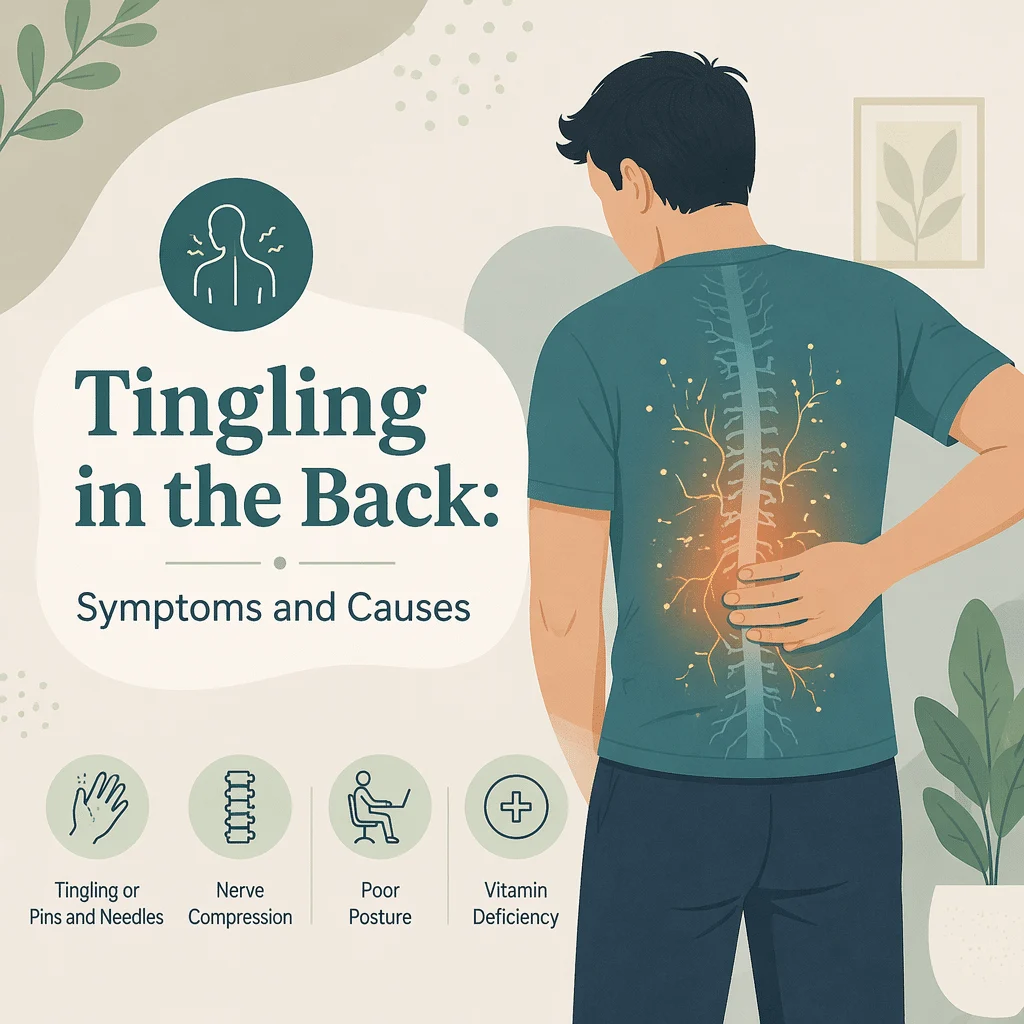
Tingling in the back is one of those symptoms that feels alarming precisely because it is so hard to describe. It may arrive as pins and needles, a patch of numb skin, a burning stripe, or an electric flicker along the spine. Most of the time it is not dangerous, and the useful information is rarely in the sensation itself — it is in the pattern. Where it sits, whether it stays on one side, whether it follows a band around the trunk or a line down one leg, and what else comes with it are what narrow the possibilities. In this article you will learn how clinicians read those patterns, which causes are mechanical and which are body-wide, which blood tests help, and the warning signs that mean you should not wait.
What tingling in the back actually is
The medical word for pins and needles is paresthesia: an abnormal sensation that appears without anything touching the skin. It is not a disease but a signal that somewhere between your skin and your brain, a nerve is sending information it should not be sending.
Nerves work a little like insulated wiring. Sensory fibers carry touch, temperature and position signals from the skin to the spinal cord and onward to the brain. When a nerve is squeezed, irritated, inflamed or metabolically unwell, that wiring becomes unstable and fires when it should be quiet. Your brain interprets those signals as prickling, buzzing or burning coming from the skin.
Why a nerve misfires
Three broad things go wrong. A nerve can be compressed, as when a disc bulges against a nerve root or a muscle stays contracted for hours. It can be irritated or inflamed, as when a dormant virus reactivates inside it. Or its metabolism can falter, as when the body runs short of vitamin B12 or sugar levels stay high for years. A separate guide covers nerve compression syndrome and its treatments.
This matters practically: compression usually maps neatly onto a territory of skin, while metabolic causes produce something diffuse and symmetrical — a distinction that does a great deal of work before anyone orders a test.
Where the tingling sits, and what the pattern suggests
Each spinal nerve supplies a defined strip of skin called a dermatome, and because those strips are mapped and predictable, the shape of your symptom is informative. The table below is not a diagnosis — it is the reasoning a clinician runs through in the first minutes of a consultation.
| Pattern of tingling | What it often points to | What usually happens next |
|---|---|---|
| A burning band on one side, wrapping toward the front; skin sensitive to clothing | Shingles — reactivation of the chickenpox virus inside a nerve | Call a clinician within days; antivirals work best started early |
| A line running from the lower back down the back of one leg | Nerve root irritation, often from a herniated disc — the sciatic pattern | Examination and conservative care first; imaging if it persists |
| A coin-sized itchy or tingling patch below one shoulder blade, lasting months | Notalgia paresthetica, a benign irritation of a small nerve branch | Posture work and physical therapy; topical treatment if bothersome |
| Symmetrical tingling that crept into both feet, then both hands, over months | A body-wide cause such as diabetes-related nerve damage or low vitamin B12 | Blood tests, typically glucose, HbA1c, vitamin B12 and thyroid function |
| Tingling across the upper back with tight, aching muscles after desk hours | Muscle strain and sustained posture rather than nerve damage | Movement breaks, stretching, and a workstation review |
| Numbness in the saddle area between the legs, trouble urinating, weakness in both legs | Possible compression of the nerve bundle at the base of the spine | Emergency assessment within hours — not an appointment next week |
| Sudden one-sided numbness or weakness with facial drooping or slurred speech | Possible stroke | Call 911 immediately |
Mechanical and spinal causes of tingling in the back
Structural problems in and around the spine are the largest group of explanations, and the most likely to improve on their own.
A herniated disc pressing on a nerve root
The discs between the vertebrae are soft, pressurized cushions. If the outer ring weakens, the inner material can bulge outward and press on the nerve root beside it. The result follows that nerve’s territory: tingling, numbness, sometimes weakness, in a band or line rather than a vague area. Most disc-related symptoms settle over weeks with time, movement and pain control.
Spinal stenosis and age-related changes
Over decades, discs lose height, ligaments thicken and small arthritic spurs form, narrowing the bony canal that houses the spinal cord and nerve roots. Symptoms come on slowly, affect both sides, and worsen with standing or walking while easing with sitting or leaning forward.
Muscle strain and sustained posture
Muscles do not tingle by themselves, but one held contracted for hours reduces local blood flow and can press on small nerve branches passing through it. This is the most common explanation for tingling that appears across the upper back after a long working day and eases once you move. Our team also explains a pinched nerve in the shoulder blade.
The sciatic pattern down one leg
When a lower lumbar nerve root is irritated, the symptom travels: buttock, back of the thigh, calf, sometimes the foot, almost always on one side. That travelling quality is the signature. This guide details the symptoms of sciatica.
Shingles: a burning band on one side of the back
Shingles deserves its own place here because of timing. If you had chickenpox, the virus never left; it lies dormant in nerve cell clusters beside the spine. When it reactivates it travels back out along a single nerve, which is why the rash appears as a stripe on one side and stops abruptly at the midline.
The important detail is that the nerve symptoms often come first. Burning, tingling, itching or a strange sensitivity along that band can precede any visible rash by several days, and people understandably assume they strained something. That early phase is why a new one-sided burning band is worth a phone call rather than a wait-and-see week.
Timing changes the outcome. Antiviral medicines shorten the illness and reduce pain intensity most effectively when started within roughly the first three days of symptoms; waiting until the rash is well established narrows what treatment can achieve. We describe the symptoms, causes and testing of shingles in a dedicated article.
Skin, nerve and body-wide causes worth naming
Notalgia paresthetica, the itchy patch below a shoulder blade
This condition is common, harmless, and reassuring to be able to name. It produces a persistent itchy, tingling or burning patch of skin below one shoulder blade, often with a slightly darker area from years of rubbing. It comes from irritation of small nerve branches passing through the back muscles on their way to the skin — not from a tumor or a spinal emergency. Many people carry it for years without ever being given a name for it.
Vitamin B12 deficiency
B12 builds and maintains the myelin sheath that insulates nerves, so when it runs low, nerve signaling degrades. The classic pattern is symmetrical tingling in the feet and hands, sometimes with unsteadiness, but it can also mimic a trapped nerve convincingly. Caught early it is largely reversible; left long enough it may not be. Our library explains the symptoms of low vitamin B12, and a companion article covers folate deficiency symptoms and treatments.
Diabetes-related nerve damage
Sustained high blood sugar damages the smallest nerve fibers first, so symptoms usually begin in the toes and creep upward over years rather than starting in the back. Back tingling is rarely the opening symptom of diabetes, but diabetes is a common background contributor when tingling is widespread and symmetrical. We explain blood glucose levels and what changes them, and our team provides an A1C conversion chart.
Thyroid disease, alcohol and medications
An underactive thyroid can cause fluid retention that presses on nerves, alongside fatigue and cold intolerance. Chronic heavy alcohol use damages nerves directly and through the nutritional deficiencies that accompany it. Certain chemotherapy drugs do too — if you are on treatment and notice a new sensation, report it, because dose adjustments exist for exactly this reason. We also explain normal thyroid levels and their ranges.
Anxiety and hyperventilation
This is a real mechanism, not a polite way of saying nothing is wrong. Rapid breathing lowers blood carbon dioxide, which changes how excitable nerve membranes are, and tingling follows — typically around the mouth, in the hands, and across the upper back. It resolves as breathing normalizes and deserves no embarrassment. What it does not deserve is being used as a default explanation before the pattern has been looked at.
Multiple sclerosis, uncommon but often the underlying fear
Many people arrive at this topic quietly worried about multiple sclerosis, so it is worth addressing plainly. MS is an uncommon cause of back tingling, and tingling alone is not a reason to suspect it. The feature most associated with the spine is a brief electric-shock sensation running down the back when the neck is bent forward, known as Lhermitte sign — and even that is not exclusive to MS. What raises concern is a combination: symptoms that come and go over weeks, affect different body parts at different times, and appear alongside visual changes, unsteadiness or persistent weakness.
When to seek emergency care now
Most tingling in the back can wait for a routine appointment. The following cannot. If any of these apply, go to an emergency department or call 911.
- Numbness in the saddle area between your legs, new loss of bladder or bowel control, or an inability to urinate — especially combined with weakness in both legs. Together these can indicate cauda equina syndrome, compression of the nerve bundle at the base of the spine, which needs assessment within hours to avoid permanent damage.
- Sudden numbness or weakness on one side of the body, particularly with facial drooping, arm weakness or trouble speaking. This is a stroke until proven otherwise, and time is the most important variable.
- Tingling or numbness that begins after a fall, a car accident or any significant impact, which raises the possibility of spinal injury.
- Fever with back pain and neurological symptoms, which can indicate a spinal infection.
- Weakness that is worsening over hours or days rather than staying stable, or numbness that is spreading upward from the legs.
Being unsure counts as a reason to be seen, not a reason to wait. And an emergency visit that turns out to be a strained muscle is a good outcome, not a wasted trip.
What blood tests can and cannot show
Here is the honest version. A blood test cannot show a pinched nerve, see a herniated disc, measure the width of your spinal canal, or confirm that a nerve root is compressed. Those questions belong to physical examination, imaging and nerve conduction studies.
What blood tests do is complementary: they find the treatable, body-wide contributors imaging cannot see. Someone can have a normal MRI and a vitamin B12 level low enough to explain their symptoms entirely. The first-line panel when tingling is unexplained or widespread includes:
- Vitamin B12 and folate, sometimes with additional markers that detect a deficiency earlier than B12 alone.
- Fasting glucose and HbA1c, to identify diabetes or prediabetes as a background driver.
- Thyroid function tests, since an underactive thyroid is common and straightforward to treat.
- A complete blood count, which can reveal anemia and the enlarged red cells hinting at a B12 or folate problem. Our guide shows how to read a complete blood count.
- Inflammatory markers, which help flag infection or inflammation when the picture is unclear. We describe high CRP levels and what raises them.
Think of this panel as the reversible-causes search. It will not explain a mechanical problem — it exists to make sure a treatable contributor is not quietly sitting underneath one.
Latest scientific advances
Research from the past three years has sharpened several of the points above, in plain terms.
The first blood tests for unexplained tingling have become more standardized
A 2026 review of peripheral neuropathy — damage to the nerves outside the brain and spinal cord — set out the initial work-up most specialists now follow: blood glucose, vitamin B12 with related markers that catch a shortfall earlier, and a protein test screening for a specific blood disorder. It also noted that in a meaningful minority, no cause is found even after full testing. What this means for you: if your first tests come back normal, that is a recognized outcome rather than a testing failure.
Vitamin B12 deficiency can convincingly imitate a trapped nerve
A 2024 case report described a young man treated for a pinched nerve in the neck whose actual problem was B12 deficiency. Nerve symptoms can appear before any change shows up in the blood count, so a normal count does not rule the deficiency out. What this means for you: if tingling persists with no confirmed mechanical cause, asking whether B12 has been checked is reasonable — and delay matters, because late treatment can leave lasting effects.
Notalgia paresthetica has a clearer explanation and better options
A 2025 review concluded that the itchy patch below the shoulder blade most likely comes from irritation of small nerve branches leaving the thoracic spine, and called the condition under-diagnosed and frequently mismanaged. A 2024 systematic review — a study pooling the available research on a question — found physical therapy a reasonable first choice, with injections reserved for symptoms that do not respond. What this means for you: a persistent itchy patch on the back is a recognized condition, and physical therapy is a legitimate first step rather than a brush-off.
Shingles treatment is time-sensitive, and prevention now works well
A 2024 clinical review reaffirmed that antiviral treatment reduces the severity, duration and pain of shingles when started within about 72 hours, and confirmed the strong performance of the recombinant vaccine. A 2025 study in adults over 50 with rheumatoid arthritis — a group at higher risk because of immune-suppressing treatment — found two doses of that vaccine substantially reduced both shingles and the nerve pain that can follow it, without triggering disease flares. What this means for you: if a burning band appears on one side of your back, the clock is short; and if you are over 50 or take immune-suppressing medication, vaccination is worth discussing early.
Diabetic nerve damage is common, and early detection still matters most
A 2025 overview of diabetic neuropathy noted that roughly half of people with diabetes eventually develop some nerve damage, and that no treatment yet reverses it — which puts the weight on glucose control, cardiovascular risk management and early detection. What this means for you: if you live with diabetes and notice new tingling anywhere, report it at your next appointment rather than waiting.
Glossary of key terms
| Term | Definition |
|---|---|
| Paresthesia | The medical term for pins and needles: an abnormal sensation of tingling, prickling or numbness that occurs without anything touching the skin. |
| Dermatome | The strip of skin supplied by a single spinal nerve. Because these strips are mapped, the shape of a symptom helps identify which nerve is involved. |
| Nerve root | The point where a nerve exits the spinal cord and leaves the spine. It is a narrow passage, which makes it a common site of compression. |
| Radiculopathy | Symptoms caused by irritation or compression of a nerve root, typically pain, tingling, numbness or weakness following that nerve’s territory. |
| Herniated disc | A condition in which the soft inner material of a spinal disc pushes through its outer ring and can press on a nearby nerve. |
| Spinal stenosis | Narrowing of the bony canal that houses the spinal cord and nerve roots, usually developing gradually with age-related changes. |
| Notalgia paresthetica | A benign nerve condition causing a persistent itchy or tingling patch of skin, usually below one shoulder blade. |
| Cauda equina syndrome | Compression of the bundle of nerves at the base of the spine. It is a medical emergency requiring assessment within hours. |
| Peripheral neuropathy | Damage to the nerves outside the brain and spinal cord, often producing symmetrical tingling or numbness that starts in the feet. |
| Lhermitte sign | A brief electric-shock sensation running down the spine when the neck is bent forward. It has several possible causes and is not specific to one condition. |
| HbA1c | A blood test reflecting average blood sugar over roughly the previous three months, used to identify and monitor diabetes. |
Frequently asked questions
What does it mean if I get tingling in the same spot on my back, with no pain?
Repeated tingling in one fixed spot, without pain, most often points to a local and benign cause. Notalgia paresthetica is a frequent explanation when the spot sits below a shoulder blade and itches. A small nerve branch irritated by posture, a backpack strap or a habitually tense muscle can do the same. The reassuring features are that it stays in one place, does not spread, does not come with weakness, and has been stable for weeks or months. The features that change the picture are spreading numbness, new weakness, or a burning band that appeared suddenly.
Why is the tingling only on the left side of my back?
One-sided symptoms are usually good news in the sense that they point toward a single nerve rather than a body-wide problem. Nerve roots exit the spine in pairs, one to each side, so compression or irritation of one root produces a symptom on one side only. Shingles is also strictly one-sided and stops at the midline. Body-wide causes such as vitamin deficiency or diabetes almost always produce symmetrical symptoms instead. Side alone does not indicate severity, and left is no more concerning than right.
Can back muscles themselves tingle?
Not directly — muscles have no mechanism for producing pins and needles. What happens is indirect. A muscle held tight for hours reduces local blood flow and can compress small nerve branches passing through or beside it, and those nerves generate the sensation. This is why tingling that appears across the upper back after a long day at a desk usually eases within minutes of standing, stretching and moving. If it eases with movement and returns with sustained posture, muscles are a very likely part of the story.
What does back pain with tingling in the arm usually mean?
That combination generally points to the neck rather than the upper back. Nerve roots in the cervical spine supply the shoulder, arm and hand, so irritation there can produce pain felt between the shoulder blades along with tingling travelling down one arm. A herniated disc or age-related narrowing in the neck are the common causes. It is worth having assessed if it persists beyond a couple of weeks, and worth having assessed promptly if grip strength is weakening or the arm feels clumsy.
Is tingling in the upper back between the shoulder blades serious?
Usually not. That region is one of the most common sites for posture-related and muscular tingling, and for notalgia paresthetica. It is far less commonly a sign of serious spinal disease than the lower back is. The features that warrant prompt attention are a new burning band on one side, tingling accompanied by chest symptoms or breathlessness, symptoms following an injury, or anything paired with fever or unexplained weight loss.
How long should I wait before seeing a doctor about tingling in the back?
As a general guide, tingling that is mild, has an obvious postural trigger and improves with movement can reasonably be watched for two to three weeks. Tingling that persists beyond that, is progressing, or has no clear trigger deserves an appointment. A new one-sided burning band deserves a call within days rather than weeks. And the emergency signs listed above deserve immediate care, regardless of how long the symptom has been present.
Sources
- MedlinePlus Medical Encyclopedia — Numbness and tingling — U.S. National Library of Medicine — medlineplus.gov
- Mayo Clinic — Herniated disk: symptoms and causes — mayoclinic.org
- Cleveland Clinic — Paresthesia: what it is, causes, symptoms and treatment — my.clevelandclinic.org
- Mauermann ML, Staff NP — Peripheral Neuropathy: A Review — JAMA, 2026 — doi.org/10.1001/jama.2025.19400
- Mehta A, Lynch W, Jha P — Vitamin B12 deficiency presenting as neck pain and cervical radiculopathy — BMJ Case Reports, 2024 — doi.org/10.1136/bcr-2024-259696
- Nguyen P, Parikh S, Ko C, et al. — Notalgia Paresthetica: An Updated Review of Pathophysiology, Diagnosis, and Treatment Approaches — Current Pain and Headache Reports, 2025 — doi.org/10.1007/s11916-025-01402-2
- Nilforoushzadeh MA, Ghane Y, Heidari N, et al. — A systematic review of procedural modalities in the treatment of notalgia paresthetica — Skin Research and Technology, 2024 — doi.org/10.1111/srt.13723
- Lim DZJ, Tey HL, Salada BMA, et al. — Herpes Zoster and Post-Herpetic Neuralgia: Diagnosis, Treatment, and Vaccination Strategies — Pathogens, 2024 — doi.org/10.3390/pathogens13070596
- Rayens E, Sy LS, Qian L, et al. — Effectiveness and safety of the recombinant zoster vaccine in individuals aged 50 years and over with rheumatoid arthritis — Annals of the Rheumatic Diseases, 2025 — doi.org/10.1016/j.ard.2025.01.045
- Yang Y, Zhao B, Wang Y, et al. — Diabetic neuropathy: cutting-edge research and future directions — Signal Transduction and Targeted Therapy, 2025 — doi.org/10.1038/s41392-025-02175-1
Further reading
- Diabetes: causes, symptoms and treatments
- Tingling in the chest: causes, symptoms and risks
- A numb big toe: causes, symptoms and treatments
- A pinched nerve in the knee: symptoms, causes and treatments
- The vitamin B12 guide: benefits, sources and levels
Understand your lab results with AI DiagMe
If tingling in the back has sent you looking for answers, a blood panel is often the part of the picture that is easiest to obtain and hardest to read on your own. AI DiagMe turns results such as vitamin B12, blood sugar and HbA1c, thyroid hormones and a complete blood count into clear, plain-language explanations, so you can see which values sit outside their usual range and what that generally indicates. It is built to help you understand your results and prepare better questions — it does not make a diagnosis and does not replace your doctor.
Get your results interpreted in minutes