Low vitamin B12 is usually described as a cause of anemia. That description is the reason it gets missed. Vitamin B12 keeps the protective sheath around your nerves intact, and that sheath can start to fail while your red blood cells still look completely normal. Numbness in the feet, unsteadiness in the dark, poor concentration and low mood can all appear on a day when the blood count comes back reassuring. Anemia is neither necessary nor early, and nerve damage that is left untreated for long enough can become permanent.
In this article you’ll learn what B12 actually does, why a normal blood count does not rule deficiency out, the two very different symptom groups, the causes that are commonly overlooked, why the standard blood test is imperfect, and what a doctor does after an abnormal result.
What vitamin B12 does, and why running short is serious
Vitamin B12, also called cobalamin, is used in two places that matter enormously. It is needed to build DNA, which is why fast-dividing cells such as those in the bone marrow suffer when it runs out. It is also needed to build and maintain myelin, the fatty insulation wrapped around nerve fibers.
Those two jobs fail on different timetables. The bone marrow has some capacity to keep producing red cells, and the liver holds a store of B12 that can last years. Nerves have no equivalent buffer. Once myelin starts to break down, the sensory fibers that carry position and vibration information from your feet are among the first affected.
Absorbing B12 is also unusually complicated. Stomach acid releases it from food, a stomach protein called intrinsic factor carries it, and it is taken up only at the very end of the small intestine, in a segment called the terminal ileum. Anything that interrupts that chain can produce deficiency in someone who eats plenty of it.
Why a normal blood count does not rule out low vitamin B12
This is the single most important point on this page. “Your blood count was fine” is not the same as “you do not have a B12 problem.”
The complete blood count looks at red cell numbers and red cell size. In classic B12 deficiency the red cells become abnormally large, which shows up as a high MCV. But a substantial number of people with neurological damage from B12 deficiency never develop anemia at all, and never develop large red cells either. Their blood count is normal on the day the nerves are already in trouble.
Several things can hide the blood picture. Iron deficiency makes red cells small, so someone with low ferritin and low B12 at the same time can end up with an average red cell size that looks entirely ordinary, or even a low MCV. Thalassemia trait does the same thing. And folate supplements can correct the anemia of B12 deficiency while the nerve damage continues underneath, which is covered in detail from the folate side in our guide to folate deficiency.
The practical consequence is simple. If you have the neurological symptoms and a normal blood count, the blood count has not answered the question. It needs to be asked directly.
Subacute combined degeneration, explained simply
The most serious neurological consequence of B12 deficiency has a name that sounds worse than it reads: subacute combined degeneration of the spinal cord.
“Subacute” means it develops over weeks to months rather than suddenly. “Combined” means two separate tracts within the spinal cord are affected together: the columns at the back, which carry the sense of where your limbs are in space, and the tracts that carry movement commands down to the legs.
That combination explains the classic story. Someone notices pins and needles in both feet. Then walking feels unreliable, and it is noticeably worse in the dark or with the eyes closed, because vision had been quietly compensating for the lost position sense. Later, the legs become weak and stiff. Recovery depends heavily on how long this went on before treatment started.
Symptoms: two groups that do not arrive together
Separate what deficiency does to blood from what it does to nerves: you can have either group without the other.
The anemia group
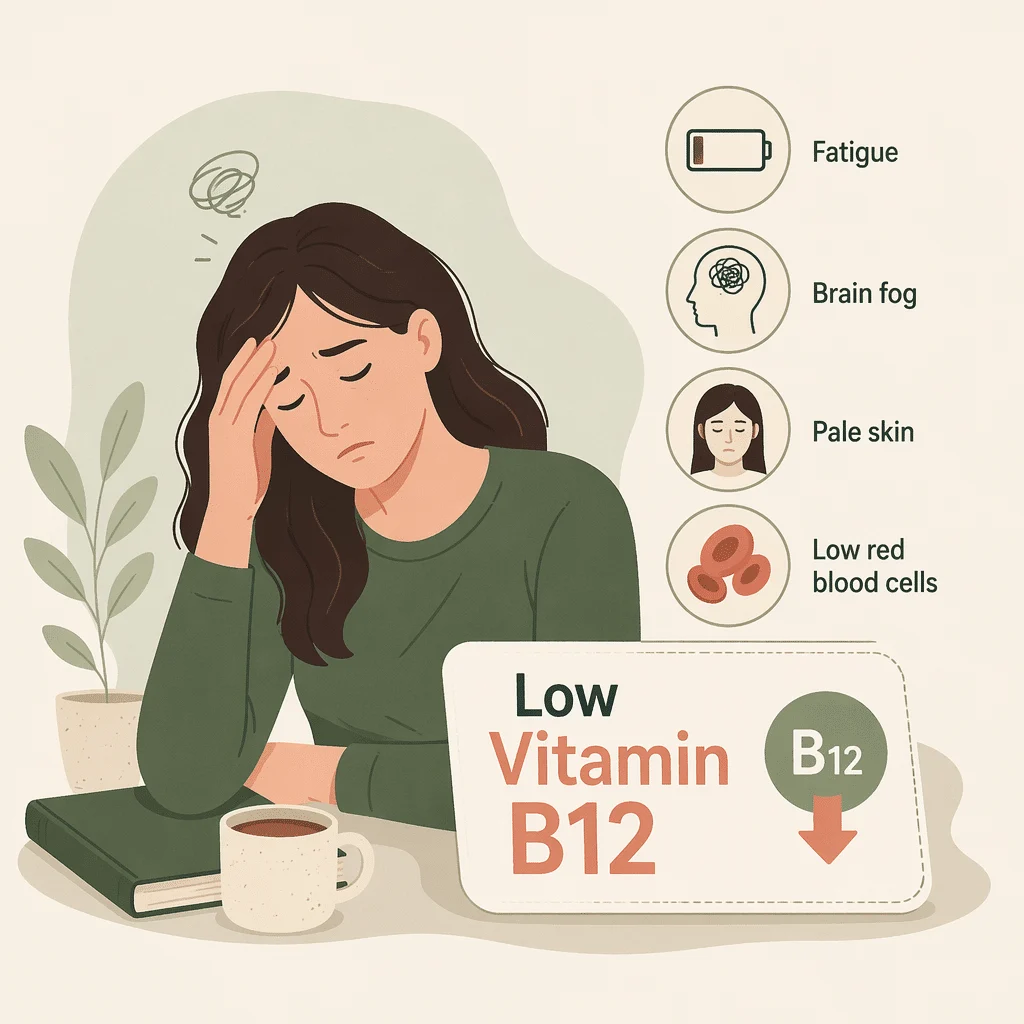
Tiredness that rest does not fix. Breathlessness on stairs or mild exertion. Pale skin, sometimes with a faint yellow tinge. Palpitations. A sore, smooth, unusually red tongue, called glossitis. Mouth ulcers. These overlap almost completely with every other cause of anemia, which is why the cause has to be identified by testing rather than by pattern recognition.
The nerve and brain group
Numbness, tingling or burning in the feet and hands, typically on both sides and typically starting at the toes. Loss of vibration sense. An unsteady, wide-based walk that worsens in poor light. Weakness in the legs. Problems with memory, concentration and word-finding. Irritability, low mood, or a personality change that other people notice first. Less often, blurred or dim central vision from damage to the optic nerve.
Because these can start in one small area, a persistently numb big toe or a numb patch on the sole is worth mentioning to a doctor rather than waiting for it to spread.
The causes worth finding
Finding low B12 is only half the job. The cause determines what happens next, and several common causes are routinely under-recognized.
Pernicious anemia
The classic cause. The immune system attacks the parietal cells of the stomach lining, so intrinsic factor is no longer produced and B12 cannot be absorbed however much is eaten. Two antibody tests are used: intrinsic factor antibodies, which are highly specific but miss around half of cases, and parietal cell antibodies, which are more sensitive but less specific. Pernicious anemia often travels with other autoimmune conditions, so thyroid function is usually checked alongside it.
Metformin
Metformin is one of the most widely prescribed medicines in the world, and it interferes with calcium-dependent uptake of B12 in the terminal ileum. The effect builds with dose and duration, so it tends to appear after years rather than months, and it is frequently not monitored.
This matters twice over, because diabetic nerve damage and B12 nerve damage cause the same tingling feet. Attributing the symptom to diabetes alone can leave a treatable second cause sitting untouched. If you take metformin, particularly if you have had raised glucose levels for years, ask your doctor whether your B12 has been checked recently. Do not stop or change the medicine yourself; the request is for monitoring, not for withdrawal.
Long-term acid suppression
Proton pump inhibitors and H2 blockers reduce stomach acid, and stomach acid is what prises B12 free from food protein. Used over years, they can reduce how much B12 you extract from a perfectly adequate diet. The same rule applies: ask about checking your level, but never stop a prescribed medicine on your own.
Surgery, gut disease and age
Gastric surgery and bariatric procedures remove or bypass the parts of the stomach that make acid and intrinsic factor, so deficiency afterwards is expected rather than surprising. Crohn’s disease affecting the terminal ileum, or surgical removal of that segment, takes out the absorption site itself. Celiac disease, pancreatic insufficiency and bacterial overgrowth interfere in their own ways; celiac serology is often part of the work-up.
With age, stomach acid production falls. The result is food-bound malabsorption: B12 in a supplement is absorbed normally, but B12 locked inside food protein is not released properly. This is a common and easily missed reason for low levels in older adults.
Vegan and strict vegetarian diets
Vitamin B12 is made by bacteria, and in the human diet it comes almost entirely from animal foods and fortified products. A vegan or strict vegetarian diet without a reliable fortified or supplemental source will eventually produce deficiency; the liver store simply delays it. There is no judgement in this. The fix is straightforward and the point is awareness.
It matters most in pregnancy and breastfeeding. A breastfed infant depends on the mother’s B12 status, and deficiency in infancy can cause failure to thrive, loss of skills already gained and lasting developmental harm. Anyone pregnant, planning a pregnancy or breastfeeding on a plant-based diet should raise B12 specifically with their midwife or doctor.
Nitrous oxide
Recreational nitrous oxide, known as nos, whippits, balloons or laughing gas, is a rising cause of serious spinal cord injury in young people, and it works differently from every other cause here.
Nitrous oxide oxidizes the cobalt atom at the center of the B12 molecule and permanently inactivates it. The vitamin is still in your bloodstream; it simply no longer works. This has two consequences that matter for anyone reading this. First, damage can develop quickly, over weeks of heavy use rather than years. Second, a serum B12 result can come back normal in someone who is already developing a myelopathy, because the test measures the molecule, not whether it is functioning.
The presentation is usually numbness and tingling that starts in the feet or hands and climbs, followed by unsteady walking and sometimes weakness. Taking B12 supplements alongside continued use does not reliably prevent it. If you use nitrous oxide and you have new tingling, numbness or difficulty walking, this needs urgent medical assessment, not a wait-and-see approach. Early treatment is the single biggest determinant of whether the damage reverses.
Why the blood test can mislead, and what MMA and homocysteine add
The standard test is serum total vitamin B12. It is useful, cheap and widely available, and it has a weakness patients are rarely told about.
Most of the B12 circulating in your blood is bound to a carrier protein called haptocorrin, and that fraction cannot be delivered into cells. Only the portion bound to transcobalamin, known as active B12 or holotranscobalamin, is available for use. Serum total B12 measures both, so it is dominated by the inactive pool. A result inside the “normal” range therefore does not exclude tissue deficiency, especially when the symptoms fit. Our guide to vitamin B12 blood test results covers how the number is reported.
When the picture is unclear, two metabolites help, because they measure whether B12 is doing its job inside cells rather than how much is floating past. Methylmalonic acid, or MMA, accumulates when B12 is not available for one of its two enzyme reactions, and it rises early and fairly specifically. Homocysteine rises too, though it also rises when folate is low, in kidney impairment and in some inherited conditions, so it is less specific. Some laboratories offer active B12 directly. Kidney function is taken into account when interpreting either metabolite.
One more point deserves emphasis. Starting B12 supplements before you are tested makes the result uninterpretable. The number rises, the metabolites normalize, and the opportunity to establish whether you were deficient, and why, is lost. If you are being investigated, tell your doctor about everything you already take.
What happens after an abnormal result
Three things follow, in order. Confirming the deficiency is real, usually by repeating the level and adding MMA or homocysteine when the first result was borderline or when symptoms and numbers disagree. Finding the cause, through intrinsic factor and parietal cell antibodies, celiac serology, a medication review, a dietary history and questions about surgery, gut disease and nitrous oxide. Then treatment, which follows from the cause.
That last point is where the route matters. If the problem is dietary, oral replacement addresses it. If the problem is a failure of absorption, such as pernicious anemia or an absent terminal ileum, tablets alone are not a reliable answer and injections are generally used instead. Which route, and for how long, is a prescriber’s decision based on the cause, the severity and whether nerves are involved. This article deliberately does not give amounts or schedules.
What it does say clearly is this: do not self-supplement to see whether your symptoms improve. It obscures the diagnosis, it can leave the underlying cause unaddressed, and where nerve symptoms are already present, the delay is exactly what turns reversible damage into permanent damage.
| Situation | What it usually means | What to do |
|---|---|---|
| Low B12 with a completely normal blood count | Entirely possible and not reassuring; anemia is a late feature, not an early one | Treat the B12 result as real and ask for the cause to be investigated |
| Borderline B12 with tingling feet or unsteady walking | The number may be underselling a genuine tissue deficiency | Ask whether MMA, homocysteine or active B12 would clarify it, before starting anything |
| Low B12 while taking metformin or a long-term acid-suppressing medicine | A recognized drug-related effect that builds over years | Ask about monitoring and about how it will be managed; never stop the medicine yourself |
| Low B12 on a vegan or strict vegetarian diet | Usually intake rather than absorption, but absorption is still worth excluding | See your doctor; flag pregnancy, breastfeeding or a breastfed infant as a priority |
| Nerve symptoms in someone using nitrous oxide, even with a normal B12 | Functional deficiency; the vitamin is present but inactivated | Seek urgent assessment and say that nitrous oxide has been used |
Red flags that need prompt medical assessment
Any of the following should be assessed by a doctor rather than met with a supplement:
- Numbness, tingling or burning in the hands or feet
- Unsteadiness when walking, especially in the dark or with the eyes closed
- New problems with memory, thinking or personality
- Blurred, dim or altered central vision
- Any of the above in someone using nitrous oxide, which needs urgent assessment
- Severe breathlessness, chest pain or fainting
- Suspected B12 deficiency in pregnancy, in breastfeeding, or in an infant
With neurological symptoms, the interval between noticing them and starting treatment is the part you can still influence.
Latest scientific advances in vitamin B12 testing
A 2025 multicenter French cohort published in Revue Neurologique, led by Florian Boulin, described 41 people with neurological damage after recreational nitrous oxide use. What was found: most had myeloneuropathy, meaning both the spinal cord and the peripheral nerves were affected, and serum B12 was normal in most of them, with raised homocysteine and methylmalonic acid confirming a functional deficiency. What this means for you: a normal B12 number does not settle the question when nitrous oxide is involved, and the metabolites are what reveal the problem.
A 2024 case series and literature review in The Neurologist, led by Maud Pichon, pooled 154 published patients with nitrous oxide-related neurological disease. What was found: the typical patient was in their early twenties, and those left with lasting disability were more likely to have had a motor deficit at presentation, regular use, lower B12 and higher homocysteine. What this means for you: severity at the first assessment predicts the outcome, which argues for going early rather than waiting.
A 2024 hospital case series in The New Zealand Medical Journal, led by Shilpan Patel, reviewed 12 patients admitted with nitrous oxide-associated myelopathy. What was found: several of them had been taking over-the-counter B12 supplements while continuing heavy use, and still developed spinal cord injury. What this means for you: supplementing does not neutralize ongoing exposure, and it should not be treated as a safeguard.
A 2025 systematic review and meta-analysis in BMJ Nutrition, Prevention & Health, led by Daya Krishan Mangal, pooled 132 studies covering more than 52,000 people with type 2 diabetes. What was found: B12 deficiency was notably more frequent in the group taking metformin. What this means for you: if you take metformin long term, asking whether your B12 has been checked is a reasonable, evidence-based question.
A 2024 diagnostic accuracy study in Cureus, led by Noareen Tufail, compared holotranscobalamin, the active fraction, with serum total B12 in 95 patients with megaloblastic anemia, using methylmalonic acid as the reference standard. What was found: the active fraction identified deficiency far more reliably than total B12, which missed a substantial share of cases. What this means for you: where active B12 is offered it can resolve an ambiguous total B12, though not every laboratory provides it.
Glossary of key terms
| Term | Definition |
|---|---|
| Cobalamin | The chemical name for vitamin B12, built around a central cobalt atom |
| Intrinsic factor | A protein made by the stomach lining that B12 must bind to before it can be absorbed |
| Pernicious anemia | An autoimmune condition in which the stomach stops making intrinsic factor, blocking B12 absorption |
| Terminal ileum | The last part of the small intestine, and the only site where B12 bound to intrinsic factor is taken up |
| Myelin | The insulating sheath around nerve fibers; B12 is needed to build and maintain it |
| Subacute combined degeneration | Damage to the back and side tracts of the spinal cord from B12 deficiency, causing numbness, unsteadiness and weakness |
| Holotranscobalamin | Active B12, the fraction bound to transcobalamin and actually available to cells |
| Methylmalonic acid (MMA) | A substance that builds up when cells cannot use B12; rises early in true deficiency |
| Homocysteine | An amino acid that rises when B12 or folate is low, and in some other conditions |
| Myeloneuropathy | Damage affecting the spinal cord and the peripheral nerves at the same time |
Frequently asked questions
Can I have a B12 deficiency with a normal test result?
Yes. Serum total B12 measures mostly the inactive, protein-bound fraction, so a result inside the reference range does not exclude deficiency at tissue level, particularly if you have typical neurological symptoms. This is a known limitation of the test rather than a rare exception. When the number and the symptoms disagree, methylmalonic acid, homocysteine or active B12 can settle it, because they reflect whether B12 is actually being used inside cells. Nitrous oxide is the clearest example: it inactivates the vitamin without necessarily lowering the measured level.
Should I just take B12 tablets and see if I feel better?
No, and this is worth being firm about. Supplementing before testing makes the result uninterpretable, so nobody can tell afterwards whether you were deficient or why. It can also partially mask symptoms while the underlying cause continues. Most importantly, if you already have numbness, tingling or unsteadiness, absorption failure may mean tablets do not deliver enough, and time spent waiting is time in which reversible nerve damage can become permanent. Get tested first, then treated according to the cause.
How long does it take to feel better?
The two symptom groups recover on very different timescales. Blood counts typically begin improving within the first couple of weeks of effective treatment, and the fatigue tends to lift over the following weeks. Nerve symptoms are slower: improvement is usually measured in months, and it can continue for six to twelve months or longer. Some recovery may be incomplete if the deficiency went unrecognized for a long time. Your doctor will monitor both the response and the underlying cause.
Does taking metformin mean I will become deficient?
Not inevitably, but the risk is real and it increases with dose and with years of use. That is why B12 is worth checking periodically in anyone on long-term metformin, and particularly in anyone who develops tingling or numbness in the feet, since diabetic nerve damage and B12 nerve damage look alike. Raise it at a routine appointment. The action is to check the level and manage what is found, not to stop a medicine that is treating your diabetes.
Is B12 deficiency from nitrous oxide reversible?
Often, but not always, and the difference is usually timing. People assessed and treated soon after symptoms begin tend to recover well. Those who continue using after symptoms appear, or who present with leg weakness rather than tingling alone, are more likely to be left with lasting problems. Stopping exposure is part of the treatment, not an optional extra. If you have tingling, numbness or difficulty walking and you use nitrous oxide, seek assessment now and tell the clinician about the use.
Do I need a B12 test if I am vegan and feel fine?
Feeling fine is not strong evidence, because the liver store can mask a shortfall for years and the earliest nerve symptoms are subtle. If you follow a vegan or strict vegetarian diet without a reliable fortified or supplemental source, it is reasonable to discuss testing with your doctor, and more than reasonable if you are pregnant, planning a pregnancy, breastfeeding, or feeding a breastfed infant. In those situations the consequences of missing it fall on someone whose nervous system is still developing.
Sources
- National Institutes of Health, Office of Dietary Supplements. Vitamin B12: Fact Sheet for Health Professionals. https://ods.od.nih.gov/factsheets/VitaminB12-HealthProfessional/
- MedlinePlus, U.S. National Library of Medicine. Vitamin B12 deficiency anemia. https://medlineplus.gov/ency/article/000574.htm
- National Institute of Neurological Disorders and Stroke. Peripheral Neuropathy. https://www.ninds.nih.gov/health-information/disorders/peripheral-neuropathy
- Boulin F, Bedat-Millet AL, Didier-Laurent A, Louillet F, Quesney G, Hebant B, Sudrie-Arnaud B, Maltete D, Welter ML, Guyant-Marechal L, Zourdani L. Neurological damage from recreational nitrous oxide use: two distinct electroclinical profiles in a retrospective cohort. Revue Neurologique. 2025. https://doi.org/10.1016/j.neurol.2025.07.002
- Pichon M, Majhadi L, Menn AM. Neurological manifestations induced by nitrous oxide abuse: a case series and review of literature. The Neurologist. 2024. https://doi.org/10.1097/NRL.0000000000000531
- Patel SG, Zhang T, Liem B, Sundram F, Roxburgh RH, Barber PA. Nitrous oxide myelopathy: a case series. The New Zealand Medical Journal. 2024. https://doi.org/10.26635/6965.6477
- Mangal DK, Shaikh N, Tolani H, Gautam D, Pandey AK, Sonnathi Y, Gupta SD, Kalra S, Sharma KC, Prasad J, Tewari R, Anwar F. Burden of micronutrient deficiency among patients with type 2 diabetes: systematic review and meta-analysis. BMJ Nutrition, Prevention & Health. 2025. https://doi.org/10.1136/bmjnph-2024-000950
- Tufail N, Kataria M, Chaudhary AJ, Dhillon RA, Asif Naveed M, Mohsin S. Comparing holotranscobalamin and total vitamin B12 in diagnosing vitamin B12 deficiency in megaloblastic anemia patients. Cureus. 2024. https://doi.org/10.7759/cureus.71278
Further reading
- Folate deficiency: symptoms, causes and why B12 is checked first
- High B12 levels: causes, symptoms and risks
- Understanding high MCV levels: causes and symptoms
- Vitamin B12: benefits, sources and levels
- Gluten intolerance and celiac disease
Understand your lab results with AI DiagMe
A vitamin B12 result rarely stands alone. It usually arrives next to folate, a full blood count and an MCV, and the meaning sits in how those numbers relate to each other and to your symptoms. AI DiagMe reads your report and explains, in plain language, what each value refers to and which questions are worth raising. It helps you understand your results. It does not diagnose deficiency and it does not replace your doctor.
Get your results interpreted in minutes