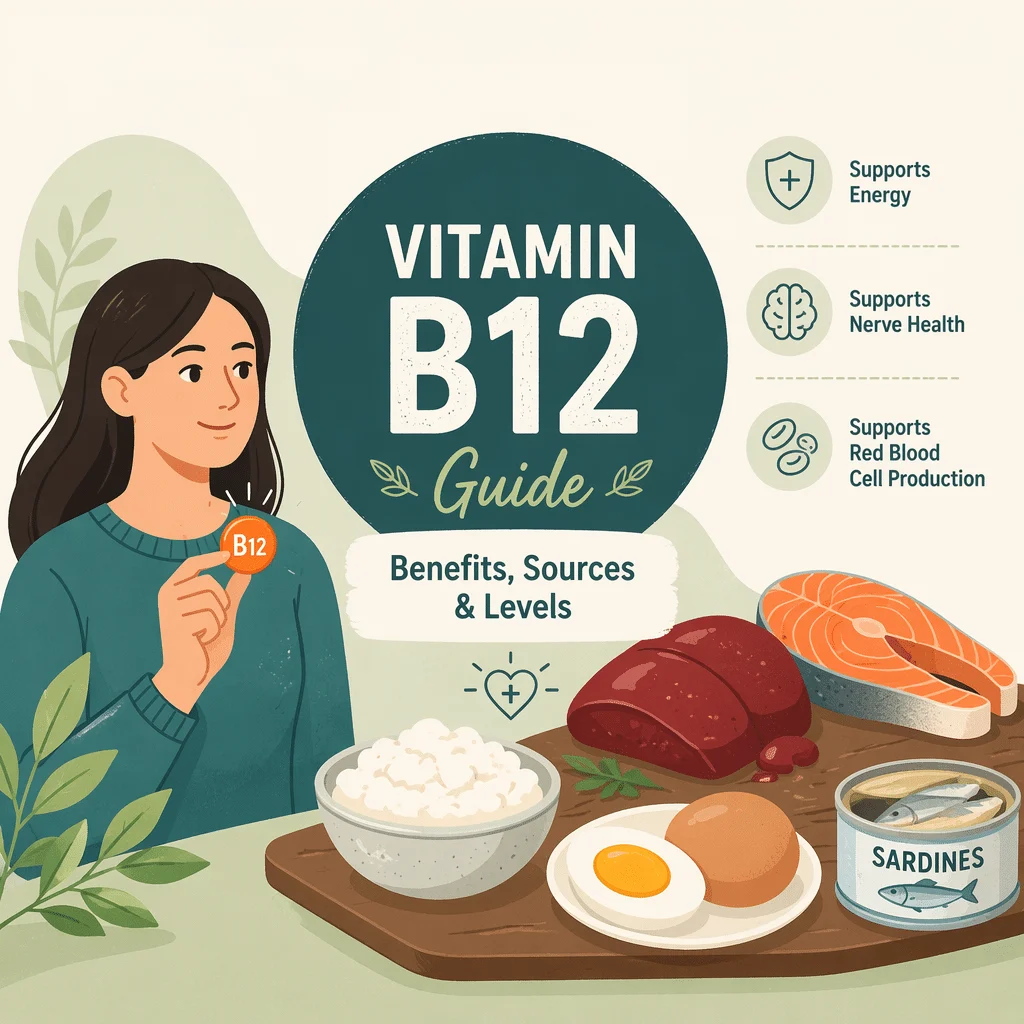
Vitamin B12 deficiency is one of the most common — and most easily missed — nutrient problems, partly because its early signs (tiredness, brain fog, low mood) are so simple to blame on a busy life. Vitamin B12, also called cobalamin, helps your body make red blood cells, keep nerves healthy, and build DNA, so running low can quietly affect your energy, memory, and even how your hands and feet feel. This guide walks through the benefits of vitamin B12, the symptoms and causes of deficiency, how it is tested, what counts as a normal level, the best food sources, and how a deficiency is treated.
What vitamin B12 does — and its main benefits
Vitamin B12 works behind the scenes in three big jobs. It helps your bone marrow make healthy red blood cells, which is why a shortage can lead to anemia and fatigue. It keeps your nervous system in good repair by helping build myelin, the protective coating around nerves. And it is essential for DNA synthesis, so fast-dividing tissues depend on it. B12 also teams up with folate (vitamin B9) to keep homocysteine in check, an amino acid linked to heart and vessel health when it climbs too high.
One honest caveat on “benefits”: extra B12 does not give an energy boost if your levels are already fine. The real benefit is preventing the problems that a deficiency causes. That matters most for people with higher needs or absorption issues — older adults, people who eat little or no animal food, and women who are pregnant or breastfeeding, where adequate B12 supports the baby’s developing brain and nervous system.
Vitamin B12 deficiency symptoms
Because your liver stores a few years’ worth of B12, deficiency usually develops slowly, and symptoms can be vague at first. Early vitamin B12 deficiency symptoms often include persistent tiredness, weakness, brain fog, trouble concentrating, low mood, pale or slightly yellow skin, and a sore, smooth, or red tongue.
As a deficiency deepens, it can affect the nerves. Classic neurological signs include pins-and-needles, numbness or tingling in the hands and feet, balance problems, muscle weakness, and memory or thinking changes. These nerve symptoms are the most important to catch early, because if a severe deficiency goes untreated for a long time, some of the damage can become permanent. Symptoms overlap heavily with iron and folate problems, which is why testing — not guessing — is the safe path. If you want a symptom-by-symptom breakdown, see our detailed guide to low vitamin B12 symptoms, causes, and treatments.
What causes vitamin B12 deficiency
B12 is found naturally only in animal foods, and absorbing it is a multi-step process that needs stomach acid and a protein called intrinsic factor. Anything that disrupts intake or absorption can cause a deficiency. The most common causes are:
- Diet: vegans and many vegetarians get little natural B12, since it is not reliably present in plant foods.
- Pernicious anemia: an autoimmune condition where the body attacks the cells that make intrinsic factor — the leading cause of severe, clinically obvious deficiency.
- Age-related low stomach acid (atrophic gastritis), which makes it harder to release B12 from food.
- Medications: long-term use of metformin (for diabetes) and acid-reducing drugs such as proton pump inhibitors (PPIs) and H2 blockers can lower absorption over time.
- Gut conditions and surgery: celiac disease, Crohn’s disease, and weight-loss (bariatric) surgery all reduce how much B12 you take in.
- Other: dialysis and heavy alcohol use can also play a role.
How doctors diagnose vitamin B12 deficiency
Diagnosis usually starts with a simple vitamin B12 blood test that measures the total amount in your serum. That first test is useful but imperfect: it can miss an early or “functional” deficiency, where your cells are short on B12 even though the blood number looks acceptable. To sharpen the picture, clinicians may add active B12 (holotranscobalamin, the fraction your cells can actually use) and two functional markers — methylmalonic acid (MMA) and homocysteine — which rise when B12 is low.
A complete blood count adds context: B12 deficiency classically enlarges red blood cells, so a high MCV (macrocytosis) is a common clue. If pernicious anemia is suspected, an intrinsic factor antibody test can help confirm it. Not sure what the codes on your report mean? Our lab test abbreviations guide can help.
| Test | Typical adult reference | Suggests deficiency | Good to know |
|---|---|---|---|
| Serum (total) B12 | ~200–900 pg/mL (148–664 pmol/L) | Below ~200 pg/mL; 200–300 is a gray zone | First-line test; can miss early or functional deficiency |
| Active B12 (holotranscobalamin) | Lab-specific | Low | Reflects the B12 your cells can actually take up |
| Methylmalonic acid (MMA) | Below ~0.27 µmol/L | Elevated | Rises early; a more specific sign of true B12 shortage |
| Homocysteine | Below ~15 µmol/L | Elevated | Sensitive but not specific (also rises with low folate or kidney issues) |
| CBC / MCV | MCV ~80–100 fL | High MCV (large red cells) | Can look normal if iron deficiency is also present |
Reference ranges vary between laboratories and by the method used, so always read your result against your own lab’s range and alongside your symptoms.
Normal vitamin B12 levels: what the numbers mean
As a rough guide used by many U.S. labs, a serum B12 below about 200 pg/mL (148 pmol/L) points to deficiency, while 200–300 pg/mL is a borderline “gray zone” that often needs a confirmatory MMA or active B12 test. Levels comfortably above that are usually considered adequate. The catch is that “normal” on a lab report is a statistical range, not a personal guarantee — some people have symptoms and abnormal functional markers while their total B12 still reads low-normal. That is exactly why clinicians look at the whole picture rather than a single line.
How vitamin B12 deficiency is treated
Treatment for vitamin B12 deficiency has two goals: refill your stores and fix the underlying cause. The right route and dose depend on how severe the deficiency is and why it happened.
- B12 injections: intramuscular B12 (often as hydroxocobalamin or cyanocobalamin) is the traditional choice for pernicious anemia, malabsorption, or when there are neurological symptoms. It typically involves several “loading” doses followed by maintenance shots every one to three months.
- High-dose oral or sublingual B12: for dietary shortfalls — and, increasingly, for selected absorption problems — daily high-dose tablets (commonly 1,000–2,000 mcg) can work well, because a small fraction is absorbed passively without intrinsic factor.
- Diet and fortified foods: important for prevention and for milder, diet-related cases, especially in people who eat little animal food.
Blood counts usually start improving within a few weeks. Neurological symptoms can take months to recover and may not fully reverse if the deficiency was severe and long-standing — another reason not to wait. Your clinician will choose the dose, route, and follow-up testing that fit your situation, and will recheck your levels to confirm you are back on track.
Vitamin B12 foods and how much you need
Most adults need about 2.4 mcg of vitamin B12 per day, rising to 2.6 mcg in pregnancy and 2.8 mcg while breastfeeding (infants need far less, around 0.4–0.5 mcg). Vitamin B12 is found naturally in animal foods, and a few servings usually cover daily needs. Vegans and vegetarians should rely on fortified foods or a supplement, since plants are not a dependable source.
| Food | Vitamin B12 per serving |
|---|---|
| Beef liver, cooked, 3 oz | 70.7 mcg |
| Clams, cooked, 3 oz | 17 mcg |
| Fortified nutritional yeast, ¼ cup | 8.3–24 mcg |
| Salmon, cooked, 3 oz | 2.6 mcg |
| Milk (2%), 1 cup | 1.3 mcg |
| Fortified breakfast cereal, 1 serving | ~0.6 mcg |
Other everyday sources include eggs, poultry, beef, tuna, trout, and dairy. Because animal foods dominate this list, plant-based eaters get the biggest benefit from planning fortified foods or a daily supplement into their routine.
Who is at higher risk
Some groups should be more alert to vitamin B12 deficiency: older adults (lower stomach acid and appetite), vegans and long-term vegetarians, pregnant and breastfeeding women following plant-based diets, people taking metformin or acid-reducing medicines for a long time, and anyone who has had bariatric or other gastrointestinal surgery. People on dialysis are also at higher risk. If you fall into one of these groups — especially with symptoms — it is reasonable to ask your clinician whether a B12 check makes sense.
Vitamin B12 supplements: safety, side effects, and interactions
Vitamin B12 is water-soluble and has very low toxicity, so there is no established upper limit — your body simply excretes what it does not use. That is why high-dose supplements, including common 1,000 mcg and even 5,000 mcg tablets, are generally considered safe for most people. The practical point is that more is not automatically better: taking large doses will not help if the real issue is something else, and it will not fix a cause like a medication effect on its own.
Side effects are uncommon. Injections can cause mild soreness at the injection site, and true allergic reactions are rare. Two interactions are worth remembering: long-term metformin and acid-reducing drugs can lower B12 over time, and high-dose folic acid (or heavy intake of folate) can mask the anemia of B12 deficiency while nerve damage quietly continues — so B12 and folate are best assessed together. If you are starting or stopping a supplement because of symptoms, it is safer to test first than to treat blind.
Latest scientific advances
Research on vitamin B12 has moved quickly over the past three years, especially around how deficiency is defined, diagnosed, and treated. Four recent developments stand out (always discuss what they mean for you with your own clinician).
“Normal” B12 may not be enough for the aging brain. A 2025 study in Annals of Neurology followed healthy older adults and found that lower vitamin B12 levels — even within today’s normal range — were linked to slower processing speed and more white-matter changes on brain scans, signs of subtle nerve injury. What this means for you: a low-normal result is not automatically “fine,” especially with symptoms, and functional markers like MMA can add clarity (doi.org/10.1002/ana.27200).
No single test is perfect. A 2024 review in Annals of Clinical Biochemistry confirmed there is no gold-standard test for B12 status and recommended combining serum B12 with active B12 (holotranscobalamin), MMA, and homocysteine when results are unclear. What this means for you: if your serum B12 is borderline, it is reasonable to ask whether an active B12 or MMA test would help (doi.org/10.1177/00045632241292432).
Pills may work even in pernicious anemia. Injections have long been the default for pernicious anemia, but a 2024 prospective study in The American Journal of Clinical Nutrition found that high-dose oral B12 restored levels in many patients through passive absorption. What this means for you: some people may be able to move from injections to tablets — but only under medical supervision (doi.org/10.1016/j.ajcnut.2024.05.019).
A hidden autoimmune cause in the brain. In 2024, researchers writing in Science Translational Medicine described an autoantibody (anti-CD320) that blocks B12 from reaching the brain, causing neurological symptoms despite normal blood levels. What this means for you: it helps explain some rare, puzzling neurological cases and points toward smarter testing in the future (doi.org/10.1126/scitranslmed.adl3758).
Glossary of key terms
- Cobalamin: the scientific name for vitamin B12.
- Intrinsic factor: a stomach protein needed to absorb B12; without it, absorption fails.
- Pernicious anemia: an autoimmune condition that destroys intrinsic factor production, causing severe B12 deficiency.
- Active B12 (holotranscobalamin): the portion of B12 in your blood that cells can actually use.
- Methylmalonic acid (MMA): a substance that builds up when B12 is low; a specific functional marker of deficiency.
- Homocysteine: an amino acid that rises when B12 or folate is low.
- Macrocytic (megaloblastic) anemia: anemia with abnormally large red blood cells, a classic sign of B12 or folate deficiency.
Frequently asked questions
What vitamin B12 level is considered deficient?
Many labs treat a serum B12 below about 200 pg/mL (148 pmol/L) as deficient, with 200–300 pg/mL a borderline zone. Because ranges vary and the blood number can miss a functional shortage, clinicians often confirm unclear results with methylmalonic acid (MMA) or active B12 testing.
How is vitamin B12 deficiency treated, and how long does recovery take?
Treatment refills B12 with injections or high-dose oral supplements and addresses the cause. Blood counts usually improve within a few weeks. Nerve-related symptoms can take months to recover and may not fully reverse if the deficiency was severe and long-standing, which is why early treatment matters.
Are B12 injections better than tablets?
Not always. Injections are preferred for severe deficiency, neurological symptoms, or clear malabsorption, but research shows high-dose oral B12 works for many people — including some with pernicious anemia. The best route depends on your cause and severity, so decide with your clinician.
Is 5,000 mcg of vitamin B12 too much?
For most people it is not harmful, because B12 is water-soluble and excess is excreted, so there is no established upper limit. That said, a very high dose is not automatically better — if you have symptoms, it is worth testing to find and fix the cause rather than simply taking more.
Can vegans and vegetarians get enough B12 from food?
Not reliably from natural plant foods. Vegans, and many vegetarians, should use fortified foods (such as fortified nutritional yeast, plant milks, or cereals) or a B12 supplement to meet their needs, especially during pregnancy and breastfeeding.
Do metformin and acid-reducing medicines cause B12 deficiency?
They can lower B12 over time. Long-term metformin and acid reducers such as proton pump inhibitors reduce how much B12 you absorb, so periodic checks are sensible if you take them for years — particularly alongside other risk factors.
Can vitamin B12 deficiency be a sign of something serious like cancer?
A deficiency itself is usually caused by diet or absorption problems rather than cancer. However, pernicious anemia (an autoimmune cause) slightly raises the long-term risk of stomach cancer, so it warrants follow-up. Separately, an unusually high B12 level — the opposite of deficiency — can occasionally reflect liver disease or blood disorders and should be reviewed by a clinician.
Sources
- National Institutes of Health, Office of Dietary Supplements. Vitamin B12 — Health Professional Fact Sheet, 2024. ods.od.nih.gov
- Vitamin B12 (clinical review). BMJ, 2023;383:e071725. doi.org/10.1136/bmj-2022-071725
- The application and interpretation of laboratory biomarkers for the evaluation of vitamin B12 status. Annals of Clinical Biochemistry, 2024. doi.org/10.1177/00045632241292432
- Vitamin B12 levels and biomarkers of central nervous system injury in older adults. Annals of Neurology, 2025. doi.org/10.1002/ana.27200
- Oral vitamin B12 supplementation in pernicious anemia: a prospective cohort study. The American Journal of Clinical Nutrition, 2024. doi.org/10.1016/j.ajcnut.2024.05.019
- Transcobalamin receptor antibodies in autoimmune vitamin B12 central deficiency. Science Translational Medicine, 2024. doi.org/10.1126/scitranslmed.adl3758
- Vitamin B12 Deficiency: Common Questions and Answers. American Family Physician, 2025. pubmed.ncbi.nlm.nih.gov
Understand your lab results with AI DiagMe
A single vitamin B12 deficiency result is easier to make sense of when you can see it alongside your other markers — your complete blood count, MCV, folate, and homocysteine — instead of staring at one highlighted line. AI DiagMe helps you understand what your results mean together and prepare better questions for your doctor. It supports your understanding through AI-assisted blood analysis; it does not diagnose and does not replace your clinician. Get a clear interpretation in minutes.