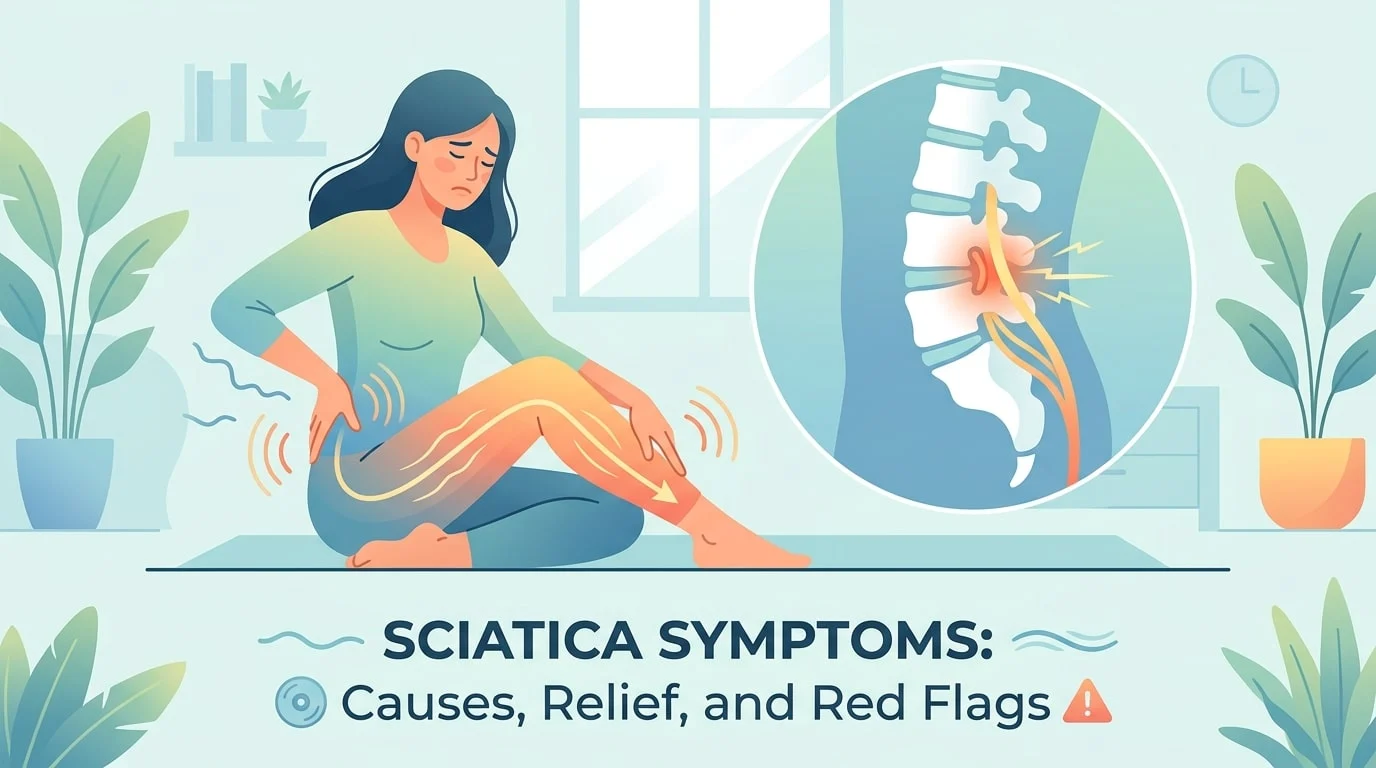
Sciatica symptoms usually announce themselves as a sharp, shooting pain that travels from the lower back, through the buttock and down one leg. The discomfort comes from irritation or pressure on the sciatic nerve, the longest nerve in the body. For most people the problem eases within a few weeks, but the pain can be intense, and a few warning signs mean you should be seen quickly. This article explains what sciatica symptoms feel like, what causes them, the red flags to take seriously, how the condition is diagnosed, and the treatments that help. You will also find a comparison table, a glossary, and answers to common questions.
What sciatica symptoms feel like
Sciatica almost always affects just one side of the body. The sensation can range from a mild ache to a burning or electric-shock pain, and it often follows a clear path from the lower back to the back of the thigh and calf. Typical features include:
- Pain that radiates from the lower back or buttock down the leg
- Numbness or a pins-and-needles feeling in the leg or foot
- Muscle weakness in the affected leg
- Pain that worsens when you cough, sneeze or sit for a long time
One part of the leg may hurt while another feels numb. Some people first notice tingling in the back before the pain spreads downward, and in some cases the discomfort reaches the foot and causes numbness in the heel.
What causes sciatica
Sciatica is a symptom of an underlying problem rather than a disease in itself. It happens when something presses on or irritates the sciatic nerve or the nerve roots that form it. Common causes include:
- A herniated (slipped) disk in the lower spine, the most frequent cause
- Bone spurs that narrow the space around the nerve
- Spinal stenosis, a narrowing of the spinal canal
- Pregnancy, as the growing uterus and loosened ligaments add pressure
- Less often, a tumour or cyst pressing on the nerve
Sciatica is one example of a wider group of problems doctors call nerve compression syndrome, and the same mechanism can produce a pinched nerve in the knee. Risk factors that raise your chances include age-related wear on the spine, a job that involves heavy lifting or long periods of sitting, carrying extra weight, smoking, and diabetes, which can make nerves more vulnerable to damage. Another common culprit behind bone spurs is osteoarthritis.
Red flags: when sciatica symptoms are an emergency
Most sciatica is not dangerous, but a small number of cases signal a serious problem with the spinal nerves that needs urgent care. Seek immediate medical attention if you have:
- Loss of control of your bladder or bowels
- Numbness in the inner thighs, groin or saddle area
- Sudden, severe weakness in one or both legs
- Pain following a violent injury, such as a car accident
These can be signs of cauda equina syndrome, a rare but serious condition in which nerves at the base of the spine are compressed. It is treated as an emergency because acting quickly protects long-term function.
How sciatica is diagnosed
A clinician usually recognises sciatica from your description and a physical exam. They will ask how the pain behaves and check your strength, reflexes and sensation. A common bedside check is the straight leg raise test, in which the doctor slowly lifts your straightened leg to see at what point the pain appears.
Imaging is not needed right away for most people, and tests are usually reserved for severe or worsening symptoms or when another cause is suspected. When imaging is used, an MRI or CT scan can show a herniated disk or narrowing around the nerve. Blood tests do not diagnose sciatica, but they can help rule out other explanations: if an inflammatory or infectious cause is a concern, doctors may measure the C-reactive protein (CRP) blood test and add the erythrocyte sedimentation rate.
Could it be something else?
Several conditions can imitate sciatica, and telling them apart guides the right treatment. The table below shows how some common mimics tend to differ and what can help distinguish them.
| Condition that can mimic sciatica | How it tends to differ | What can help tell them apart |
|---|---|---|
| Hip joint problem | Pain centres in the groin and worsens on weight-bearing | Hip examination and imaging |
| Gout | A sudden hot, swollen joint, often the big toe | A uric acid blood test |
| Inflammatory back disease | Stiffness worse in the morning that eases with movement | Inflammation markers such as CRP and ESR |
| Peripheral neuropathy (e.g., from diabetes) | Numbness in both feet in a stocking pattern | Blood sugar checks and nerve tests |
| Muscle strain | Pain stays in the back without shooting down the leg | Physical examination |
If a flare of gout is suspected, a clinician may order a uric acid blood test to check the level in the blood. These checks do not replace a hands-on exam, but they help the picture come together.
Relief and treatment
The good news is that most sciatica improves with simple measures and time. Care usually starts at home and steps up only if needed.
- Cold then heat: ice can ease pain in the first few days, with heat afterwards, about 20 minutes at a time
- Gentle movement and stretching: staying active is better than long bed rest, which can slow recovery
- Over-the-counter anti-inflammatory medicines: these may reduce pain and swelling
- Physical therapy: guided exercises build core strength and relieve pressure on the nerve
- Spinal injections or surgery: reserved for severe, persistent pain or significant nerve problems
Short rest during the first day or two is fine, but too much rest tends to make symptoms last longer. Low-impact activity such as walking or swimming usually helps recovery.
How long does sciatica last?
For most people, sciatica settles within four to six weeks, often without any medical treatment. More stubborn cases can last several weeks or months and may need physical therapy or, occasionally, a procedure. If your pain is not improving after a few weeks, is severe, or keeps coming back, it is worth checking in with a healthcare professional to review the cause and the plan.
Latest evidence on sciatica
Recent research has refined how clinicians describe and treat spine-related leg pain. These findings inform care but should be applied by a professional who knows your situation.
- An international expert group in the journal Pain recommended moving away from the vague label “sciatica” toward clearer terms such as spine-related leg pain, and offered a way to identify when the pain is truly nerve-related. (Schmid and colleagues, 2023)
- A large review in The BMJ found that surgery (discectomy) gave faster early relief of leg pain than non-surgical care, but the advantage shrank over the following months as conservative treatment caught up. (Liu and colleagues, 2023)
- A 2024 review of non-surgical options reported moderate evidence for patient education, exercise therapy, manual therapy and nerve-mobilisation techniques in disk-related sciatica. (El Melhat and colleagues, 2024)
The overall message is reassuring: most people recover with conservative care, and surgery is usually reserved for specific situations rather than a first step.
Glossary of sciatica terms
| Term | Definition |
|---|---|
| Sciatic nerve | The largest nerve in the body, running from the lower back through the buttock and down each leg. |
| Radiculopathy | A pinched or irritated nerve root in the spine that causes pain, numbness or weakness along the nerve. |
| Herniated disk | A spinal disk whose soft centre pushes through its outer layer and can press on a nerve. |
| Spinal stenosis | A narrowing of the spinal canal that can put pressure on the nerves. |
| Straight leg raise test | A bedside check that lifts the straightened leg to reproduce nerve pain. |
| Cauda equina syndrome | A rare emergency caused by compression of the nerves at the base of the spine. |
| Bone spur | A bony overgrowth that can narrow the space around a nerve. |
| Piriformis | A buttock muscle that, when tight, can irritate the sciatic nerve. |
Frequently asked questions
What does sciatica feel like?
Most people describe a sharp or burning pain that shoots from the lower back or buttock down one leg, sometimes with numbness, tingling or weakness. It often gets worse when coughing, sneezing or sitting for a long time, and it usually affects only one side.
How long does sciatica last?
Many cases improve within four to six weeks, often on their own. If pain lasts longer than a few weeks, becomes severe, or keeps returning, see a healthcare professional to review the cause and consider physical therapy or other options.
Does sciatica go away on its own?
Frequently, yes. Mild sciatica often settles with self-care such as gentle movement, stretching and over-the-counter pain relief. Resting too much can actually slow recovery, so staying gently active is usually encouraged.
When should I see a doctor for sciatica?
Get urgent care for loss of bladder or bowel control, numbness in the groin or inner thighs, sudden leg weakness, or pain after a serious injury. Otherwise, contact a professional if pain does not ease within a week, is severe, or gets worse.
Can blood tests diagnose sciatica?
No. Sciatica is diagnosed from your symptoms and a physical exam, supported by imaging when needed. Blood tests are used mainly to rule out other causes, such as gout or an inflammatory or infectious condition, rather than to confirm sciatica itself.
What is the fastest way to relieve sciatica pain?
In the first few days, ice, gentle movement and over-the-counter anti-inflammatory medicine often help most. Avoid prolonged bed rest, and ease back into light activity. If pain is severe or persistent, a clinician can suggest physical therapy or other treatments.
Sources
- Mayo Clinic — Sciatica: Symptoms and causes
- MedlinePlus (U.S. National Library of Medicine) — Sciatica
- Cleveland Clinic — Sciatica
Further reading
- Rheumatoid arthritis: symptoms, causes and treatments
- Fibromyalgia: understanding, diagnosing and treating it
- Gout pain relief: treatments and management
- Arthritis: types, symptoms and treatments
- Knee muscle spasm: causes, symptoms and treatments
Understand your lab results with AI DiagMe
Sciatica is diagnosed from your symptoms and exam, but when leg pain does not fit the usual pattern, blood tests help rule out other causes such as gout, inflammation or a nerve problem linked to diabetes. AI DiagMe helps you make sense of results like uric acid, inflammation markers and blood sugar in plain language, so you can have a more informed conversation with your clinician. It is built to help you understand your results, not to diagnose disease or replace your doctor.
Get your results interpreted in minutes