


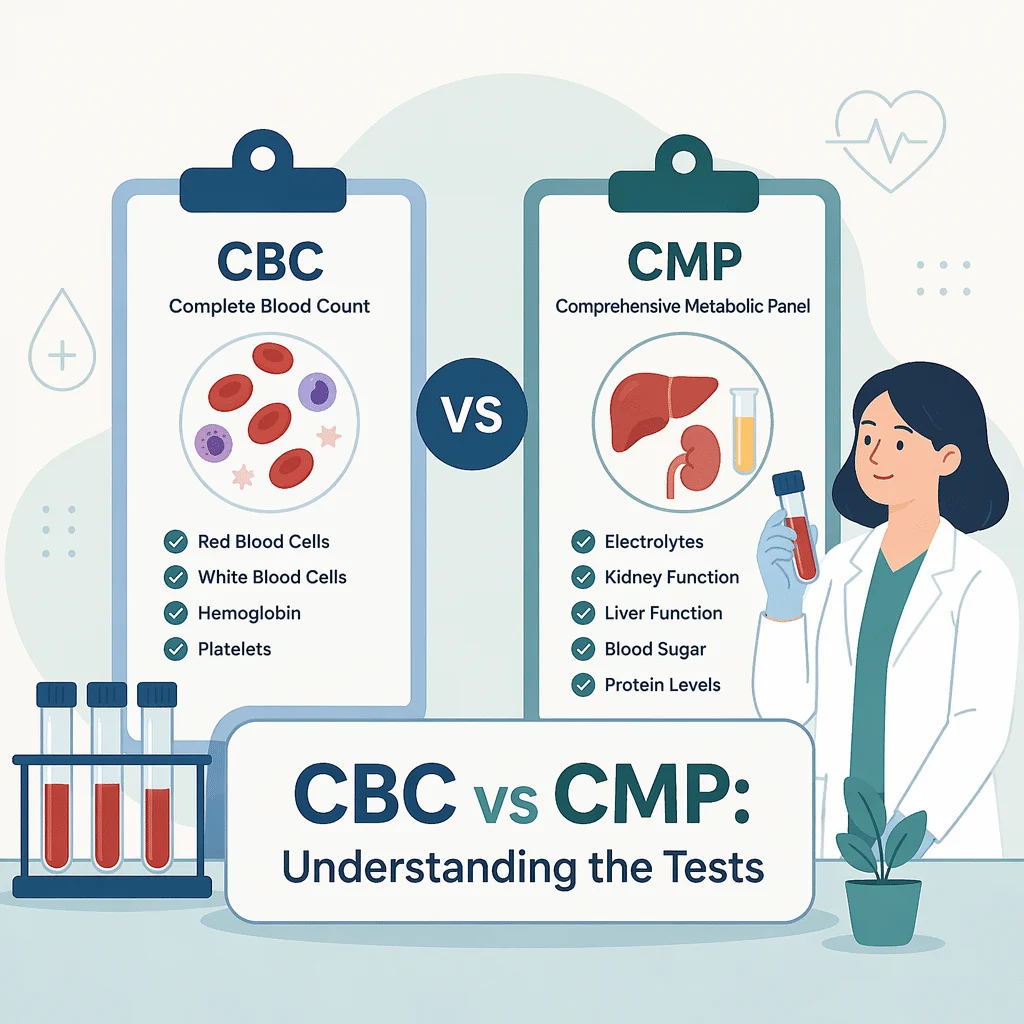
CBC vs CMP is one of the most common questions people ask when they look at a lab order form and see two acronyms sitting side by side. The short answer is that a complete blood count (CBC) examines the cells floating in your blood, while a comprehensive metabolic panel (CMP) examines the chemistry those cells are floating in. They answer different questions, which is exactly why clinicians so often order them together as a baseline rather than choosing between them.
In this article you will learn what each panel measures, what question each one answers, how a comprehensive metabolic panel differs from the shorter basic metabolic panel, why fasting is sometimes requested for one and not the other, what each test can and cannot tell you, and what to do when a value comes back flagged.
CBC vs CMP: the short answer
Both tests start the same way. One blood draw, usually from a vein in the crook of your arm, often filling two differently colored tubes from the same needle stick. What happens next in the laboratory is where they separate.
A complete blood count counts and measures cells. A comprehensive metabolic panel measures substances dissolved in the liquid part of your blood: sugars, salts, waste products, enzymes and proteins. Neither one is the better test. They are simply pointed at different parts of the same sample, and a normal result on one says nothing at all about the other.
| Point of comparison | Complete blood count (CBC) | Comprehensive metabolic panel (CMP) |
|---|---|---|
| What it measures | The cells in your blood: red cells, white cells, platelets, plus calculated red cell indices | The chemistry of your blood: glucose, electrolytes, kidney waste products, liver enzymes, proteins and calcium |
| The question it answers | How are your blood cells doing? | How are your kidneys, liver, blood sugar and salt balance doing? |
| Typical reason it is ordered | Fatigue, suspected anemia, easy bruising or bleeding, immune concerns, routine baseline | Routine baseline, blood pressure or diabetes follow-up, medication monitoring, kidney or liver concerns |
| Number of components | Roughly 8 to 15 reported values, depending on whether a differential is included | 14 substances |
| Fasting | Not needed for the CBC itself | Sometimes requested, because of the glucose measurement |
| Blood draw | One draw | One draw, usually the same one |
What a complete blood count measures: the cells
The CBC is a census of the three cell populations circulating in your blood, plus a set of calculated figures that describe the red cells in more detail.
Red blood cells, hemoglobin and hematocrit
Red blood cells carry oxygen from your lungs to the rest of your body. The panel reports how many there are, how much hemoglobin they contain (hemoglobin is the oxygen-carrying protein packed inside them), and the hematocrit, which is the share of your blood volume made up of red cells. Taken together, these are the first numbers a clinician looks at when anemia is a possibility. This article explains the symptoms and causes of anemia.
The red cell indices
The indices are calculated by the analyzer rather than counted directly. MCV describes the average size of your red cells, MCH and MCHC describe how much hemoglobin they hold, and RDW describes how much the cells vary in size from one another. They matter because they often point toward the reason behind a low hemoglobin: a larger than usual average cell size leads down a different path than a smaller one. Our team covers the causes of a high MCV.
White blood cells and the differential
White blood cells are the cells of your immune system. A basic CBC gives a total count. A CBC with differential breaks that total into its five subtypes: neutrophils, lymphocytes, monocytes, eosinophils and basophils. The breakdown is useful because a perfectly ordinary total can conceal a shift between subtypes. This guide reviews the common causes of high neutrophils.
Platelets
Platelets are the small cell fragments that clump together to stop bleeding. The panel reports how many you have and, on most analyzers, their average size. Counts that drift slightly low or slightly high are usually followed over time rather than acted on from one reading.
Our team also explains how to read a complete blood count, marker by marker.
What a comprehensive metabolic panel measures: the chemistry
According to MedlinePlus, the CMP measures 14 different substances in a sample of your blood. Those 14 fall into four practical groups.
Blood sugar
Glucose is the sugar your cells burn for fuel. A single glucose value on a metabolic panel is a snapshot of one moment, and it is strongly influenced by when you last ate, which is the reason fasting sometimes gets requested. Our team details the meaning of high and low glucose levels.
Electrolytes and acid-base balance
Sodium, potassium, chloride and carbon dioxide (which stands in for bicarbonate) describe your fluid balance and how acidic or alkaline your blood is. These four move with hydration, with vomiting or diarrhea, and with several common medications, diuretics in particular. This article describes the full electrolyte panel.
Kidney markers
Blood urea nitrogen, usually abbreviated BUN, and creatinine are waste products your kidneys are meant to clear from the blood. Creatinine is also used to calculate an estimated glomerular filtration rate, or eGFR, a single figure that summarizes how much blood your kidneys filter each minute. Our team explains the kidney function panel.
Liver enzymes, proteins and calcium
ALT, AST, alkaline phosphatase and bilirubin are the liver-facing members of the panel. Albumin and total protein reflect nutrition, liver production and, in some situations, protein lost through the kidneys or the gut. Calcium sits slightly apart, mattering for bones, nerves and muscle, and part of it travels bound to albumin, which is why the two values are read alongside each other. Our team details the liver panel and its enzymes, and this article covers the causes of low albumin.
For the detail on each of the 14 values, our team walks through every measurement in a comprehensive metabolic panel.
CMP vs BMP: the line on your order form nobody explains
Many people meet a third acronym before they have finished with the second. BMP stands for basic metabolic panel, and the relationship is simpler than it looks: the basic panel is the comprehensive one minus the liver and protein markers. MedlinePlus puts it plainly, describing a BMP as similar to a CMP but containing only 8 of the 14 tests, leaving out total protein, albumin, bilirubin and the liver enzymes.
| Component | Basic metabolic panel (BMP) | Comprehensive metabolic panel (CMP) |
|---|---|---|
| Number of substances measured | 8 | 14 |
| Glucose, electrolytes, BUN, creatinine, calcium | Included | Included |
| Liver enzymes (ALT, AST, alkaline phosphatase) | Not included | Included |
| Bilirubin | Not included | Included |
| Albumin and total protein | Not included | Included |
| What it is usually used for | A quick check of blood sugar, salts and kidney function | The same, plus a look at the liver and at protein status |
So if your form says BMP rather than CMP, nothing has been left off by mistake. Your clinician did not need the liver and protein portion on this occasion. If a liver question comes up later, the comprehensive version can be ordered then.
Why your doctor orders a CBC and a CMP together
Seeing both on one form can look like duplication. It is closer to the opposite: the pairing exists because the two panels barely overlap, so together they cover a lot of ground for very little extra effort.
- They measure almost nothing in common. Nothing on the CBC tells you about kidney filtration. Nothing on the CMP tells you about your platelet count. Run one alone and you leave half the picture blank.
- They cost one needle stick. Both panels are normally run from the same draw, in different tubes, so adding the second means an extra tube rather than an extra appointment.
- Symptoms are rarely specific. Fatigue, for example, can come from the cell side (a low hemoglobin) or from the chemistry side (a thyroid or kidney issue, or blood sugar). Ordering both stops the process from becoming a sequence of one-test-at-a-time guesses.
This is why the combination shows up as a general health baseline, before surgery, at the start of a new medication that needs monitoring, and in follow-up for long-term conditions. It is a wide, cheap, fast first look, not a deep investigation of any one organ.
Fasting, timing and how results reach you
Do you need to fast for a CBC or a CMP?
The complete blood count does not require fasting. Mayo Clinic states that you can eat and drink as usual before a CBC, and that fasting only enters the picture if other tests are being drawn at the same time. The metabolic panel is frequently that other test, because of its glucose measurement. Cleveland Clinic notes that providers sometimes ask patients to avoid food and drink for 10 to 12 hours before a CMP, while MedlinePlus describes fasting for several hours as a possibility rather than a rule. Whether you are asked depends on your clinician, the laboratory and the reason for the test, so follow the instruction printed on your own order rather than a general guideline. Our team explains the fasting rules before a blood test.
How long the results take
Both panels are automated and quick inside the laboratory, and both are usually available to the ordering clinician within the same day or the next. The wait you experience is often longer than the analysis, because results are typically reviewed before release and weekends push the timeline out. If a value is extreme the laboratory does not wait: most treat certain results as critical and telephone the ordering clinician directly.
How the report is laid out
Reports for both panels follow the same layout: the name of the measurement, your value, the unit, and the laboratory’s reference interval, usually with a letter beside anything outside it, commonly H for high and L for low. Each laboratory establishes those intervals from its own population, equipment and methods, which is why the range beside your result may not match a chart you find elsewhere.
What each panel can and cannot tell you
This is where expectations tend to outrun the tests.
A CBC can describe the number, size and mix of your blood cells, and it can flag a pattern that deserves a closer look. It cannot name a diagnosis on its own. Mayo Clinic is explicit on the point, noting that a CBC may not give all the answers about a diagnosis and that results outside the standard range may need follow-up.
A CMP can give a broad picture of kidney filtration, liver enzyme activity, blood sugar at a single moment, and fluid and salt balance. It cannot confirm or exclude a specific disease. A raised liver enzyme is a signal that something has irritated liver cells, not a diagnosis of what.
Neither panel is a cancer screen, and neither one rules out infection or serious illness by itself. Both are wide-angle starting points designed to tell a clinician where to look next, which is a genuinely useful job and a different one from making a diagnosis.
When to see a doctor about a flagged result
A letter beside one number is common, and on its own it is usually not an emergency. Reference intervals are built so that a small share of perfectly healthy people fall outside them, which means isolated flags happen often. Context is what turns a number into information.
- One value slightly outside the interval, no symptoms: reasonable to raise at your next appointment. A single borderline figure is frequently repeated rather than investigated.
- The same value flagged on two separate draws: worth a conversation sooner. A pattern carries far more weight than a one-off.
- A markedly abnormal potassium, calcium, glucose or hemoglobin: expect to be contacted. Laboratories flag extreme values as critical and notify the ordering clinician directly.
- Any flag together with symptoms: shortness of breath, chest pain, confusion, heavy or unexplained bleeding, a fever that will not settle, or a sharp drop in how much you are urinating all warrant prompt care rather than waiting for a scheduled follow-up.
- Flags that appear after starting a new medication: tell the prescriber. Several common drugs shift electrolytes, kidney markers or liver enzymes in predictable ways.
This article explains what abnormal blood test results mean in more detail.
Latest scientific advances
Recent research on these two panels is less about adding new markers than about extracting more meaning from numbers laboratories already produce. Here is what recent studies indexed in PubMed show, in plain language.
The kidney part of the CMP was recalculated
What was found: in 2021 a joint task force of the National Kidney Foundation and the American Society of Nephrology recommended new equations for turning your creatinine result into an eGFR, equations that no longer include race as a variable. A 2024 review explains how and why that change was made, and a 2025 US expert consensus recommended that these race-free equations also replace an older formula still used to adjust medication doses.
What this means for you: the creatinine measured on your CMP has not changed, but the eGFR calculated from it may read slightly differently than on an older report. That difference reflects a change in the arithmetic, not a change in your kidneys, which is worth knowing before you compare a fresh result against one from several years ago.
Ordinary CBC numbers carry more signal than they appear to
What was found: a 2024 study in the journal Clinical Chemistry trained a computer model on seven routine CBC values, using records from eight Dutch laboratories and testing it on a separate one. The model told inherited hemoglobin disorders such as thalassemia apart from iron deficiency anemia with high accuracy, using nothing beyond the numbers a standard blood count already reports.
What this means for you: nothing changes about your blood draw. This is laboratory-side work, aimed at having the analyzer raise a hand when the pattern inside an ordinary CBC deserves a second look. It is still at the development stage rather than something you would ask for by name.
A complete blood count still cannot screen for cancer
What was found: a 2024 systematic review, meaning a study that pools and appraises earlier work rather than collecting new patients, examined ten evaluations of an algorithm that scans routine CBC results to flag people at higher risk of colorectal cancer. The verdict was measured: it identified only a minority of cases and performed well below established methods such as a stool test or a colonoscopy, even though it sometimes flagged people earlier than usual care.
What this means for you: this is a useful negative result. A normal CBC is not a cancer screen, and it should never replace the screening your clinician recommends for your age and risk profile. Where such algorithms may eventually help is in nudging someone toward proper screening, never in standing in for it.
Glossary
| Term | Definition |
|---|---|
| Complete blood count (CBC) | A panel that counts and measures the cells in your blood: red cells, white cells and platelets. |
| Comprehensive metabolic panel (CMP) | A panel of 14 measurements covering blood sugar, electrolytes, kidney and liver markers, proteins and calcium. |
| Basic metabolic panel (BMP) | A shorter version of the CMP containing 8 of its 14 measurements, without the liver enzymes, bilirubin, albumin and total protein. |
| Differential | The breakdown of your total white blood cell count into its five subtypes, rather than a single combined number. |
| Hematocrit | The proportion of your blood volume that is made up of red blood cells, reported as a percentage. |
| MCV (mean corpuscular volume) | The average size of your red blood cells, calculated by the analyzer rather than measured cell by cell. |
| Electrolytes | Dissolved salts, chiefly sodium, potassium and chloride, that govern fluid balance, nerve signals and muscle function. |
| BUN (blood urea nitrogen) | A waste product from protein breakdown that the kidneys clear, reported on the metabolic panel alongside creatinine. |
| eGFR (estimated glomerular filtration rate) | A calculated figure, derived mainly from creatinine, that estimates how much blood your kidneys filter each minute. |
| Reference interval | The span of values a laboratory considers usual for its own population and methods. It is not a personal target, and it varies between laboratories. |
Frequently asked questions
Can a CBC replace a CMP, or the other way around?
No, because they measure different things. A complete blood count reports on cells and a metabolic panel reports on dissolved chemistry, and there is almost no overlap between the two lists. A normal CBC gives no information at all about your kidney filtration, your liver enzymes or your blood sugar, and a normal CMP says nothing about your hemoglobin or your platelet count. When a clinician orders only one, it is because the question being asked sits clearly on one side or the other.
What is the difference between a CBC and a CBC with differential?
A plain CBC reports one combined white blood cell count. A CBC with differential splits that total into its five subtypes, so you can see the proportion of neutrophils, lymphocytes, monocytes, eosinophils and basophils. The blood draw is identical and the additional analysis is automated on modern equipment. Many laboratories now run the differential as standard, which is why you may see it on your report even when the order form did not spell it out.
Do I need to fast if a CBC and a CMP are drawn together?
Possibly, and only because of the metabolic panel. The blood count itself never requires fasting. When the two are ordered together, any fasting instruction comes from the glucose measurement in the CMP, and practice varies between clinicians and laboratories. Some request 10 to 12 hours without food or drink, some ask for a shorter period, and some do not ask at all when the glucose value is not the point of the test. Follow the instruction attached to your own order and ask if none was given.
Are CBC and CMP normal values the same at every laboratory?
Not exactly. Each laboratory establishes its own reference intervals based on the population it serves, the equipment it uses and the methods behind each measurement. Values also legitimately differ by age, by sex and, for some measurements, during pregnancy. Practically, this means you should read your result against the interval printed on your own report rather than a chart found elsewhere, and be cautious about comparing a value from one laboratory with a value from another.
Do the two panels need separate blood draws?
Usually not. Both panels can be filled from a single venipuncture, with the blood divided between differently colored tubes, because the count and the chemistry require different preservatives. If your clinician adds further tests, more tubes may be filled from that same needle stick. Occasionally a second draw is needed, for example when a sample clots or when a measurement has to be repeated on a fresh specimen.
Which is ordered more often, a BMP or a CMP?
Both are common, and the choice depends on the question. A basic metabolic panel is often enough for a straightforward check of blood sugar, salts and kidney function, such as monitoring a blood pressure medication. The comprehensive version is preferred when the liver is also of interest, when protein status matters, or when a broad baseline is being established. Neither is more thorough as a matter of principle; the comprehensive panel simply covers more ground.
Sources
- MedlinePlus, National Library of Medicine — Comprehensive Metabolic Panel (CMP), 2023 — medlineplus.gov
- MedlinePlus, National Library of Medicine — Complete Blood Count (CBC), 2024 — medlineplus.gov
- Mayo Clinic — Complete blood count (CBC): about, why it’s done and results — mayoclinic.org
- Cleveland Clinic — Comprehensive Metabolic Panel (CMP) — my.clevelandclinic.org
- Charles K, Lewis MJ, Montgomery E, Reid M — The 2021 Chronic Kidney Disease Epidemiology Collaboration Race-Free Estimated Glomerular Filtration Rate Equations in Kidney Disease: Leading the Way in Ending Disparities — Health Equity, 2024 — doi.org/10.1089/heq.2023.0038
- St Peter WL, Bzowyckyj AS, Anderson-Haag T, et al. — Moving forward from Cockcroft-Gault creatinine clearance to race-free estimated glomerular filtration rate to improve medication-related decision-making in adults across healthcare settings — American Journal of Health-System Pharmacy, 2025 — doi.org/10.1093/ajhp/zxae317
- Schipper A, Rutten M, van Gammeren A, et al. — Machine Learning-Based Prediction of Hemoglobinopathies Using Complete Blood Count Data — Clinical Chemistry, 2024 — doi.org/10.1093/clinchem/hvae081
- Putri RD, Sujana SA, Hanifa NN, Santoso TA, Abdullah M — Efficacy of ColonFlag as a Complete Blood Count-Based Machine Learning Algorithm for Early Detection of Colorectal Cancer: A Systematic Review — Iranian Journal of Medical Sciences, 2024 — doi.org/10.30476/ijms.2024.101219.3400
Further reading
- How to read your blood test results
- Normal blood test ranges explained
- How long blood test results take
- What a full blood panel includes
- Blood work before surgery
Understand your lab results with AI DiagMe
Once you know that one panel counts your blood cells and the other measures your blood chemistry, the next hurdle is your own report: a column of abbreviations, units and letters beside the values. AI DiagMe reads that report with you, putting your hemoglobin, white cell count, glucose, creatinine and liver enzymes into plain language against the reference intervals your laboratory printed. It is built to help you understand what you are looking at and arrive at your appointment with better questions. It does not make a diagnosis and it does not replace your doctor.
Get your results interpreted in minutes