Cushing’s syndrome symptoms appear when the body is exposed to too much cortisol for months or years, and the most common reason is not a tumor at all: it is steroid medication taken for another condition. That single fact changes how the whole picture should be read. In this article you will learn which signs actually point toward high cortisol and which ones are far too common to mean much on their own, what causes the condition, and why diagnosis is a stepwise process built on several laboratory tests rather than one blood draw. A table below sets out the screening tests, what each involves, and the everyday things that distort results, which is why a single abnormal value never settles the question.
What cortisol does, and why a constant excess is harmful
Cortisol is a hormone made by the adrenal glands, two small organs on top of the kidneys. It follows a daily rhythm: highest in the early morning, lowest around midnight. It keeps blood sugar steady, supports blood pressure, dampens inflammation, and helps the body cope with stress and illness. In normal amounts it is essential.
Trouble starts when that rhythm flattens and the level stays high around the clock. Sustained excess pushes blood sugar up, raises blood pressure, thins skin and bone, breaks down muscle protein, moves fat toward the trunk, face and upper back, and blunts the immune response. Because cortisol touches so many systems at once, the effects build quietly over months. Our team also explains the symptoms and causes of high cortisol levels.
Why the timing of a test matters so much
Losing the normal night-time dip is one of the earliest measurable changes, which is why several screening tests are deliberately done late at night instead of in the morning. A level that looks unremarkable at 8 a.m. can be clearly abnormal at 11 p.m. Our team also explores the link between burnout and cortisol rhythms.
Cushing’s syndrome symptoms: which signs actually discriminate
Most symptom lists mix two very different groups, and that is where the confusion begins. A handful of features are relatively specific: uncommon otherwise and hard to explain any other way. The rest are extremely common in people who do not have the condition.
Features that raise real suspicion
- Easy bruising with little or no remembered injury, especially on the forearms.
- Muscle weakness worst in the thighs and shoulders, making it hard to rise from a low chair, climb stairs or lift the arms overhead.
- Wide purple or reddish stretch marks, typically over a centimeter across, on the abdomen, thighs, breasts or armpits.
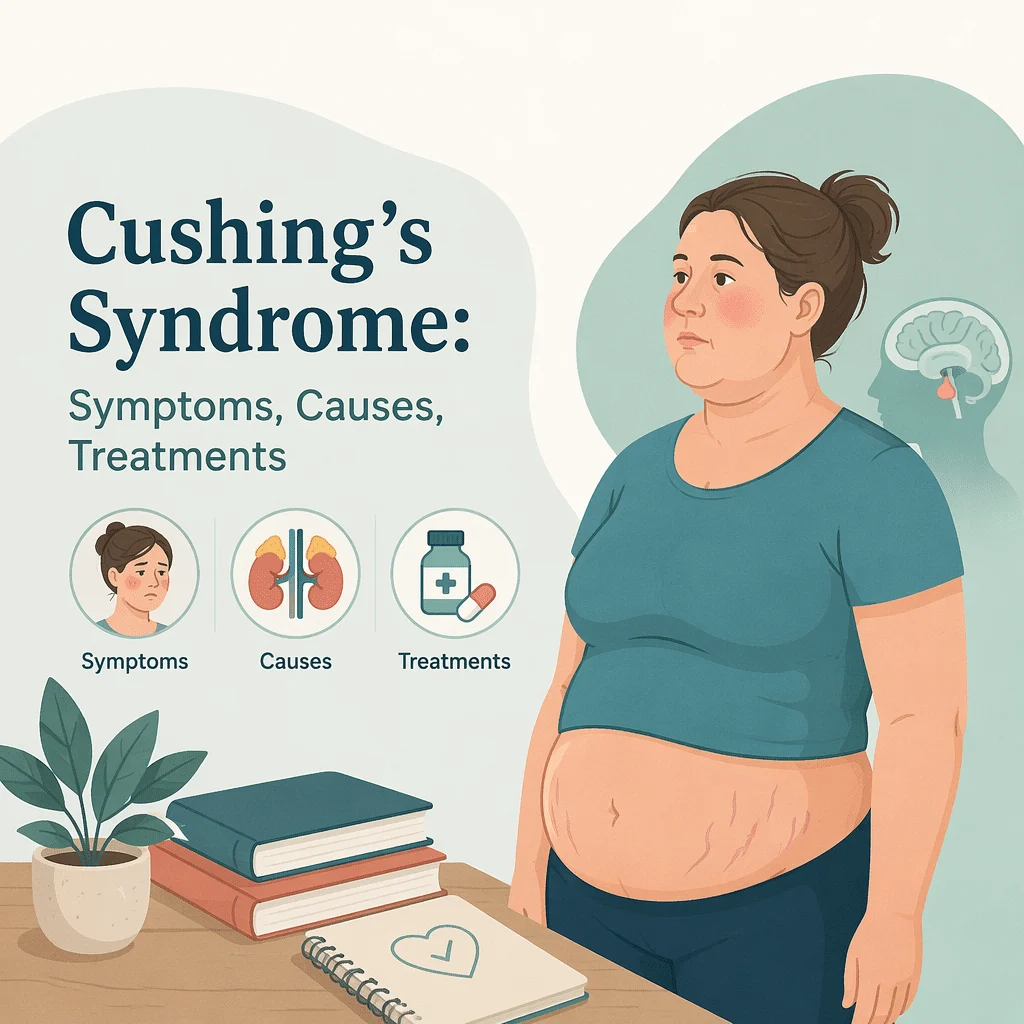
- A rounded, flushed face, sometimes with skin thin enough for small blood vessels to show through.
- A fracture after minor trauma, or unexpected bone thinning on a scan at a young age.
- In children, weight gain with a slowdown in height growth.
Symptoms that rarely mean Cushing’s on their own
Weight gain, tiredness, low mood, irregular periods, acne, high blood pressure and raised blood sugar all occur in Cushing’s syndrome, and in millions of people who do not have it. Taken alone, none is a reason to assume cortisol excess. They become meaningful when several specific features appear together, when they worsen quickly, or when they sit alongside diabetes or hypertension that resists standard treatment. This guide explains the meaning of high blood glucose levels.
Depression deserves its own note. Mood disorders can themselves push the stress-hormone axis into overdrive and genuinely raise cortisol without any tumor being present, which makes test results harder to read. Our library also covers the symptoms and treatments of depression.
What causes Cushing’s syndrome
Steroid medication: the most common cause by far
Glucocorticoid medicines, including prednisone, prednisolone, dexamethasone and hydrocortisone, are prescribed for asthma, rheumatoid arthritis, inflammatory bowel disease, skin disorders, transplant rejection and much else. Taken at a high enough dose for long enough, they reproduce the full picture of cortisol excess, because they act on the body the way cortisol does. This form is called exogenous Cushing’s syndrome, meaning the hormone came from outside the body.
Tablets are the usual source, but not the only one. Repeated joint injections, potent creams used over large areas or under dressings, and high-dose inhaled steroids all add to total exposure. Risk is higher in young children, in people with reduced kidney or liver function, and in anyone also taking a medicine that slows the breakdown of steroids, such as certain antifungal or HIV treatments.
Endogenous causes: when the body makes too much itself
When no outside steroid explains the picture, the excess comes from within. Three sources account for nearly all such cases:
- A benign pituitary tumor that secretes too much ACTH, the hormone instructing the adrenal glands to release cortisol. This is the most common endogenous cause.
- A tumor or overgrowth of one or both adrenal glands, producing cortisol directly and independently of ACTH.
- Ectopic ACTH production, where a tumor elsewhere in the body, most often in the lung, starts making ACTH even though that is not its job.
Our team also explains the role of the ACTH hormone, and details the markers grouped in an adrenal panel.
The naming trap: Cushing’s disease is not Cushing’s syndrome
Cushing’s syndrome is the umbrella term for the effects of prolonged cortisol excess, whatever the source. Cushing’s disease is one specific cause of it: a pituitary adenoma driving ACTH too high. Everyone with Cushing’s disease has the syndrome, but most people with the syndrome do not have the disease, because medication accounts for the majority of cases. The two terms are often used loosely, so it is worth checking which one is meant.
How Cushing’s syndrome is diagnosed, step by step
No single blood test diagnoses this condition. According to a 2026 review of biochemical diagnosis, the assessment proceeds in stages: establish that cortisol really is in excess, confirm it, then find the source. Skipping a stage is how both false alarms and missed cases happen.
Step 1: account for every steroid
Before any laboratory test is ordered, the clinician asks about steroids taken in recent months: tablets, injections, inhalers, nasal sprays, eye drops and creams, plus anything bought without a prescription or supplied elsewhere. If a steroid explains the picture, testing for endogenous causes is not the next step; reviewing the medication is.
Step 2: the three first-line screening tests
Three tests are used first, usually two of them, each repeated. They probe different aspects of the same problem. Late-night salivary cortisol looks for loss of the night-time dip. Twenty-four-hour urinary free cortisol measures total output across a day. The overnight 1 mg dexamethasone suppression test checks whether the system still switches off when told to.
Why a single daytime blood cortisol is a poor test
Blood cortisol swings widely through the day by design, and it rises with illness, pain, anxiety and even a difficult blood draw. A one-off value can be high in a healthy person and normal in someone who has the condition, so it settles nothing on its own. Our team explains the practical uses and limits of a cortisol blood test.
| Screening test | How it is done | What can throw the result off |
|---|---|---|
| Late-night salivary cortisol | You collect saliva at home on a small swab, usually between 11 p.m. and midnight, on two separate nights. | Night or rotating shift work, a very late bedtime, tobacco, eating, drinking or brushing teeth just before the sample, and blood in the saliva. |
| 24-hour urinary free cortisol | You collect every drop of urine over a full 24 hours in a container from the laboratory, usually on two separate days. | A missed or incomplete collection, very high fluid intake, reduced kidney function, pregnancy, and some medicines. |
| Overnight 1 mg dexamethasone suppression test | You take one 1 mg dexamethasone tablet at about 11 p.m. and have blood drawn for cortisol at around 8 a.m. the next morning. | Oral estrogen and combined contraceptive pills, pregnancy, medicines that speed up or slow the breakdown of dexamethasone, poor absorption, and taking the tablet late or not at all. |
| Single random blood cortisol | One blood sample taken at a routine daytime appointment. | Not a screening test for this condition. Cortisol swings through the day and rises with stress, illness or a painful draw, so one value confirms nothing. |
Step 3: confirmation, then finding the source
An abnormal screening result is repeated first, because cortisol output varies from week to week and some cases are genuinely cyclical. Once the excess is confirmed, an ACTH blood level splits the possibilities in two: a suppressed ACTH points to the adrenal glands, a normal or high ACTH to the pituitary or an ectopic source. Imaging follows, usually an MRI of the pituitary or a CT scan of the adrenal glands, chest and abdomen.
Imaging alone is not proof. Small harmless pituitary lesions are common, and some ACTH-producing adenomas are too small to see. When the scan and the hormone results disagree, specialist centers use inferior petrosal sinus sampling, in which a catheter measures ACTH directly in the veins draining the pituitary and compares it with a peripheral vein. A 2026 joint consensus statement from the Korean and Japanese endocrine societies noted that even expert groups still differ on exact thresholds and on the imaging sequence, which is why this work belongs with an endocrinologist.
Separating true Cushing’s syndrome from a functional, non-tumor rise in cortisol, long called pseudo-Cushing’s, is the hardest part. Severe stress, poorly controlled diabetes, heavy alcohol use, obesity, pregnancy and depression all raise cortisol without any tumor. Our library also explains the results of a urine cortisol test, and covers the causes of low morning cortisol for readers whose numbers point the other way.
Treatment options, in outline
When a steroid medication is the cause
The answer is to reduce the steroid to the lowest effective dose, to stop it, or to switch treatment, always under the supervision of the prescriber. Never adjust a prescribed steroid on your own. After weeks or months of treatment the adrenal glands stop making cortisol themselves, so stopping abruptly can leave the body with almost none, a state called adrenal insufficiency. It can escalate into an adrenal crisis, with collapsing blood pressure, vomiting and confusion, which is a medical emergency and can be fatal. A 2024 review of secondary adrenal crisis lists abrupt reduction or cessation of glucocorticoid doses among its main triggers, and that is why tapering is deliberately slow.
When a tumor is the cause
Surgery is usually the first choice: removal of a pituitary adenoma through the nose, of the affected adrenal gland, or of an ectopic ACTH-producing tumor. Radiation to the pituitary may follow when surgery does not cure the problem or cannot be repeated, and it acts gradually over months to years.
Cortisol-lowering medicines
Medicines are used before surgery when cortisol is dangerously high, while radiation takes effect, or long term when surgery is not possible or has not worked. Some block cortisol production in the adrenal glands, some reduce ACTH output, and some block the effect of cortisol at its receptor. All need regular blood tests, because the aim is to bring cortisol down without pushing it too low. Potassium is watched closely, since cortisol excess and several of these drugs can lower it. Our team also describes the minerals measured in an electrolyte panel.
When to see a doctor
Book an appointment rather than waiting if several of the more specific features appear together: easy bruising, wide purple stretch marks, weakness in the thigh and shoulder muscles, a rounded flushed face, a fracture after a minor knock. The same applies if blood pressure or blood sugar becomes hard to control for no clear reason, or if a child gains weight while height growth slows.
Untreated cortisol excess is not harmless. It raises the risk of heart disease, stroke, diabetes, osteoporosis, infections and blood clots, and those risks fall once the excess is controlled, so persistent suspicious features are worth assessing rather than watching. Anyone on long-term steroids who develops severe vomiting, dizziness, confusion or extreme weakness, especially after a missed dose, an infection or an operation, needs urgent medical care.
Latest scientific advances
Research over the past three years has focused less on new symptoms than on making the tests and treatments better. Here is what has changed, in plain terms.
Screening advice is being harmonized, slowly
In 2026, the Korean and Japanese endocrine societies published a joint statement merging their national recommendations for diagnosing Cushing’s disease. What it revealed is as useful as what it recommends: expert groups still disagree on exact cutoff values and on when to image. What this means for you is that a borderline result in one laboratory may be read differently in another, and repeat testing is normal rather than a sign something went wrong.
The late-night saliva test is convenient, but not infallible
A systematic review, meaning a study that pools the results of many earlier studies, compared the tests used to separate true Cushing’s syndrome from a stress-related rise in cortisol. The saliva test proved the least consistent, largely because laboratories use different methods and cutoffs. What this means for you is that a home saliva collection is useful and easy to do, but it is a first filter rather than a verdict, and following the instructions exactly makes a real difference.
Depression and the cortisol axis
A 2024 review tackled a question clinicians face often: which people with mood disorders should be screened for cortisol excess? Depression itself activates the stress-hormone system, so results can be abnormal with no tumor present. The authors suggest reserving screening for those who also show the more specific physical features, or whose depression resists standard treatment. What this means for you is that an abnormal cortisol test alongside depression calls for careful follow-up, not an immediate diagnosis.
More medicine options when cortisol will not come down
A 2026 practical review summarized the drugs now available for lowering cortisol when surgery is not an option, including newer agents such as osilodrostat and levoketoconazole alongside older ones. A large 2026 trial tested relacorilant, which works differently: rather than reducing how much cortisol is made, it blocks the receptor cortisol acts on. Participants who stayed on it were more likely to keep their blood pressure controlled than those switched to a placebo. What this means for you is that options have widened for the minority whose cortisol cannot be normalized by surgery alone, though these remain specialist treatments with close monitoring.
New sample types are being explored
Cortisol can also be measured in hair, where it reflects average exposure over weeks to months rather than a single moment. A 2025 review describes hair cortisol, salivary cortisone and steroid fingerprinting as promising additions to the toolkit. What this means for you is that these are research and specialist tools for now, not tests to request at a routine visit, though they are why the field expects today’s repeated sampling to get simpler.
Glossary
| Term | Definition |
|---|---|
| ACTH (adrenocorticotropic hormone) | The pituitary hormone that tells the adrenal glands to release cortisol. Measuring it helps show where an excess is coming from. |
| Adrenal glands | Two small glands sitting on top of the kidneys. They produce cortisol, aldosterone and several other hormones. |
| Adrenal insufficiency | A shortage of cortisol. It can follow the abrupt withdrawal of long-term steroid treatment and, untreated, can become an emergency. |
| Cortisol | The main stress hormone. It regulates blood sugar, blood pressure and inflammation, and normally follows a daily rhythm. |
| Cushing’s disease | One specific cause of Cushing’s syndrome: a benign pituitary tumor that produces too much ACTH. |
| Dexamethasone suppression test | A test in which a synthetic steroid tablet is taken at night to see whether the body switches its own cortisol production off by morning. |
| Ectopic ACTH | ACTH produced by a tumor outside the pituitary gland, most often in the lung. |
| Glucocorticoid | The family of steroid medicines that act like cortisol, including prednisone, prednisolone and dexamethasone. |
| Inferior petrosal sinus sampling | A specialist procedure that measures ACTH in the veins draining the pituitary, used when scans and hormone results disagree. |
Frequently asked questions
Can weight gain on its own mean Cushing’s syndrome?
Rarely. Weight gain is one of the least specific features of the condition, and the overwhelming majority of people who gain weight have no cortisol problem at all. What raises suspicion is the pattern and the company it keeps: fat gathering on the trunk, face and upper back while the arms and legs grow thinner, together with easy bruising, wide purple stretch marks or weakness in the thigh muscles. If weight gain is your only symptom, cortisol testing is usually not the first step.
What other conditions can mimic Cushing’s syndrome?
Several. Poorly controlled diabetes, obesity with metabolic syndrome, polycystic ovary syndrome, untreated obstructive sleep apnea, heavy alcohol use, severe depression, pregnancy and chronic physical stress can all raise cortisol or copy parts of the clinical picture. Clinicians group the non-tumor versions under the label non-neoplastic hypercortisolism, sometimes called pseudo-Cushing’s. Telling them apart usually requires repeat testing and, at times, second-line tests carried out by a specialist.
Are the symptoms different in women?
The core features are the same, but women may also notice irregular or absent periods, excess facial and body hair, and acne, because cortisol excess disturbs the other reproductive hormones. These signs are common in other conditions too, especially polycystic ovary syndrome, so they carry more weight when they appear together with the more specific features such as wide purple stretch marks or unexplained bruising.
Can an inhaled or topical steroid really cause it?
Yes, although far less often than tablets. High doses of inhaled steroid, potent creams applied to large areas or under dressings, and repeated joint injections all add to the total steroid load. Risk is higher in young children, in people with reduced kidney or liver function, and when another medicine slows the breakdown of steroids. This is why it is worth telling any clinician about every steroid product used, not just the prescribed tablets.
How long does it take to recover after treatment?
Recovery is gradual and varies by person. Blood pressure and blood sugar often improve within months, while facial changes, skin quality and muscle strength usually take longer, sometimes a year or more. Bone density recovers slowest. After a successful operation or a steroid taper, cortisol production may stay low for a while, so replacement treatment and regular follow-up testing are common during that period.
Sources
- National Institute of Diabetes and Digestive and Kidney Diseases (NIDDK), National Institutes of Health — Cushing’s Syndrome — niddk.nih.gov
- Mayo Clinic — Cushing syndrome: symptoms and causes — mayoclinic.org
- Cleveland Clinic — Cushing syndrome: what it is, symptoms and treatment — my.clevelandclinic.org
- Asla Q, Urgell E, Terzan S, et al. — Biochemical diagnosis of hypercortisolism: when and how? — Vitamins and Hormones, 2026 — doi.org/10.1016/bs.vh.2026.03.001
- Lee J, Fukuoka H, Park SS, et al. — Consensus on the diagnosis of Cushing’s disease: a collaborative statement from the Korean Endocrine Society and Japan Endocrine Society — Endocrinology and Metabolism (Seoul), 2026 — doi.org/10.3803/EnM.2025.2707
- Hinojosa-Amaya JM, Diaz-Gonzalez-Colmenero F, Alvarez-Villalobos NA, et al. — The conundrum of differentiating Cushing’s syndrome from non-neoplastic hypercortisolism: a systematic review and meta-analysis — Pituitary, 2024 — doi.org/10.1007/s11102-024-01408-w
- Ferrante E, Simeoli C, Mantovani G, Pivonello R — Who and how to screen for endogenous hypercortisolism in patients with mood disorders — Journal of Endocrinological Investigation, 2024 — doi.org/10.1007/s40618-024-02457-5
- Araujo-Castro M, Lamas C, Nowak E, et al. — Update and practical recommendations for the use of medical treatment of Cushing syndrome — Endocrine Reviews, 2026 — doi.org/10.1210/endrev/bnaf042
- Pivonello R, Arnaldi G, Auchus RJ, et al. — Efficacy and safety of relacorilant for the treatment of patients with Cushing’s syndrome (GRACE): a multicentre, phase 3, randomised-withdrawal study — The Lancet Diabetes and Endocrinology, 2026 — doi.org/10.1016/S2213-8587(25)00362-6
- Ferriere A, Tabarin A — Current challenges in Cushing’s syndrome testing: blood, saliva, urine, or hair? — Current Opinion in Endocrinology, Diabetes and Obesity, 2025 — doi.org/10.1097/MED.0000000000000923
- Martel-Duguech L, Poirier J, Bourdeau I, Lacroix A — Diagnosis and management of secondary adrenal crisis — Reviews in Endocrine and Metabolic Disorders, 2024 — doi.org/10.1007/s11154-024-09877-x
Further reading
- The calcium blood test and the bone and mineral panel
- The blood tests used to diagnose diabetes
- The A1C conversion chart and average glucose
- DHEA levels, benefits and risks explained
- Testosterone as an essential blood marker
Understand your lab results with AI DiagMe
Cushing’s syndrome is one of the conditions where laboratory results do most of the talking, and where a single number rarely means what it seems to. AI DiagMe reads your report and explains, in everyday language, what markers such as cortisol, ACTH, blood glucose and potassium are measuring and how they fit together. It is built to help you understand your results and prepare better questions for your appointment. It does not diagnose, and it does not replace your doctor.
Get your results interpreted in minutes