




Human papillomavirus (HPV) is the most common sexually transmitted infection in the United Kingdom, and nearly every sexually active person will encounter it at some point in life. For most people the infection causes no symptoms and clears on its own within a year or two. In a smaller number of cases, certain high-risk types can linger and, over many years, lead to cancer. Understanding how the virus spreads, what it does and does not do, and how vaccination and screening protect you can replace worry with a clear plan. In this article you’ll learn what HPV is, the difference between harmless and high-risk types, the symptoms to watch for, the cancers it can cause, and how the HPV vaccine and modern testing keep you safe.
What Is Human Papillomavirus?
Human papillomavirus is not a single virus but a family of more than 200 related viruses. They infect the skin and the moist linings, called mucous membranes, of the body, including the cervix, vagina, vulva, penis, anus, mouth, and throat. About 40 of these types are spread through sexual contact. Doctors sort the sexually transmitted types into two broad groups based on the risk they carry.
Low-Risk Versus High-Risk Types
Low-risk types, such as HPV 6 and HPV 11, can cause genital warts but almost never lead to cancer. High-risk types, especially HPV 16 and HPV 18, rarely cause any visible sign, yet they are responsible for nearly all cervical cancers and a large share of cancers of the anus, penis, vagina, vulva, and throat. Most infections of either kind are cleared by the immune system. It is a high-risk infection that persists for years, quietly changing cells, that raises the risk of cancer.
How HPV Spreads
HPV passes from person to person through close skin-to-skin contact, most often during vaginal, anal, or oral sex. Penetration is not required, because contact with infected skin is enough to transmit the virus. Since it is so widespread and can stay silent for years, a new diagnosis does not reveal when or from whom you got it, and it is not a sign of unfaithfulness. This point matters: HPV is a near-universal part of human life, not a moral failing. Public health data suggest that around 8 in 10 people will have an HPV infection at some point, and the overwhelming majority never develop any health problem from it. Rarely, a pregnant person can pass the virus to their baby during delivery, though this seldom causes lasting harm.
Who Is More Likely to Carry a Persistent Infection
Anyone who is sexually active can get HPV. A few factors make it harder for the body to clear a high-risk infection, including a weakened immune system, whether from HIV or from immune-suppressing medicines, as well as smoking and having many sexual partners. Your immune system does most of the work, usually clearing the virus within one to two years by producing antibodies. If you are curious how the body’s antibody defences are measured, you can read our guide to the IgG antibody blood test, and to see how the immune cells that fight infections are counted, you can review our guide to high lymphocyte counts.
Symptoms: From Genital Warts to Silent Infections
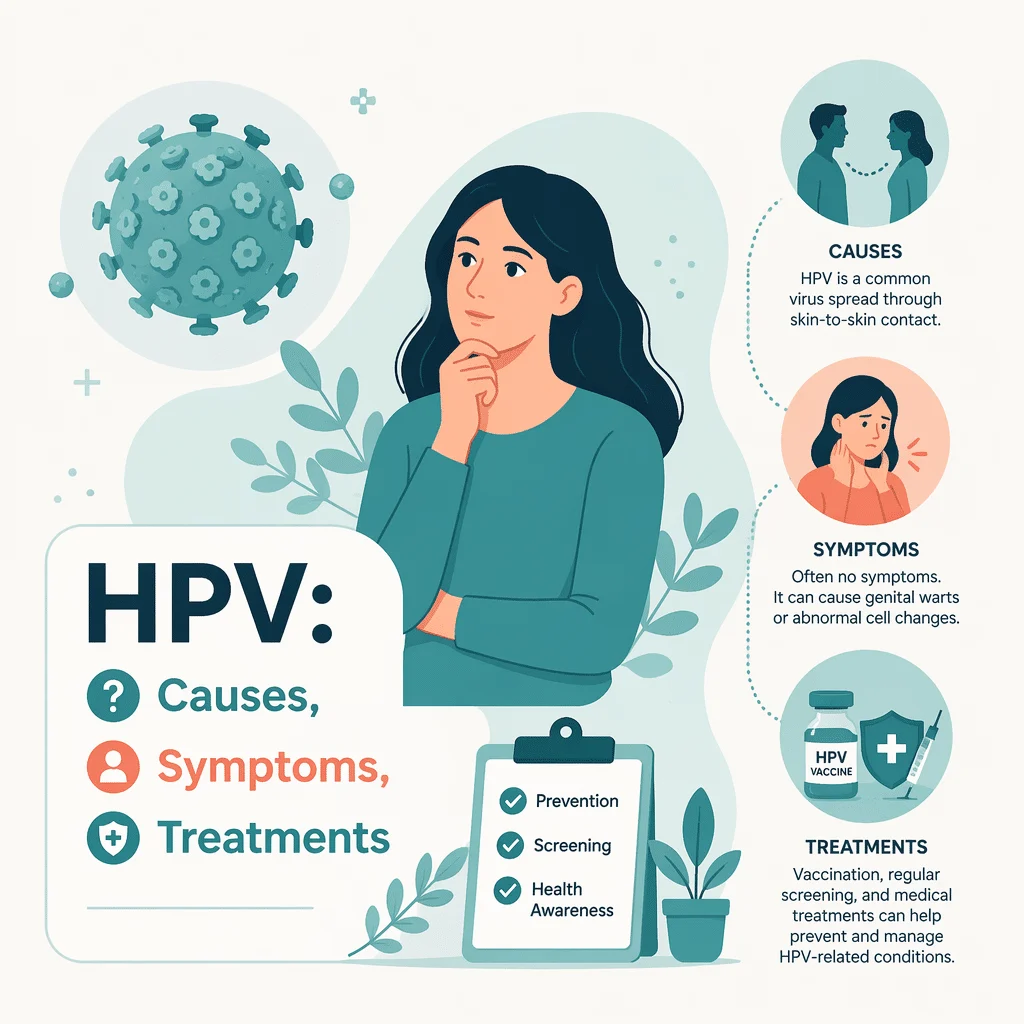
Most people with HPV never notice a thing. When symptoms do appear, they depend on the type of virus. Low-risk types can cause genital warts, which are soft, skin-coloured or grey growths that may be flat or shaped like tiny cauliflowers. They can appear on or around the genitals, anus, mouth, or throat and are usually painless. High-risk types typically cause no symptoms at all, which is exactly why they are dangerous: cellular changes on the cervix develop quietly and are found through screening, not through how you feel. In some cases a high-risk infection can leave the cervix fragile and prone to bleeding, so if this concerns you, you can read our guide to a friable cervix. Because warts and cell changes can resemble other conditions, only a clinician can confirm what is causing a particular symptom.
HPV in the Mouth and Throat
HPV can also infect the mouth and throat, where it has become a growing cause of oropharyngeal (throat) cancers, particularly in men. Oral infections rarely cause early symptoms, but a hoarse voice, a sore throat, or a lump in the neck that lasts more than a couple of weeks deserves a medical check. To learn how the virus behaves in the mouth, you can read our guide to oral HPV on the tongue.
The Cancers HPV Can Cause
Given enough time, a persistent high-risk infection can turn normal cells into precancerous ones and, eventually, into cancer. Cervical cancer is the best-known example, and almost all cases are caused by HPV. The virus is also behind most anal cancers and many cancers of the throat, penis, vagina, and vulva. According to the National Cancer Institute, HPV causes roughly 3 out of every 100 cancers in women and about 2 out of every 100 in men. HPV-related throat cancer has been rising, especially among men, which is one reason vaccination is now recommended for everyone rather than for girls alone. The reassuring part is that this process takes years, which gives screening ample time to catch changes early. Precancerous cells can usually be found and removed long before they would ever become cancer, which is why widespread screening has cut cervical cancer deaths so sharply over the past several decades. For a fuller picture of how these changes are found and treated, you can read our complete guide to cervical cancer.
HPV Testing and Cervical Screening
Screening is how clinicians catch the effects of HPV before they become dangerous, and it relies on two related tests. The HPV test, also called an HPV DNA test, looks for the genetic material of high-risk types in a sample of cervical cells. The Pap test, or Pap smear, examines the cells themselves under a microscope for abnormal changes. When the two are done from the same sample, it is called co-testing.
In the United Kingdom, screening usually begins between ages 21 and 25. From about age 30 to 65, guidelines increasingly favour a primary HPV test every five years, although a Pap test every three years or co-testing every five years remain accepted options. Guidance is steadily shifting towards testing for the virus first, because it can flag risk earlier than looking at cells alone. Whatever schedule your clinician recommends, the most important thing is to keep up with it, since screening only protects you when it is done regularly.
| Feature | HPV test (HPV DNA test) | Pap test (Pap smear) |
|---|---|---|
| What it looks for | Genetic material of high-risk HPV types | Abnormal cell changes on the cervix |
| What a result shows | Whether a high-risk type is present | Whether cells already look abnormal |
| Main strength | Very sensitive, so it flags risk early | Shows whether changes have already begun |
| Often used | Alone (primary HPV test) or with a Pap | Alone or as part of co-testing |
| Sample | Cervical swab or self-collected vaginal swab | Cervical cell sample |
What a Positive HPV Result Does and Does Not Mean
A positive HPV result can feel alarming, but it usually means only that a high-risk type is present, not that you have cancer or even abnormal cells. Many people have a normal smear test alongside a positive HPV test, and most of these infections clear on their own with time. It signals that your care team will keep a closer eye on you, not that something is wrong today. To understand this common combination in more detail, you can read our explainer on a normal Pap test with a positive HPV result.
A newer option lets people collect their own vaginal sample for HPV testing, either in a clinic or at home, which can make screening far easier to access. To see how this approach works, you can read our report on the HPV self-collection test.
What Happens After an Abnormal Result
If a screening test comes back abnormal, the usual next step is a closer look at the cervix with a magnifying instrument, in a procedure called colposcopy. During colposcopy, a clinician can take a tiny tissue sample, or biopsy, to check whether precancerous cells are present and how advanced they are. Most changes found this way are mild and either resolve on their own or are removed with a short outpatient procedure. Being called back for more testing is common, and in the large majority of cases it ends with reassuring news rather than a cancer diagnosis.
Preventing HPV
The HPV Vaccine
The HPV vaccine is the single most effective way to prevent infection. The version used in the United States, Gardasil 9, protects against nine types, including the high-risk types behind most HPV-related cancers. The Centers for Disease Control and Prevention recommends routine vaccination at age 11 or 12, though it can start as early as age 9, with catch-up doses through age 26. Some adults between 27 and 45 may still benefit and can discuss it with their clinician. The vaccine works best before any exposure, which is why it is given young, and it prevents new infection rather than treating one you already have.
Everyday Measures
Beyond vaccination, condoms and dental dams lower the odds of passing HPV, although they cannot remove the risk entirely because the virus lives on skin they do not cover. Not smoking and keeping up with recommended screening complete the picture, since tobacco makes it harder for the body to clear a high-risk infection. Together, vaccination and regular screening are the reason cervical cancer is now considered a largely preventable disease, and why the World Health Organization has set a global goal to eliminate it.
Latest Scientific Advances
The clearest medical news of the last few years is that HPV vaccination is working, and dramatically so. England ran the first national programme, and researchers found that offering the vaccine to girls aged 12 to 13 sharply cut later rates of cervical cancer and serious precancer compared with unvaccinated groups (Falcaro and colleagues, 2021). A 2024 study from Scotland went further still: among women who had received the earlier bivalent vaccine at ages 12 to 13, the team found no cases of invasive cervical cancer at all (Palmer and colleagues). What this means for you is that getting vaccinated on time offers powerful, long-lasting protection against the cancers HPV can cause.
Testing is improving too. A large Swedish study that randomly assigned women to different screening methods, a design called a randomised trial and considered the strongest kind of evidence, found that testing for the virus first gave better protection against invasive cervical cancer than the traditional Pap test alone (Wang and colleagues, 2024). What this means for you is that if your clinic offers a primary HPV test, it is a well-supported choice rather than an experimental one.
Finally, because many people skip screening altogether, researchers have studied letting women collect their own sample. A 2024 review that pooled the results of many randomised trials, an approach known as a meta-analysis, found that offering or posting self-sampling kits clearly increased the number of women who got screened (Wong and colleagues). What this means for you is that self-collection is making screening easier to fit into a real, busy life, especially for anyone who finds a clinic visit hard to arrange. These findings are consistent and encouraging, though screening programmes continue to refine exactly how and when to use each option.
When to See a Doctor
Most HPV infections need no action at all, but a few situations deserve a professional’s eye. Contact a healthcare provider if you notice any of the following:
- New growths or warts on or around the genitals, anus, or mouth.
- Unusual vaginal bleeding, including bleeding after sex or between periods.
- A positive HPV test result, so your provider can plan the right follow-up.
- A hoarse voice, sore throat, or neck lump that does not go away.
- A missed or overdue cervical screening, whatever your vaccination history.
Even after HPV vaccination, regular screening still matters, because the vaccine does not cover every high-risk type.
Glossary
| Term | Definition |
|---|---|
| Human papillomavirus (HPV) | A family of more than 200 related viruses; about 40 are spread through sexual contact. |
| High-risk HPV | Types such as HPV 16 and 18 that can cause cancer if an infection persists for years. |
| Low-risk HPV | Types such as HPV 6 and 11 that may cause genital warts but rarely cause cancer. |
| Genital warts | Soft growths on the genital or anal area caused by low-risk HPV types. |
| Pap test (Pap smear) | A test that examines cervical cells under a microscope for abnormal changes. |
| HPV test (HPV DNA test) | A test that detects the genetic material of high-risk HPV types in cervical cells. |
| Co-testing | Doing an HPV test and a Pap test together on the same sample. |
| Precancer (dysplasia) | Abnormal cervical cells that are not cancer but could become cancer if left untreated. |
| Oropharyngeal cancer | Cancer of the throat, base of the tongue, and tonsils, increasingly linked to HPV. |
Frequently Asked Questions
Can men get HPV, and how would they know?
Yes. Men can catch and pass on HPV just as women can, and they usually have no symptoms. Some develop genital or anal warts from low-risk types, whilst high-risk types can, over time, contribute to cancers of the throat, anus, or penis. There is no routine, approved HPV screening test for men, so vaccination and paying attention to unusual growths, sores, or a persistent sore throat are the main ways to stay ahead of it.
Can HPV be cured?
There is no medicine that removes the virus itself. In the great majority of cases, though, the immune system clears HPV on its own within one to two years, so no treatment is needed. What doctors can treat are the problems HPV sometimes causes, such as genital warts or precancerous cervical changes. This is why screening matters so much: it finds those changes early, when they are straightforward to manage.
Does the HPV vaccine work if I am already sexually active?
It can still help. The vaccine gives the strongest protection when given before any exposure, which is why it is recommended in early adolescence. But because it guards against nine types, someone who is already sexually active is unlikely to have encountered all of them, so vaccination may still prevent new infections. Catch-up vaccination is recommended up to age 26, and some adults up to 45 may benefit after a conversation with their clinician.
What does a positive HPV test mean if my smear is normal?
It usually means a high-risk type is present but has not yet caused visible cell changes. This is a common and generally low-risk situation. Your provider will typically recommend repeat testing in a year or a follow-up test to see whether the infection clears, which most do. A positive HPV test with a normal smear is a reason for watchful follow-up, not a diagnosis of cancer.
Does HPV always go away on its own?
Most of the time, yes. Around 9 in 10 HPV infections become undetectable within one to two years as the immune system clears them. A minority of high-risk infections persist, and it is this small group that needs monitoring, because long-lasting infection is what can eventually lead to cancer. Regular screening is designed precisely to identify the infections that are not going away.
Can I still get HPV if I have had the vaccine?
Yes, but your risk is much lower for the most dangerous types. Gardasil 9 covers nine HPV types, including those responsible for most HPV-related cancers, yet it does not cover every type that exists. For that reason, vaccinated people should still follow the recommended cervical screening schedule. Vaccination and screening work best as a pair.
Sources
- Centers for Disease Control and Prevention — About Genital HPV Infection, 2024 — cdc.gov
- National Cancer Institute — HPV and Cancer, 2023 — cancer.gov
- U.S. Food and Drug Administration — GARDASIL 9 (HPV 9-valent vaccine) — fda.gov
- Palmer TJ, et al. — Invasive cervical cancer incidence following bivalent HPV vaccination: a population-based observational study — Journal of the National Cancer Institute, 2024 — doi.org/10.1093/jnci/djad263
- Falcaro M, et al. — The effects of the national HPV vaccination programme in England on cervical cancer and CIN3 incidence — The Lancet, 2021 — doi.org/10.1016/S0140-6736(21)02178-4
- Wang J, et al. — Human papillomavirus-based cervical screening and long-term cervical cancer risk: a randomised health-care policy trial in Sweden — The Lancet Public Health, 2024 — doi.org/10.1016/S2468-2667(24)00218-4
- Wong HY, et al. — Invitation strategy of vaginal HPV self-sampling to improve participation in cervical cancer screening: a systematic review and meta-analysis — BMC Public Health, 2024 — doi.org/10.1186/s12889-024-19881-0
Further Reading
- Cervical Cancer: Understanding, Prevention, Treatment
- Understanding a Normal Smear With a Positive HPV Test
- HPV Self-Collection Test: What’s New in Cervical Cancer Screening
- HPV on the Tongue: Symptoms, Risks, Treatments
- Full Blood Count (FBC): How to Read Your Results
Understand your lab results with AI DiagMe
HPV mostly stays out of sight, so the numbers on your lab reports are often your clearest window into what is happening inside your body. AI DiagMe explains those results in plain, everyday language, from a cervical screening report to a routine blood panel. If you want to make sense of a white-blood-cell result, you can learn how to read a full blood count, and for antibody testing, you can read our guide to the immunoglobulin A blood test. AI DiagMe helps you understand your results and prepare better questions for your visit; it does not diagnose disease and does not replace your doctor.
Get your results interpreted in minutes