








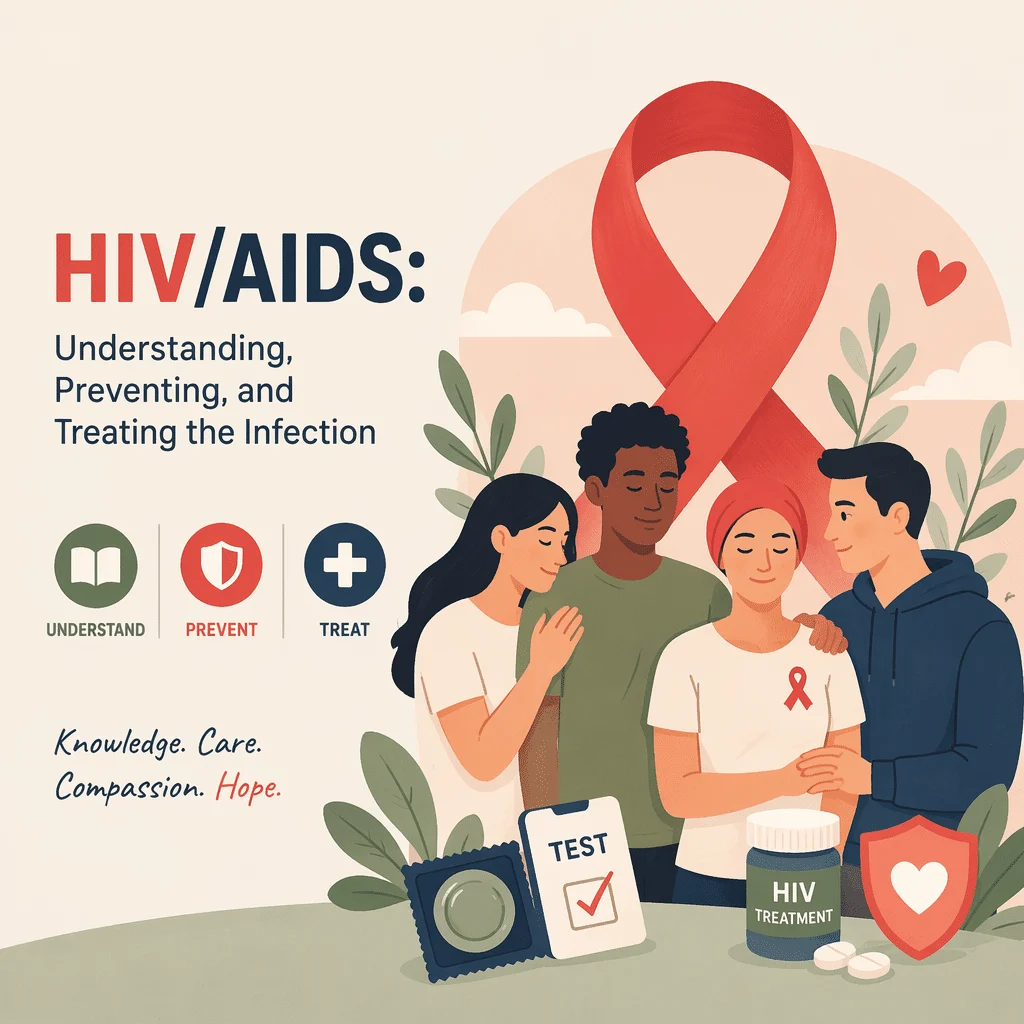
HIV and AIDS are often mentioned in the same breath, yet they are not the same thing, and understanding the difference is the first step towards prevention, testing, and effective care. HIV (human immunodeficiency virus) is a virus that slowly weakens the immune system, while AIDS is the most advanced stage of an untreated HIV infection. That distinction matters, because AIDS is now largely preventable. Thanks to modern medicine, HIV has become a manageable long-term condition: with the right treatment, people living with HIV can expect a life expectancy close to anyone else’s, and they do not pass the virus to sexual partners once it is fully suppressed. In this article you’ll learn how HIV spreads and how it does not, the symptoms and stages, how testing and lab monitoring work, what today’s treatments involve, and the tools that prevent new infections.
What are HIV and AIDS, and how do they differ?
HIV and AIDS describe two points on the same journey, not two separate diseases. HIV is the virus itself. AIDS (acquired immunodeficiency syndrome) is what can happen years later if that virus is left untreated and the immune system becomes severely damaged. With effective treatment started early, most people never progress to AIDS.
What HIV does to the immune system
HIV targets a type of white blood cell called the CD4 T-lymphocyte, one of the immune system’s key coordinators. The virus enters these cells, copies itself, and gradually reduces their numbers. Over time, without treatment, the body has fewer defenders left to fight off infections and some cancers.
Doctors measure the strength of these defences with a blood test called the CD4 count. A related test, the viral load, shows how much virus is circulating. Together, these two numbers tell a clinician how the infection and the treatment are behaving.
When HIV becomes AIDS
An HIV infection is generally classed as AIDS when the CD4 count falls below a defined threshold, or when a person develops one of several specific serious infections or cancers known as opportunistic illnesses. Because treatment keeps the immune system strong, this advanced stage is far less common today than it was decades ago.
How HIV is transmitted, and how it is not
Clear, accurate information about transmission removes a lot of unnecessary fear. HIV spreads only through specific body fluids, and only in specific situations. It is a fragile virus that does not survive well outside the body.
The main routes of transmission
HIV can be passed on through blood, semen, pre-seminal fluid, rectal fluids, vaginal fluids, and breast milk. In practice, that means it is transmitted mainly through:
- Sex without a condom or without prevention medicine, when one partner has a detectable viral load.
- Sharing needles, syringes, or other injection equipment.
- Pregnancy, childbirth, or breastfeeding, from a parent with a detectable viral load to their baby.
Certain factors raise the chance of transmission, including another untreated sexually transmitted infection, which can create small breaks in the skin or lining that make it easier for the virus to enter.
How HIV is not spread
Everyday contact carries no risk. You cannot get HIV from saliva, sweat, tears, or urine, and it is not passed through hugging, shaking hands, sharing food or utensils, using the same toilet, or through insect bites. Casual social contact with a person living with HIV is completely safe. Knowing this helps replace stigma with facts.
Symptoms and stages of HIV
HIV usually moves through three broad stages. Symptoms vary widely from person to person, and many people have no obvious signs for years, which is exactly why testing rather than symptoms is the reliable way to know your status.
Acute HIV infection
Within two to four weeks of infection, many people develop a short flu-like illness sometimes called seroconversion. Fever, sore throat, swollen glands, rash, muscle aches, and fatigue are common. These symptoms are easy to mistake for other viral infections, and they fade on their own.
The long asymptomatic stage
After the early phase, HIV enters a quieter clinical latency stage that can last a decade or more. A person may feel entirely well while the virus continues to affect the immune system at a low level. Treatment during this stage keeps the immune system healthy and prevents progression.
Advanced HIV and AIDS
Without treatment, the immune system eventually weakens enough that opportunistic infections appear. Warning signs can include rapid weight loss, drenching night sweats, prolonged diarrhoea, persistent fever, and infections such as tuberculosis. This advanced stage is preventable and, importantly, treatable even once it develops.
Testing and lab monitoring for HIV
Testing is quick, confidential, and the only way to know your status. Several test types exist, and each one becomes reliable at a different point after a possible exposure, known as the window period.
Types of HIV tests
The three main test categories differ in what they measure and how soon they can detect infection. The table below summarises them. For a deeper look at the blood work itself, see our detailed guide to HIV screening results.
| Test type | What it detects | Typical window period |
|---|---|---|
| Antigen/antibody lab test (blood draw from a vein) | HIV antibodies and the p24 antigen, a viral protein | About 18 to 45 days after exposure |
| Antibody test (rapid test or self-test, finger-stick or oral fluid) | HIV antibodies only | About 23 to 90 days after exposure |
| Nucleic acid test (NAT, also used to measure viral load) | The genetic material of the virus (HIV RNA) | About 10 to 33 days after exposure |
If you test early and the result is negative, a repeat test after the window period confirms it. A reactive screening result is always confirmed with a second, more specific laboratory test before a diagnosis is made.
What CD4 count and viral load mean
Once someone is diagnosed, two blood tests guide their care over time. The CD4 count reflects immune strength, and the viral load shows how well treatment is controlling the virus. Doctors also track your general health with a routine full blood count, since HIV and its treatment can affect other blood cells too.
| Measurement | What it shows | General interpretation |
|---|---|---|
| CD4 count (cells per cubic millimetre) | The strength of your immune defences | Roughly 500 to 1,500 is a typical healthy range; below 200 signals advanced HIV and a higher risk of other infections |
| Viral load (copies per millilitre) | How much HIV is circulating in the blood | Lower is better; an undetectable result, often under 50 copies, is the goal of treatment |
| CD4/CD8 ratio | The balance between two immune cell types | Used alongside the CD4 count to follow immune recovery on treatment |
A weakened immune system can also show up in other results, which we cover in our guide to low lymphocyte counts. We also publish a companion guide to high lymphocyte counts, because context always matters when you read a blood test.
When to get tested or see a doctor
Testing at least once is recommended for everyone as part of routine care. Consider testing sooner, or more often, in these situations:
- After sex without a condom or prevention medicine with a partner whose status you do not know.
- After sharing needles or injection equipment.
- When you have another sexually transmitted infection.
- If you are pregnant or planning a pregnancy.
- Before starting a new sexual relationship, as a shared step with a partner.
Seek medical advice promptly if you have a flu-like illness after a possible exposure, and seek care without delay for unexplained weight loss, night sweats, or persistent infections.
Treatment: antiretroviral therapy and U=U
HIV treatment has been transformed. What was once a fatal diagnosis is now a manageable condition treated with daily medicine, and increasingly with long-acting options.
How antiretroviral therapy works
Treatment is called antiretroviral therapy, or ART. It combines several medicines that block the virus at different points in its life cycle, so it can no longer copy itself effectively. ART does not remove HIV from the body, but it lowers the amount of virus dramatically, usually to undetectable levels within a few months. Taken consistently, it lets the immune system recover and stay strong.
Because ART also protects other parts of the body, doctors monitor treatment with regular blood tests, adjusting the regimen if side effects or resistance appear.
Undetectable equals untransmittable (U=U)
One of the most important messages in HIV care is U=U, which stands for Undetectable equals Untransmittable. It means that a person whose treatment keeps their viral load undetectable does not pass HIV to sexual partners. Modern treatment can lower the virus to undetectable levels, as explained by the U.S. Centers for Disease Control and Prevention, and reaching that point is both a personal health goal and a powerful form of prevention. This is a message of hope and a strong reason to start and stay on treatment.
Preventing HIV: PrEP, PEP, and everyday tools
HIV is preventable, and there are more options than ever. Prevention is a personal choice, and combining several methods offers the strongest protection.
PrEP: prevention before exposure
PrEP, or pre-exposure prophylaxis, is medicine taken by HIV-negative people to prevent infection. Taken as prescribed, it is highly effective. It has traditionally been a daily pill, and long-acting injectable versions are now expanding the options, as covered below.
PEP: emergency prevention after exposure
PEP, or post-exposure prophylaxis, is an emergency course of medicine started as soon as possible, and within 72 hours, after a possible exposure. It is taken for about a month and can stop an infection from taking hold. PEP is for occasional emergencies, not regular use.
Other prevention that works
Condoms remain a reliable barrier that also protects against other sexually transmitted infections. Using new needles and never sharing injection equipment prevents blood-borne spread. Regular testing, treatment that keeps the virus undetectable, and screening for other infections all reduce transmission across a community. Because HIV and hepatitis B share routes of spread, clinicians often check the hepatitis B surface antigen test, and they may also request the anti-HCV hepatitis C screening test.
Latest scientific advances
Research over the past few years has made both treatment and prevention simpler and more effective. Here is what the newest studies mean in plain terms.
Long-acting injectable treatment
For years, treatment meant a daily pill. Now some people can switch to a long-acting injection, given by a nurse every two months, that combines two medicines (cabotegravir and rilpivirine). In real-world United States clinics, people who started these injections generally kept the virus suppressed, and a large 2025 review of many clinics found that treatment failure was very uncommon, about as rare as with daily pills. What this means for you: if daily tablets are hard to keep up with, an injectable option may control HIV just as well, though it is not right for everyone and still requires regular clinic visits.
Longer-acting prevention
Prevention is also becoming simpler. In two large 2024 trials known as PURPOSE, a twice-yearly injection given under the skin (lenacapavir) protected people from catching HIV. Among young women in one trial, no one who received the injection became infected; in the companion trial in men and gender-diverse people, new infections were far below what would normally be expected. What this means for you: instead of a daily prevention pill, a jab every six months could offer strong protection, and an even longer-acting once-a-year version is now being tested in a late-stage study. Because these results are recent, availability varies by country and setting.
Stronger evidence for U=U
The science behind Undetectable equals Untransmittable keeps getting stronger. A 2025 analysis that pooled nearly 150 studies found that when a mother’s viral load is undetectable, the risk of passing HIV to her baby around the time of birth is extremely low, and essentially zero for those already on treatment before pregnancy. What this means for you: staying on treatment and reaching an undetectable viral load protects partners and, during pregnancy and birth, protects the baby. Awareness still lags, though, since surveys show some people remain unsure whether U=U is true, so sharing accurate information matters.
Is a cure coming?
A true cure is not yet available. Scientists are studying therapeutic vaccines and antibody-based treatments designed to control HIV with less or no daily medicine, but these approaches remain experimental. For now, consistent antiretroviral therapy is the proven way to stay healthy and live a long life.
Living well with HIV
An HIV diagnosis today is the start of a manageable health journey, not the end of a full life. People on effective treatment can work, travel, have relationships, and have children who are HIV-free.
The foundations are simple: take treatment consistently, keep regular appointments so your CD4 count and viral load can be tracked, and look after general health with sleep, activity, and a balanced diet. Vaccinations and screening for other infections add protection, and mental-health support matters as much as physical care. Perhaps most importantly, replacing stigma with accurate information helps people test earlier, start treatment sooner, and live openly and well. HIV tests look for antibodies, the same kind of proteins described in our overview of the IgG antibody blood test, and tuberculosis is a common opportunistic infection, so we explain the checks in our full guide to tuberculosis testing.
Glossary
| Term | Definition |
|---|---|
| Antiretroviral therapy (ART) | A combination of medicines that stops HIV from multiplying and keeps the immune system healthy. |
| CD4 count | A blood test that measures CD4 T-cells, the immune cells HIV attacks; it reflects immune strength. |
| Viral load | The amount of HIV in a sample of blood, used to check how well treatment is working. |
| Undetectable | A viral load so low that standard laboratory tests cannot measure it. |
| U=U | Undetectable equals Untransmittable: a sustained undetectable viral load means HIV is not passed on sexually. |
| PrEP | Pre-exposure prophylaxis: medicine taken by HIV-negative people before possible exposure to prevent infection. |
| PEP | Post-exposure prophylaxis: emergency medicine started within 72 hours after a possible exposure. |
| Opportunistic infection | An illness that takes advantage of a weakened immune system, such as certain lung or brain infections. |
| Seroconversion | The early period when the body starts producing antibodies against HIV, sometimes with flu-like symptoms. |
| Window period | The time after exposure before a given test can reliably detect HIV. |
Frequently asked questions
Can HIV be cured?
There is no widely available cure for HIV yet. However, antiretroviral therapy controls the virus so well that people who take it consistently can live long, healthy lives and cannot pass HIV to sexual partners once undetectable. Research into vaccines and other cure strategies is active but still experimental, so ongoing treatment remains essential.
What are the main ways HIV is transmitted?
HIV is passed through specific body fluids: blood, semen, pre-seminal and rectal fluids, vaginal fluids, and breast milk. In everyday terms, that means sex without a condom or prevention medicine, sharing needles or injection equipment, and transmission from a parent with a detectable viral load to their baby during pregnancy, birth, or breastfeeding. It is not spread by casual contact.
Can you get HIV from kissing, saliva, or sharing a toilet?
No. HIV is not transmitted through saliva, sweat, tears, or urine, so kissing, hugging, sharing food or utensils, and using the same toilet carry no risk. Insect bites do not spread it either. These reassuring facts are well established and help reduce unnecessary fear and stigma.
How soon after exposure can a test detect HIV?
It depends on the test. A nucleic acid test can detect the virus from about 10 to 33 days after exposure, an antigen/antibody laboratory test from about 18 to 45 days, and an antibody rapid or self-test from about 23 to 90 days. If you test very early and the result is negative, a follow-up test after the window period gives a reliable answer.
What is PrEP, and who should consider it?
PrEP is medicine taken by people who do not have HIV to prevent infection, available as a daily pill and, increasingly, as a long-acting injection. It is highly effective when used as prescribed. It may be worth discussing with a clinician if you have a partner living with HIV, multiple partners, or other factors that raise your chance of exposure.
Does an undetectable viral load mean I cannot pass HIV?
For sexual transmission, yes: a sustained undetectable viral load means you do not transmit HIV to partners, which is the meaning of U=U. Prevention such as condoms still protects against other sexually transmitted infections. During breastfeeding the risk is very low but not proven to be zero, so discuss feeding choices with your care team.
Sources
- Centers for Disease Control and Prevention (CDC) — About HIV — cdc.gov/hiv/about
- National Institutes of Health, HIVinfo — HIV Treatment: The Basics — hivinfo.nih.gov
- Mayo Clinic — HIV/AIDS: Symptoms and causes — mayoclinic.org
- Bekker LG, Das M, Abdool Karim Q, et al. — Twice-Yearly Lenacapavir or Daily F/TAF for HIV Prevention in Cisgender Women — New England Journal of Medicine, 2024 — doi.org/10.1056/NEJMoa2407001
- Kelley CF, Acevedo-Quiñones M, Agwu AL, et al. — Twice-Yearly Lenacapavir for HIV Prevention in Men and Gender-Diverse Persons — New England Journal of Medicine, 2024 — doi.org/10.1056/NEJMoa2411858
- Haser GC, Balter L, Gurley S, et al. — Early Implementation and Outcomes Among People with HIV Who Accessed Long-Acting Injectable Cabotegravir/Rilpivirine at Two Ryan White Clinics in the U.S. South — AIDS Research and Human Retroviruses, 2024 — doi.org/10.1089/AID.2024.0007
- Ring K, Elias A, Devonald M, et al. — Long-acting injectable cabotegravir and rilpivirine in observational cohort studies: a systematic review on virological failure, resistance and re-suppression — HIV Medicine, 2025 — doi.org/10.1111/hiv.70057
- Dugdale CM, Ufio O, Giardina J, et al. — Estimating the effect of maternal viral load on perinatal and postnatal HIV transmission: a systematic review and meta-analysis — The Lancet, 2025 — doi.org/10.1016/S0140-6736(25)00765-2
- Calabrese SK, Zaheer MA, Flores JJ, et al. — Messaging About HIV Transmission Risk When Viral Load Is Undetectable: Reactions and Perceived Accuracy Among US Sexual Minority Men — Journal of Acquired Immune Deficiency Syndromes, 2024 — doi.org/10.1097/QAI.0000000000003417
- Gilead Sciences — Once-Yearly Intramuscular Lenacapavir for HIV Pre-exposure Prophylaxis (Phase 3), ClinicalTrials.gov — clinicaltrials.gov/study/NCT07047716
Further reading
- Understanding your HIV screening test results
- How to read a full blood count
- Low lymphocytes: causes, symptoms, and risks
- The anti-HCV hepatitis C marker explained
- Tuberculosis testing: types and results
Understand your lab results with AI DiagMe
Getting tested for or living with HIV means dealing with lab numbers, from a CD4 count to a viral load or a screening result, that can be hard to read on your own. AI DiagMe explains what these lab results mean in plain language, so you can walk into your next appointment better informed. It is designed to help you understand your results, not to diagnose you or to replace your doctor.
Get your results interpreted in minutes