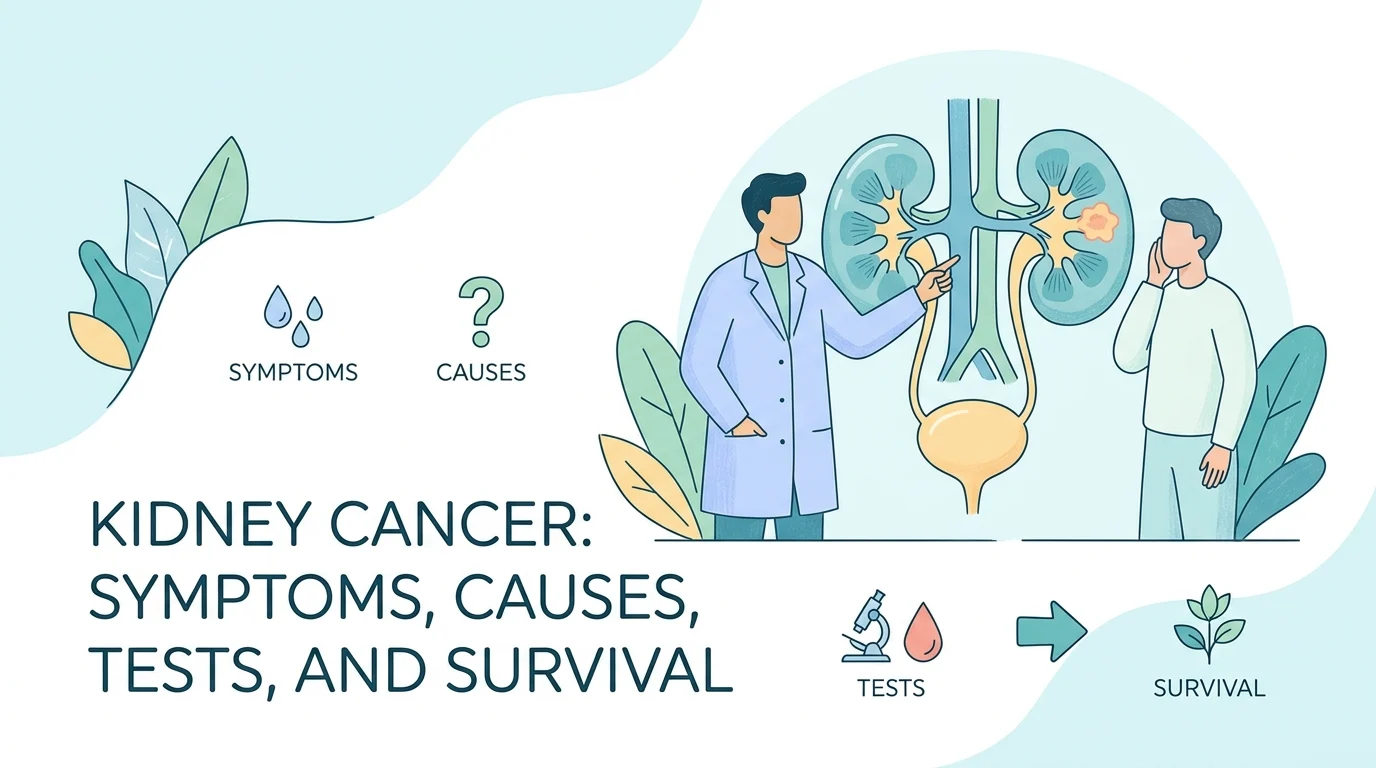
Kidney cancer has quietly become one of the most frequently diagnosed cancers in the United Kingdom, with about 80,450 new cases expected in 2026 according to the National Cancer Institute. It is also one of the most misunderstood, because the way it is usually found today bears almost no resemblance to the textbook description. Two thirds of cases are caught whilst the tumour is still confined to the kidney, and most of those are discovered on a scan ordered for something else entirely. That single fact explains both the reassuring overall survival figure of 79.2 per cent and the strange experience many people have of being told they have a cancer they never felt. This guide covers the types, how the disease is actually found, the symptoms worth acting on, what blood and urine tests can and cannot show, and what the survival numbers mean by stage.
What kidney cancer is
The kidneys are two fist-sized organs sitting either side of the spine, just above the waist, behind the abdominal cavity. They filter waste from the blood, control fluid and mineral balance, help regulate blood pressure, and produce hormones including erythropoietin. Kidney cancer develops when cells in the kidney begin to grow abnormally, most often in the lining of the tiny tubes where filtration takes place.
| Type | Share of cases | What characterises it |
|---|---|---|
| Renal cell carcinoma | About 85 per cent | Starts in the tube-lining cells; the clear cell subtype is the most common |
| Transitional cell carcinoma | 6 to 7 per cent | Begins where the kidney meets the ureter, and behaves more like bladder cancer |
| Wilms tumour | About 5 per cent | Almost exclusively a childhood cancer, managed very differently |
| Renal sarcoma | About 1 per cent | Rare, arising from connective tissue rather than filtering cells |
Because renal cell carcinoma accounts for the large majority of adult cases, most of what follows describes that disease. It is also worth separating primary kidney cancer, which starts in the kidney, from cancer that has spread to the kidney from elsewhere; the two are different situations with different treatments.
How most kidney cancers are found today
This is the part that rarely appears at the top of a search result, and it changes how the rest of the article should be read. The kidneys sit deep in the body with room around them, so a tumour can grow for a long time without touching anything that produces a symptom. Historically that meant kidney cancer was found late.
What changed is the volume of cross-sectional imaging. A CT or ultrasound ordered for abdominal pain, a kidney stone, an injury, or a routine pre-operative check now frequently reveals a small kidney mass that nobody was looking for. Clinicians call this an incidental finding. The consequence is visible in the statistics: 66 percent of cases are localised at diagnosis, and localised disease has a five-year relative survival of 93.6 percent. In other words, the good outcomes in kidney cancer are largely a story about accidental early detection, not about symptom awareness.
Two things follow. First, there is currently no screening programme for kidney cancer in the general population, and no blood or urine test approved to detect it. Second, if you have been told a mass was seen on a scan, that is the beginning of an assessment, not a diagnosis: a significant proportion of small renal masses turn out to be benign.
Kidney cancer symptoms
Most early kidney cancers cause no symptoms at all. When they do appear, the signs below are the ones most often reported.
- Blood in the urine, which may look pink, red, or cola-coloured, and which can come and go
- Persistent pain in the side or back, below the ribs, that does not resolve
- A lump or mass felt in the side or abdomen
- Unexplained weight loss
- Loss of appetite
- Tiredness that is not explained by sleep or activity
- Fever that recurs without an infection, sometimes with night sweats
The classic triad, and why you should not wait for it
Medical textbooks describe a triad of blood in the urine, flank pain, and a palpable mass. It is worth knowing precisely so that it can be set aside: all three together are uncommon, and when they do occur they usually indicate advanced disease. Waiting for a complete picture is the opposite of what the evidence supports. A single sign, particularly visible blood in the urine, is enough reason to be assessed.
Are symptoms different in women?
The symptoms are the same. Kidney cancer is diagnosed roughly twice as often in men, and the median age at diagnosis is 65. One practical difference does exist: blood in the urine in women is more often attributed first to a urinary tract infection, which can delay investigation if the bleeding persists after treatment. Blood in the urine that returns after antibiotics deserves a further look regardless of sex.
When to seek care
- Visible blood in the urine at any age, even once, and even if it has stopped
- Blood in the urine that returns after a treated infection
- Side or back pain lasting more than two weeks without an obvious cause
- A lump felt in the abdomen or flank
- Unintentional weight loss, recurrent fever, or drenching night sweats without explanation
Risk factors
Most people diagnosed have no identifiable cause, but several factors are well established.
- Older age, with most diagnoses after 60
- Smoking, one of the strongest modifiable risks
- Obesity
- High blood pressure
- Long-term dialysis for advanced kidney failure
- A family history of kidney cancer in a close relative
- Inherited syndromes, including von Hippel-Lindau disease, Birt-Hogg-Dubé syndrome, tuberous sclerosis complex, hereditary papillary renal cell carcinoma, and familial renal cancer
The inherited syndromes account for a small minority of cases, but they matter disproportionately because they change surveillance: people with a known syndrome, or several affected relatives, may be offered regular imaging where the general population is not.
Diagnosis, and what lab tests can and cannot show
Imaging is what identifies a kidney tumour. A CT scan with contrast is the standard, with MRI used when contrast must be avoided or when the appearance is unclear. Increasingly, a needle biopsy of the mass is performed before deciding on treatment, precisely to avoid operating on lesions that are benign.
Blood and urine tests play a supporting role, and understanding what that role is prevents a great deal of unnecessary worry. No routine blood test diagnoses kidney cancer. What the tests do is describe kidney function before and after treatment, and occasionally flag a consequence of the disease.
- Urinalysis can detect blood that is not visible to the eye, which is often what triggers imaging in the first place; for the wider picture, read our guide to blood in urine, and for the other cells a urine test reports, read our guide to leukocytes in urine
- Kidney function is measured to know how much reserve exists before removing tissue; consult our creatinine guide, see our eGFR test guide, and open our BUN test guide
- A full blood count may show anaemia, common in kidney cancer, or more rarely a raised red cell count, since some tumours overproduce the hormone the kidney normally uses to control red cell production; review our erythropoietin guide
- Calcium is checked because kidney cancer is one of the tumours that can raise it, a finding known as a paraneoplastic effect; check our calcium blood test guide
- Liver enzymes and inflammatory markers are sometimes included when staging, as part of the broader assessment
Each of these values has many more common explanations than cancer. They are pieces of context, not answers.
Stages and survival
Kidney cancer is staged by tumour size, whether it has grown beyond the kidney, and whether it has reached lymph nodes or distant organs. Cancer registries report survival using three broader groups, and the differences between them are substantial.
| Extent at diagnosis | Share of cases | Five-year relative survival |
|---|---|---|
| Localised, confined to the kidney | 66 percent | 93.6 percent |
| Regional, spread to nearby structures or nodes | 17 percent | 77.6 percent |
| Distant, spread to other organs | 15 percent | 20.3 percent |
| Unstaged | 3 percent | 55.2 percent |
Across all stages combined the figure is 79.2 percent, and around 15,160 deaths are expected in the United States in 2026. Three cautions apply. Relative survival compares people with the diagnosis to people of the same age without it, so it isolates the effect of the cancer rather than predicting an individual’s lifespan. The figures describe people diagnosed several years ago, treated with the options available at the time, which in advanced kidney cancer have changed considerably. And they pool all tumour types and grades, which behave differently.
How kidney cancer is treated
Treatment depends on the stage, the size and position of the tumour, and how well the kidneys work.
- Partial nephrectomy removes the tumour and spares the rest of the kidney, and is preferred for smaller tumours because it preserves function
- Radical nephrectomy removes the whole kidney, sometimes with surrounding tissue, for larger or more invasive tumours
- Thermal ablation destroys a small tumour with heat or cold delivered through a needle, usually through the skin
- Active surveillance monitors a small mass with repeat imaging rather than treating it immediately, an option that has moved firmly into guidelines
- Immunotherapy, particularly checkpoint inhibitor combinations, is the backbone of treatment for advanced disease
- Targeted therapies acting on tumour blood supply and growth signals are used alone or alongside immunotherapy
- Radiotherapy has a limited but growing role, including stereotactic treatment for people who cannot have surgery
Conventional chemotherapy is largely ineffective in renal cell carcinoma, which often comes as a surprise to patients and is a frequent source of confusion online.
Latest scientific advances
The last three years have pushed in two directions at once: doing less for small tumours, and doing considerably more for advanced disease. The findings below come from peer-reviewed literature and clinical guidelines, simplified for general readers, and none of them replaces the judgement of a treating team.
Updated national guidelines published in 2025 reaffirmed the central role of needle biopsy in deciding treatment, with growing support for a broader strategy of biopsying renal masses rather than proceeding straight to surgery, explicitly in order to reduce overtreatment. The same guidelines establish active surveillance as a safe and effective option for small renal masses, including selected complex cystic lesions, with cancer outcomes comparable to immediate intervention. They also confirm a centre-volume effect, meaning outcomes are better in centres that perform a high number of these operations, which is a reasonable thing for a patient to ask about.
For small tumours that are treated, a 2025 network meta-analysis compared needle-based ablation against surgery across 32 studies, covering 8,568 patients with T1a tumours and 1,019 with T1b tumours. For T1a disease it found no significant difference in five-year recurrence-free survival between open partial nephrectomy and percutaneous radiofrequency ablation, percutaneous cryoablation, or the laparoscopic equivalents. Percutaneous microwave ablation was associated with lower local recurrence and fewer post-procedure adverse events than surgery. For T1b tumours, outcomes were similar across the percutaneous approaches studied. The practical implication is that for a small tumour, more than one reasonable option may exist, and the choice depends on tumour position, kidney function, and local expertise.
Detection is where the most work remains. A systematic review published in 2025 examined urinary biomarkers for kidney cancer, screening 46 studies and identifying 105 individual markers plus 29 multi-marker panels. Several showed promising accuracy, including markers of disrupted energy metabolism, the proteins AQP1 and PLIN2, and a set of microRNAs. The authors were explicit that external validation is severely lacking and that none is ready for clinical use. Read alongside the absence of any screening test, this is the honest state of play: a urine test for kidney cancer is a research goal, not an available option. Imaging-based approaches are somewhat further along, with a confirmatory trial of an antibody-based PET scan designed to identify clear cell carcinoma non-invasively currently recruiting.
In advanced disease, guideline updates published in 2025 recorded two meaningful shifts. Upfront removal of the kidney is no longer recommended for unselected patients with metastatic disease, remaining an option only for carefully chosen people with limited spread, and a randomised trial is still running to settle that question across nearly 400 sites. Active surveillance can also be considered for slow-growing, asymptomatic, low-volume metastatic disease. First-line treatment now prioritises immunotherapy-based combinations chosen according to individual risk factors. A separate systematic review found that where metastases have been completely removed surgically, adjuvant pembrolizumab appears to benefit that group, while other agents have not shown the same effect. A search of ClinicalTrials.gov in September 2026 returns 21 recruiting phase 3 trials in renal cell carcinoma, several testing newer agents that block the pathway driving clear cell tumours.
Glossary
| Term | Meaning |
|---|---|
| Renal cell carcinoma | The most common kidney cancer in adults, about 85 per cent of cases. |
| Small renal mass | A kidney lesion of about 4 centimetres or less; many are benign. |
| Incidental finding | Something seen on a scan done for an unrelated reason. |
| Haematuria | Blood in the urine, visible or detected only on testing. |
| Partial nephrectomy | Surgery removing the tumour while sparing the rest of the kidney. |
| Ablation | Destroying a tumour with heat or cold through a needle. |
| Active surveillance | Monitoring a small mass with repeat imaging instead of treating it. |
| Paraneoplastic effect | A body-wide effect of a tumour, such as raised calcium, away from the tumour itself. |
| Relative survival | Survival compared with people of the same age without the cancer. |
Frequently asked questions
What is the first sign of kidney cancer?
Most often there is none, which is why two thirds of cases are found on scans done for other reasons. When a first sign does appear it is usually blood in the urine, which may be visible or picked up on a routine urine test. Flank pain and a palpable lump are later signs and are not reliable early warnings.
Can a blood test detect kidney cancer?
No. There is no blood test that diagnoses or screens for kidney cancer. Blood tests are used to assess kidney function before and after treatment, to detect anaemia or raised calcium that can accompany the disease, and to monitor recovery. A tumour is identified by imaging, and confirmed by examining tissue.
How serious is kidney cancer?
It depends almost entirely on how far it has spread. Five-year relative survival is 93.6 percent when the cancer is still confined to the kidney, which is the situation for 66 percent of cases, and 20.3 percent once it has reached distant organs. The overall figure across all stages is 79.2 percent.
Does a mass on the kidney mean cancer?
Not necessarily. Small kidney masses are common, and a meaningful proportion turn out to be benign lesions such as cysts, angiomyolipomas, or oncocytomas. This is one reason guidelines increasingly favour taking a biopsy of a renal mass before deciding on treatment rather than assuming the worst.
Can you live with one kidney after treatment?
Yes. A single healthy kidney can generally do the work of two, and many people live normally after having one removed. Kidney function is monitored afterwards with blood tests, and where possible surgeons now prefer to remove only the tumour and preserve the rest of the kidney.
Is kidney cancer treated with chemotherapy?
Rarely. Renal cell carcinoma responds poorly to conventional chemotherapy. Treatment for advanced disease is built on immunotherapy and targeted drugs instead, which is a significant difference from most other solid cancers and a frequent source of confusion.
Should I be screened if a relative had kidney cancer?
There is no general screening programme, but a family history changes the conversation, particularly if more than one relative was affected, if they were diagnosed young, or if an inherited syndrome is known in the family. That is a discussion to have with your doctor, who may refer you for genetic assessment and periodic imaging.
Sources
- Cancer Stat Facts: Kidney and Renal Pelvis Cancer — SEER Programme, National Cancer Institute
- Renal Cell Cancer Treatment (PDQ) Patient Version — National Cancer Institute, National Institutes of Health
- Kidney Cancer — MedlinePlus, National Library of Medicine
- Kidney Cancer, Symptoms and Causes — Mayo Clinic
- Kidney Cancer: Symptoms, Causes and Treatment — Cleveland Clinic
- Bigot P. et al. Updated 2025 French guidelines for renal cell carcinoma — The French Journal of Urology, 2025 (indexed in PubMed)
- Shaaban Abdelgalil M. et al. Thermal Ablation Modalities That Best Compete with Partial Nephrectomy for T1A and T1B Renal Cell Carcinoma: A Network Meta-Analysis — Journal of Vascular and Interventional Radiology, 2025 (indexed in PubMed)
- Kelly J.F. et al. Renal cell carcinoma detection: a systematic review in diagnostic urinary biomarkers — BMC Cancer, 2025 (indexed in PubMed)
- Barragan-Carrillo R. et al. Management of Metastatic Renal Cell Carcinoma: Guideline Updates — European Urology Focus, 2025 (indexed in PubMed)
- Monda S. et al. Post-Metastasectomy Adjuvant Therapy in Patients with Renal Cell Carcinoma: A Systematic Review — Kidney Cancer, 2024 (indexed in PubMed)
- Immunotherapy-Based Combination Therapy With or Without Cytoreductive Nephrectomy for Metastatic Renal Cell Carcinoma, PROBE Trial (NCT04510597) — ClinicalTrials.gov
- 89Zr-girentuximab PET/CT to Non-invasively Detect Clear Cell Renal Cell Carcinoma in Indeterminate Renal Masses (NCT06750419) — ClinicalTrials.gov
Other articles
- Blood in Urine (Haematuria): Causes and When to Get Checked
- Creatinine Levels: What They Reveal About Your Kidneys
- eGFR Test: What Your Kidney Filtration Result Means
- BUN Test: What Your Blood Urea Nitrogen Levels Mean
- Erythropoietin (EPO): a complete guide to understanding your test results
- Calcium Blood Test: What Your Levels Mean
- Leukocytes in Urine: How to Read and Understand Your Results
- Prostate Cancer: Symptoms, Diagnosis, and Treatment
Kidney results are far easier to act on when creatinine, eGFR, urea, calcium, and the urine findings are explained together rather than read one line at a time. Understand your lab results with AI DiagMe, which reads your report line by line and explains each value in plain language, with interpretation reviewed by a committee of physicians.