





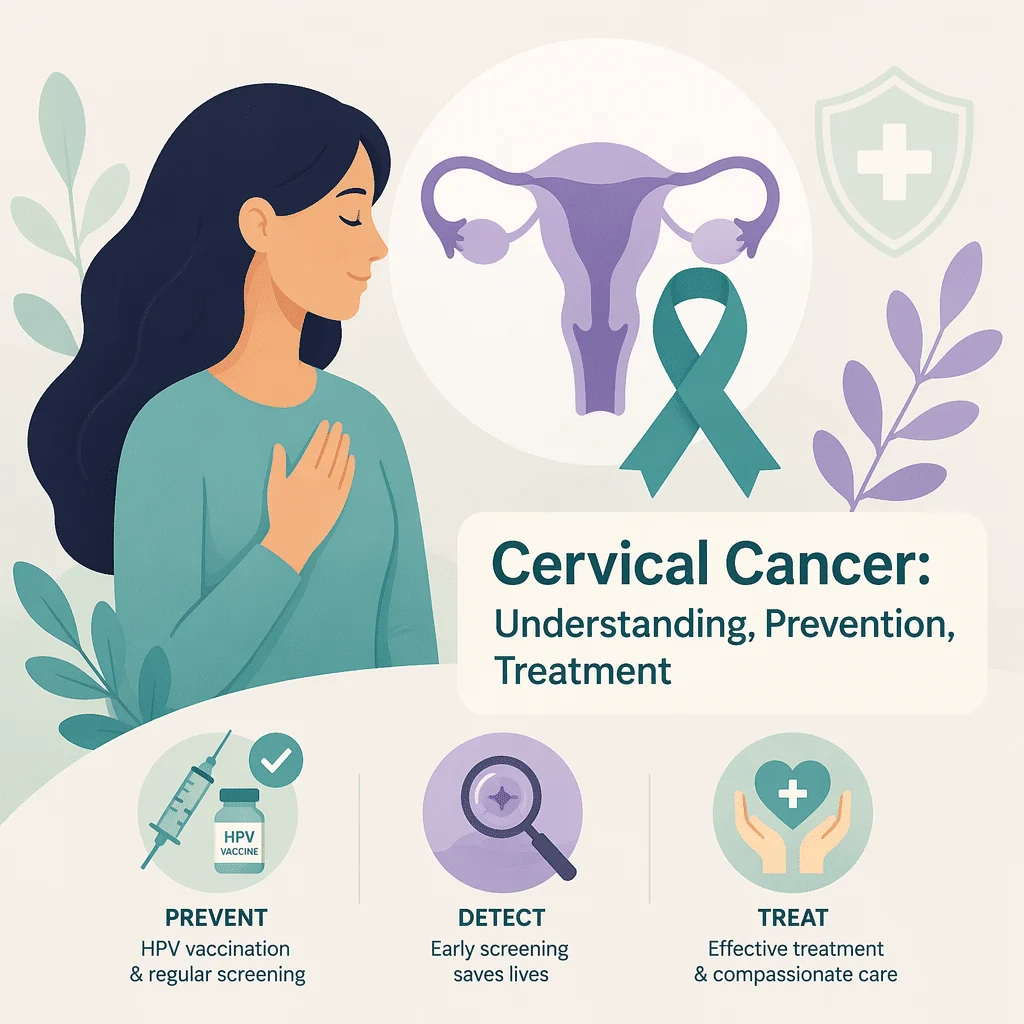
Cervical cancer and uterine cancer are two of the most common cancers of the female reproductive system, and they are often confused with each other. Cervical cancer starts in the cervix, the narrow lower end of the uterus, and is almost always linked to the human papillomavirus (HPV). Uterine cancer, most often endometrial cancer, begins in the lining of the uterus and is tied more closely to hormones. The reassuring part is that both are highly treatable when found early, and one of them, cervical cancer, is now considered largely preventable.
In this article you’ll learn how these two cancers differ, what raises your risk, which symptoms deserve attention, and how screening and lab tests help catch them early. We also cover HPV vaccination, the shift towards HPV-based screening, and recent advances in treatment, all in plain language.
Cervical cancer and uterine cancer: what they are
Although the cervix and the body of the uterus sit right next to each other, they are different tissues, and cancers that start in each behave differently. Understanding the distinction helps you make sense of your symptoms, your screening options, and any lab results your doctor orders.
The cervix and the uterus
The uterus (womb) is the pear-shaped organ where a pregnancy grows. Its inner lining is called the endometrium. The cervix is the narrow neck at the bottom of the uterus that opens into the vagina. Because these areas are lined by different types of cells, they give rise to different cancers with different causes, different warning signs, and different prevention strategies.
Two cancers, two different stories
Cervical cancer usually develops slowly, over many years, from cell changes caused by a long-lasting HPV infection. Uterine cancer, in its most common endometrial form, is driven mainly by long-term exposure to the hormone oestrogen, and it tends to cause noticeable bleeding earlier. The table below summarises the main differences at a glance.
| Feature | Cervical cancer | Uterine (endometrial) cancer |
|---|---|---|
| Where it starts | Cervix, the neck of the womb | Endometrium, the lining of the womb |
| Main cause | Long-lasting high-risk HPV infection | Long-term oestrogen exposure |
| Typical age at diagnosis | Often between 35 and 44 | Usually after menopause, age 55 and older |
| Common early sign | Often none until advanced; bleeding after sex | Abnormal or postmenopausal bleeding |
| Routine screening test | Smear test and HPV test | No routine screening test |
| Main prevention | HPV vaccine and regular screening | Managing weight, hormones, and risk factors |
What raises your risk
Risk factors are not a diagnosis. Many people with several risk factors never develop cancer, and some people with none do. Still, knowing your personal risk helps you and your doctor decide how closely to watch.
Cervical cancer risk factors
Nearly all cervical cancers are caused by a persistent infection with high-risk types of HPV, a very common virus passed through skin-to-skin and sexual contact. Most infections clear on their own within a year or two, but a small number linger and slowly change cervical cells. Factors that make a lasting infection more likely include smoking, a weakened immune system (for example from HIV), long-term use of oral contraceptives, and having had many full-term pregnancies. The Centers for Disease Control and Prevention notes that HPV is so common that most sexually active people are exposed at some point, yet only a small share of infections ever progress to cancer.
Uterine cancer risk factors
Uterine cancer risk rises with anything that increases lifetime exposure to oestrogen without enough progesterone to balance it. That list includes obesity, starting periods early or reaching menopause late, never having been pregnant, polycystic ovary syndrome (PCOS), oestrogen-only hormone therapy, and the breast cancer medicine tamoxifen. Type 2 diabetes and a family history of uterine, ovarian, or bowel cancer (including the inherited condition Lynch syndrome) also raise risk. Because hormones sit at the centre of this cancer, understanding your hormone levels can be useful, and you can read our guide to reading oestradiol levels on a hormone panel. Women with PCOS may want to explore our guide to high testosterone in women and PCOS.
Symptoms and warning signs
The two cancers tend to signal themselves in different ways. Knowing what is normal for your own body is the single most useful thing you can do, because change is what matters most.
Cervical cancer symptoms
Early cervical cancer often causes no symptoms at all, which is exactly why regular screening is so important: it can find changes before you would ever feel them. When symptoms do appear, they may include bleeding between periods, bleeding after sex, heavier or longer periods than usual, watery or foul-smelling discharge, or pelvic pain. Bleeding after intercourse does not usually mean cancer, and it can come from fragile cervical tissue instead; for that scenario, see our article on the causes of a friable cervix.
Uterine cancer symptoms
Uterine cancer tends to announce itself earlier, usually through abnormal bleeding, which is why it is more often caught at an early, curable stage. Any bleeding after the menopause should be checked promptly, even if it is light or happens only once. Before the menopause, warning signs include bleeding between periods, unusually heavy periods, or a clear change in your normal pattern. Telling a harmless mid-cycle spot from a warning sign can be tricky, so it helps to read our guide to ovulation spotting and mid-cycle bleeding.
How cervical and uterine cancer are diagnosed
Diagnosis follows very different paths for these two cancers. Cervical cancer has a mature, organised screening system; uterine cancer is usually found only after symptoms appear.
Cervical screening: smear and HPV tests
Two tests anchor cervical screening. A smear test (also called a cervical smear or Pap test) looks for abnormal cells under a microscope, whilst an HPV test looks for the virus that causes those changes. They are often done from the same sample at the same visit, an approach called co-testing. If a result is abnormal, the next step is usually colposcopy, a close look at the cervix, sometimes with a small biopsy. A very common and reassuring result is a normal smear with a positive HPV finding, and you can read our guide to reading a normal smear test alongside a positive HPV test.
Diagnosing uterine cancer
There is no routine screening test for uterine cancer, so diagnosis usually begins when abnormal bleeding prompts a transvaginal ultrasound. This painless scan measures the thickness of the endometrium; a thin lining is reassuring, whilst a thickened one may need a closer look. The same imaging is often used to check the ovaries, and you can see our overview of ovarian cyst size on ultrasound. A definitive answer comes from an endometrial biopsy, a small sample of the lining taken in the clinic. A blood test called CA-125 is sometimes measured, but it has real limits: it can be normal in early cancer and raised by many harmless conditions such as fibroids, endometriosis, or even menstruation, so it cannot rule the disease in or out on its own. To understand those limits, consult our explainer on how to interpret the CA 125 blood marker.
Preventing cervical and uterine cancer
Cervical cancer is one of the few cancers we can largely prevent, thanks to a vaccine and screening. Uterine cancer has no vaccine, but several everyday steps lower the risk.
The HPV vaccine
The HPV vaccine protects against the virus types that cause most cervical cancers. It works best when given before any exposure to HPV, which is why it is recommended in early adolescence, though older teenagers and young adults can still benefit. According to the National Cancer Institute, long-lasting HPV infection causes almost all cervical cancers, so preventing that infection prevents the disease itself.
Regular cervical screening
Vaccination does not replace screening, because the vaccine does not cover every high-risk HPV type. Continuing your Pap and HPV tests on the recommended schedule catches the small number of changes that slip through. Screening is what turned cervical cancer from a leading cause of cancer death into a largely preventable disease over the past several decades.
Lowering uterine cancer risk
Because uterine cancer is fuelled by oestrogen, staying at a healthy weight, being physically active, and managing conditions like diabetes and PCOS all help. If you take hormone therapy after the menopause, ask whether a combined oestrogen-plus-progesterone form is safer for you than oestrogen alone. Reporting any abnormal bleeding early is itself a form of prevention, because it leads to treatment whilst the disease is still curable.
How cervical and uterine cancer are treated
Treatment depends on the type of cancer, its stage, and your overall health and plans, such as whether you hope to preserve fertility. Care is usually planned by a team.
For early cervical cancer, treatment may be as limited as removing the abnormal area (a procedure called conisation) or a hysterectomy to remove the uterus. More advanced cervical cancer is often treated with a combination of radiation and chemotherapy. For early uterine cancer, surgery to remove the uterus is usually the main treatment, sometimes followed by radiation. Advanced or recurrent uterine cancer may add chemotherapy, hormone therapy, and newer immunotherapy, which we explain in the next section. The American Cancer Society offers detailed, stage-by-stage treatment information for endometrial cancer if you want to go deeper.
Latest scientific advances
Research on these two cancers has moved quickly. Here is what recent studies mean for everyday readers, translated out of the technical language.
Cervical cancer is becoming a preventable disease
Large real-world studies now show that HPV vaccination is dramatically reducing cervical cancer. In England, women offered the vaccine at ages 12 to 13 had roughly 87% fewer cervical cancers than earlier generations who were not vaccinated, a drop so large that the researchers described the disease as almost eliminated in those groups (Falcaro and colleagues, 2021). In Scotland, a follow-up study found no cases at all of invasive cervical cancer among women who had been fully vaccinated at ages 12 to 13 (Palmer and colleagues, 2024). What this means for you: getting the vaccine on time, ideally in early adolescence, offers powerful and lasting protection.
Screening is shifting towards HPV testing first
Screening guidelines are increasingly built around testing for high-risk HPV as the first step, rather than the smear test alone, because the virus test spots risk earlier. A 2025 modelling study, which uses data to project future trends, estimated that HPV testing every two to three years, combined with vaccination, could bring cervical cancer to the point of elimination years sooner (Luu and colleagues, 2025). A clinical review explains this move towards primary HPV testing and follow-up based on your personal risk rather than a one-size-fits-all schedule (Gavinski and DiNardo, 2022). What this means for you: you may be offered an HPV test as your main screen, which is a sign that care is becoming more precise, not less thorough.
New immunotherapy for advanced uterine cancer
Advanced endometrial cancer used to have very few options once chemotherapy stopped working. That has changed with immunotherapy, treatments that help your own immune system recognise and attack the tumour. A systematic review, which pools the results of many trials, found that a class of drugs called immune checkpoint inhibitors reshaped treatment, especially for tumours with a feature known as mismatch repair deficiency, a flaw in the cell’s DNA repair machinery that makes the cancer more visible to the immune system (Maiorano and colleagues, 2022). Medicines such as pembrolizumab and dostarlimab release a brake on immune cells called the PD-1 checkpoint, and they are now approved options; adding the targeted drug lenvatinib to pembrolizumab improved survival in a major trial (Salutari, 2025; Marin-Jimenez and colleagues, 2022). What this means for you: even advanced uterine cancer now has more effective and better-targeted treatments than it did a few years ago, and a simple tumour test that checks mismatch repair status helps match each patient to the right one.
When to see a doctor
Book an appointment, without waiting for your next routine visit, if you notice any of the following:
- Any vaginal bleeding after the menopause, even a single light episode.
- Bleeding between periods, after sex, or periods that suddenly become much heavier or longer.
- Unusual, watery, or foul-smelling vaginal discharge.
- Persistent pelvic pain or pain during sex.
- A cervical screening result you do not understand, or a screening test you are overdue for.
None of these symptoms means you have cancer, most have harmless explanations, but each one deserves a professional check so the cause can be found and treated early.
Glossary
| Term | Definition |
|---|---|
| Cervix | The narrow lower part of the uterus that opens into the vagina. |
| Endometrium | The inner lining of the uterus, where endometrial cancer begins. |
| HPV (human papillomavirus) | A common virus spread by skin and sexual contact; certain high-risk types cause most cervical cancers. |
| Pap test | A screening test, also called a cervical smear, that looks for abnormal cells on the cervix. |
| HPV test | A screening test that detects high-risk HPV types on the cervix, often done together with a Pap test. |
| Colposcopy | A close examination of the cervix using a lighted magnifier, usually after an abnormal screening result. |
| Endometrial biopsy | A small sample of the uterine lining taken to confirm or rule out uterine cancer. |
| Transvaginal ultrasound | A painless scan that images the uterus and ovaries and measures the thickness of the endometrium. |
| CA-125 | A blood marker that can be raised by some gynaecological cancers but also by many harmless conditions. |
| Immunotherapy | Treatment that helps the immune system attack cancer; checkpoint inhibitors are one type used in uterine cancer. |
Frequently asked questions
Is cervical cancer the same as uterine cancer?
No. They are two separate cancers that happen to be neighbours. Cervical cancer starts in the cervix, the neck of the womb, and is caused almost entirely by long-lasting HPV infection. Uterine cancer, usually endometrial cancer, starts in the lining of the uterus and is driven mainly by hormones. They differ in typical age, warning signs, how they are found, and how they are prevented, which is why doctors treat them as distinct conditions.
Can the HPV vaccine prevent cervical cancer completely?
The HPV vaccine prevents most, but not all, cervical cancers, because it targets the highest-risk virus types rather than every type that exists. Real-world studies show very large reductions, especially when the vaccine is given in early adolescence before any exposure. That is why the current advice is to be vaccinated and to keep up with screening, since the two together offer far stronger protection than either one alone.
What are the survival rates for these cancers?
Outcomes depend heavily on the stage at which the cancer is found, and both cancers are frequently curable when caught early. Because uterine cancer usually causes bleeding at an early stage, it is often diagnosed whilst still confined to the uterus, when treatment works best. Cervical cancer found through screening, before it spreads, also has favourable outcomes. Your own outlook depends on many personal factors, so the most reliable figures come from your care team.
What causes uterine cancer if it is not HPV?
Unlike cervical cancer, uterine cancer is not caused by a virus. Its main driver is long-term exposure to oestrogen that is not balanced by progesterone. Conditions and factors that raise oestrogen exposure, such as obesity, PCOS, oestrogen-only hormone therapy, early periods, late menopause, and never having been pregnant, all increase risk. Some uterine cancers are also linked to inherited conditions such as Lynch syndrome, which is why family history matters.
At what age should cervical screening start and stop?
In the United Kingdom, cervical screening generally begins around age 25 and continues until about age 65 for people who have had normal results. The exact test and interval depend on your age, your history, and current guidelines, which increasingly favour HPV testing as the main screen. Because recommendations are updated over time and vary by individual, ask your clinician which schedule fits you.
Can I have cervical or uterine cancer with no symptoms?
Yes, especially with cervical cancer, which often causes no symptoms in its early stages; this is the whole reason routine screening exists. Uterine cancer more often produces early bleeding, but not always, and some people notice only a subtle change. This is why any abnormal or postmenopausal bleeding should be checked, and why keeping up with cervical screening matters even when you feel perfectly well.
Sources
- Centers for Disease Control and Prevention (CDC) — Cervical Cancer Basics, 2024 — cdc.gov
- National Cancer Institute (NCI) — Cervical Cancer, 2023 — cancer.gov
- National Cancer Institute (NCI) — Uterine Cancer — cancer.gov
- American Cancer Society (ACS) — Endometrial Cancer — cancer.org
- Falcaro M, et al. — The effects of the national HPV vaccination programme in England on cervical cancer and CIN3 incidence — The Lancet, 2021 — doi.org/10.1016/S0140-6736(21)02178-4
- Palmer TJ, et al. — Invasive cervical cancer incidence following bivalent HPV vaccination — Journal of the National Cancer Institute, 2024 — doi.org/10.1093/jnci/djad263
- Luu XQ, et al. — Cervical Cancer Screening, HPV Vaccination, and Cervical Cancer Elimination — JAMA Network Open, 2025 — doi.org/10.1001/jamanetworkopen.2025.26683
- Gavinski K, DiNardo D — Cervical Cancer Screening — Medical Clinics of North America, 2022 — doi.org/10.1016/j.mcna.2022.10.006
- Maiorano BA, et al. — How Immunotherapy Modified the Therapeutic Scenario of Endometrial Cancer: A Systematic Review — Frontiers in Oncology, 2022 — doi.org/10.3389/fonc.2022.844801
- Salutari V — Advancing endometrial cancer treatment: immunotherapy and tyrosine kinase inhibitors — Drugs in Context, 2025 — doi.org/10.7573/dic.2025-4-4
- Marin-Jimenez JA, et al. — Facts and Hopes in Immunotherapy of Endometrial Cancer — Clinical Cancer Research, 2022 — doi.org/10.1158/1078-0432.CCR-21-1564
Further reading
- Abnormal blood test results: what they mean
- CEA (carcinoembryonic antigen), explained
- The CA 19-9 tumour marker
- Common lab test abbreviations
- More AI DiagMe health guides
Understand your lab results with AI DiagMe
Get your results interpreted in minutes
Cervical and uterine cancer care involves a lot of test results, from HPV and smear co-testing to endometrial ultrasound findings and blood markers like CA-125. AI DiagMe helps you read those numbers in plain language, so you understand what a positive HPV result or an out-of-range marker actually suggests before your next appointment. It is built to help you understand your results, not to diagnose you, and it never replaces your doctor.