










A selenium blood test measures how much of this trace element is circulating in your blood, and it is usually ordered to answer one of two questions: are you getting too little, or are you getting too much? Selenium is unusual among nutrients because those two answers sit close together. The amount an adult needs each day and the amount that begins to cause harm are separated by a narrower margin than for almost any other mineral, which is why StatPearls describes selenium as a nutrient with a narrow therapeutic-to-toxic range.
In this article you'll learn what selenium does in the body, what a plasma or serum result actually reflects, who in the United States is genuinely at risk of running low, why Brazil nuts appear in every conversation about selenium, and what large randomised trials found when they tested selenium supplements for preventing cancer. The honest through-line: for most people eating a varied diet, more selenium is not better.
What selenium does in the body
Selenium is a trace element: your body needs it in very small amounts and cannot make it, so it comes from food. Once absorbed, selenium is built into a family of about 25 proteins known as selenoproteins, and essentially everything selenium does, it does through them.
Antioxidant defence
The best known selenoproteins are the glutathione peroxidases. These enzymes neutralise peroxides, reactive by-products of normal metabolism that would otherwise damage cell membranes. This is the origin of selenium's reputation as an antioxidant mineral, and it fairly describes the chemistry. It is not evidence that extra selenium produces extra protection, a distinction that matters later in this article.
Thyroid hormone metabolism
The thyroid gland holds a higher concentration of selenium than any other organ. Selenium-dependent enzymes called deiodinases convert thyroxine, the relatively inactive hormone the thyroid mostly releases, into triiodothyronine, the active form your tissues use. Other selenoproteins shield thyroid tissue from the hydrogen peroxide generated during hormone production. This is why selenium keeps appearing alongside thyroid testing, and our guide explains the TSH blood test that usually comes first in that workup.
Why a selenium blood test is ordered, and what it measures
Selenium is not part of a routine panel. A doctor typically orders it for a specific reason: suspected malabsorption, long-term nutrition delivered through a vein, dialysis, an unexplained cardiomyopathy, or a suspicion that someone has been taking far too much of a supplement.
Several trace elements are tested this way, and each carries the same interpretive caution. Our sibling article explains the chromium blood test, whilst separate guides cover the zinc blood test and the copper blood test.
What a plasma or serum result reflects
Plasma and serum selenium are the usual measures, and the NIH Office of Dietary Supplements notes that these reflect recent intake rather than long-term status. This is the single most useful thing to understand about the test. A result taken a week after you started eating Brazil nuts daily will look different from one taken before. Selenium concentrations in whole blood, including red cells, track longer-term status, whilst hair and nail content reflect intake over months or years.
Functional markers
Two selenoproteins in plasma, glutathione peroxidase 3 and selenoprotein P, can be measured as functional markers of selenium status, meaning they show whether there is enough selenium to actually do the job rather than simply how much is present. Both have a real limitation: inflammation and oxidative stress can push them around independently of selenium, so some experts question how reliably they identify deficiency. Research also suggests these markers only rise with supplementation in people who were deficient to begin with. In a well-nourished person, adding selenium does not push them higher.
What your selenium result means: too little, enough, too much
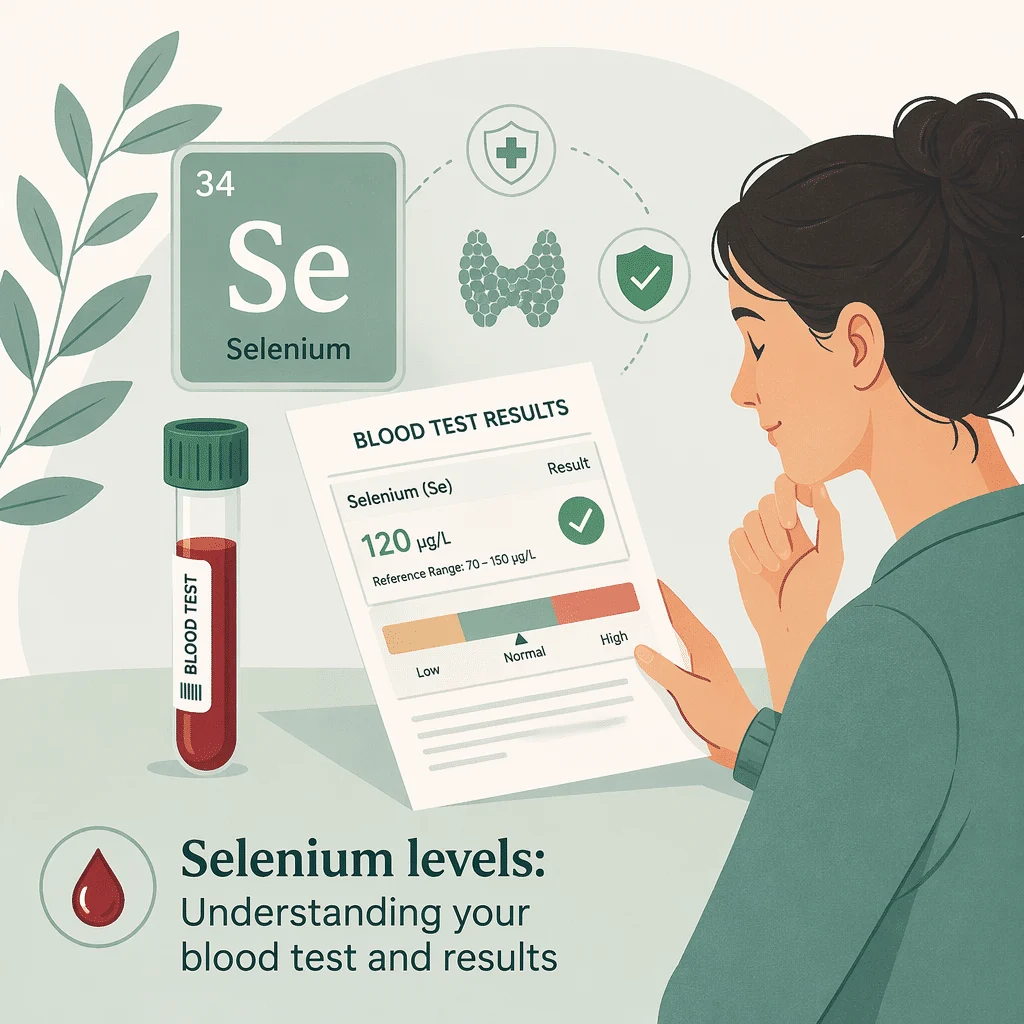
Reference ranges vary between laboratories, so always read your result against the range printed on your own report. As a broad orientation, the NIH Office of Dietary Supplements considers plasma or serum concentrations of 8 mcg/dL or higher sufficient for selenoprotein production in healthy people, and StatPearls cites a serum reference range of 70 to 155 mcg/L.
A result inside the reference range means your recent selenium intake has been adequate. It does not mean you need a supplement, and it does not by itself diagnose or rule out any condition. The table below sets out the three territories.
| Result | Typical causes | What you might notice | What usually happens next |
|---|---|---|---|
| Too little | Severe malabsorption such as Crohn's disease, long-term nutrition given through a vein, dialysis, very restricted diets, living in a selenium-poor region | Often nothing. Deficiency alone rarely causes obvious illness. Severe, prolonged shortage can affect heart muscle and joints | Your doctor looks for the underlying cause rather than treating the number, and decides whether correction is needed |
| Enough | A varied diet. Selenium reaches UK food from a wide geographic area, so intakes sit comfortably above requirements even in low-soil regions | Nothing. This is the expected result for most people in the United Kingdom | No action. Adding a supplement on top of an adequate result has no established benefit |
| Too much | Almost always supplements, occasionally large daily quantities of Brazil nuts, rarely a mislabelled or misformulated product | Garlic odour on the breath, metallic taste, brittle or shedding hair and nails, rash, nausea, diarrhoea, fatigue, irritability | Your doctor reviews every supplement you take and every source of intake, and advises on what to change |
Low selenium: who is actually at risk
Selenium deficiency is very rare in the United Kingdom and Ireland. The reason is straightforward: soil selenium varies enormously by region, but food does not come from one region. Produce, grain and meat travel across the country and are imported from abroad, which averages out local soil differences. The NIH Office of Dietary Supplements states that intakes in North America sit well above the recommended amount even in low-selenium areas.
Deficiency here is therefore about circumstance, not geography. The groups that genuinely warrant attention are people with severe malabsorption such as Crohn's disease, those receiving long-term parenteral nutrition without added selenium, those on long-term haemodialysis, which removes selenium from the blood, people living with HIV, and people on very restricted diets, including medical diets such as those used in phenylketonuria.
Keshan and Kashin-Beck disease in context
Two diseases are always mentioned in connection with selenium, and both deserve their context. Keshan disease is a cardiomyopathy, a disease of the heart muscle, identified in parts of China where soil selenium is extremely low and adult intakes were no more than about 10 mcg a day. Kashin-Beck disease is a joint and bone disorder appearing in low-selenium, low-iodine areas of China, Tibet, Siberia and North Korea.
Neither is a plausible explanation for a mildly low result on a British lab report. They occurred where habitual intake was a fraction of what any UK diet delivers, and Keshan disease also appears to require an additional trigger, such as a viral infection. They are important for understanding why selenium is essential; they are not a reason to worry about a borderline number.
High selenium and selenosis: the risk most sites underplay
Here is the point most selenium articles skip. For a nutrient, the distance between the recommended amount and the harmful amount is remarkably short. The NIH Office of Dietary Supplements sets the Recommended Dietary Allowance for adults at 55 mcg a day, rising to 60 mcg in pregnancy and 70 mcg whilst breastfeeding, and sets the Tolerable Upper Intake Level, the most you can take daily without expecting harm, at 400 mcg a day for adults. Roughly seven times the requirement, and you are at the ceiling. For comparison, most vitamins have a far wider margin. A 2023 European Food Safety Authority opinion set an even lower adult limit of 255 mcg a day.
Chronically exceeding that ceiling causes selenosis. According to the NIH Office of Dietary Supplements, the earliest indicators are a garlic odour on the breath and a metallic taste in the mouth. The most characteristic signs are hair loss and brittle or shedding nails. Others include skin rash, nausea, diarrhoea, fatigue, irritability, and abnormalities of the nervous system.
Brazil nuts: a food, not a hazard
Brazil nuts are extraordinarily selenium-dense, far beyond any other common food, and their content is variable because it depends on the soil the tree grew in. The NIH Office of Dietary Supplements puts a single nut at roughly 68 to 91 mcg of selenium and a one-ounce serving of six to eight nuts at about 544 mcg, which is above the 400 mcg daily ceiling from that serving alone.
The point is easy to overstate, so read it carefully. Brazil nuts are a food, not a poison, and eating them is not dangerous. What makes them worth knowing is the arithmetic: a small handful is not a modest snack in selenium terms, it is several times an adult’s daily requirement, and the amount per nut is not consistent. The NIH Office of Dietary Supplements notes that Brazil nuts could cause selenium toxicity if eaten regularly in quantity. Occasional handfuls are not the concern. A large serving every day, indefinitely, is a different matter, and if you also take a selenium-containing supplement the two intakes add together.
When supplements go wrong
Over-supplementation is a documented cause of real harm, not a theoretical one. Acute selenium poisoning has resulted from misformulated over-the-counter products. In 2008, according to the NIH Office of Dietary Supplements, 201 people in the United States suffered severe adverse reactions after taking a liquid dietary supplement that contained 200 times the selenium stated on its label. Acute toxicity at that scale can cause severe digestive and neurological symptoms, hair loss, tremors, kidney failure, heart failure and, rarely, death.
Do selenium supplements help? What the trials found
Selenium has been promoted for preventing cancer, boosting immunity, and supporting the thyroid. The trial evidence is worth reporting plainly, because it is not what the marketing suggests.
SELECT and prostate cancer
The Selenium and Vitamin E Cancer Prevention Trial, known as SELECT, was a large randomised controlled trial, meaning participants were assigned by chance to receive selenium or a dummy pill so the groups could be fairly compared. It enrolled 35,533 men aged 50 and over across the United States, Canada and Puerto Rico, and tested 200 mcg of selenium a day, with or without vitamin E. Published in JAMA by Lippman and colleagues, it was stopped early when the results showed no reduction in prostate cancer risk in any group. Extra follow-up after participants stopped the supplements confirmed the finding.
Two further signals emerged, and both point the same direction. A later analysis within SELECT found an increased risk of high-grade prostate cancer among men who already had higher selenium status when they started, and the researchers recommended that men over 55 avoid selenium supplements at doses above recommended dietary intakes. Separately, a 2018 Cochrane Review concluded with high certainty that 200 mcg a day does not reduce the risk of prostate, colorectal, lung or bladder cancer. The US Food and Drug Administration has concluded it is highly unlikely that selenium supplements reduce prostate cancer risk.
The diabetes signal
SELECT also recorded more cases of type 2 diabetes in the selenium group, though this particular difference was not statistically significant, meaning it could plausibly have been chance. It has not been dismissed either, because other lines of evidence point the same way. The fair summary is that a possible signal exists, it has not been confirmed by trials, and it is another reason not to take selenium casually.
Selenium and thyroid disease
Selenium’s role in thyroid biology is real, so unlike the cancer question, whether supplements help people with thyroid disease is a legitimate one. The answer is narrower than the internet suggests.
Trials in Hashimoto’s thyroiditis, an autoimmune condition in which the immune system attacks the thyroid, have generally shown that selenium can lower thyroid peroxidase antibodies. Far less clear is whether that translates into anyone feeling better or needing less treatment. Reviews summarised by the NIH Office of Dietary Supplements found no consistent effect on thyroid function or quality of life, and concluded the evidence does not support routine selenium supplementation for autoimmune thyroiditis. In 2017 the American Thyroid Association recommended against selenium supplementation for pregnant women who are thyroid peroxidase antibody positive.
None of this is a reason to start or stop anything on your own. If you have thyroid disease, this is a conversation for the doctor managing it. Our guide covers anti-TPO antibodies, and separate articles explain the T4 thyroid test and hypothyroidism.
When to see a doctor
Contact a doctor if you notice a persistent garlic odour on your breath, a metallic taste, unexplained hair loss, or nails that have become brittle or are separating, particularly if you take any supplement containing selenium.
Speak to a doctor before changing anything if you have thyroid disease, if you are pregnant or breastfeeding, if you have Crohn disease or another condition affecting absorption, or if you are on dialysis.
Bring every supplement bottle you take to the appointment, including multivitamins, hair and nail formulas and immune blends, which frequently contain selenium that people do not realise they are taking. Never start or stop a supplement based on a number you read online.
Latest scientific advances in selenium testing
Research since 2023 has mostly sharpened the picture rather than overturned it, and the direction of travel is towards caution about supplementation and better attention to who is actually low.
A systematic review and meta-analysis of randomised trials in Hashimoto’s thyroiditis, published in the journal Thyroid by Huwiler and colleagues, pooled 35 studies. It found that selenium lowered thyroid stimulating hormone and thyroid peroxidase antibodies in people not taking thyroid hormone replacement, with side effects no different from placebo, and rated the overall certainty of that evidence as moderate. What this means for you: in this one specific condition selenium does measurably change antibody numbers, but changing a number is not the same as changing how you feel, and this remains a decision for your doctor rather than a reason to self-supplement.
An overview of systematic reviews in the journal Nutrients by Wang and colleagues took a harder look at the same question, examining six reviews covering 75 trials. It found antibody reductions at three and six months that were no longer present at twelve months, and rated the certainty of the evidence as low to very low. What this means for you: the thyroid benefit that does exist appears to fade, and the underlying studies are weaker than headlines imply. Certainty ratings matter here, because they describe how much the conclusion might change as better studies arrive.
A 2025 comprehensive review in The Journal of Nutrition by Liang and colleagues examined selenium and type 2 diabetes across observational studies, genetic studies and trials. Observational and genetic evidence pointed to higher selenium status being associated with more type 2 diabetes, whilst pooled analyses of randomised trials did not show that supplements cause it. The authors described the relationship as multiphased, with both too little and too much appearing unfavourable. What this means for you: this is the narrow window again, seen from the metabolic side. Observational studies can only show that two things occur together, not that one causes the other, which is exactly why the trial evidence is quoted separately here.
Finally, a 2023 review in the International Journal of Molecular Sciences by Köhrle set out how selenium, iodine and iron work together in thyroid hormone production, and why an imbalance in one can disturb the system. What this means for you: selenium is rarely the whole story on a thyroid report, and a low selenium result is best interpreted alongside the rest of your thyroid picture rather than in isolation. Our article explains normal thyroid levels.
Across all of this, no research group recommends selenium supplements for the general population, and no new test has replaced plasma or serum selenium in everyday practice.
Glossary
| Term | Definition |
|---|---|
| Trace element | A mineral the body needs in very small amounts and cannot produce itself, so it must come from food |
| Selenoprotein | Any of about 25 proteins that contain selenium. Selenium performs its functions through these proteins |
| Glutathione peroxidase | A selenoprotein enzyme that neutralises peroxides and protects cell membranes from oxidative damage |
| Selenoprotein P | A selenium-carrying protein in plasma, sometimes measured as a functional marker of selenium status |
| Deiodinase | A selenium-dependent enzyme that converts thyroid hormone between its inactive and active forms |
| Selenosis | The illness caused by chronically excessive selenium intake, marked by hair and nail loss and garlic breath odour |
| Recommended Dietary Allowance (RDA) | The daily intake judged sufficient to meet the needs of nearly all healthy people. For selenium it is 55 mcg for adults |
| Tolerable Upper Intake Level (UL) | The highest daily intake unlikely to cause harm. For selenium it is 400 mcg a day for adults |
| Selenomethionine | The organic form of selenium found in most foods and used in many supplements and research trials |
| Randomised controlled trial | A study in which participants are assigned by chance to one group or another, so the groups can be compared fairly |
Frequently asked questions
What is the selenium blood test called, and how is the sample taken?
You may see it on a request form or report as serum selenium, plasma selenium, or simply Se. It is an ordinary blood draw from a vein in your arm, and the sample is usually analysed by a specialist laboratory rather than the hospital’s routine bench, so results can take longer than a standard panel. Because trace element testing can be affected by contamination from the collection equipment itself, laboratories use specific tubes for it. If you are asked to attend a particular site or the tube looks unusual, that is why.
How many Brazil nuts a day is too many?
There is no single number that applies to everyone, and no one should treat nuts as a dose. What is useful is the arithmetic. The NIH Office of Dietary Supplements puts one Brazil nut at roughly 68 to 91 mcg of selenium, against an adult daily requirement of 55 mcg and a daily ceiling of 400 mcg. So a single nut can already exceed a day’s requirement, and an ounce, six to eight nuts, is listed at about 544 mcg, above the ceiling on its own. The content also varies with the soil the trees grew in, so you cannot know what any given nut contains. Enjoy them as a food; just don’t treat a large daily handful as a health strategy, and if you have questions about your own intake, ask your doctor.
Should I take a selenium supplement?
That is a question for your doctor, and for most people in the United Kingdom the honest answer is that there is no established reason to. Deficiency is very rare here, and the NIH Office of Dietary Supplements notes that intakes sit well above requirements even in low-soil regions. MedlinePlus states directly that taking a selenium supplement in addition to food sources is not currently recommended for preventing cancer. SELECT found no benefit for prostate cancer, and a later analysis found more high-grade prostate cancer amongst men who started with higher selenium. If you have malabsorption, are on dialysis, receive nutrition through a vein, or have thyroid disease, the answer may be different, but it should come from the doctor who knows your case.
Do I need to fast before a selenium blood test?
Usually not, though some laboratories prefer it to standardise conditions, and your request form may say. What matters more than fasting is that the result reflects recent intake, so tell whoever ordered the test what you have been eating and every supplement you take, including ones you may not think of as selenium sources. Follow the instructions your own laboratory gives you, and our article explains fasting before a blood test in more detail.
Can a selenium test tell me if my supplement is working?
Not in the way most people hope. A plasma or serum result will rise if you take more selenium, so it confirms the supplement is being absorbed. It does not tell you that you are healthier for it. Research summarised by the NIH Office of Dietary Supplements suggests the functional markers, glutathione peroxidase and selenoprotein P, only increase with supplementation in people who were genuinely deficient. In someone with adequate selenium, adding more raises the number without adding function, which is the core of why more is not better.
Does selenium interact with any medications?
It can, which is another reason not to start supplements independently. The NIH Office of Dietary Supplements notes that selenium supplements may interact with some medications, and that certain drugs, including the chemotherapy agent cisplatin, can lower selenium levels in the body. Tell your doctor and pharmacist about any selenium-containing product you take, including multivitamins and combination formulas, especially if you are receiving cancer treatment or taking several medications.
Sources
- National Institutes of Health, Office of Dietary Supplements. Selenium: Fact Sheet for Health Professionals. https://ods.od.nih.gov/factsheets/Selenium-HealthProfessional/
- MedlinePlus, US National Library of Medicine. Selenium in diet. https://medlineplus.gov/ency/article/002414.htm
- Shreenath AP, Hashmi MF, Dooley J. Selenium Deficiency. StatPearls, NCBI Bookshelf, updated 2023. https://www.ncbi.nlm.nih.gov/books/NBK482260/
- Lippman SM, Klein EA, Goodman PJ, et al. Effect of selenium and vitamin E on risk of prostate cancer and other cancers: the Selenium and Vitamin E Cancer Prevention Trial (SELECT). JAMA. 2009;301(1):39-51. https://doi.org/10.1001/jama.2008.864
- Huwiler VV, Maissen-Abgottspon S, Stanga Z, et al. Selenium Supplementation in Patients with Hashimoto Thyroiditis: A Systematic Review and Meta-Analysis of Randomized Clinical Trials. Thyroid. 2024;34(3):295-313. https://doi.org/10.1089/thy.2023.0556
- Wang YS, Liang SS, Ren JJ, et al. The Effects of Selenium Supplementation in the Treatment of Autoimmune Thyroiditis: An Overview of Systematic Reviews. Nutrients. 2023;15(14):3194. https://doi.org/10.3390/nu15143194
- Liang X, Li L, Lu H, et al. Body Selenium Status and Diabetes and Complications: The Multiphased Effect of Selenium. The Journal of Nutrition. 2026;156(1):101230. https://doi.org/10.1016/j.tjnut.2025.11.001
- Köhrle J. Selenium, Iodine and Iron-Essential Trace Elements for Thyroid Hormone Synthesis and Metabolism. International Journal of Molecular Sciences. 2023;24(4):3393. https://doi.org/10.3390/ijms24043393
Further reading
- Our sibling article explains the chromium blood test.
- Our guide covers the zinc blood test.
- We explain the copper blood test.
- Our article describes the vitamin E blood test.
- We break down normal blood test ranges.
Understand your lab results with AI DiagMe
Selenium rarely travels alone on a lab report. It often sits beside TSH, free T4 or zinc, and a number only starts to make sense once you can see it in context. AI DiagMe turns your results into plain language so you can follow the conversation about your own health. It helps you understand your results; it does not diagnose, and it does not replace your doctor.
Get your results interpreted in minutes