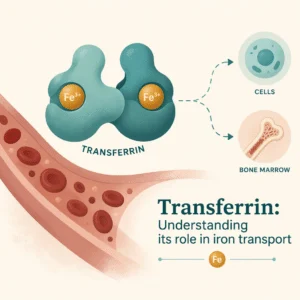









A copper blood test measures the copper travelling in your bloodstream when the sample was taken. On its own, that number answers less than most people expect. Doctors almost always read it next to a second test, ceruloplasmin, the protein carrying the great majority of circulating copper. The two rise and fall together, and both are pushed up by inflammation, infection, pregnancy and oestrogen. So a “high copper” found during an illness often says nothing about how much copper your body actually holds.
In this article you’ll learn what copper does, why serum copper and ceruloplasmin are read as a pair, how ordinary situations distort both, why Wilson disease produces a counter-intuitive pattern, and why copper deficiency, including the kind driven by too much zinc, deserves attention.
What copper does, and what the test measures
Copper is a trace element: your body needs it in tiny amounts, but cannot function without it. It works as a cofactor, a helper molecule that allows an enzyme to do its job, for enzymes involved in energy production, iron handling, connective tissue, nerve signalling and protection against oxidative damage. The National Institutes of Health Office of Dietary Supplements (NIH ODS) notes that the liver keeps the balance by releasing surplus copper into bile.
A serum copper test measures total copper in the liquid part of your blood. It is a snapshot of what is in transit, not a measure of your stores, and that distinction explains nearly every confusing copper result. NIH ODS states plainly that copper status is not routinely assessed in clinical practice, and that no biomarker reliably measures it. Copper is not part of a general check-up: it is ordered when a specific question needs answering, such as unexplained liver abnormalities, a movement or psychiatric disorder in a young person, unexplained anaemia, or unexplained nerve symptoms.
Why copper and ceruloplasmin are read together
Ceruloplasmin is a copper-carrying protein made by the liver. According to NIH ODS, it transports more than 95% of the total copper in healthy human plasma, so practically everything your serum copper test detects is copper riding on ceruloplasmin.
This creates a dependency that trips people up. If ceruloplasmin goes up, serum copper goes up with it, because there are more seats on the bus. If ceruloplasmin falls, serum copper falls too. Neither movement necessarily reflects a change in your body’s copper.
So a copper result usually arrives with ceruloplasmin beside it, and a doctor may add a 24-hour urine collection, which measures how much copper the body is actually dumping. Only the pattern of the three carries meaning. Compare your value with the range printed on your own report and no other, since methods and units differ between labs; we also explain normal blood test ranges.
How inflammation, pregnancy and oestrogen distort the result
Ceruloplasmin is an acute-phase protein: the liver makes more of it whenever the body mounts an inflammatory response to an infection, an inflammatory condition, or a recent injury or surgery. The rise is normal, not a copper problem, but because ceruloplasmin carries the copper it drags serum copper up with it. Someone with a chest infection can have a copper result flagged high whilst their copper handling is entirely normal.
NIH ODS lists oestrogen status, pregnancy, infection, inflammation and some cancers as factors influencing both plasma ceruloplasmin and copper. Ceruloplasmin climbs substantially during pregnancy and serum copper climbs with it; this is expected physiology, and our guide covers blood tests during pregnancy. Combined oral contraceptives and other oestrogen-containing treatments raise ceruloplasmin too, and copper with it.
In neither case has the copper in your tissues changed; the carrier has multiplied. This is why doctors ask whether you were unwell when the sample was taken, and may check an inflammation marker alongside it; our article explains high CRP levels. An isolated high copper in someone ill, pregnant or on oestrogen is often simply repeated later.
Wilson disease: copper overload that shows low serum copper
Wilson disease is the main reason a copper blood test gets ordered. It is a rare inherited disorder, affecting roughly 1 in 30,000 people according to MedlinePlus Genetics, caused by variants in the ATP7B gene, which makes the protein the liver uses to move copper out of the body. When it fails, copper accumulates to toxic levels in the liver and brain. Signs usually appear between the ages of 6 and 45, most often in the teenage years: liver disease, tremors, difficulty walking or speaking, and psychiatric changes including depression, anxiety and mood swings.
The counter-intuitive part
Here is what surprises almost everyone. Wilson disease is a copper overload disease, yet the classic blood picture shows low ceruloplasmin and a serum copper that is low or low-normal, whilst urinary copper is high.
The explanation is mechanical. The same faulty protein that fails to excrete copper is also needed to load copper onto ceruloplasmin. Without it, ceruloplasmin circulates largely empty and is broken down faster, so blood levels drop, and total serum copper drops with them. The copper that cannot be packaged or excreted spills into the blood unbound, pours into the urine, and deposits in tissue. The copper is not missing. It is in the liver and brain, where the blood test cannot see it. NIDDK puts it directly: people with Wilson disease often have low ceruloplasmin, but not always, and may have lower than normal blood copper.
One exception matters: in acute liver failure caused by Wilson disease, damaged liver cells release stored copper at once and blood copper can be very high. That is a medical emergency.
Why the diagnosis is a composite, never one test
No single test diagnoses Wilson disease. Specialist bodies including the American Association for the Study of Liver Diseases (AASLD) and the European Association for the Study of the Liver (EASL) use a scoring approach, known as the Leipzig score, combining several strands of evidence:
- serum ceruloplasmin
- 24-hour urinary copper excretion
- Kayser-Fleischer rings, copper deposits forming a greenish-brown ring at the edge of the cornea, seen on a slit-lamp eye examination
- copper measured in a liver biopsy sample
- genetic testing of the ATP7B gene
- signs of haemolysis, the premature breakdown of red blood cells
NIDDK describes the same combination. Liver enzymes are usually part of the picture; we cover liver function tests, and in more depth the ALT blood test and the AST blood test.
The consequence is worth stating clearly: one low ceruloplasmin, or one odd copper value, is not a diagnosis. Low ceruloplasmin also occurs in advanced liver disease, protein loss, and healthy carriers of a single ATP7B variant, who are not ill and need no treatment. Equally, a normal ceruloplasmin does not rule the condition out, which is exactly why the composite exists.
It is treatable, and treating it early matters
Wilson disease deserves accurate framing rather than drama. Untreated, it is serious and can be fatal. Treated, it is one of the more manageable inherited metabolic conditions: lifelong treatment removes excess copper or blocks its absorption, and people diagnosed before permanent organ damage often do well for decades. The outlook depends on catching it early, which is why doctors pursue the diagnosis energetically. If your result raises the question, the next step is a specialist assessment, not a conclusion.
Copper deficiency: under-recognised, and sometimes irreversible
Copper deficiency is uncommon but genuinely under-recognised, and its consequences can be severe. It causes two things that often appear together: cytopenias, meaning low blood cell counts (typically anaemia and low neutrophils, a type of white blood cell), and myeloneuropathy, damage to the spinal cord and nerves. The blood counts usually correct once the cause is addressed. The nerve damage frequently does not: treatment reliably stops progression but does not reliably reverse what has happened, which is the whole argument for recognising this early.
The neurological picture is easy to mistake for something else: numbness, an unsteady gait, and loss of the sense of where your limbs are in space, close to indistinguishable from vitamin B12 deficiency. That is why the two are usually checked together, and we detail the vitamin B12 blood test. Because blood counts fall too, doctors usually review the complete blood count as well.
Who is at risk
Copper is absorbed in the upper small intestine, so anything that bypasses or damages that stretch of gut can cause deficiency: bariatric and other upper gastrointestinal surgery, the most common cause, which can strike years or decades later; malabsorption, with NIH ODS citing a coeliac disease study in which 15% of 200 adults and children had copper deficiency; long-term intravenous feeding without adequate copper; and excess zinc.
Excess zinc blocks copper absorption
Zinc and copper compete for absorption in the gut, and zinc also triggers intestinal cells to produce a protein that traps copper and carries it out of the body. Sustained high zinc intake therefore starves the body of copper, quietly, over months to years. NIH ODS reports that markers of copper status fall at zinc intakes around 60 mg/day for as little as 10 weeks, and that people who regularly take high-dose zinc supplements, or use excessive amounts of zinc-containing denture creams, can develop copper deficiency. This is one reason the Food and Nutrition Board set the tolerable upper intake level for zinc at 40 mg/day for adults. Zinc denture adhesives are not a historical footnote: they caused a recognised cluster of neurological damage, and cases still appear.
The point is not to prompt anyone to change what they take. Do not start copper and do not stop zinc on the strength of an article. Zinc is prescribed deliberately in some conditions, including as a treatment for Wilson disease itself, where stopping it would be harmful. The useful action is to tell your doctor about every supplement, dose and denture product you use, because that history is what makes the result interpretable. The two are often assessed together, and we explain the zinc blood test in a companion article.
Menkes disease
Menkes disease is the rare mirror image of Wilson disease: an X-linked genetic disorder caused by variants in the ATP7A gene, appearing in infancy. Copper absorption drops sharply, producing low serum copper and low ceruloplasmin. NIH ODS describes the typical features as failure to thrive, impaired cognitive development, seizures and unusually kinky hair. Specialist teams manage it from infancy; it is not a factor in adult testing.
Reading the pattern: copper, ceruloplasmin and urine together
The table below shows how the three results combine. It illustrates how doctors reason and is not a self-diagnosis tool: every line ends with a clinician, because context, symptoms and repeat testing decide the outcome.
| Serum copper | Ceruloplasmin | 24-hour urinary copper | Likely picture | Usual next step |
|---|---|---|---|---|
| Low or low-normal | Low | High | The pattern that raises the question of Wilson disease | Specialist referral; slit-lamp eye exam, genetic testing, sometimes liver biopsy |
| Low | Low | Low | Consistent with copper deficiency: malabsorption, prior gastric surgery, or excess zinc | Doctor reviews surgical history and every supplement; blood counts and zinc checked |
| High | High | Usually not needed | Most often inflammation, infection, pregnancy or oestrogen, not copper excess | Interpreted with context; often simply repeated once you are well |
| Very high | Low | High | Uncommon; can occur in acute liver failure caused by Wilson disease | Urgent hospital assessment |
| Normal | Normal | Normal or not done | No evidence of a copper handling problem | Usually no further copper testing |
What a normal copper blood test result means
A copper value inside your laboratory’s reference range, with a normal ceruloplasmin and no relevant symptoms, is reassuring: it makes both Wilson disease and significant copper deficiency unlikely, though a doctor reads it alongside the reason for testing.
NIH ODS gives normal serum concentrations of 10 to 25 micromoles per litre (63.5 to 158.9 micrograms per decilitre) for copper and 180 to 400 milligrams per litre for ceruloplasmin, while noting that laboratories set their own ranges. Your report’s range is the one that applies.
Two caveats keep a normal result honest. Because inflammation raises both markers, a normal copper measured during an illness could mask a low baseline. And NIH ODS is explicit that no blood marker reliably captures copper status, so a normal result is evidence, not proof.
When to see a doctor
Book an appointment, taking your results and a full list of your supplements, if you have:
- numbness, tingling or an unsteady gait, especially after gastric or bariatric surgery, or with long-term use of zinc supplements or zinc-containing denture cream
- unexplained anaemia or low white cells alongside an abnormal copper result
- tremor, involuntary movements, slurred speech or new psychiatric symptoms in a young person, particularly with abnormal liver tests
- jaundice, meaning yellowing of the skin or the whites of the eyes, or abdominal swelling
- a family history of Wilson disease, since relatives of an affected person are screened routinely
- a copper or ceruloplasmin result that stays abnormal when repeated after any illness resolves
Seek urgent care for jaundice with confusion, vomiting or rapidly worsening illness.
Latest scientific advances in copper testing
Research since 2023 has focused on the problem this article describes: the standard tests are unreliable alone.
A new measure targets the copper that actually matters
A 2025 study at France’s national Wilson disease referral centre, published in JHEP Reports, tested a marker called relative exchangeable copper (REC) in 778 people: 204 with Wilson disease, 359 healthy carriers, and 215 without the condition. Rather than counting all the copper, REC measures the fraction not bound to ceruloplasmin as a proportion of the total. It separated people with Wilson disease from everyone else with very high accuracy, in children and adults alike, and now features in the 2025 EASL guidelines.
What this means for you: ordinary serum copper misleads because it mostly measures the carrier protein, so isolating the unbound copper sidesteps that flaw. The promise is fewer inconclusive workups and less need for liver biopsy. REC is not yet in every laboratory, so it is a question for a specialist.
Standard markers are being honestly reassessed
A 2025 review in the Journal of Clinical and Experimental Hepatology examined why Wilson disease is still diagnosed late. Its conclusion was blunt: ceruloplasmin, urinary copper and liver biopsy each lack sufficient sensitivity and specificity, meaning each both misses real cases and flags people who do not have the disease. With no single gold-standard test, misclassification is common, and the authors argue for pairing conventional tests with newer biomarkers.
What this means for you: if your doctor orders several tests rather than acting on one, that is the evidence base working as intended.
Copper deficiency myelopathy: the damage often does not reverse
A 2024 systematic review in The Spine Journal pooled 116 studies covering 198 cases of copper deficiency myelopathy. The most common cause was previous gastric surgery, followed by excessive zinc from denture cream. Despite treatment with copper, only about a quarter of patients reported any neurological improvement, and only about 5% recovered fully. The condition mimics cervical spondylotic myelopathy, a common spinal problem, so closely that patients had undergone spinal decompression surgery and kept deteriorating afterwards. The authors recommend checking copper, ceruloplasmin and B12 before surgery in anyone with myelopathy plus gastric bypass, malabsorption, zinc excess or low blood counts.
What this means for you: this is a case series, so it reflects reported cases rather than everyone with the condition, and severe cases are likelier to be published. The core message survives: copper deficiency is treatable, but the nerve damage often is not.
Glossary
| Term | Definition |
|---|---|
| Serum copper | The total copper measured in the liquid part of your blood. It reflects copper in transit, not the amount stored in your tissues. |
| Ceruloplasmin | A protein made by the liver that carries more than 95% of the copper in healthy plasma. Almost always measured alongside serum copper. |
| Acute-phase protein | A protein the liver produces in greater quantity during inflammation or infection. Ceruloplasmin is one, which is why illness raises copper results. |
| Trace element | A mineral the body needs in very small amounts. Copper, zinc and selenium are examples. |
| 24-hour urinary copper | A test measuring all the copper passed in urine over a full day. It shows how much copper the body is actually excreting. |
| ATP7B | The gene that makes the protein the liver uses to move copper out of the body. Variants in it cause Wilson disease. |
| Kayser-Fleischer ring | A greenish-brown ring of copper deposited at the edge of the cornea, visible during a slit-lamp eye examination. |
| Myeloneuropathy | Damage to both the spinal cord and the peripheral nerves, causing numbness, unsteadiness and weakness. |
| Cytopenia | A low count of one or more types of blood cell, such as anaemia or a low neutrophil count. |
| Leipzig score | A scoring system used by liver specialists that combines several test results to assess the likelihood of Wilson disease. |
Frequently asked questions
Do I need to fast before a copper blood test?
Usually not, but follow the instructions your laboratory gives you, because they vary between labs and depend on what else is being measured in the same draw. Copper is often collected alongside liver tests or a blood count, and one of those may carry its own requirement. What matters more than fasting is telling the laboratory and your doctor about anything that could shift the result: recent illness, pregnancy, oestrogen-containing contraception, and every supplement you take, especially zinc. That context is what turns a number into an interpretable result.
Can zinc supplements cause copper deficiency?
Yes, sustained high zinc intake can. Zinc competes with copper for absorption in the gut and prompts intestinal cells to trap copper and carry it out of the body, so a high zinc intake maintained over months or years can deplete copper. NIH ODS reports that markers of copper status fall at zinc intakes around 60 mg/day within 10 weeks, and that high-dose zinc supplements and zinc-containing denture creams have caused copper deficiency. The tolerable upper intake level for zinc is 40 mg/day for adults. This is not a reason to stop zinc on your own: zinc is prescribed deliberately in some conditions, including as a treatment for Wilson disease. Tell your doctor what you take and at what dose, and let them decide.
Can copper pipes or tap water raise my copper level?
Water can pick up copper from copper plumbing, particularly if it is acidic or has been standing in the pipes. NIH ODS notes that copper toxicity has been reported in people drinking water with high copper levels from stagnant water in copper pipes and fixtures. The Environmental Protection Agency sets a recommended upper limit of 1.3 mg/L for copper in public water systems. For most people on a public supply this is not a realistic cause of an abnormal blood result, and a doctor would look at inflammation, pregnancy, oestrogen and medication first.
Why did my copper level change between two tests?
Most often because something changed around the time of the test rather than in your copper handling. Ceruloplasmin rises with inflammation, infection, pregnancy and oestrogen, and serum copper follows it, so a sample taken whilst you were unwell can read considerably higher than one taken when you were well. Laboratories also differ in method and units, so results from two different labs are not directly comparable. This is exactly why doctors repeat an isolated abnormal copper result once any illness has settled, rather than acting on a single value.
If I have Wilson disease, will my family be tested?
Yes. Wilson disease is inherited in an autosomal recessive pattern, meaning both copies of the gene carry a variant, and MedlinePlus Genetics explains that both parents of an affected person carry one altered copy without usually showing symptoms. Because siblings can be affected whilst still feeling entirely well, first-degree relatives of someone with Wilson disease are screened as a matter of routine. This is one of the clearest examples of why early detection matters: relatives found before organ damage occurs can start treatment ahead of any symptoms. Your specialist team will arrange this.
Is copper linked to Alzheimer’s disease?
The link is debated and unresolved. NIH ODS reports that meta-analyses have found people with Alzheimer’s disease tend to have higher serum copper than people without it, whilst other researchers argue that copper deficiency contributes instead, and one clinical trial of copper supplementation in mild Alzheimer’s disease found no effect on cognition. NIH ODS concludes that much more research is needed. In practice, nothing about your copper result should be interpreted as telling you anything about your dementia risk, and no copper-related action should be taken on that basis.
Sources
- National Institutes of Health, Office of Dietary Supplements. Copper: Fact Sheet for Health Professionals. https://ods.od.nih.gov/factsheets/Copper-HealthProfessional/
- MedlinePlus Genetics, U.S. National Library of Medicine. Wilson disease. https://medlineplus.gov/genetics/condition/wilson-disease/
- National Institute of Diabetes and Digestive and Kidney Diseases (NIDDK). Diagnosis of Wilson Disease. https://www.niddk.nih.gov/health-information/liver-disease/wilson-disease/diagnosis
- Djebrani-Oussedik N, Desjardins C, Obadia MA, et al. Relative exchangeable copper: a highly specific and sensitive biomarker for Wilson disease diagnosis. JHEP Reports, 2025. https://doi.org/10.1016/j.jhepr.2025.101537
- Aboalam HS, Hassan MK, El-Domiaty N, et al. Challenges and recent advances in diagnosing Wilson disease. Journal of Clinical and Experimental Hepatology, 2025. https://doi.org/10.1016/j.jceh.2025.102531
- Chen JW, Zeoli T, Hughes NC, Lane A, Berkman RA. Copper deficiency myelopathy mimicking cervical spondylitic myelopathy: a systematic review of the literature with case report. The Spine Journal, 2024. https://doi.org/10.1016/j.spinee.2024.06.018
Further reading
- Zinc levels: understanding your blood test and its results
- Selenium blood test: what your results mean
- Chromium blood test: what it really measures
- Liver function tests: how to read results
- Vitamin B12 blood test: how to read results
A copper result rarely stands alone. It is read with ceruloplasmin, often with liver function tests, and sometimes with zinc, and the pattern across them is what carries the meaning. AI DiagMe helps you understand what those numbers say and what questions to bring to your appointment. It does not diagnose anything and does not replace your doctor.
Understand your lab results with AI DiagMe
Get your results interpreted in minutes