




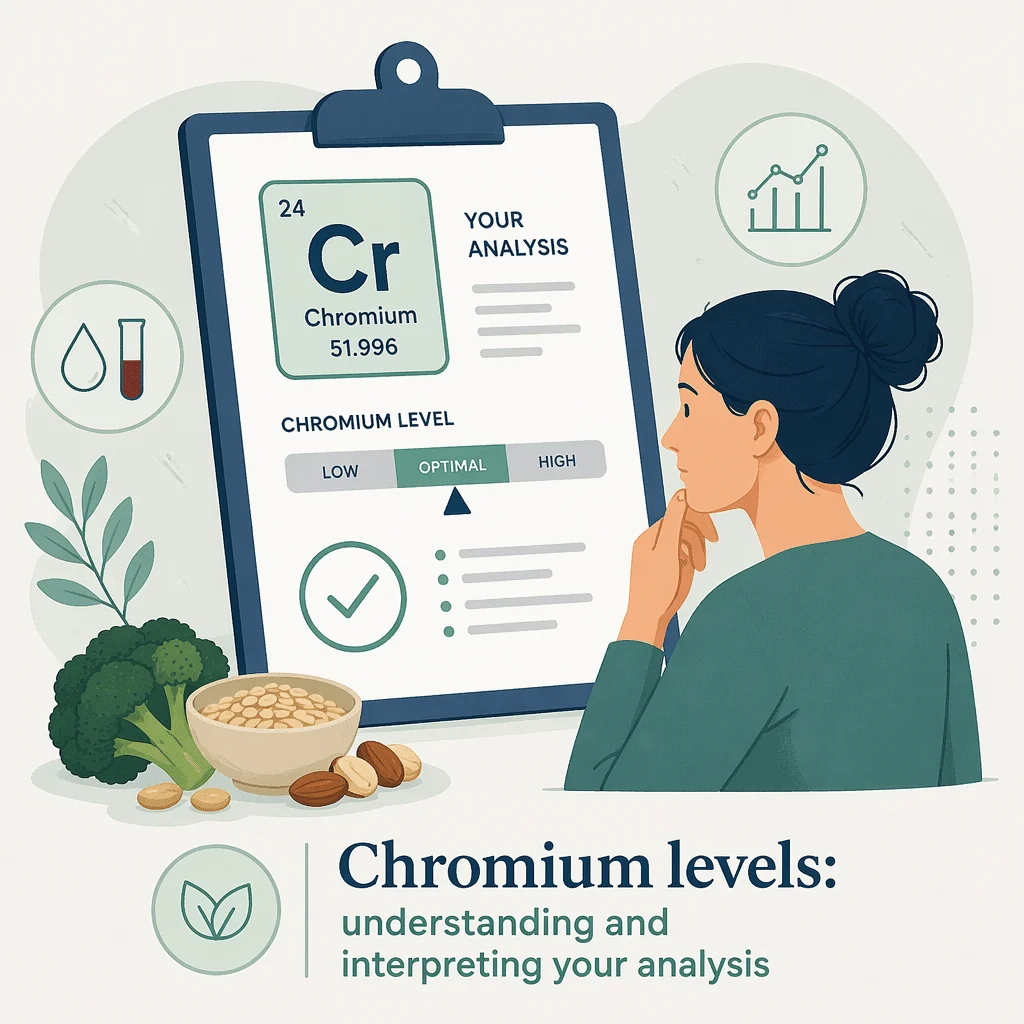
A chromium blood test measures how much chromium is circulating in your blood at the moment the sample was drawn. It does not measure whether your body has enough chromium, and it is not a sensible way to decide whether you need a supplement.
That surprises many people, because chromium is marketed almost entirely as a blood sugar and weight loss aid. The test exists for other reasons: monitoring metal-on-metal hip implants and other cobalt-chromium prostheses, checking workplace or environmental exposure, and investigating suspected toxicity.
In this article you’ll learn why the trivalent and hexavalent forms of chromium carry completely different risks, why blood chromium is a poor guide to nutrition, the real reasons a doctor orders the test, how to approach a raised result if you have a prosthesis, and what the NIH Office of Dietary Supplements says about the supplement evidence.
What chromium is, and why the two forms are not interchangeable
Chromium turns up in two very different guises. Confusing them is the most common mistake readers make, and it changes how a result should be read.
Trivalent chromium, the dietary form
Trivalent chromium, written Cr(III), is the form found in food and in dietary supplements. According to the NIH Office of Dietary Supplements, it may play a role in how the body handles carbohydrates, fats and proteins by supporting the action of insulin, though the precise mechanism has never been pinned down. It appears in meats, grain products, some vegetables and fruit, and in brewer’s yeast. Small amounts also transfer into food from stainless steel cookware and processing equipment.
Hexavalent chromium, the industrial contaminant
Hexavalent chromium, written Cr(VI), is an entirely different substance. It is produced by industrial processes rather than found in a balanced diet, and the Health and Safety Executive describes it as a known cause of cancer that also targets the respiratory system, kidneys, liver, skin and eyes. Welding on stainless steel, chrome plating and certain pigments and primers are the main routes of workplace exposure.
A routine laboratory measurement of chromium in blood reports total chromium. It does not separate the two forms. The distinction comes from your history and your circumstances, not from the number itself.
| Feature | Trivalent chromium, Cr(III) | Hexavalent chromium, Cr(VI) |
|---|---|---|
| Where it comes from | Food, drinks and dietary supplements | Industrial processes such as welding, chrome plating and pigment manufacture |
| Main route into the body | Swallowed, and poorly absorbed | Breathed in as fume or dust, or absorbed through skin contact |
| Cancer risk | Not classified as a carcinogen at dietary amounts | Recognised by the HSE as causing cancer, chiefly through inhalation |
| Who deals with it | Your doctor or a registered dietitian | Occupational health services and workplace safety programmes |
Why a chromium blood test does not measure your nutritional status
This is the crux of the matter, and it deserves stating plainly. The NIH Office of Dietary Supplements states that no validated methods for determining chromium status exist, and that no clinically defined chromium deficiency state exists either. Blood, urine, hair, sweat and toenails have all been measured in research settings. None of them has been shown to reflect how much chromium your body actually holds.
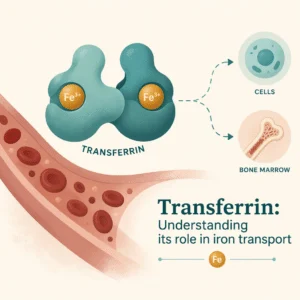
The reasons are mechanical. Most chromium in blood travels bound to plasma proteins, particularly transferrin, the same protein that carries iron. The chromium that does get stored accumulates in the liver, spleen, soft tissue and bone, where a blood sample cannot see it. What circulates reflects recent intake and recent exposure far more than it reflects reserves.
So a number on a report tells you something about the last few days. It does not tell you whether your diet is adequate, and it cannot identify a deficiency, because there is no agreed definition of what a chromium deficiency looks like in a healthy person.
This matters for anyone who has been sold a panel of trace element tests as a wellness check. Measuring chromium to decide whether to buy chromium is not a meaningful exercise. Reference ranges carry this kind of hidden limitation across many markers, and a separate guide explains normal blood test ranges.
The real reasons a chromium blood test gets ordered
When the test is ordered for a good reason, it is almost never about nutrition. Three situations account for nearly all legitimate requests.
Monitoring a cobalt-chromium implant
This is the most common reason a reader has this test in hand. Hip resurfacings, metal-on-metal hip replacements and many other joint prostheses use cobalt-chromium alloys. As the bearing surfaces move and the tapers corrode, tiny amounts of metal are released and find their way into the bloodstream. Chromium is measured alongside cobalt because the pair together tells the surgical team more than either alone.
Occupational or environmental exposure monitoring
Workers in welding, electroplating, tanning and pigment manufacture may be monitored as part of a workplace health programme. Here the concern is Cr(VI), and the monitoring sits inside a broader occupational health framework rather than a routine check-up.
Suspected toxicity
Occasionally a doctor investigates a genuine suspicion of chromium poisoning, usually after a known exposure or an accidental ingestion. This is rare.
| Why chromium is measured | What a raised result may suggest | Usual next step |
|---|---|---|
| You have a cobalt-chromium joint implant | Wear or corrosion at the bearing or taper may be releasing metal | The orthopaedic team repeats the measurement, checks symptoms and often arranges imaging |
| You work with chromium compounds | Workplace exposure controls may need reviewing | Occupational health reviews the exposure and the protective measures in place |
| Suspected poisoning after a known exposure | The exposure may have been significant | Clinical assessment, sometimes with a toxicology service |
| Reduced kidney function alongside any of the above | Metal may be clearing more slowly rather than accumulating faster | Your doctor reviews the kidney function panel |
| Curiosity about chromium nutrition | Little of value, because the test does not measure body stores | A conversation about diet, not a supplement purchase |
Reading a raised chromium result when you have a prosthesis
If you have a metal-on-metal hip or another cobalt-chromium implant and your chromium has come back above the laboratory’s range, the first thing to understand is what that result is and is not. It is a monitoring signal. It is not a verdict on your implant, and it is not an emergency in itself.
Surgeons interpret metal ion results in context. A single raised value carries much less weight than a trend across repeated measurements. Rising levels over time, especially when paired with new hip pain, clicking, swelling or a change in how the joint feels, prompt a closer look. Stable levels in someone with a comfortable, well-functioning joint often prompt nothing more than continued observation.
Chromium is also read next to cobalt, and the two do not always move together. Cobalt tends to be the more responsive of the pair, which is why the combination is measured.
Your kidneys clear metal ions from the blood, so anything that reduces kidney filtration can raise levels without any change at the implant itself. When a chromium comes back raised, your doctor will usually also check creatinine and the estimated filtration rate.
The practical action is simple: take the result to the orthopaedic team that looks after your implant. They have the operation notes, the implant type and your previous values, which turn a number into a decision.
Chromium and occupational exposure
Occupational exposure is a different world from the supplement aisle. The Agency for Toxic Substances and Disease Registry, which maintains the toxicological profile for chromium, and OSHA both focus on Cr(VI) breathed in as fume or dust.
The concerns there are largely respiratory: irritation, damage to the lining of the nose, asthma-like reactions and, with sustained exposure, lung cancer. Skin contact can cause ulcers and allergic dermatitis. None of this maps onto swallowing a chromium tablet, and none of it should be read into a result in someone with no industrial exposure.
If you work in welding, plating, painting or tanning, exposure monitoring belongs inside your workplace health programme, where results are read against air sampling and the controls in place.
Chromium supplements and the evidence, without the marketing
Chromium picolinate is sold heavily for blood sugar control and weight loss. The evidence does not support the promise, and the NIH Office of Dietary Supplements says so in fairly direct language.
On diabetes and high blood sugar, the Office of Dietary Supplements reports that studies have had mixed results, and notes that the American Diabetes Association does not recommend chromium supplements for people with diabetes because they do not have a clear benefit. On metabolic syndrome, the trials it reviewed did not show a benefit. On polycystic ovary syndrome, results were mixed and any potential benefits appear very small. On cholesterol, mixed again.
On weight and body composition, the Office of Dietary Supplements is blunter still: clinical trials have found only a very small benefit, and that benefit is unlikely to make any difference in health or appearance.
There is a deeper point underneath all of this. In 2001 the Food and Nutrition Board treated chromium as an essential nutrient and set Adequate Intake values on that basis. Those values are still quoted, and the Office of Dietary Supplements lists them at 35 micrograms a day for men aged 19 to 50 and 25 micrograms a day for women in the same age band, with lower figures after 50. But the Board has not revisited chromium since 2001, and in 2014 the European Food Safety Authority concluded that no convincing evidence shows chromium is an essential nutrient at all, and that setting intake recommendations would therefore be inappropriate.
Chromium deficiency has not been reported in healthy populations, and no definitive deficiency symptoms have been established. The famous case reports from the 1970s and 1980s involved patients fed intravenously for long periods, and later evaluations concluded those cases do not actually demonstrate that healthy people can develop chromium deficiency.
Two safety notes are worth carrying away. The Food and Nutrition Board did not set a tolerable upper intake level for chromium, because no adverse effects had been linked to high intakes from food or supplements, but it cautioned that the data are limited and that people with kidney or liver disease may be more susceptible. And chromium supplements can interact with medicines, including insulin and metformin, where the concern is low blood sugar, and levothyroxine, where absorption may be reduced.
None of this is a reason to change anything you are already taking on your own. If you have diabetes and are curious about chromium, that conversation belongs with the clinician managing your treatment. Blood sugar control is tracked by measures that have earned their place, and a separate article explains the HbA1c normal range and target levels. Another guide covers fasting blood glucose levels.
What a normal or low chromium result actually tells you
A chromium result inside the laboratory’s range means your circulating chromium was unremarkable on the day of the draw. If you have an implant, that is genuinely reassuring, particularly when it matches your previous values. If you were tested out of curiosity about your nutrition, it tells you very little.
A low chromium result is the one that most often gets over-interpreted. There is no established clinical picture of chromium deficiency in healthy people, so a low number is not evidence that you are lacking anything, and it is not an indication to start a supplement. Low values are common and unremarkable.
Reference ranges for chromium vary noticeably between laboratories, more than for many routine markers, because the measurement is technically demanding and samples are easily contaminated by stainless steel needles, tubes and even dust. Always read your value against the range printed on your own report, and be cautious about comparing results across laboratories.
If you were tested as part of a broader trace element panel, the same caution applies unevenly across it. Some trace elements do have usable blood measurements, and others share chromium’s problem. Separate guides cover the selenium blood test, explain the zinc blood test, and set out the copper blood test.
When to see a doctor
Chromium results rarely need urgent action, but a few situations deserve a prompt conversation.
| Situation | What to do |
|---|---|
| You have a joint implant and new pain, clicking, swelling or reduced movement | Contact your orthopaedic team, whatever the chromium number says |
| Your chromium and cobalt have risen across successive tests | Ask your surgical team to review the trend rather than a single value |
| You work with chromium compounds and have a cough, nosebleeds or skin ulcers | Report it through occupational health and see a doctor |
| You have kidney or liver disease and take chromium-containing supplements | Raise it with your doctor, since the Food and Nutrition Board flags this group as more susceptible |
| You take insulin, metformin or levothyroxine and are considering chromium | Discuss it before starting, because of documented interactions |
Latest scientific advances in chromium testing
Research published since 2023 has mostly reinforced the split described above: chromium as an implant-monitoring marker is a live clinical field, while chromium as a supplement keeps producing underwhelming results.
A pooled look at chromium supplements and metabolic risk
Monfared and colleagues combined twenty randomised trials of chromium supplementation in people who were overweight or living with obesity, examining blood sugar, blood fats, blood pressure, body measurements and liver enzymes. Their own summary describes a positive effect, but the underlying numbers are more restrained than that headline: the pooled changes in fasting blood glucose and in HbA1c, the two measures that matter most for blood sugar control, did not reach statistical significance, meaning the results were compatible with no real effect. Small changes appeared in insulin and in a calculated measure of insulin resistance, and the shifts in weight and waist size were slight.
What this means for you: even a large pooling of trials could not show a convincing effect of chromium on the blood sugar measures people actually buy it for. Read confident supplement claims, and confident abstract conclusions, against the numbers underneath them.
Chromium supplements and body composition in type 2 diabetes
Vajdi and colleagues pooled fourteen randomised trials in people with type 2 diabetes, looking at body weight, body mass index, waist circumference and fat mass. Chromium supplementation did not significantly change any of the four. Hints appeared in subgroups, but subgroup findings are exploratory and the authors called for larger trials.
What this means for you: in the group most often targeted by chromium marketing, the supplement did not meaningfully shift weight or body fat. This is consistent with what the NIH Office of Dietary Supplements concluded from the wider literature.
How much monitoring do metal implants really need?
Lukas and colleagues compared blood cobalt and chromium in 132 patients who had hip resurfacing against 63 who had knee replacement, measuring before surgery and again at six and twelve months. The finding that surprised them was that knee replacements, which are not metal-on-metal bearings, raised metal ion levels by one year about as much as hip resurfacing did. Chromium in particular showed no significant differences between the groups over the follow-up. The authors suggested that routine monitoring probably should not be recommended when clinical outcomes are good.
What this means for you: a detectable or modestly raised metal ion level after joint surgery is not automatically a sign of a failing implant. It is one input, weighed against symptoms and how the joint is performing. This was a retrospective study following patients for a year, so it describes the early picture rather than the long term.
Cobalt and chromium do not always move together
Freund and colleagues followed 56 patients who received hip or knee megaprostheses, large custom implants used after bone tumour surgery, measuring cobalt and chromium before surgery and three times during the first year. Cobalt rose significantly by one year in the knee group. Chromium did not rise. Cobalt levels also tracked with age and with kidney filtration rate, hinting that how well the kidneys clear metal shapes the result too.
What this means for you: chromium and cobalt are read as a pair precisely because they behave differently, and your kidney function is part of the interpretation. This was a small prospective cohort at two centres, so the signal is worth knowing rather than definitive.
Where metal ion levels fit in the wider picture
Tandon and colleagues reviewed metallosis, the accumulation of metal debris from joint implants. They set out how debris is generated, not only through wear at the bearing surfaces but also through corrosion at the tapered junctions where components meet. They describe cobalt and chromium ion levels as useful biomarkers for screening and monitoring patients showing signs of metallosis.
What this means for you: your chromium result belongs to the metal-wear conversation, not the nutrition one. This was a narrative review summarising existing work rather than new data, so it is best read as a map of the field.
Glossary
| Term | Definition |
|---|---|
| Trivalent chromium, Cr(III) | The form of chromium found in food and dietary supplements, poorly absorbed when swallowed |
| Hexavalent chromium, Cr(VI) | An industrial form of chromium recognised as causing cancer, mainly when breathed in as fume or dust |
| Cobalt-chromium alloy | A hard, corrosion-resistant metal blend used in many joint implants and other prostheses |
| Metal-on-metal implant | A joint replacement in which both bearing surfaces are metal, now largely superseded by other designs |
| Metallosis | The build-up of metal debris in tissue around an implant, which can provoke inflammation and loosening |
| Metal ion monitoring | Repeated blood measurement of cobalt and chromium to track how an implant is behaving over time |
| Adequate Intake (AI) | An intake value set when the evidence is too thin to establish a recommended dietary allowance |
| Tolerable Upper Intake Level (UL) | The highest daily intake unlikely to cause harm; none has been set for chromium |
| Transferrin | A blood protein that carries iron and also binds most of the chromium circulating in blood |
| Chromium picolinate | A common supplement form of trivalent chromium, widely marketed for blood sugar and weight loss |
Frequently asked questions
Do chromium supplements help blood sugar or weight loss?
The honest answer is that the evidence is weak and inconsistent. The NIH Office of Dietary Supplements reports that studies of chromium and blood sugar have had mixed results, and notes that the American Diabetes Association does not recommend chromium supplements for people with diabetes because there is no clear benefit. On weight, the same office states that clinical trials have found only a very small benefit, unlikely to make any difference to health or appearance. Pooled analyses published since 2023 point the same way. If you have diabetes, do not change your treatment based on a supplement claim; speak to the clinician managing your care.
What is a normal chromium level in blood?
There is no single universal figure, and this is one marker where laboratory-to-laboratory variation is genuinely large. Chromium is measured at very low concentrations, and samples are easily contaminated during collection and handling, so each laboratory validates its own range for its own method. Read your value against the range printed on your own report. More importantly, a value inside the range does not confirm good chromium nutrition, and a value below it does not confirm a deficiency, because blood chromium was never a measure of body stores.
Should I get my chromium checked to see if I need a supplement?
No, and the reason is straightforward. The NIH Office of Dietary Supplements states that no validated methods for determining chromium status exist and that no clinically defined chromium deficiency state exists. There is no result the test could return that would establish you need chromium. If you are worried about your diet overall, a conversation about eating patterns is more useful than a trace element panel.
Can a chromium test tell the difference between Cr(III) and Cr(VI)?
A standard blood chromium test measures total chromium and does not separate the forms. Specialised speciation methods exist in research and occupational settings, but they are not what a routine request produces. In practice the distinction comes from your history: someone who welds stainless steel and someone who takes a multivitamin are in completely different situations, even with similar numbers on the page.
My chromium is high and I have a hip replacement. Should I be worried?
A raised result is a reason to talk to your orthopaedic team, not a verdict on your implant. Surgeons weigh the trend across several measurements far more heavily than one value, and they read chromium alongside cobalt, your symptoms, your implant type and your kidney function. Many people with modestly raised levels and a comfortable, well-functioning joint are simply monitored. Bring the result, and your previous results, to the team that placed the implant.
Can kidney problems raise my chromium level?
Yes, and this is an important part of the interpretation. Chromium is cleared largely by the kidneys, so reduced filtration can allow levels to rise without any change in how much metal is being released. Research on implant patients has found metal ion levels tracking with kidney filtration rate. This is why chromium is usually read alongside kidney markers such as creatinine, and why your doctor will want the full picture rather than the chromium number on its own.
Sources
- NIH Office of Dietary Supplements — Chromium: Fact Sheet for Health Professionals
- NIH Office of Dietary Supplements — Chromium: Fact Sheet for Consumers
- MedlinePlus, U.S. National Library of Medicine — Chromium in diet
- Agency for Toxic Substances and Disease Registry — Toxicological Profile for Chromium
- Occupational Safety and Health Administration — Hexavalent Chromium: Overview
- Monfared V, Rashin H, Malekinejad S, et al. The effect of chromium supplementation on cardio-metabolic risk factors in overweight and obese patients: a systematic review and meta-analysis of randomised controlled trials. Journal of Trace Elements in Medicine and Biology, 2025 (via PubMed)
- Vajdi M, Khajeh M, Safaei E, et al. Effects of chromium supplementation on body composition in patients with type 2 diabetes: a dose-response systematic review and meta-analysis of randomised controlled trials. Journal of Trace Elements in Medicine and Biology, 2023 (via PubMed)
- Lukas S, Martinot P, Putman S, et al. Metal ion release after hip resurfacing arthroplasty and knee arthroplasty: a retrospective study of one hundred ninety-five cases. International Orthopaedics, 2023 (via PubMed)
- Freund SS, Thorn APJ, Puri A, Petersen MM, Baad-Hansen T. Elevated cobalt levels in metal-on-polyethylene knee megaprostheses: a prospective 1-year cohort study of 56 patients with hip and knee megaprostheses. Acta Orthopaedica, 2024 (via PubMed)
- Tandon M, Chetla N, Hodges J, et al. Mechanical considerations and clinical implications of joint arthroplasty metallosis. Cureus, 2024 (via PubMed)
Further reading
- Understanding your selenium blood test
- Understanding your zinc blood test
- Understanding your copper blood test
- How to read your magnesium test results
- What a kidney function panel measures
Understand your lab results with AI DiagMe
A chromium result makes far more sense next to the values around it. AI DiagMe reads your report and explains what chromium, cobalt, kidney function and glucose each mean in plain language, and how they relate to one another. It helps you understand your results and prepare better questions. It does not diagnose anything, and it does not replace your doctor.
Get your results interpreted in minutes