










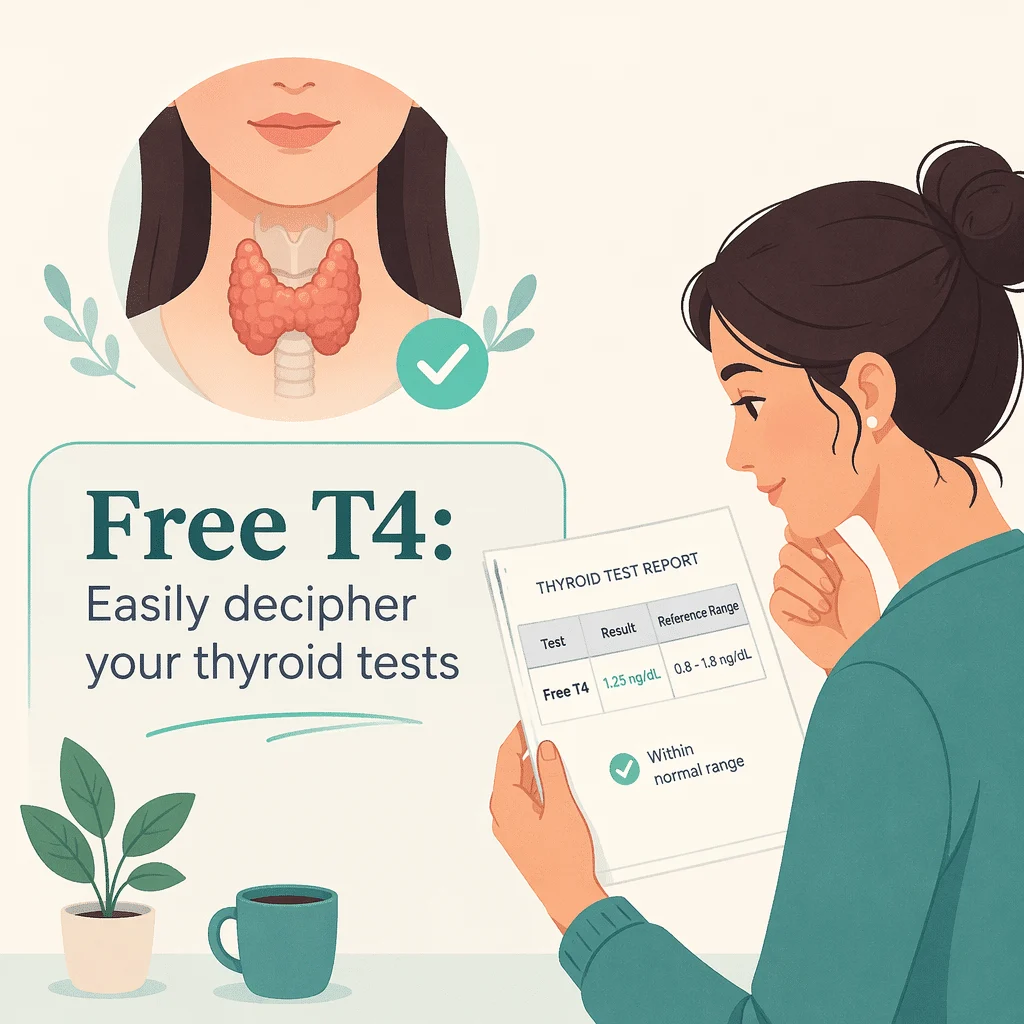
A free T4 blood test measures the active, unbound form of thyroxine — the main hormone your thyroid gland produces — circulating in your blood. Your doctor almost always orders it alongside TSH, because the two numbers only make sense as a pair. Seeing a value and a reference range on a lab report can feel opaque, yet the logic behind the test is simpler than it looks once you know what it is actually measuring.
In this article you’ll learn what T4 does in your body, why laboratories prefer free T4 over total T4, how TSH and free T4 are read together, what high and low results point to, and which everyday factors — pregnancy, illness, biotin, some medications — can move your numbers without any thyroid problem being present.
What T4 is and what your thyroid does with it
Your thyroid is a small, butterfly-shaped gland at the base of your neck. Its main job is to make thyroxine, abbreviated T4 — each molecule carries four iodine atoms, which is why iodine in your diet matters for thyroid function.
Roughly four-fifths of everything the gland releases is T4. On its own, though, T4 is relatively quiet. Tissues around your body convert it into T3 (triiodothyronine), the more active hormone that does most of the work inside cells. Think of T4 as a stable reserve your body activates where and when it needs to. To understand the other half of that pair, you can read our article on free T3.
What T4 does around your body
Thyroid hormone sets the pace of your metabolism — the speed at which your cells use energy. That influence touches:
- Body temperature and how warm or cold you feel
- Heart rate and the force of each heartbeat
- Appetite, weight and how quickly you burn energy at rest
- Digestion, mood, concentration and energy levels
- Skin, hair and nail growth
- Brain development before birth and in early childhood
Because thyroid hormone reaches nearly every tissue, symptoms of an imbalance are often diffuse and easy to blame on something else — stress, poor sleep, ageing. That is why a free T4 blood test is useful: it turns a vague feeling into a measurable number.
Total T4 versus free T4: why the free fraction is preferred
Once T4 enters your bloodstream, most of it does not travel alone: it attaches to carrier proteins, chiefly thyroxine-binding globulin. Only a very small slice — well under one per cent — floats unattached. That slice is free T4, and it is the only portion able to enter cells and act.
- A total T4 test measures everything: the bound reserve plus the free fraction.
- A free T4 test measures only the active, unbound part.
How binding proteins can mislead a total T4 result
The number of carrier proteins in your blood is not fixed. Pregnancy raises them substantially, as do oestrogen-containing contraceptives and hormone therapy. Liver disease, kidney disease and some inherited variations push them the other way. When carrier proteins rise, total T4 rises with them — but the free, active fraction may be perfectly normal, and the person feels entirely well.
A total T4 result can therefore look abnormal purely because transport proteins shifted, not because the thyroid is misbehaving. A free T4 blood test largely sidesteps that trap, which is why most laboratories and clinical guidelines have made it the standard measurement. For a closer look at the carrier proteins, see our guide to thyroxine-binding globulin. Total T4 still has niche uses, such as newborn screening.
Why your doctor orders a free T4 test with TSH
A free T4 blood test is rarely ordered by itself, because a single hormone value cannot tell you where a problem lies. Your thyroid does not run independently: it answers to your pituitary gland, a pea-sized structure at the base of your brain.
The pituitary constantly samples how much thyroid hormone is circulating. When levels drop, it releases more TSH (thyroid-stimulating hormone) to prod the thyroid into working harder; when levels climb, it eases off. This feedback loop — the hypothalamic-pituitary-thyroid axis — means TSH acts as a sensitive early-warning signal, often moving before free T4 does.
Reading the two together tells your doctor whether hormone output is off and where in the chain the fault lies. TSH alone can flag a problem; free T4 shows how far it has gone. To understand the partner test in depth, you can read our guide to the TSH blood test.
Common reasons for ordering the pair include:
- Symptoms suggesting an underactive or overactive thyroid
- An abnormal TSH on a routine panel, prompting a reflex free T4
- A goitre, thyroid nodule or neck swelling
- Follow-up of a known thyroid condition, or monitoring of levothyroxine or antithyroid medication
- Pregnancy, or planning a pregnancy, in women at higher risk
Monitoring levothyroxine treatment
If you take levothyroxine — a synthetic form of T4 that replaces what an underactive thyroid cannot make — your doctor will recheck your thyroid tests periodically. TSH is usually the primary guide, with free T4 adding context, particularly when TSH behaves unexpectedly or the pituitary is the source of the problem.
Timing matters. Levothyroxine taken shortly before a blood test can produce a transient peak in free T4 that does not reflect your usual level, so many clinicians suggest having blood taken before the day’s dose. Any decision about whether a dose should change belongs with the doctor who prescribed it, weighed against your symptoms and your full result set.
How TSH and free T4 are read together
Doctors interpret the two results as a pattern rather than as separate numbers. The grid below shows the combinations most often seen. It is a map of the reasoning, not a diagnosis — your symptoms, history, medications and other markers all feed into the final picture.
| TSH | Free T4 | What this pattern usually suggests |
|---|---|---|
| Normal | Normal | Thyroid function is very likely normal |
| High | Low | Primary hypothyroidism — an underactive thyroid gland |
| High | Normal | Subclinical hypothyroidism — an early or mild form, often just monitored |
| Low | High | Hyperthyroidism — an overactive thyroid gland |
| Low | Normal | Subclinical hyperthyroidism — mild overactivity, or a temporary dip |
| Low or normal | Low | Possible central hypothyroidism — a pituitary or hypothalamic cause, warranting specialist review |
| High | High | Uncommon — assay interference, a rare pituitary tumour, or reduced tissue sensitivity to thyroid hormone |
One caveat: TSH and free T4 do not always move in step. After treatment, TSH can lag for weeks, so a mismatched pair sometimes just reflects a system still catching up. For a broader tour of the ranges, see our overview of normal thyroid levels.
What a high free T4 result can mean
A free T4 above your laboratory’s reference range, paired with a low TSH, points towards hyperthyroidism — the thyroid producing more hormone than your body needs. Everything speeds up: a racing or irregular heartbeat, unintended weight loss despite a good appetite, feeling hot when others are comfortable, trembling hands, anxiety and disturbed sleep.
Common causes of an overactive thyroid
- Graves’ disease, an autoimmune condition in which antibodies over-stimulate the gland. It is the most frequent cause, and it can also affect the eyes, causing them to feel gritty or appear to bulge.
- Thyroiditis, an inflammation of the gland after a viral illness or childbirth. Stored hormone leaks out, producing a temporary overactive phase that often gives way to an underactive one.
- A toxic nodule or multinodular goitre, where lumps produce hormone on their own, ignoring the pituitary’s signals.
- Too much thyroid hormone from outside the body, whether prescribed or from unregulated supplements.
- Excess iodine, occasionally from scan contrast dye or from medications such as amiodarone.
Sustained hyperthyroidism can strain the heart and thin the bones, so a confirmed high result deserves proper follow-up. If a low TSH is what brought you here, our article covers the causes and symptoms of a low TSH.
What a low free T4 result can mean
A free T4 below the reference range means less active hormone is available than your body expects. Things slow down: persistent tiredness, feeling cold, weight gain that resists effort, constipation, dry skin, thinning hair, low mood and foggy thinking. Because these creep in gradually, many people put them down to a busy life long before a blood test explains them.
Primary hypothyroidism
By far the most common scenario is a problem in the gland itself. TSH rises as the pituitary pushes harder, whilst free T4 falls — the classic high-TSH, low-free-T4 pattern. The usual culprit is Hashimoto’s thyroiditis, in which the immune system gradually damages thyroid tissue. Antibody testing helps confirm it; you can read our guide to anti-TPO antibodies. Surgery, radioactive iodine, some medications and severe iodine deficiency can also leave the gland underproducing. Our dedicated article explains the diagnosis and treatment of hypothyroidism, and we also cover the symptoms and risks of a high TSH.
Central hypothyroidism, where the pituitary is at fault
Less often, the thyroid is healthy but receives no orders. If the pituitary or hypothalamus is not producing enough TSH, the gland idles. Free T4 drops — yet TSH stays low or sits deceptively within the normal range, because the very hormone that should be sounding the alarm is the one that is missing.
This is the strongest argument for measuring free T4 rather than relying on TSH alone: a TSH-only screen can look reassuring whilst central hypothyroidism goes unnoticed. Causes include pituitary tumours, head injury, brain surgery and radiotherapy to the head. It is uncommon, but it needs an endocrinologist, because it often travels with other pituitary hormone shortfalls.
What else can move your free T4 result
An out-of-range free T4 does not automatically mean thyroid disease. Several ordinary things shift the number.
Pregnancy
Pregnancy reshapes thyroid biology from the first weeks. hCG mildly stimulates the thyroid and nudges TSH down, whilst carrier proteins climb sharply and send total T4 up. Free T4 typically rises a little early on, then drifts downward across the second and third trimesters. Applying the standard non-pregnant reference range here can suggest a problem where none exists. The American Thyroid Association recommends interpreting results against pregnancy-specific and trimester-specific ranges where a laboratory has them. If you are expecting, review our guide to blood tests during pregnancy.
Biotin supplements
Biotin, sold widely for hair, skin and nail health, is a common reason for a puzzling thyroid result. Many analysers rely on a biotin-streptavidin binding step, and a large dose of biotin in your sample can hijack that chemistry. The classic footprint is a free T4 that looks falsely high next to a TSH that looks falsely low — mimicking hyperthyroidism in someone who feels perfectly well.
Standard multivitamin doses are rarely a problem; high-dose supplements are the concern. Tell your doctor about any biotin you take, as a short pause before the blood test usually resolves the issue.
Medications and other illness
Several medicines can influence thyroid results: amiodarone and lithium, some anti-epileptic drugs, high-dose steroids, oestrogen-containing contraceptives, heparin, and certain cancer immunotherapies. Serious non-thyroid illness — a hospital stay, major infection, surgery — can also distort thyroid tests temporarily, which is why testing during an acute illness is often deferred. No fasting is needed, though many clinics prefer a consistent time of day.
When to see a doctor
Book an appointment if you notice
- A free T4 or TSH result outside your laboratory’s reference range, whether or not you feel unwell
- Persistent tiredness, cold intolerance, unexplained weight gain or low mood
- A racing or irregular heartbeat, tremor, unintended weight loss or new anxiety
- Swelling, a lump or pressure in the front of your neck, or difficulty swallowing
- Eye changes: grittiness, redness, bulging or double vision
- Pregnancy or plans to conceive, if you have a thyroid condition or a family history of one
Seek urgent care if you have
- Chest pain, a very fast heartbeat with fever and confusion, or severe shortness of breath
- Extreme drowsiness or confusion alongside a known underactive thyroid
Otherwise, a single out-of-range value is a starting point, not a verdict.
Latest scientific advances in T4 testing
Research since 2023 has focused less on what free T4 means and more on how reliably we can measure it — a question that affects anyone comparing results across laboratories or over time.
Results depend on which analyser measured them
The US Centers for Disease Control and Prevention ran an interlaboratory comparison, checking 21 free T4 assays against a reference measurement procedure — the closest thing the field has to a gold standard. Every free T4 assay read lower than the reference method, and when the same donor samples were classified as normal or abnormal, the assays frequently disagreed with one another. TSH assays, by contrast, agreed well. Recalibrating the free T4 assays to the reference method sharply improved that agreement.
What this means for you: your free T4 number is tied to the assay that produced it. That is exactly why laboratories print their own reference range beside your result, and why comparing a value from one lab against a range from another — or against a number found online — can mislead. If you switch laboratories mid-follow-up, mention it to your doctor.
Recalibration can bring laboratories into line
A 2026 study measured the same donor samples on three major analyser platforms, then applied a statistical recalibration to build a single shared reference interval. Agreement between platforms improved markedly for free T4 and TSH, though T3 proved harder to harmonise. The authors concluded that a common reference interval is practical and affordable.
What this means for you: the inconsistency between laboratories is a solvable problem, and work is under way to solve it. Until that becomes routine, your lab’s own range remains the correct yardstick.
Reference ranges are being rebuilt from real-world data
Canadian researchers analysed over a million anonymised thyroid results from routine practice, filtering out people with known thyroid disease or pregnancy, then had specialists review the derived ranges. The exercise widened the upper TSH limit in adults and produced age-specific free T4 ranges, with much higher values in newborns.
What this means for you: reference ranges are not fixed truths. They are periodically re-derived as better data arrives, and they legitimately differ by age. A result just outside a range is a prompt for a conversation, not a diagnosis.
Pregnancy needs its own reference ranges
A prospective study followed pregnant women through all three trimesters, testing women without thyroid antibodies or thyroid medication. TSH was lowest in the first trimester and higher later; free T4 declined steadily as pregnancy progressed, whilst total T4 was highest early on. The authors concluded that trimester-specific ranges are needed for accurate assessment.
What this means for you: a free T4 that looks mildly low in late pregnancy may be entirely expected. If you are pregnant and your thyroid results are being reviewed, ask whether pregnancy-specific ranges are being applied.
Biotin interference is real, and newer reagents handle it better
Researchers measured biotin levels across several hospital departments and tested how biotin affects common immunoassays. Patients on dialysis and in intensive care had the highest levels, likely from supplements. High biotin concentrations produced falsely raised free T4 results with older reagents, whilst newer reagents tolerated far more biotin before results drifted.
What this means for you: biotin interference is a genuine cause of misleading thyroid results, so mentioning your supplements before a blood test remains worthwhile. The reassuring part is that laboratories have been actively engineering the problem out.
Glossary
| Term | Definition |
|---|---|
| Thyroxine (T4) | The main hormone made by the thyroid gland, carrying four iodine atoms. It acts largely as a reserve that tissues convert into the more active T3. |
| Free T4 (FT4) | The small fraction of T4 not attached to carrier proteins. It is the only part able to enter cells and act, which is why laboratories measure it. |
| Total T4 | All the T4 in your blood, bound and unbound together. It shifts when carrier protein levels change, even if thyroid function is normal. |
| TSH | Thyroid-stimulating hormone, released by the pituitary gland to tell the thyroid how hard to work. It usually moves before free T4 does. |
| Thyroxine-binding globulin (TBG) | The main carrier protein that transports T4 through the bloodstream. Pregnancy and oestrogen raise it; liver and kidney disease can lower it. |
| Hypothalamic-pituitary-thyroid axis | The feedback loop between brain and thyroid that keeps hormone levels steady, much like a thermostat. |
| Primary hypothyroidism | An underactive thyroid caused by a problem in the gland itself, showing as a high TSH with a low free T4. |
| Central hypothyroidism | An underactive thyroid caused by the pituitary or hypothalamus failing to send enough TSH. Free T4 is low while TSH is low or misleadingly normal. |
| Immunoassay | The laboratory method used to measure hormones such as free T4, relying on antibodies that latch onto the target molecule. |
| Reference interval | The range of values seen in most healthy people, printed beside your result. It is set by the reporting laboratory and depends on the assay used. |
Frequently asked questions
What does T4 free mean on a blood test report?
It refers to the portion of thyroxine circulating in your blood that is not attached to carrier proteins. Only this unbound fraction can enter cells and have an effect, so it reflects what your tissues actually have available. Your report will show a number, a unit — usually ng/dL in the United States, or pmol/L elsewhere — and the laboratory’s reference interval. Because different analysers produce different values, always compare your result against the range printed on your own report rather than one from another laboratory or a website.
Do you need to fast for a free T4 blood test?
No. Fasting is not required for thyroid tests, and you can eat and drink normally beforehand. Thyroid hormone levels do vary slightly across the day, so many clinics prefer to draw blood in the morning and keep the timing consistent between tests, which makes changes easier to interpret. Two things are worth mentioning to whoever takes your blood: any biotin supplements you take, and if you use levothyroxine, when you took your most recent dose.
What is the difference between a total T4 blood test and free T4?
A total T4 test measures all the thyroxine in your blood — the large bound reserve plus the tiny free fraction. A free T4 test measures only the unbound, active part. The distinction matters because carrier protein levels change in pregnancy, on oestrogen-containing contraceptives, and in liver or kidney disease. When they shift, total T4 shifts too, even though thyroid function is normal. Free T4 is far less affected, which is why it has become the standard measure. Total T4 still has occasional uses, such as newborn screening.
Why is my TSH high whilst my free T4 is normal?
This combination is called subclinical hypothyroidism, and it is common. Your thyroid is starting to struggle, so the pituitary sends more TSH to compensate — and thanks to that extra push, the gland still manages to keep free T4 within range. Many people in this situation feel fine. Doctors typically repeat the test after a few weeks, since a single raised TSH can reflect a passing illness or normal daily variation. Whether it needs treatment depends on how high the TSH is, whether thyroid antibodies are present, your symptoms, and whether you are pregnant or trying to conceive.
Can my free T4 be normal and I still feel unwell?
Yes, and this is worth saying plainly. A normal free T4 makes a significant thyroid problem less likely, but tiredness, weight change and low mood have many causes beyond the thyroid — iron deficiency, vitamin D or B12 deficiency, anaemia, sleep problems, depression, diabetes. It is also possible to sit at the edge of a reference range and still be symptomatic. A normal result is genuinely useful information: it lets your doctor look elsewhere rather than dismissing what you feel.
How often is free T4 checked when taking levothyroxine?
That is a decision for your prescribing doctor, and it depends on your situation. In general, thyroid tests are rechecked some weeks after starting treatment or after any change, because the body takes time to reach a steady state — rechecking too early can give a misleading picture. Once results are stable, testing usually becomes much less frequent. TSH is normally the main guide, with free T4 adding context, especially when TSH is unreliable or the pituitary is involved. Pregnancy calls for closer monitoring.
Sources
- Thyroxine (T4) Test — MedlinePlus, National Library of Medicine
- Thyroid Function Tests — American Thyroid Association
- Thyroid Tests — National Institute of Diabetes and Digestive and Kidney Diseases (NIDDK)
- Physiology, Thyroid Function — StatPearls, NCBI Bookshelf
- Ribera A, et al. — Evaluation of the current state of thyroid hormone testing in human serum: results of the free thyroxine and thyroid stimulating hormone interlaboratory comparison study — Thyroid, 2025
- Cho GW, et al. — Harmonisation of thyroid function test measurements across multiple immunoassay platforms for a common reference interval — Laboratory Medicine, 2026
- Lewis C, et al. — Multidisciplinary approach to redefining thyroid hormone reference intervals with big data analysis — Clinical Biochemistry, 2024
- Pan LH, et al. — A prospective study to determine trimester-specific thyroid function reference intervals — Journal of Endocrinological Investigation, 2025
- Chiu KC, et al. — Biotin interference in routine clinical immunoassays — Practical Laboratory Medicine, 2025
Further reading
- To understand the partner test ordered with almost every free T4, read our guide to the TSH blood test.
- To follow what happens after T4 is converted, see our article on free T3.
- To learn how carrier proteins shift a total T4 result, consult our guide to thyroxine-binding globulin.
- To find out whether autoimmunity explains an abnormal result, read our guide to anti-TPO antibodies.
- To place your numbers in context, browse our overview of normal thyroid levels.
Understand your lab results with AI DiagMe
Thyroid panels rarely arrive one marker at a time. Free T4, TSH, free T3 and thyroid antibodies usually come together, each printed against its own reference range, and the meaning lies in how they combine. AI DiagMe reads your report and explains what each value represents in plain language, so you walk into your appointment already knowing what to ask. It helps you understand your results — it does not diagnose you, and it does not replace your doctor.
Get your results interpreted in minutes