





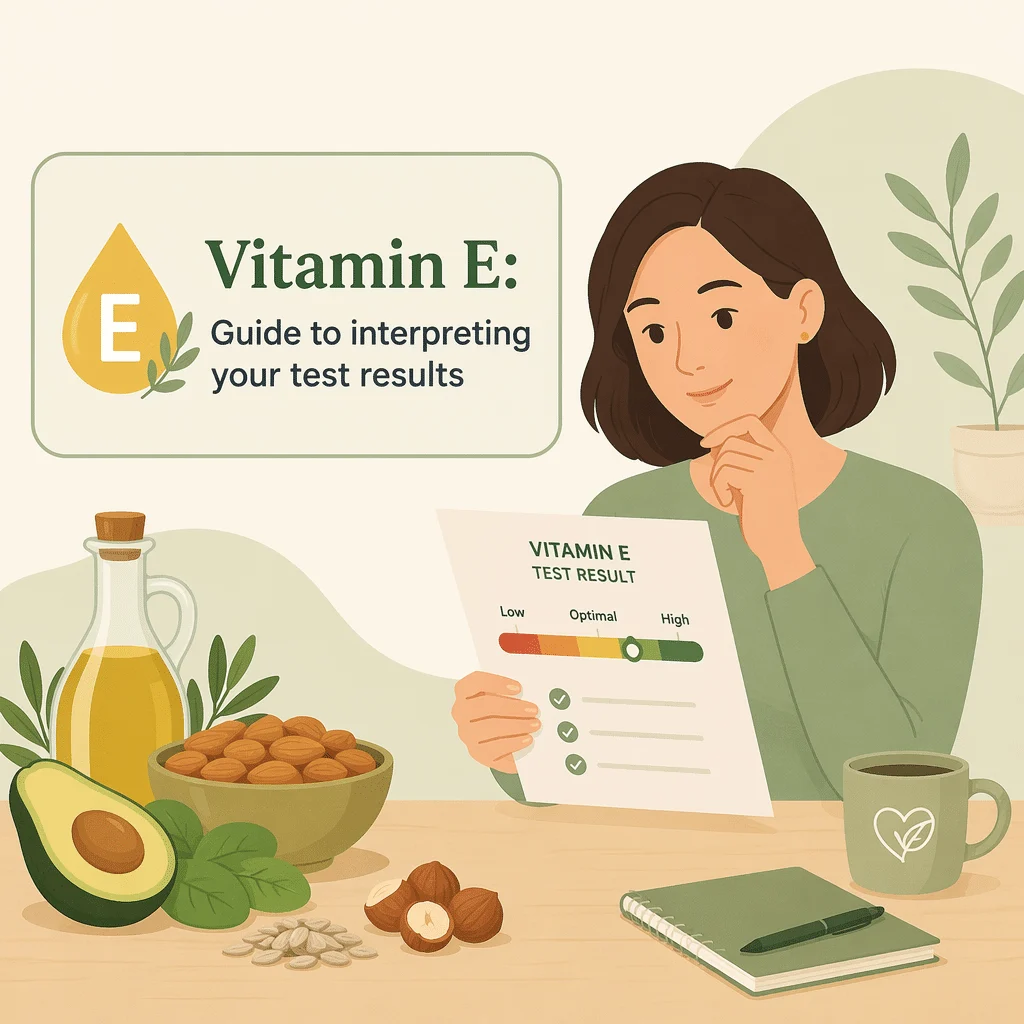
A vitamin E blood test measures alpha-tocopherol, the form of vitamin E your body actually keeps and uses, circulating in your bloodstream. If this line appeared on your lab report, it usually means your doctor wanted to check how well you absorb dietary fats, or to investigate a specific neurological or red blood cell question. It is not a routine test, and most healthy people never need it.
In this article you’ll learn what the test measures, why doctors order it so rarely, why laboratories often compare your result against your blood fats instead of reading it on its own, what low and high values can point to, who is genuinely at risk of deficiency, and when a result deserves a conversation with your doctor.
What vitamin E does and what the vitamin E blood test measures
Vitamin E is not one molecule but a family of eight fat-soluble compounds — four tocopherols and four tocotrienols. Fat-soluble means they dissolve in fat rather than water, so they travel through your blood packaged inside fat-carrying particles rather than floating freely.
Its main job is to act as an antioxidant. Your cell membranes are built largely from fats that can be damaged by unstable molecules called free radicals, in a chain reaction known as lipid peroxidation. Vitamin E interrupts that chain, protecting the membrane before the damage spreads. Red blood cells and nerve cells are particularly dependent on this protection, which is why the clearest consequences of a real deficiency show up in the blood and the nervous system.
Why the test reports alpha-tocopherol
Although your diet contains several forms of vitamin E, your liver holds on to just one preferentially. A liver protein called alpha-tocopherol transfer protein selects alpha-tocopherol and loads it back into circulation, while the other forms are largely broken down and excreted. That is why a laboratory reporting your vitamin E status measures alpha-tocopherol specifically — it is the form that reflects what your body has retained.
Your body cannot make vitamin E. It comes entirely from food: vegetable oils such as sunflower and wheat germ oil, nuts and seeds, and green leafy vegetables. Because absorption depends on dietary fat, anything that disrupts fat digestion also disrupts vitamin E uptake — a point that runs through everything below.
Why and when doctors order a vitamin E blood test
This test is uncommon, and that is appropriate. In well-nourished populations, true vitamin E deficiency is genuinely rare, so screening healthy people would produce far more confusion than useful information. Doctors order it when there is a specific reason to suspect a problem.
Typical reasons include:
- A known condition that impairs fat absorption, such as cystic fibrosis, chronic pancreatic insufficiency, coeliac disease or Crohn’s disease.
- Cholestasis — reduced or blocked bile flow — since bile is needed to absorb fats and the vitamins carried in them.
- Unexplained neurological symptoms, particularly progressive balance and coordination problems.
- Certain rare inherited conditions, including abetalipoproteinaemia and ataxia with vitamin E deficiency.
- Monitoring of someone already receiving prescribed vitamin E treatment.
- Occasionally, suspected excessive supplement use, especially alongside blood-thinning medication.
Because these situations rarely involve one nutrient alone, the vitamin E result is usually read alongside others. Your doctor may order a broader vitamin panel blood test, and if fat malabsorption is suspected, they will often also review liver function tests. Pancreatic function is assessed with amylase and lipase tests. Since vitamin A travels the same absorption route, some clinicians pair the request with the vitamin A blood test.
How the test is done and why your blood lipids matter
In practice, the test is straightforward: a standard blood draw from a vein in your arm. Laboratories usually ask you to fast beforehand, mainly because a recent fatty meal temporarily raises the fat-carrying particles in your blood, and — as you will see — those particles change how your vitamin E reading comes out. Results are reported in milligrams per litre (mg/L) or micromoles per litre (µmol/L).
The tocopherol-to-lipid ratio
Here is the part that surprises most people, and the single most useful thing to understand about this test. Vitamin E does not float freely in blood. It rides inside lipoproteins — the particles that carry cholesterol and triglycerides around your body. So your blood vitamin E level does not only reflect how much vitamin E you have; it also reflects how many carrier particles you happen to have.
The consequence is real and works in both directions. Someone with high cholesterol has plenty of carriers, so their total vitamin E reading can look reassuringly high even when the amount delivered to their tissues is unremarkable. Someone with very low blood fats — which occurs in severe malabsorption and in some liver disease — has few carriers, so their vitamin E reading can look alarmingly low even when their actual status is acceptable.
To correct for this, laboratories often calculate a lipid-adjusted result: the tocopherol-to-lipid ratio, meaning your alpha-tocopherol divided by your cholesterol, or by cholesterol plus triglycerides combined. This is why your doctor may request a lipid panel at the same time, and why your triglyceride levels appear in the interpretation. The adjusted figure is generally considered the more reliable reflection of vitamin E status, particularly when blood fats are unusual.
The practical takeaway: if your vitamin E value looks abnormal on its own, do not draw conclusions before knowing what your blood lipids were doing on the same day.
What low vitamin E levels can mean
A low result is far more often a clue about absorption than about diet. Adults who simply eat imperfectly do not usually develop measurable vitamin E deficiency, because the body stores it in fat tissue and depletes those stores slowly — often over years.
Fat malabsorption
This is the dominant cause. If fat is not absorbed properly, neither is vitamin E, no matter how much is eaten. Cystic fibrosis, chronic pancreatitis and pancreatic insufficiency, coeliac disease, Crohn’s disease, short bowel syndrome and cholestatic liver disease all fall into this group. In these situations, the low vitamin E is a signal about the underlying condition, and treating that condition is the priority.
Inherited causes
Two rare genetic conditions produce deficiency even when absorption of fat is intact. In abetalipoproteinaemia, the body cannot assemble the carrier particles that transport fats and fat-soluble vitamins. In ataxia with vitamin E deficiency (AVED), the liver protein that reloads alpha-tocopherol into the blood does not work, so vitamin E is lost rather than retained. AVED matters clinically because it is one of the few inherited ataxias where identifying the cause changes management — which is precisely why doctors sometimes measure vitamin E in someone with unexplained progressive ataxia.
Neurological and red blood cell effects
When deficiency is genuine and prolonged, the effects concentrate in two places. In the nervous system, it can cause a peripheral neuropathy — damage to the nerves outside the brain and spinal cord — producing loss of sensation, reduced reflexes, muscle weakness and, characteristically, ataxia, meaning unsteady and poorly coordinated movement. These changes develop slowly and can be partly reversible if caught and treated early, which is the main argument for testing when the clinical picture fits.
In the blood, deficiency leaves red blood cell membranes vulnerable to oxidative damage, so the cells rupture more easily. This is haemolytic anaemia — anaemia caused by red blood cells breaking down faster than they are replaced — and it typically shows up on a complete blood count before anyone thinks of vitamin E. It is most relevant in premature infants, whose stores are low at birth.
What high vitamin E levels can mean
A high result has a much simpler explanation: supplements. Reaching a high blood level through food alone is essentially impossible, because typical vitamin-E-rich foods do not deliver anything close to supplemental doses.
The relevant concern with high intake is bleeding. According to the NIH Office of Dietary Supplements, vitamin E can inhibit platelet aggregation — the clumping of blood cells that starts a clot — and can antagonise vitamin K-dependent clotting factors. Taking large doses alongside anticoagulant or antiplatelet medication such as warfarin can therefore increase bleeding risk, particularly when vitamin K intake is low. The NIH Office of Dietary Supplements notes that the supplemental amounts needed to produce clinically meaningful effects are not precisely known but probably exceed 400 IU per day.
This is where the vitamin K relationship becomes practical rather than theoretical, and it is explained further in our article on the vitamin K blood test. If bleeding risk is a genuine question, your doctor may order a coagulation panel to see how your clotting is actually behaving.
It is worth being clear-eyed about the wider evidence. High-dose vitamin E supplements were studied extensively in the hope that their antioxidant effect would prevent heart disease, cancer and cognitive decline. Broadly, those trials did not deliver the expected benefit, and some raised safety concerns. That history is the reason mainstream guidance no longer encourages high-dose supplementation for the general population.
Reference intakes, as set by named authorities
Any figures here belong to the authorities that set them, not to us. The NIH Office of Dietary Supplements publishes a Recommended Dietary Allowance for vitamin E of 15 mg per day for adults aged 14 and over, rising to 19 mg per day during lactation. It also publishes a Tolerable Upper Intake Level — the maximum daily intake unlikely to cause adverse effects — of 1,000 mg per day from supplements for adults aged 19 and over. The full detail, including the mg-to-IU conversions that cause so much confusion on supplement labels, is set out in the NIH Office of Dietary Supplements vitamin E fact sheet. Decisions about whether any supplement is appropriate for you belong with your doctor.
Who is actually at risk of vitamin E deficiency
Because this test is so often ordered out of general concern rather than genuine risk, it helps to see who the at-risk groups really are.
| Group | Why the risk exists |
|---|---|
| People with cystic fibrosis | Pancreatic enzymes are lacking, so dietary fat and the vitamins carried in it are poorly absorbed |
| People with cholestatic liver disease | Bile flow is reduced or blocked, and bile is required to absorb fat-soluble vitamins |
| People with coeliac or Crohn’s disease | The intestinal lining is damaged or inflamed, reducing absorption across the gut wall |
| People after extensive bowel surgery | Less absorptive surface remains, so fat and fat-soluble vitamins pass through unabsorbed |
| People with abetalipoproteinaemia | The carrier particles that transport vitamin E in blood cannot be assembled |
| People with AVED | The liver protein that retains alpha-tocopherol is faulty, so vitamin E is lost rather than kept |
| Very low birth weight premature infants | Stores are small at birth and the immature gut absorbs fat inefficiently |
| Healthy adults eating an ordinary diet | Not a risk group — body stores are substantial and frank deficiency is rare |
The pattern is consistent: with the exception of premature infants, deficiency is a consequence of another condition rather than a standalone dietary problem.
Low versus high results at a glance
| Result | Usual explanations and what happens next |
|---|---|
| Low alpha-tocopherol | Most often fat malabsorption; sometimes very low blood lipids making the raw number misleading; rarely an inherited cause. Your doctor investigates the underlying condition and may check the lipid-adjusted ratio |
| Low ratio after lipid adjustment | More convincing evidence of genuine depletion than a low raw value alone, and more likely to prompt further investigation |
| High alpha-tocopherol | Almost always supplements; occasionally high blood cholesterol inflating the raw number. Your doctor reviews your supplement use, particularly if you take anticoagulants |
| Normal | Reassuring in context, though a single value is a snapshot rather than a diagnosis |
When to see a doctor about your vitamin E blood test
A number outside the reference range is information, not a diagnosis. Reference ranges describe where most healthy people fall — they are not a boundary between well and unwell. That said, some situations do warrant prompt medical attention rather than watchful waiting.
Contact your doctor without delay if you notice:
- Progressive unsteadiness, difficulty walking in the dark, or a sense that your balance is worsening over months.
- Numbness, tingling or loss of sensation that spreads or persists.
- Muscle weakness you cannot explain by activity or illness.
- Unusual bruising, nosebleeds or bleeding that stops slowly, especially if you take anticoagulant or antiplatelet medication.
- Persistent pale, greasy or floating stools, or unexplained weight loss, which can point to fat malabsorption.
Book a routine appointment to discuss your result if it sits outside the range without any of the above, if you take vitamin E supplements and are unsure whether you should, or if you have a condition affecting fat absorption and have never had your fat-soluble vitamins checked. Bring your full supplement list — including anything bought without a prescription — because this is exactly the information that explains most high results. If your report has left you uncertain more broadly, we explain what to do about abnormal blood test results.
Latest scientific advances in vitamin E testing
Recent work has sharpened, rather than overturned, how clinicians read this test. Here is what the last few years have added, in plain terms.
Lipid adjustment changes who looks deficient
A cross-sectional study — a snapshot of a population at one point in time — of 846 adults in Wuhan, China, measured both raw and lipid-adjusted vitamin E. Fewer than one in two hundred participants fell below the threshold used to define functional deficiency. The researchers also found that people with high cholesterol tended to show higher raw vitamin E but lower lipid-adjusted vitamin E, because they simply had more carrier particles. What this means for you: in a well-nourished population, a genuinely deficient result is unusual, and a raw number read without your blood lipids can point in the wrong direction. This was a single-centre study in one city, so the exact prevalence figure will not transfer everywhere, but the mechanism behind it is well established.
Vitamin E status tracks with body fat and circulating lipids
A 2025 study of 127 adults measured several vitamin E forms alongside body fat and metabolic markers. Adults with excess body fat tended to show lower vitamin E concentrations, and the strongest relationship was with circulating lipids rather than with diet alone. What this means for you: your vitamin E reading reflects your metabolic context, not only what you ate. It reinforces why the lipid-adjusted ratio exists. This was a small study and describes an association rather than proving cause and effect, so it is still preliminary and needs confirmation in larger groups.
Coeliac disease remains a live reason to check fat-soluble vitamins
A 2025 review examined vitamin deficiencies in coeliac disease and made a point clinicians find easy to overlook: severe malabsorption is now rare thanks to earlier diagnosis, so doctors have become less likely to look for nutritional gaps — yet deficiencies can arise both from the untreated disease and from a poorly balanced gluten-free diet. What this means for you: if you have coeliac disease, fat-soluble vitamins including vitamin E are still worth discussing, both at diagnosis and later on.
Vitamin E stays on the list for unexplained neuropathy
A 2025 review of nutritional neuropathies confirms vitamin E deficiency’s place among the treatable nutritional causes of nerve damage, alongside vitamin B12, thiamine and copper. What this means for you: when nerve symptoms have no obvious explanation, checking vitamin E is a reasonable step — not because deficiency is likely, but because it is one of the few causes where correcting the deficiency can change the course.
Inherited ataxias: identifying the cause matters
A 2025 review of dietary and lifestyle approaches in hereditary ataxias covers ataxia with vitamin E deficiency amongst the inherited ataxias where nutritional status is directly relevant to management. What this means for you: for the small number of people with AVED, measuring vitamin E is not a nutritional curiosity but a diagnostic step, which is why specialists order it in unexplained progressive ataxia. Treatment decisions in these conditions are specialist territory and are individualised.
Taken together, the direction of travel is consistent: the test is narrow in its usefulness, most valuable in defined at-risk groups, and best interpreted alongside your blood lipids rather than in isolation.
Glossary
| Term | Definition |
|---|---|
| Alpha-tocopherol | The form of vitamin E your liver retains and returns to the blood; the form laboratories measure |
| Fat-soluble | Dissolves in fat rather than water, so absorption depends on dietary fat and on normal fat digestion |
| Antioxidant | A substance that neutralises unstable molecules called free radicals before they damage cells |
| Lipid peroxidation | A chain reaction in which fats in cell membranes are progressively damaged by free radicals |
| Lipoprotein | A particle that carries fats, cholesterol and fat-soluble vitamins through the bloodstream |
| Tocopherol-to-lipid ratio | Your vitamin E level divided by your blood fats, used to correct for how many carrier particles you have |
| Malabsorption | Reduced ability of the intestine to take up nutrients from food into the bloodstream |
| Cholestasis | Reduced or blocked flow of bile, which impairs absorption of fats and fat-soluble vitamins |
| Ataxia | Unsteady, poorly coordinated movement caused by disruption to the nerves controlling balance |
| Haemolytic anaemia | Anaemia arising because red blood cells break down faster than the body replaces them |
Frequently asked questions
How much does a vitamin E blood test cost, and is it covered?
Costs vary widely between laboratories and countries, and coverage usually depends on whether the test is clinically indicated. Because vitamin E is measured by specialised equipment rather than a routine analyser, it is generally more expensive than common tests and is often sent to a reference laboratory, which also means results take longer to come back. If your doctor ordered it for a recognised reason — malabsorption, unexplained neuropathy, monitoring of prescribed treatment — it is more likely to be covered than if you requested it yourself out of curiosity. Ask the laboratory for the price and your insurer about coverage before booking, as neither can be reliably predicted from general information.
What is the normal range for a vitamin E blood test?
Most laboratories report an adult reference range of roughly 5.5 to 17 mg/L, though the exact figures differ by laboratory and by the method used. Always read your result against the range printed on your own report rather than one found online. More importantly, the raw range means less than people expect, because it does not account for your blood lipids. A value near the bottom of the range in someone with very low cholesterol may be perfectly adequate, whilst a value in the middle of the range in someone with high cholesterol may be less reassuring than it appears. This is why the lipid-adjusted ratio often carries more weight than the raw number.
Do I need to fast before a vitamin E blood test?
Many laboratories request an overnight fast, typically 8 to 12 hours with water allowed. The reason is not that food changes your vitamin E stores — it does not, meaningfully — but that a recent fatty meal temporarily raises your circulating lipids, which shifts both the raw vitamin E value and the lipid-adjusted ratio. Fasting simply makes results comparable between tests. Follow the specific instructions your laboratory gives you, and if you were not told to fast, mention what and when you last ate when you arrive, so it can be noted alongside your result.
Can medications affect my vitamin E level?
Yes. Medications that reduce fat absorption, such as orlistat and bile acid sequestrants like cholestyramine, can lower vitamin E absorption because the vitamin depends on dietary fat to be taken up. In the other direction, high-dose vitamin E supplements can amplify the effect of anticoagulant and antiplatelet medications and increase bleeding risk. Tell your doctor and pharmacist about everything you take, including over-the-counter supplements, since these interactions are the most common practical reason a vitamin E result matters.
Can I raise my vitamin E level by eating differently?
For most people with a genuinely low result, diet is not the bottleneck — absorption is, which is why identifying the underlying cause matters more than changing your shopping list. Vitamin E is found in vegetable oils, nuts, seeds, avocados and leafy greens, and because it needs fat to be absorbed, eating it with some fat helps. But if a malabsorption condition is driving your result, more almonds will not fix it. Discuss any change in approach with your doctor rather than self-treating, particularly before starting a supplement.
Should I take a vitamin E supplement just in case?
That is a decision for your doctor, not for an article. What can be said factually is that large trials of high-dose vitamin E supplements did not show the broad protective benefits once hoped for, and that high doses carry a recognised bleeding risk, particularly for people on blood thinners. The NIH Office of Dietary Supplements sets a tolerable upper intake level of 1,000 mg per day for adults from supplements. Frank deficiency is rare in people who absorb fat normally, so for most people there is no gap to fill in the first place.
Sources
- National Institutes of Health, Office of Dietary Supplements — Vitamin E: Fact Sheet for Health Professionals — https://ods.od.nih.gov/factsheets/VitaminE-HealthProfessional/
- MedlinePlus, U.S. National Library of Medicine — Vitamin E — https://medlineplus.gov/ency/article/002406.htm
- Kemnic TR, Coleman M — Vitamin E Deficiency — StatPearls, NCBI Bookshelf — https://www.ncbi.nlm.nih.gov/books/NBK519051/
- Shen Y et al. — The low prevalence rate of vitamin E deficiency in urban adults of Wuhan from central China: findings from a single-centre, cross-sectional study — European Journal of Medical Research, 2023 — https://consensus.app/papers/details/b91e1d58f3bd57dd80c886a1d3fae379/
- Szewczyk K et al. — Nutritional Status of Vitamin E and Its Association with Metabolic Health in Adults — Nutrients, 2025 — https://consensus.app/papers/details/138364822f8b5999990bf543f58b17b5/
- Scarampi M, Mengoli C, Miceli E, Di Stefano M — Vitamins and Celiac Disease: Beyond Vitamin D — Metabolites, 2025 — https://doi.org/10.3390/metabo15020078
- Varon M, Pasnoor M, Dimachkie MM — Nutritional Neuropathies — Neurologic Clinics, 2025 — https://doi.org/10.1016/j.ncl.2025.05.010
- Yang W, Thompson B, Kwa FAA — Dietary and lifestyle interventions for the management of hereditary ataxias — Frontiers in Nutrition, 2025 — https://doi.org/10.3389/fnut.2025.1548821
Further reading
- To understand the other fat-soluble vitamin most often checked alongside this one, read our guide to the vitamin D blood test.
- To explore the water-soluble antioxidant that works with vitamin E, see our article on the vitamin C blood test.
- To learn about a mineral that supports the same antioxidant defences, consult our guide to the selenium blood test.
- To see how several vitamins are assessed together, read our overview of the vitamin panel blood test.
- To build confidence with lab reports in general, start with our guide explaining how to read blood test results.
Understand your lab results with AI DiagMe
A vitamin E result rarely stands alone. It makes most sense next to your lipid panel, your liver function tests and, sometimes, your vitamin A level — which is a lot of numbers to hold in your head at once. AI DiagMe turns those lines into plain language you can actually use, so you arrive at your appointment with better questions. It helps you understand your results; it does not diagnose, and it does not replace your doctor.
Get your results interpreted in minutes