




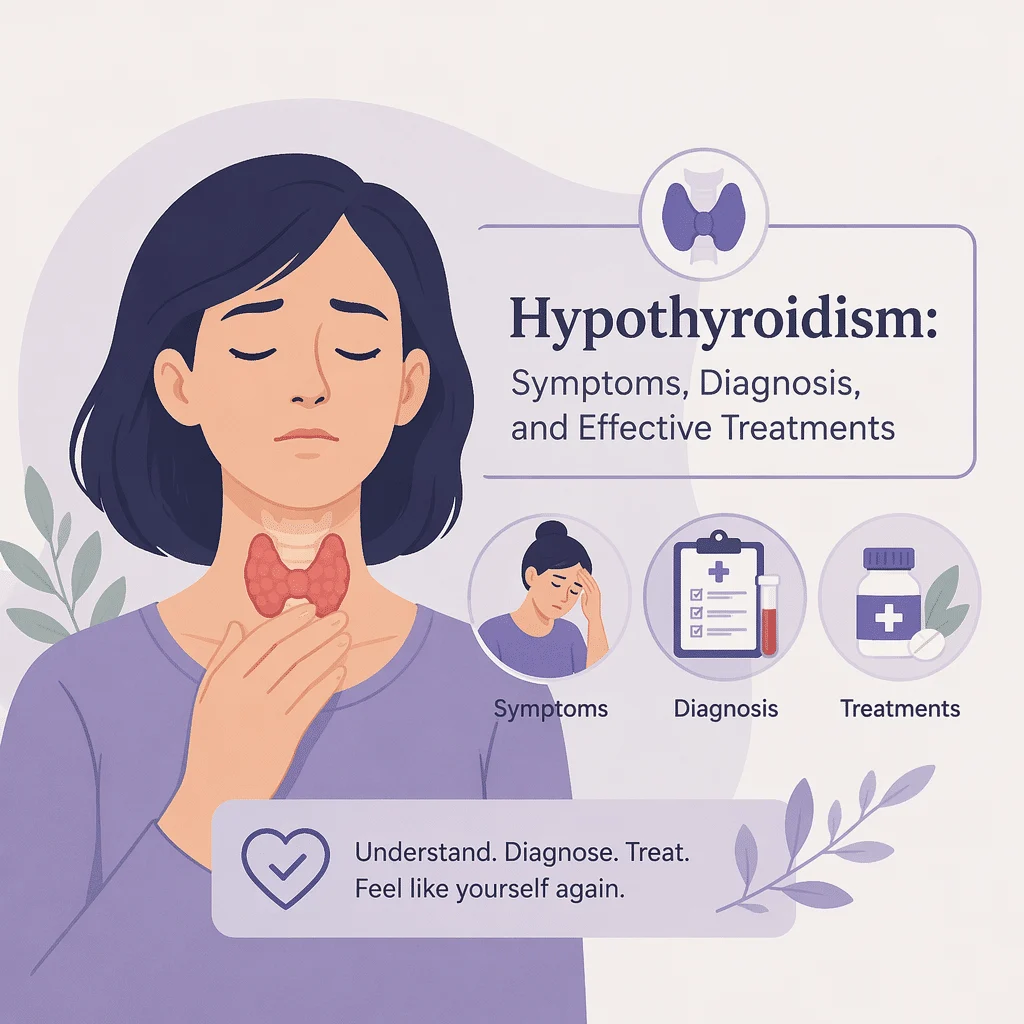
Hypothyroidism, also called an underactive thyroid, develops when the thyroid gland makes too little thyroid hormone for the body’s needs. Because these hormones set the pace of your metabolism, a shortage gradually slows many systems at once, which is why the early signs are so easy to miss. Fatigue, weight gain, feeling cold, and low mood can all trace back to a thyroid that has quietly stopped keeping up. The reassuring news is that the condition is common, measurable with a simple blood test, and highly treatable once it is identified. In this article you will learn what hypothyroidism is, what causes it, how doctors diagnose it from your lab results, and how treatment restores the balance.
What is hypothyroidism?
The thyroid is a small, butterfly-shaped gland at the base of the neck. It produces two main hormones, thyroxine (T4) and triiodothyronine (T3), that travel in the blood and tell nearly every cell how fast to work. These hormones influence your heart rate, body temperature, digestion, weight, and even your mood.
In hypothyroidism, the gland cannot release enough of these hormones, so the body’s chemistry slows down. When the problem lies in the thyroid itself, doctors call it primary hypothyroidism, which accounts for the large majority of cases. Less often, the gland is healthy but receives too little stimulation from the pituitary gland in the brain, a situation known as central or secondary hypothyroidism.
How common is it?
An underactive thyroid is one of the most frequent hormonal conditions. According to the National Institute of Diabetes and Digestive and Kidney Diseases, close to 5 in 100 Americans aged 12 and older have some form of hypothyroidism. The risk rises with age and is several times higher in women than in men, which is why testing is often suggested when typical symptoms appear.
What causes hypothyroidism?
Most cases trace back to a problem inside the thyroid gland. In countries with enough dietary iodine, the single most common cause is an autoimmune condition, but several other factors can leave the gland underactive.
Hashimoto’s thyroiditis
In Hashimoto’s thyroiditis, the immune system mistakenly attacks the thyroid, gradually reducing its ability to make hormones. This slow damage often leaves measurable immune markers in the blood. When doctors suspect an autoimmune cause, the laboratory measures thyroid peroxidase antibodies (anti-TPO). A positive result helps explain why the gland is failing and confirms that the process is autoimmune.
Other common causes
- Thyroid surgery, when part or all of the gland is removed.
- Radioactive iodine or radiation therapy used to treat an overactive thyroid or head and neck cancers.
- Iodine imbalance, since too little iodine is a leading cause worldwide, whilst a sudden excess can also disrupt the gland.
- Certain medicines, such as lithium and some heart or cancer treatments.
- Thyroid changes during and after pregnancy, which sometimes resolve on their own.
- Less commonly, a pituitary problem that lowers the signal reaching the thyroid.
Who is most at risk?
Risk factors include being a woman, being older than 60, having a family history of thyroid disease, living with another autoimmune condition, and previous thyroid surgery or neck radiation. Knowing your personal risk helps you and your doctor decide when testing makes sense.
Symptoms of an underactive thyroid
Because thyroid hormones affect the whole body, the symptoms of hypothyroidism are wide-ranging and tend to appear slowly over months or years. Many people put the early signs down to stress, ageing, or a busy life. The table below groups the most common complaints by the part of the body they affect.
| Part of the body | Common signs |
|---|---|
| Energy and metabolism | Persistent fatigue, unexplained weight gain, general sluggishness |
| Temperature and skin | Feeling cold, dry skin, brittle hair and nails |
| Digestion | Constipation and bloating |
| Mood and thinking | Low mood, poor concentration, memory lapses |
| Heart and cholesterol | Slow heart rate and raised LDL and total cholesterol |
| Menstruation and fertility | Irregular or heavy periods and difficulty conceiving |
No single symptom confirms the diagnosis, and many of these signs are shared with other conditions such as anaemia, depression, or simple overwork. That is exactly why doctors rely on blood tests rather than symptoms alone, and why an unexplained cluster of these complaints is worth investigating.
Diagnosis: the thyroid lab tests that matter
Diagnosing hypothyroidism is one of the clearest examples of how much a lab report can reveal. A doctor starts with your history and a physical examination, then confirms the picture with blood tests. Diagnosis almost always begins with a blood test doctors call the thyroid-stimulating hormone (TSH) test.
TSH is the pituitary's message to the thyroid. When the gland falls behind, the pituitary signals louder, so a high TSH is usually the first sign of an underactive thyroid. To see how much hormone the thyroid is actually releasing, doctors pair that result with a test that measures free thyroxine (free T4). In selected cases the laboratory also measures the active hormone itself, free triiodothyronine (free T3).
Reading your thyroid panel
Interpreting the values together tells a clearer story than any single number. The table below shows what each test evaluates and how the pattern differs between overt hypothyroidism and the milder, earlier form called subclinical hypothyroidism.
| Thyroid test | What it evaluates | Overt hypothyroidism | Subclinical hypothyroidism |
|---|---|---|---|
| TSH | The pituitary signal telling the thyroid to work harder | High | High |
| Free T4 | The main hormone the thyroid releases into the blood | Low | Normal |
| Free T3 | The active hormone that drives metabolism in the tissues | Low or normal | Usually normal |
| Anti-TPO antibodies | A sign of autoimmune (Hashimoto’s) thyroid damage | Often positive | Often positive |
Every lab report also prints reference ranges next to your figures. These ranges vary slightly between laboratories, so a value just outside the range is not always a problem; context and repeat testing matter. If you want to see typical figures, a dedicated guide explains what counts as normal thyroid levels.
Why the pattern matters
The combination of a high TSH with a low free T4 points to overt hypothyroidism, the form that usually needs treatment. A high TSH with a still-normal free T4 suggests subclinical hypothyroidism, an early stage that does not always require medication. If anti-TPO antibodies are present, an autoimmune cause such as Hashimoto's disease is the likely explanation.
Treatment and monitoring
The standard treatment for hypothyroidism is levothyroxine, a synthetic version of the T4 hormone your thyroid can no longer supply in full. Taken as a once-daily tablet, it restores hormone levels to normal and, for most people, relieves symptoms completely.
How levothyroxine is taken
Levothyroxine works best on an empty stomach, usually 30 to 60 minutes before breakfast, taken with water. Coffee, calcium and iron supplements, and some other medicines can block its absorption, so timing and consistency are important. The dose is personal: it depends on your weight, age, the cause of your hypothyroidism, and any other health conditions you have.
Follow-up blood tests
Because the right dose is found gradually, your doctor rechecks your TSH about 6 to 8 weeks after starting or changing treatment, then less often once your levels are stable. Most people take levothyroxine for life, but the daily routine is simple and the medicine is safe when it is monitored. Regular follow-up testing is what keeps treatment on target and your symptoms at bay.
Why treatment matters
Leaving hypothyroidism untreated allows the slowdown to deepen. Over months and years it can raise cholesterol and blood pressure, strain the heart, and worsen mood, concentration, and fertility. During pregnancy, an untreated underactive thyroid can affect both mother and baby. At the far end of the spectrum, very severe and long-neglected disease can lead to a rare emergency called myxoedema, with extreme fatigue, a fall in body temperature, and confusion. The encouraging point is that these outcomes are largely preventable: finding the right dose early and checking it regularly keeps the condition from ever reaching that stage for the vast majority of people.
Hypothyroidism, cholesterol, and your heart
A slow thyroid does not only cause tiredness; it changes your blood chemistry. When metabolism slows, the body clears fats from the blood less efficiently, so over time an untreated underactive thyroid can cause high cholesterol. Doctors therefore often pair thyroid testing with a full lipid panel, and they keep an eye on the so-called bad cholesterol, or LDL cholesterol. To gauge heart risk at a glance, some clinicians also calculate a cholesterol ratio. The encouraging part is that correcting thyroid levels frequently improves these numbers, which is one more reason to treat and monitor the condition properly.
Latest scientific advances
Thyroid care is an active research field, and recent studies are refining who benefits from treatment and how to fine-tune it. Here is what the newest evidence suggests, in plain terms.
Subclinical hypothyroidism: when treatment helps
A 2025 review in JAMA and a 2024 meta-analysis of subclinical hypothyroidism, the mild stage where TSH is raised but free T4 is still normal, point in the same direction: routine hormone tablets do not reliably improve everyday symptoms in people whose TSH is only slightly elevated. The picture differs for those trying to conceive or already pregnant, where correcting a borderline result appears more important. What this means for you: a single mildly abnormal TSH does not automatically mean lifelong medication; the decision depends on your exact levels, your symptoms, and your stage of life.
Getting the dose and absorption right
A 2025 review of levothyroxine absorption problems highlights how food, coffee, and supplements such as iron and calcium, as well as some digestive conditions, can stop the tablet from being absorbed properly. Separate research on the consequences of under-treatment shows that too low a dose leaves people with lingering fatigue and higher cholesterol. What this means for you: taking the tablet consistently on an empty stomach, and keeping up with follow-up blood tests, does more for your health than any single special diet.
Combination T4 and T3 therapy
Most people feel well on T4-only treatment, but a minority do not. A 2024 overview of emerging therapies and a small 2025 trial are re-examining whether adding a low dose of T3 (liothyronine, the active hormone) helps this group. Early results are encouraging but still preliminary, meaning they need larger studies before becoming standard advice. What this means for you: if you still feel unwell despite normal lab numbers, it is worth discussing the options with your doctor, whilst knowing that combination therapy is not yet a proven solution for everyone.
Care that fits your goals
A 2024 study of patient preferences found that many people value being involved in decisions and judge success by how they feel, not only by a number on a lab report. What this means for you: it is reasonable to tell your doctor what matters most to you, whether that is energy, weight, or simple peace of mind.
Thyroid health in pregnancy
A 2025 pooled analysis of thyroid function in pregnancy linked thyroid problems and thyroid antibodies with a higher chance of complications such as gestational diabetes, a form of diabetes that appears during pregnancy. What this means for you: if you are pregnant or planning to be, ask whether thyroid testing should be part of your check-ups, because your needs often change during pregnancy.
Living with hypothyroidism
With the right dose and regular monitoring, the vast majority of people with hypothyroidism live full, healthy lives. Beyond taking your medication as prescribed, a few everyday habits help.
- Take levothyroxine at the same time each day, away from food and other supplements.
- Keep your follow-up appointments so your dose stays matched to your needs.
- Eat a balanced diet with enough iodine; there is no need for extreme thyroid diets.
- Tell any new doctor about your condition, as some medicines and pregnancy can change your dose.
- Stay active, since regular movement supports energy, mood, and a steady weight.
When to see a doctor
Speak with a healthcare professional if you notice any of the following:
- Persistent tiredness, weight gain, or feeling cold with no clear explanation.
- Dry skin, thinning hair, constipation, or low mood that lingers for weeks.
- A known thyroid condition with new or worsening symptoms.
- Planning a pregnancy, or already pregnant, if you have thyroid risk factors.
- You take levothyroxine and still feel unwell despite treatment.
Seek urgent care for rare but serious warning signs such as extreme drowsiness, confusion, or feeling very cold, which can point to severely under-treated disease.
Glossary
| Term | Definition |
|---|---|
| Hypothyroidism | An underactive thyroid that produces too little thyroid hormone, slowing the body’s metabolism. |
| Thyroid-stimulating hormone (TSH) | A pituitary hormone that tells the thyroid how much hormone to make; it rises when the thyroid is underactive. |
| Free thyroxine (free T4) | The main hormone the thyroid releases into the blood; it falls in overt hypothyroidism. |
| Free triiodothyronine (free T3) | The active thyroid hormone that drives metabolism inside the tissues. |
| Levothyroxine | A synthetic form of T4 taken as a daily tablet to replace missing thyroid hormone. |
| Hashimoto’s thyroiditis | An autoimmune disease in which the immune system attacks the thyroid; the most common cause of hypothyroidism. |
| Anti-TPO antibodies | Immune proteins against thyroid peroxidase; their presence points to autoimmune thyroid disease. |
| Subclinical hypothyroidism | A mild, early stage in which TSH is raised but free T4 is still within the normal range. |
| Myxoedema | Severe, long-untreated hypothyroidism marked by swelling and a dangerous slowing of bodily functions. |
Frequently asked questions
What are the first symptoms of hypothyroidism?
Early symptoms are easy to overlook because they build slowly. The most common are persistent fatigue, unexplained weight gain, feeling cold when others are comfortable, dry skin, and constipation. Some people also notice low mood, poor concentration, or heavier periods. Because these signs overlap with many other conditions, a blood test is the only way to confirm an underactive thyroid.
What causes an underactive thyroid?
In countries with enough dietary iodine, the leading cause is Hashimoto’s thyroiditis, an autoimmune condition in which the immune system attacks the thyroid. Other causes include thyroid surgery, radioactive iodine or radiation therapy, certain medicines, and iodine imbalance. Less often, a pituitary problem lowers the signal to the thyroid. Thyroid changes around pregnancy can also cause a temporary form.
What is the main medicine for hypothyroidism?
The standard medicine is levothyroxine, a synthetic form of the T4 hormone. Taken as a once-daily tablet on an empty stomach, it replaces the hormone your thyroid can no longer make. The dose is tailored to you and adjusted using follow-up TSH blood tests until your levels are stable, after which most people feel like themselves again.
Can hypothyroidism be cured?
In most cases hypothyroidism is a long-term condition rather than something that can be cured, especially when it follows Hashimoto’s disease or thyroid surgery. It is, however, very manageable: daily levothyroxine keeps hormone levels normal. Some cases linked to pregnancy, certain medicines, or a temporary thyroid inflammation can improve on their own over time.
Does hypothyroidism cause weight gain?
An underactive thyroid slows metabolism, which can lead to modest weight gain and some fluid retention. The gain is usually a few pounds rather than a dramatic change, and treatment often reverses part of it. Weight that does not respond once your thyroid level is corrected usually has other causes worth discussing with your doctor.
Are there foods to avoid with hypothyroidism?
There is no strict list of forbidden foods. Very large amounts of raw goitrogenic vegetables, such as cabbage or soy, can in theory interfere with the thyroid, but normal portions are fine. The most important dietary point is timing: take levothyroxine on an empty stomach and separate it from coffee, calcium, and iron, which reduce how well it is absorbed.
Sources
- National Institute of Diabetes and Digestive and Kidney Diseases (NIDDK) — Hypothyroidism (Underactive Thyroid) — niddk.nih.gov
- Mayo Clinic — Hypothyroidism (underactive thyroid): Symptoms and causes — mayoclinic.org
- American Thyroid Association — Hypothyroidism — thyroid.org
- JAMA (2025) — Hypothyroidism: A Review — doi.org/10.1001/jama.2025.13559
- Thyroid (2024) — Effects of Levothyroxine Treatment on Fertility and Pregnancy Outcomes in Subclinical Hypothyroidism: A Systematic Review and Meta-Analysis of Randomised Controlled Trials — doi.org/10.1089/thy.2023.0546
- Annual Review of Medicine (2024) — Emerging Therapies in Hypothyroidism — doi.org/10.1146/annurev-med-060622-101007
- Frontiers in Endocrinology (2025) — A feasibility double-blind trial of levothyroxine versus levothyroxine-liothyronine in postsurgical hypothyroidism — doi.org/10.3389/fendo.2025.1522753
- The Journal of Clinical Endocrinology and Metabolism (2024) — Treatment Preferences in Patients With Hypothyroidism — doi.org/10.1210/clinem/dgae651
- Medicina (2025) — Challenges in the Treatment of Hypothyroidism: Malabsorption and Pseudo-Malabsorption of Levothyroxine — pubmed.ncbi.nlm.nih.gov/41109285
- The Lancet Diabetes and Endocrinology (2025) — Association of gestational thyroid function and thyroid autoimmunity with gestational diabetes: a systematic review and individual participant meta-analysis — doi.org/10.1016/S2213-8587(25)00068-3
- Endocrine (2023) — Consequences of undertreatment of hypothyroidism — doi.org/10.1007/s12020-023-03460-1
Further reading
- TSH: understanding the hormone that regulates your thyroid
- Free T4: how to read your thyroid test
- Free T3: understanding this thyroid marker
- Anti-TPO antibodies: the autoimmune thyroid marker
- Normal thyroid levels: understanding the ranges
Understand your lab results with AI DiagMe
Understanding your TSH, free T4, and thyroid antibody results is at the heart of managing hypothyroidism, yet a page of numbers and reference ranges can be hard to make sense of on your own. AI DiagMe reads your lab report and explains what each thyroid value means in clear language, so you can arrive at your appointment better informed. It is built to help you understand your results, not to diagnose you, and it never replaces the advice of your doctor.
Get your results interpreted in minutes