





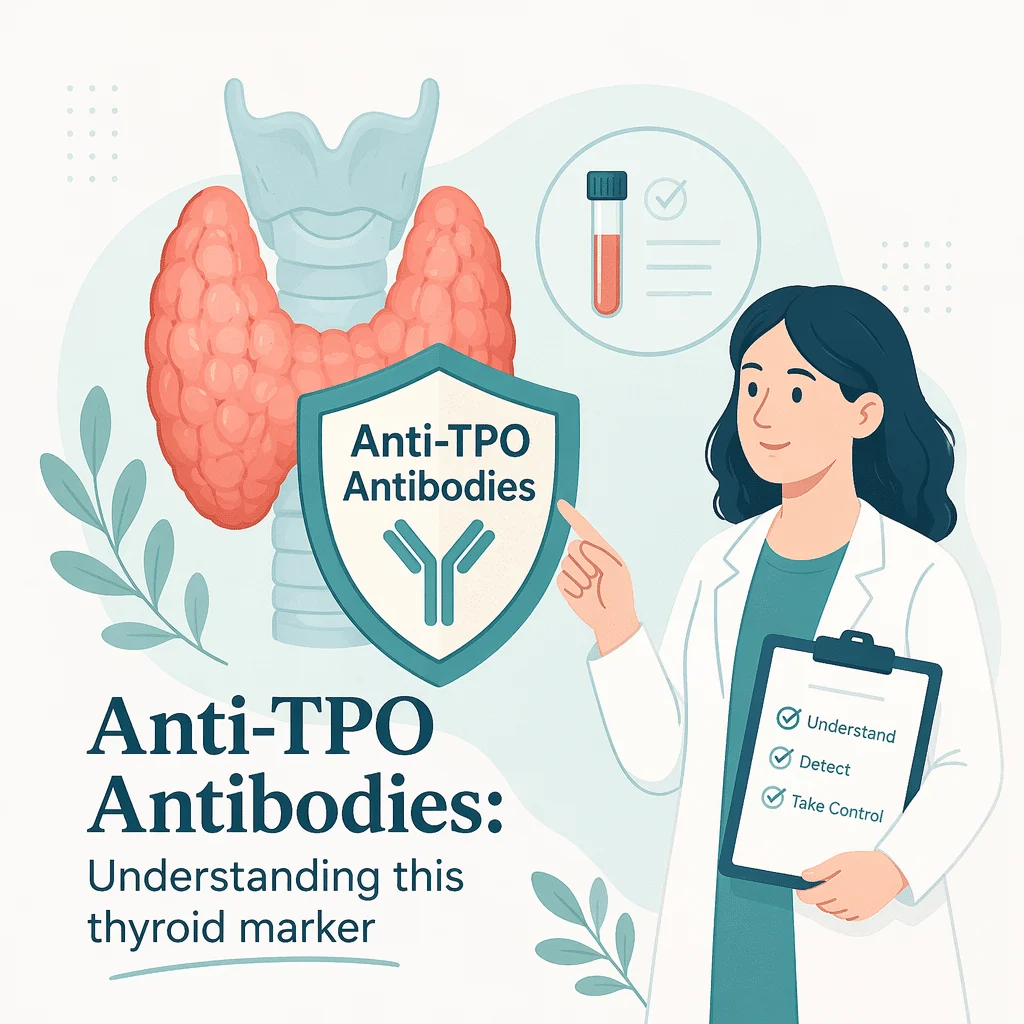
Anti-TPO antibodies are proteins that the immune system makes against thyroid peroxidase, an enzyme your thyroid gland needs to build its hormones. When a blood test detects them, it usually means your own defences are reacting against the thyroid, most often in a condition called Hashimoto’s disease. A positive result can feel worrying, yet on its own it is a signal about risk rather than a diagnosis. In this guide you will learn what anti-TPO antibodies are, why doctors test for them, how to read your result next to TSH and free T4, what high levels can point to, why they matter in pregnancy, how lifestyle fits in, and when a result is worth discussing with a doctor.
What are anti-TPO antibodies?
Antibodies are proteins the immune system normally builds to attack outside threats such as viruses and bacteria. Anti-TPO antibodies are different: they target thyroid peroxidase (TPO), one of your own enzymes. Because they act against the body rather than a germ, they are called autoantibodies, and their presence points to an autoimmune reaction inside the thyroid.
What thyroid peroxidase does
Thyroid peroxidase sits inside the thyroid, a small butterfly-shaped gland in the front of the neck. It helps attach iodine to a protein so the gland can produce its two main hormones, T4 (thyroxine) and T3 (triiodothyronine). These hormones set the pace of metabolism, influencing energy, weight, heart rate, mood, and body temperature. TPO is therefore a key worker on the thyroid’s production line.
What a positive result signals
A detectable level of anti-TPO antibodies shows that the immune system has flagged TPO as a target. The antibodies themselves do not usually cause symptoms directly. Instead, they mark an ongoing immune attack that can slowly inflame the gland and, over years, wear down its ability to make hormones. Many people carry these antibodies with a thyroid that still works perfectly well, which is why the result is read as one clue among several.
Why doctors test for anti-TPO antibodies
Doctors rarely check this marker at random. They usually order it after another test hints at a thyroid problem, or when symptoms and history point that way. Anti-TPO antibodies are the most common and earliest sign of autoimmune thyroid disease, so they help explain why a gland is underperforming.
When the test is ordered
Your doctor will almost always order a TSH blood test first, because it is the most sensitive early measure of thyroid function. If that result looks off, they frequently add a free T4 test and then look for antibodies to find the cause. Common reasons to check anti-TPO antibodies include:
- An abnormal TSH result, especially a raised value.
- Symptoms of an underactive thyroid, such as fatigue, weight gain, or feeling cold.
- A goitre, meaning a visibly enlarged thyroid.
- Planning a pregnancy, or a history of recurrent miscarriage.
- Another autoimmune condition, such as type 1 diabetes or coeliac disease.
Because the antibodies can appear years before the thyroid actually falters, a positive result can act as an early-warning system that prompts regular monitoring.
How to read your anti-TPO antibody results
On a lab report, anti-TPO antibodies appear as a number, usually measured in international units per millilitre (IU/mL). Next to it you will find the laboratory’s reference range, the values it considers normal. Always compare your figure to that printed range, because methods and cut-offs differ from one lab to another.
As a broad guide, many laboratories treat a result below about 35 IU/mL as negative, though your report’s threshold is the one that counts. A value above the cut-off is called positive. Unlike many blood markers, a low or undetectable level here is the healthy, reassuring result: it simply means no meaningful thyroid antibodies were found.
Two further points help you make sense of the number:
- How high the value climbs matters less than you might expect. A strongly raised level suggests a more active immune process, but a modest positive and a very high positive are often managed in much the same way once thyroid function is known.
- The result only makes sense in context. A positive antibody test with a normal TSH and a normal free T4 points to autoimmunity that has not yet affected hormone output, which usually calls for watchful monitoring rather than treatment.
This is why doctors read the antibody result together with your other numbers. Our companion guide explains normal thyroid levels in more detail.
What high anti-TPO antibodies can mean
A raised level is linked to several thyroid conditions. The antibodies do not name the disease on their own, but combined with your hormone results they help point to one. The table below summarises the most common associations.
| Condition | What it is | Typical anti-TPO pattern |
|---|---|---|
| Hashimoto’s thyroiditis | Autoimmune damage that slowly lowers hormone output | Positive in most cases, often at high levels |
| Subclinical hypothyroidism | A mildly raised TSH with a still-normal free T4 | A positive result flags the autoimmune cause and a higher progression risk |
| Graves’ disease | Autoimmune overactivity of the thyroid | Frequently positive, though another antibody drives the disease |
| Postpartum thyroiditis | Thyroid inflammation in the year after birth | Antibodies before or during pregnancy raise the risk |
| Positive with normal thyroid | Antibodies present whilst hormone levels stay normal | Common; usually monitored rather than treated |
Hashimoto’s disease
Hashimoto’s thyroiditis is by far the most common condition behind high anti-TPO antibodies. The American Thyroid Association notes that it is the leading cause of an underactive thyroid in the United States. The immune system slowly inflames and damages the gland, gradually reducing hormone output. As the gland slows, an underactive thyroid can produce high TSH symptoms such as tiredness, weight gain, cold sensitivity, and dry skin.
Subclinical hypothyroidism
This is an early stage in which TSH is mildly raised whilst free T4 stays normal. Finding anti-TPO antibodies in this setting reveals the autoimmune cause and raises the chance of progressing to full hypothyroidism, which is why regular follow-up is advised.
Graves’ disease
Graves’ disease is an autoimmune overactivity of the thyroid. It is driven by a different antibody, but many people with it also carry anti-TPO antibodies. Graves’ disease pushes hormone levels up and typically produces a low TSH level, alongside weight loss, a fast heartbeat, and anxiety.
Postpartum thyroiditis
Some women develop thyroid inflammation in the year after giving birth. Carrying anti-TPO antibodies before or during pregnancy is a major risk factor. This condition is often temporary and can swing from an overactive to an underactive phase before settling.
Anti-TPO antibodies, pregnancy, and fertility
This marker carries particular weight for women who are pregnant or hoping to conceive. Thyroid hormones are essential for a developing baby, especially in the first months before the foetus makes its own. When antibodies are present, the thyroid has less spare capacity to meet the extra demand of pregnancy.
Carrying anti-TPO antibodies is linked to a higher chance of an underactive thyroid emerging during pregnancy, and to a somewhat greater risk of miscarriage or premature birth. It is entirely possible to have a healthy pregnancy with a positive result, but it does call for closer monitoring. Doctors typically check thyroid function before conception and at intervals throughout pregnancy, and they may start thyroid hormone (levothyroxine) in some situations even when TSH looks borderline. Any treatment decision belongs with your own doctor, who weighs up your full picture.
Can you lower anti-TPO antibodies?
A common question is how to bring these antibodies down. There is no medication designed to erase them, and lowering the number is not usually the goal of care; managing thyroid function is. Still, a few evidence-informed habits may support the gland and general immune health.
Nutrition and micronutrients
Some nutrients play a genuine role in thyroid biology, though none is a cure:
- Selenium: some studies suggest that adequate selenium may modestly lower antibody levels in certain people. It occurs in Brazil nuts, fish, and eggs. Avoid high-dose supplements unless a doctor advises them.
- Vitamin D: low vitamin D is common in autoimmune conditions, so correcting a genuine deficiency is sensible.
- Iodine balance: the thyroid needs iodine, but both too little and too much can aggravate autoimmune thyroid disease, so extremes are best avoided.
Everyday habits
A balanced, largely anti-inflammatory diet, regular sleep, moderate exercise, not smoking, and steady stress management all support overall health and may help calm an overactive immune response. These steps complement medical care; they do not replace the monitoring or treatment your doctor recommends.
When to see a doctor
A positive result is best interpreted by a clinician alongside your symptoms and other tests. Consider booking an appointment, ideally with your doctor or an endocrinologist, if you notice any of the following:
- A positive anti-TPO result together with an abnormal TSH or free T4.
- Very high antibody levels, particularly with symptoms of thyroid trouble.
- Persistent tiredness, weight change, cold or heat intolerance, or mood changes.
- A swelling in the neck, or an ultrasound that reveals a heterogeneous thyroid gland.
- A pregnancy, a pregnancy plan, or repeated miscarriage.
Because thyroid autoimmunity can overlap with other conditions, your doctor may sometimes order a broader autoimmune panel, or ask you to watch for wider autoimmune disease symptoms and report them.
Latest scientific advances
Research from the past few years continues to sharpen what a positive result means, especially around pregnancy and early thyroid failure. Here is what recent work suggests, translated into plain language.
Antibodies and a slowly failing thyroid
A 2023 hospital study reported that anti-TPO antibodies were raised in people with both mild (subclinical) and full hypothyroidism, supporting the idea that they mark an immune process already under way. In everyday terms, that is why a positive result invites monitoring rather than alarm: it flags a thyroid worth keeping an eye on.
Pregnancy risk, clarified
A large 2024 pooled analysis of pregnancy cohorts, published in the journal of the American Thyroid Association, found that women who carry TPO antibodies are several times more likely to develop an underactive thyroid during pregnancy than women without them. A 2025 study of euthyroid women (those with normal thyroid hormones) followed through pregnancy linked a high antibody level to a greater chance of miscarriage, early birth, and thyroid inflammation after delivery. What this means for you: if you are pregnant or planning to be, a positive result is a reason for closer thyroid checks, not a verdict on the pregnancy itself.
Does treatment help?
Here, nuance matters. A 2024 review of clinical trials found that thyroid hormone (levothyroxine) may reduce the chance of pregnancy loss in women with mild hypothyroidism when it is started early, although it did not change every outcome. A broader 2025 umbrella review reached a similar conclusion, with the clearest benefit in women whose TSH was higher or who began treatment early in pregnancy. This evidence is still being refined, and treatment remains a shared decision with your doctor rather than a rule for everyone with antibodies.
The overall message from current research is steady and reassuring: anti-TPO antibodies are a useful early-warning signal, most actionable around pregnancy and mild thyroid slowdown, and best used to guide monitoring rather than to predict a fixed fate.
Glossary
| Term | Definition |
|---|---|
| Anti-TPO antibodies | Immune proteins aimed at thyroid peroxidase; a marker of autoimmune thyroid disease. |
| Thyroid peroxidase (TPO) | An enzyme the thyroid uses to build its hormones from iodine. |
| Autoantibody | An antibody that mistakenly targets the body’s own tissue instead of a germ. |
| Hashimoto’s thyroiditis | An autoimmune disease that slowly lowers thyroid hormone output; the usual cause of a positive result. |
| Hypothyroidism | An underactive thyroid that makes too little hormone, slowing the body down. |
| Subclinical hypothyroidism | An early stage with a mildly raised TSH but a still-normal free T4. |
| TSH (thyroid-stimulating hormone) | The pituitary signal that tells the thyroid how much hormone to make; the first-line thyroid test. |
| Free T4 (thyroxine) | The main hormone released by the thyroid, measured to judge its activity. |
| Euthyroid | A state of normal thyroid function, even when antibodies are present. |
| Postpartum thyroiditis | Thyroid inflammation that can appear in the year after childbirth. |
Frequently asked questions
Does a high anti-TPO antibody level mean cancer?
No. A high anti-TPO antibody level points to an autoimmune reaction, most often Hashimoto’s disease, not to thyroid cancer. These antibodies are a sign that the immune system is targeting the thyroid, and they do not measure cancer risk. Thyroid cancer is usually investigated in other ways, such as an ultrasound of a nodule and, if needed, a fine-needle biopsy. If you are worried about a lump in your neck, mention it to your doctor, who can decide whether imaging is appropriate.
What is a normal anti-TPO antibody range?
Many laboratories treat a value below about 35 IU/mL as negative, but the exact cut-off depends on the test used. That is why you should always read your result against the reference range printed on your own report. A result under the threshold is reassuring and generally means no meaningful thyroid antibodies were found. A value above it is called positive, which prompts your doctor to look at your TSH and free T4 to see whether the gland is affected.
Can anti-TPO antibodies go down or disappear?
Sometimes. After a temporary thyroid inflammation, such as postpartum thyroiditis, levels can fall over time. In established Hashimoto’s disease they usually persist, although the number can drift up and down. There is no medicine designed purely to remove them, and lowering the figure is not the aim of treatment. Care focuses on keeping thyroid hormone levels right, which is what actually affects how you feel. Healthy habits may help, but they are not a guaranteed way to clear the antibodies.
What does a very high level, such as over 200, mean?
A markedly raised level, whether a few hundred or several thousand, signals a more active immune process against the thyroid. On its own, though, it does not decide how you will be treated. A person with very high antibodies but a normal TSH and free T4 is often simply monitored, while treatment depends on the hormone results and symptoms rather than the antibody number itself. In other words, how high the figure climbs matters less than what your thyroid hormones are doing.
Should I worry if my anti-TPO antibodies are positive but my thyroid tests are normal?
This is a common and generally reassuring situation. It means your immune system is reacting to the thyroid, but the gland is still making enough hormone. Many people stay in this state for years. The usual approach is periodic monitoring of TSH so that any slowdown is caught early, rather than treatment. Tell your doctor if you develop symptoms such as fatigue, weight change, or cold intolerance, and mention any pregnancy plans, since that can change how closely you are monitored.
Are anti-TPO and thyroglobulin antibodies the same?
No, they are two different thyroid antibodies that are often measured together. Anti-TPO antibodies target the enzyme thyroid peroxidase and are the more sensitive marker of autoimmune thyroid disease. Thyroglobulin antibodies target thyroglobulin, a protein the thyroid uses to store hormone. Both can appear in Hashimoto’s disease, but anti-TPO antibodies are positive more often and are usually the first test doctors rely on. Your report may list one or both.
Sources
- MedlinePlus, National Library of Medicine — Thyroid Antibodies (medical test overview) — https://medlineplus.gov/lab-tests/thyroid-antibodies/
- American Thyroid Association — Hashimoto’s Thyroiditis (patient information) — https://www.thyroid.org/hashimotos-thyroiditis/
- Mayo Clinic — Thyroid peroxidase antibody test: What is it? (2024) — https://www.mayoclinic.org/diseases-conditions/hashimotos-disease/expert-answers/thyroid-disease/faq-20058114
- Osinga JAJ, et al. — Risk Factors for Thyroid Dysfunction in Pregnancy: An Individual Participant Data Meta-Analysis — Thyroid, 2024 — https://doi.org/10.1089/thy.2023.0646
- Provinciatto H, et al. — Levothyroxine for subclinical hypothyroidism during pregnancy: an updated systematic review and meta-analysis of randomised controlled trials — Archives of Gynecology and Obstetrics, 2024 — https://doi.org/10.1007/s00404-024-07512-3
- Raman R, et al. — Impact of Thyroid Autoantibodies on Pregnancy Outcomes in Euthyroid Women: A Prospective Cohort Study — Cureus, 2025 — https://consensus.app/papers/details/e3851461f2d8541faa0480b16b10808f/
- Wang J, et al. — Levothyroxine supplementation and pregnancy outcomes in women with thyroid disorders: an umbrella review of systematic reviews and meta-analyses — Human Reproduction Open, 2025 — https://consensus.app/papers/details/046cf39d800d58e3a170bfa9cecadd28/
- Marasini S, et al. — Thyroid Peroxidase Autoantibody in Subclinical and Overt Hypothyroidism: A Hospital Based Retrospective Study — Med Phoenix, 2023 — https://consensus.app/papers/details/2081f457f2f6578cbfc9af2291ca9fef/
Further reading
- Antinuclear antibodies (ANA): understanding your blood test
- Anti-CCP antibodies: understanding this marker
- Thyroxine-binding globulin (TBG): a guide to this marker
- Full blood count (FBC): how to read your results
- How to read your blood test results: a simple guide
A positive anti-TPO result is easier to handle when you can see it next to the rest of your thyroid panel. Reading it alongside your TSH, free T4, and thyroglobulin antibodies turns a single unsettling number into a clearer picture of what your immune system is doing. AI DiagMe explains those results in plain language and helps you prepare questions for your appointment. It is built to help you understand your report, not to diagnose you or replace your doctor.
Understand your lab results with AI DiagMe
Get your results interpreted in minutes