




A zinc blood test measures the zinc circulating in your serum or plasma, and it is a weaker measure of your body’s zinc than most people expect. That single fact explains much of the confusion this result creates. Your body defends its blood zinc level closely, and the number moves for reasons that often have nothing to do with what you eat: an infection, a recent meal, the hour of the draw, even the tube the sample went into.
A low zinc during an illness is usually the illness talking, not proof of a deficiency.
In this article you’ll learn what zinc does in the body, why serum zinc is a poor status marker, how the sample itself changes the number, who is genuinely at risk of deficiency, why a high result deserves more attention than most people give it, what the evidence really says about zinc and colds, and when to speak to a doctor.
What zinc does in the body
Zinc is an essential mineral. Your body cannot make it, so it has to come from food or supplements.
According to the NIH Office of Dietary Supplements, zinc is required for the catalytic activity of hundreds of enzymes. It supports immune function, protein and DNA synthesis, wound healing, and cell signalling and division. It also underpins normal growth during pregnancy, infancy and childhood, and it is involved in the sense of taste.
The total amount of zinc in the body is roughly 1.5 grams in women and 2.5 grams in men, and most of it sits in skeletal muscle and bone. Very little circulates in your blood at any moment. That detail is the key to reading a zinc result sensibly. Laboratories often measure zinc as part of a trace-element panel that also covers selenium levels and, less often, magnesium levels.
Why serum zinc is a poor measure of your zinc status
Serum or plasma zinc is the test almost every laboratory uses, because it is cheap, fast and widely available. It is also the best of a limited set of options. But the NIH Office of Dietary Supplements is direct about its shortcomings: these measures have important limitations, and they do not always correlate with dietary or supplemental zinc intakes.
Most of your zinc is nowhere near your blood
Because your zinc reserves live mostly in muscle and bone, the circulating pool is a small window onto a large room. Your body also defends that pool, adjusting how much zinc it absorbs and excretes, so blood levels stay relatively stable even as intake swings. A normal result therefore does not fully rule out a tissue shortfall, and a single low result does not confirm one.
Inflammation pushes zinc down
This is the most useful thing to know about the test. Zinc behaves as a negative acute-phase reactant: when you are inflamed, zinc moves out of the blood into tissues such as the liver, and the number on your report falls.
The NIH Office of Dietary Supplements notes that zinc concentrations fluctuate in response to infections, changes in steroid hormones, and muscle breakdown during weight loss or illness. An infection, an inflammatory flare, surgery or a recent injury can all produce a low zinc that has nothing to do with your diet. This is why doctors often measure C-reactive protein alongside trace elements: it shows whether inflammation is skewing the result.
Albumin, meals and the clock
Much of the zinc in your blood travels bound to a protein called albumin. When albumin is low, total serum zinc tends to fall with it, even if zinc stores are fine. For this reason a doctor interpreting your trace elements will often also check albumin, and will read the two together rather than separately. This matters most in people who have low albumin levels.
Zinc also dips after a meal and drifts across the day. The NIH Office of Dietary Supplements lists age, sex and the time of the blood draw, morning versus evening, amongst the factors that shape the result. In practice, timing and context move the number more than last week’s diet does.
How the sample itself changes the number
Few articles mention this, and it explains many odd results.
Zinc is everywhere in the ordinary world, including in the equipment used to draw and store blood. Rubber stoppers and some standard collection tubes can leach zinc into the sample and lift the reading. Laboratories therefore use special trace-element tubes, often royal blue topped, certified low in metal contamination. A sample drawn into the wrong tube can look falsely high.
Haemolysis works the same way. Red blood cells are far richer in zinc than serum is, so if cells rupture during a difficult draw or in transit, they spill zinc into the serum and raise the result.
Because zinc falls after eating and varies through the day, laboratories generally prefer a morning sample, often fasting. If your result seems out of keeping with how you feel, the sample itself is a fair question to raise with your doctor.
What moves a zinc result
Several very different situations produce a similar-looking number. This is why the result is read in context, not alone.
| What is going on | What it does to the number | What usually happens next |
|---|---|---|
| Infection, injury, surgery or an inflammatory flare | Pushes serum zinc down, sometimes well below the reference range | The doctor treats the illness and may recheck zinc once you have recovered, often with an inflammation marker |
| Low albumin | Lowers total serum zinc, because much of blood zinc rides on albumin | Albumin is measured and the two results are read together |
| Recent meal, or an afternoon blood draw | Lowers the number modestly and inconsistently | A repeat morning sample, often fasting, is preferred |
| Zinc contamination from the tube, or a haemolysed sample | Raises the number falsely | The laboratory may ask for a fresh draw in a trace-element tube |
| Genuinely low intake, or poor absorption | Lowers the number, usually alongside symptoms and a clear risk factor | The doctor reviews diet, gut health and symptoms together before concluding anything |
| Long-term high-dose zinc supplements | Can raise zinc, and quietly lowers copper over time | The doctor reviews all supplements and checks copper and a blood count |
Low zinc results: who is genuinely at risk
Real zinc deficiency exists, and it matters. It is simply less common in well-nourished populations than the number of low results suggests.
The NIH Office of Dietary Supplements identifies several groups more likely to have inadequate zinc status. People with gastrointestinal disorders such as Crohn’s disease and ulcerative colitis are prominent among them, as are people who have had bariatric surgery involving resection of the gut. Roughly 15% to 40% of people with inflammatory bowel disease have zinc deficiency, both during flares and in remission.
Other recognised groups include people following vegetarian or vegan diets, because legumes and wholegrains contain phytates that bind zinc and block its absorption; women who are pregnant or breastfeeding; older infants exclusively breastfed beyond six months; children with sickle cell disease; and people with alcohol use disorder, in whom low zinc status has been observed in 30% to 50% of cases. There is also a rare genetic cause, acrodermatitis enteropathica, in which zinc absorption is impaired from infancy.
What genuine deficiency looks like
Deficiency shows itself in the body, not only on a report. Recognised signs include changes to taste and smell, wounds that heal slowly, hair loss, diarrhoea, skin sores or rash, poor appetite, and frequent infections. In children it can delay growth.
The pattern matters more than any single value. A low number in someone with none of these features and no risk factor usually prompts a doctor to look for another explanation first, starting with inflammation.
High zinc results, and why more is not better
A high zinc result is uncommon from food. The NIH Office of Dietary Supplements notes that the amount of zinc obtained from food is rarely as high as 50 mg, so diet alone is unlikely to cause zinc toxicity. High results generally point to supplements, or to a contaminated sample.
Large amounts taken at once can cause nausea, dizziness, headaches, stomach upset, vomiting and loss of appetite. Those effects are unpleasant but short-lived. The more important problem is slower and quieter.
The copper connection
This is the most useful safety fact here, and it is under-known.
Zinc and copper compete for absorption in the gut. Taken at high doses over time, zinc blocks copper absorption and can produce a genuine copper deficiency. The NIH Office of Dietary Supplements states that doses of 50 mg of zinc or more, used over a period of weeks, can interfere with copper absorption, reduce immune function and lower HDL cholesterol.
How seriously is this taken? The Tolerable Upper Intake Level for zinc, which the NIH Office of Dietary Supplements gives as 40 mg per day for adults, was itself set on the basis of the levels of zinc that have an adverse effect on copper status. The ceiling on zinc exists because of copper.
Copper deficiency can cause anaemia and low blood cell counts, and it can damage the spinal cord and nerves, producing a myeloneuropathy with unsteadiness and altered sensation. That nerve damage may not fully reverse even after the zinc is stopped, which is why it is worth catching early. The NIH Office of Dietary Supplements reports that overuse of denture adhesive creams containing up to 34 mg zinc per gram has led to neurological symptoms including sensory ataxia and myelopathy, together with anaemia. Many denture creams have since been reformulated without zinc.
None of this is a reason to worry about an ordinary multivitamin, whose zinc content is modest and well below the upper level. It is a reason not to take high-dose zinc for months or years on your own initiative. If you take zinc regularly and have unexplained anaemia, low blood counts, numbness or unsteadiness, speak to your doctor, who can check copper levels in the blood and a complete blood count alongside your zinc.
Zinc in nasal sprays and gels
Zinc taken through the nose is a separate story from zinc swallowed. The US Food and Drug Administration has documented that by 2009 it had received more than 130 reports of anosmia, meaning loss of the sense of smell, linked to Zicam homeopathic intranasal zinc products, and determined that using them as labelled would deliver significant daily exposure to intranasal zinc, raising a serious safety concern. MedlinePlus likewise notes that people who use zinc-containing nasal sprays and gels may lose their sense of smell.
Zinc and colds: what the evidence actually shows
Zinc lozenges are widely sold for colds, and the evidence behind them is real but modest and inconsistent.
The NIH Office of Dietary Supplements summarises it fairly: trials have reported mixed results, and overall, zinc in lozenge or syrup form appears to reduce the duration, but not the severity, of cold symptoms when started shortly after a cold begins. A 2024 Cochrane Review concluded that zinc may shorten symptoms by about two days, appears to make little or no difference to preventing colds, and leaves it unclear whether severity changes at all. Its authors stressed that these conclusions rest on low to very low certainty evidence.
That is the honest summary: possibly a bit shorter, probably no less miserable, unlikely to stop you catching one, and the evidence is shaky. The doses used in cold trials are also often far above the daily upper level, which is exactly where the copper problem begins. Short-term use during a cold is a different proposition from taking those amounts all winter.
What a normal zinc result means
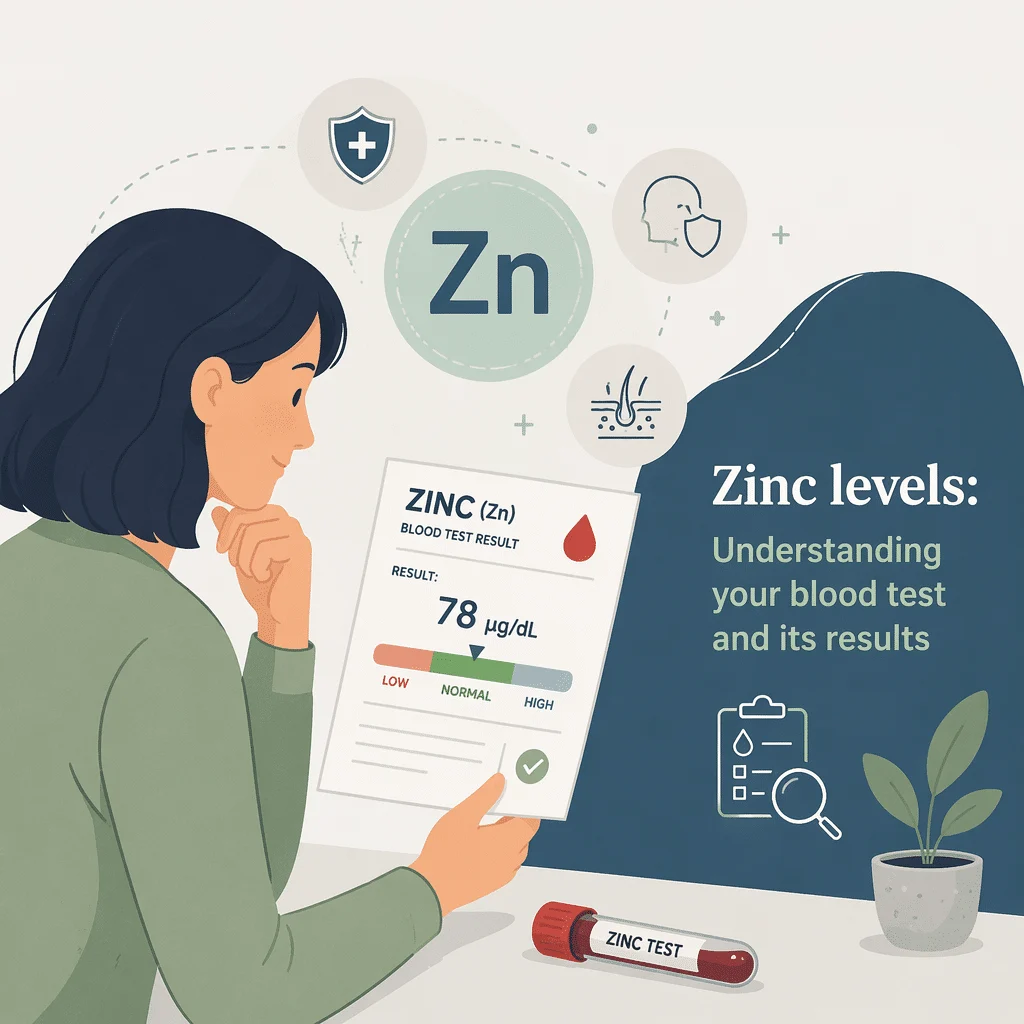
In healthy people, the NIH Office of Dietary Supplements gives serum or plasma zinc as roughly 80 to 120 micrograms per decilitre, about 12 to 18 micromoles per litre. It notes that serum zinc below 70 micrograms per decilitre in women and 74 in men indicates inadequate zinc status. Reference ranges differ between laboratories, so always compare your value against the range printed on your own report, and check the units.
A normal result is reassuring, but it does not guarantee that tissue zinc is fine, for all the reasons above. An abnormal result is a prompt to look at context, not a diagnosis. Your doctor puts the number, your symptoms, your medicines and supplements, and your other results together.
When to see a doctor
| Talk to a doctor promptly if you have taken zinc supplements at high doses for months or longer, particularly with numbness, pins and needles, unsteadiness or difficulty walking, or if a blood count has come back abnormal. These can reflect copper deficiency and are worth assessing early. |
| Arrange an appointment if you have persistent changes to taste or smell, wounds that will not heal, unexplained hair loss, ongoing diarrhoea, a stubborn skin rash, or repeated infections. |
| Mention it at your next visit if your zinc result is outside the range but you feel well, if you were unwell when the sample was taken, or if you have a condition affecting absorption, such as Crohn’s disease, coeliac disease or previous bariatric surgery. |
| Always tell your doctor about every supplement you take, including multivitamins, cold lozenges and denture creams. Zinc hides in products people do not think of as medicines. |
Do not start, stop or change a zinc supplement on the strength of a single blood result. That decision belongs with your doctor.
Latest scientific advances in zinc testing
Research since 2023 has focused less on finding a new zinc test and more on understanding why the existing one behaves as it does, and on documenting the harm caused by too much zinc.
An updated systematic review and meta-analysis of methods for assessing zinc status in humans, published in Nutrition Reviews, pooled the evidence on which markers actually respond when zinc intake changes. It confirmed that in healthy people, plasma or serum zinc and urinary zinc do shift with intake. It also identified around 40 further candidate markers proposed since 2007, but concluded that more study is needed to know whether they are sensitive or reliable. What this means for you: serum zinc is not useless, and it remains the standard because nothing better has yet proven itself, but it works better across groups of healthy people than as a precise readout for one person.
A 2025 systematic review in the same journal asked whether zinc-biofortified staple crops, bred to contain more zinc, improve zinc status. Across seven trials, plasma zinc was largely unaffected. The reviewers pointed to recurring methodological problems, and singled out the failure to adjust plasma zinc for inflammation. What this means for you: even in careful research, inflammation distorts the marker enough to hide real effects. It is a strong argument for reading your own zinc result in the light of whether you were well that day.
A 2026 analysis of a national micronutrient survey of school-age children in Malawi, published in International Health, examined how infection and inflammation relate to micronutrient markers. Children with raised inflammation markers had lower zinc, whilst ferritin moved the other way. What this means for you: this is the inflammation effect visible in a real population, and it explains why ferritin and zinc can appear to contradict each other on one report.
On the safety side, a 2025 case report in Cureus described a 68-year-old man whose zinc-induced copper deficiency mimicked myelodysplastic syndrome, a bone marrow disorder. His zinc came from supplements combined with zinc-containing denture adhesive. The authors called zinc-induced copper deficiency underdiagnosed, noting it can cause anaemia, low neutrophils, myelopathy, hair loss and skin depigmentation, and urged clinicians to consider it in unexplained low blood counts. A 2026 case in Practical Neurology similarly reported copper deficiency myelopathy caused by excessive zinc supplementation. What this means for you: this harm is real, documented and easy to miss, and everyday products can contribute.
A 2023 case report and literature review in Neurological Sciences followed patients with Wilson disease, a condition treated deliberately with zinc to lower copper. It gathered ten further published cases of neurological damage from copper deficiency during zinc therapy, mostly myelopathy and neuropathy. The authors observed that low blood counts often appeared early, before the nerve damage, and suggested that regular blood counts could catch copper deficiency in time to avoid irreversible harm. What this means for you: a routine blood count can act as an early warning, which is one reason doctors check it in people on long-term zinc.
Finally, the cold evidence remains contested rather than settled. A 2024 commentary in Frontiers in Medicine set out methodological criticisms of the 2024 Cochrane Review on zinc for the common cold, arguing that its analytical choices obscured genuine effects. What this means for you: experts still disagree about how much zinc lozenges help, which is a good reason to treat confident marketing claims with caution.
Glossary
| Term | Definition |
|---|---|
| Serum zinc | The zinc measured in the liquid part of your blood once the cells are removed. It is the standard test, and it reflects only a small, tightly controlled fraction of your body’s zinc. |
| Plasma zinc | Much the same measurement, taken from blood treated to stop it clotting. Serum and plasma zinc are used interchangeably in practice. |
| Trace element | A mineral the body needs in very small amounts, such as zinc, copper or selenium. |
| Negative acute-phase reactant | A substance in the blood that falls when the body is inflamed. Zinc behaves this way, which is why illness lowers the result. |
| Albumin | The main protein in blood. Much of your circulating zinc is carried on it, so low albumin drags the zinc number down with it. |
| Haemolysis | The rupture of red blood cells in a sample. Because those cells are rich in zinc, haemolysis falsely raises a zinc result. |
| Phytates | Compounds in legumes, grains and seeds that bind zinc in the gut and reduce how much of it you absorb. |
| Tolerable Upper Intake Level | The highest daily intake unlikely to cause harm. For zinc in adults the NIH Office of Dietary Supplements gives it as 40 mg per day, a figure set on the basis of zinc’s effect on copper. |
| Myeloneuropathy | Damage to the spinal cord and nerves together, causing unsteadiness, weakness and altered sensation. It is the serious consequence of copper deficiency. |
| Anosmia | Loss of the sense of smell, reported with zinc products used inside the nose. |
| Acrodermatitis enteropathica | A rare inherited disorder in which zinc absorption is impaired from infancy, causing rash, diarrhoea and poor growth. |
Frequently asked questions
What is the zinc blood test called?
On a laboratory request or report it usually appears as serum zinc, plasma zinc, or simply zinc, sometimes under a heading such as trace elements. The chemical symbol Zn is often used. You may also see it bundled into a trace-element panel alongside copper and selenium. If you cannot find it on your report, it is worth asking which test was actually run, because a zinc level is not part of a routine blood panel and has to be requested specifically.
Do zinc supplements help colds?
Modestly, inconsistently, and the evidence is weak. The NIH Office of Dietary Supplements reports that trials have produced mixed results, and that zinc lozenges or syrup started soon after symptoms begin appear to shorten a cold’s duration but not its severity. A 2024 Cochrane Review put the shortening at around two days, found little or no effect on preventing colds, and could not say whether severity changes. The authors rated the certainty of that evidence as low to very low, and other researchers dispute their methods. Zinc is not a cure, and the doses used in trials are often well above the daily upper level.
Can I take zinc long term?
That is a question for your doctor, not for a blood result alone. The concern with long-term zinc is copper. Zinc blocks copper absorption in the gut, and sustained high intakes can cause copper deficiency, which may lead to anaemia, low blood cell counts and nerve or spinal cord damage that does not always reverse. The NIH Office of Dietary Supplements sets the adult Tolerable Upper Intake Level at 40 mg a day, and notes that 50 mg or more over weeks can interfere with copper. A standard multivitamin sits well below that. Taking high-dose zinc for months without medical supervision is where the risk lies, so review it with your doctor.
Do I need to fast for a zinc blood test?
Often yes, and it is worth asking. Zinc falls after a meal and drifts across the day, so laboratories generally prefer a morning sample, frequently after fasting, to make results comparable over time. The sample also needs a special trace-element tube, because ordinary tubes and rubber stoppers can shed zinc into the blood and lift the reading. Follow whatever instructions your laboratory gives, and mention any supplements you take before the draw.
Is a red blood cell zinc test better than serum zinc?
Not clearly, which is why it is not standard. Red blood cell zinc has been proposed as a way to look past the day-to-day swings in serum, but it has not been shown to predict zinc status reliably. An updated systematic review of methods for assessing zinc status identified around 40 candidate markers beyond the usual ones and concluded that more research is needed to know whether any are sensitive and reliable. For now, serum or plasma zinc, interpreted alongside your symptoms, your risk factors and an inflammation marker, remains the practical option.
What does a low zinc blood test mean?
Most often it means something was affecting the measurement rather than your zinc stores. Inflammation from an infection, injury or surgery pushes zinc down, as can low albumin, a recent meal or an afternoon draw. Genuine deficiency usually comes with a reason, such as Crohn’s disease, coeliac disease, bariatric surgery, heavy alcohol use, pregnancy or a restrictive diet, and with signs such as taste or smell changes, slow wound healing, hair loss or a rash. Your doctor weighs the number against that whole picture before concluding anything.
Sources
- NIH Office of Dietary Supplements — Zinc: Fact Sheet for Health Professionals
- MedlinePlus (US National Library of Medicine) — Zinc in diet
- Rabinovich D, Smadi Y. Zinc. StatPearls, NCBI Bookshelf
- US Food and Drug Administration — Drug Products Labeled as Homeopathic: Guidance for FDA Staff and Industry (documents the reports of anosmia with intranasal zinc products)
- Ceballos-Rasgado M, Brazier AKM, Gupta S, Moran VH, Pierella E, Fekete K, Lowe NM. Methods of Assessment of Zinc Status in Humans: An Updated Review and Meta-analysis. Nutrition Reviews, 2025
- Mondal P, Kundu S, Phung HN, Rahman S, Mridha MK, Ahmed F. Efficacy or Effectiveness of Zinc-Biofortified Staples in Improving Biomarkers of Zinc Status: A Systematic Review. Nutrition Reviews, 2025
- Ntenda PAM, El-Meidany WMR, Mbewe RB, Tiruneh FN. Relationships between infection, inflammation and biomarkers of micronutrient among school-age children in Malawi. International Health, 2026
- Mims MH, Reid ES, Hash MG, Maddux A. A Hematologic Twist: Zinc-Induced Copper Deficiency Mimicking Myelodysplastic Syndrome. Cureus, 2025
- Silva MTT. Copper deficiency myelopathy induced by excessive zinc supplementation. Practical Neurology, 2026
- Tornabene D, Bini P, Gastaldi M, Vegezzi E, Asteggiano C, Marchioni E, Diamanti L. Neurological complications due to copper deficiency in the context of Wilson disease treatment. Neurological Sciences, 2023
- Hemila H, Chalker E. Shortcomings in the Cochrane review on zinc for the common cold (2024). Frontiers in Medicine, 2024
Further reading
- Copper levels blood test
- Selenium levels blood test
- Chromium levels
- High CRP levels: causes, symptoms and treatments
- Vitamin D 25-OH blood test analysis
Understand your lab results with AI DiagMe
A zinc result rarely makes sense on its own. It reads very differently next to copper, albumin and CRP, which reveal whether inflammation or a carrier protein moved the number. AI DiagMe turns those values into plain language so you can see how they fit together. It helps you understand your results and prepare better questions, it does not diagnose anything, and it does not replace your doctor.
Get your results interpreted in minutes