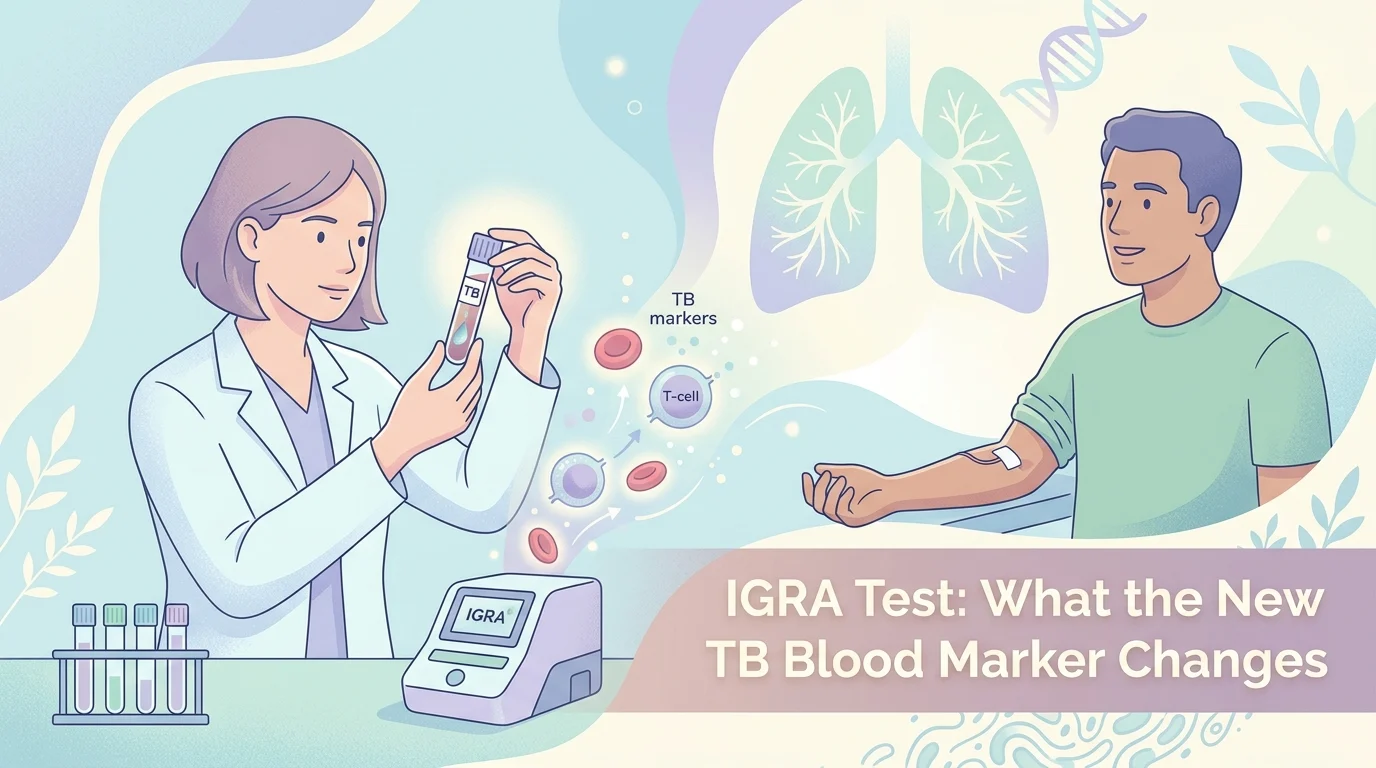
An IGRA test is a blood test that shows whether your immune system has already met the bacteria that cause tuberculosis (TB). In the United States it is the preferred TB test for many adults, especially people who received the BCG vaccine. Yet the result is often misread: a positive IGRA test does not mean you are sick or contagious, and a negative one is not a lifetime guarantee. In this article you’ll learn what the test measures, how to read each result, why a positive one leads to more tests rather than a diagnosis, and what a new TB blood marker presented at ADLM 2026 could add.
What an IGRA test measures
IGRA stands for interferon-gamma release assay. In the lab, a sample of your blood is mixed with small protein fragments that mimic Mycobacterium tuberculosis, the germ that causes TB. If your white blood cells have met this germ before, they recognize the fragments and release a chemical messenger called interferon-gamma. The test measures that response.
In other words, the IGRA blood test reads your immune memory, not the bacterium itself. It can show that an infection happened at some point in your life. It cannot show when, whether the bacteria are still alive, or whether they are causing disease today.
Two tests approved in the United States
According to the CDC, two FDA-approved IGRAs are available: QuantiFERON-TB Gold Plus, often shortened to QFT-Plus, and T-SPOT.TB. Both answer the same question with slightly different lab methods. QFT-Plus measures the amount of interferon-gamma released in whole blood, while T-SPOT.TB counts the individual immune cells that produce it. Your clinician or lab chooses the test, and you do not need to ask for a specific brand.
Why the BCG vaccine does not interfere
The CDC notes that TB blood tests are not affected by the BCG vaccine or by most other environmental mycobacteria, whereas the skin test can turn positive simply because you were vaccinated. That is why an IGRA test is preferred after BCG. It also needs only one visit, with no skin reaction to read days later. For a side-by-side view, you can compare the main types of tuberculosis tests.
Who is offered an IGRA blood test
TB testing is targeted, not routine. In May 2023, the US Preventive Services Task Force (USPSTF) recommended screening adults at increased risk of latent TB infection with either the skin test or an IGRA. The main groups are people born in, or who have lived in, countries where TB is common, and people who have lived in group settings such as homeless shelters or correctional facilities. People with weakened immunity and health care workers are also tested, often under separate clinical or workplace rules.
Close contacts of a person with active TB are tested too. For exposed health care personnel with a previous negative result, the CDC advises testing right away and again 8 to 10 weeks after the last exposure, leaving time for the immune response to develop. Screening is also common before some medicines that weaken immunity, such as certain biologic drugs for inflammatory diseases. If you live with such a condition, our overview describes rheumatoid arthritis and its treatments.
How the test is done
An IGRA test uses an ordinary blood draw from a vein in your arm. MedlinePlus notes that it usually takes less than five minutes and needs no special preparation, so there is no need to fast. If other tests are drawn at the same time, check the usual rules on fasting before a blood test. To know what to expect on the day, you can read the full blood test process.
The sample must reach the lab quickly: the CDC specifies processing within 16 hours for QFT-Plus and within 8 to 32 hours for T-SPOT.TB. IGRA test results can be available within 24 hours, although your report may take a few days. A separate guide lists typical timelines for blood test results.
How to read your IGRA test results
Your report shows one word, such as positive or negative, and often a number beside it. The table summarizes each result and the usual next step. Your clinician always reads it alongside your history, symptoms and risk factors.
| Result on the report | What it means | Usual next step |
|---|---|---|
| Positive | Your immune system has met TB bacteria at some point, without showing whether the infection is inactive (latent) or active. | Symptom review, chest X-ray and, if needed, sputum tests. |
| Negative | Inactive TB or active TB disease is unlikely. | Usually none, unless there was recent exposure, symptoms or weakened immunity. |
| Indeterminate (QFT-Plus only) | No useful answer, often because a control sample did not react as expected. | Repeat the blood test or do a skin test. |
| Borderline (T-SPOT.TB only) | The count fell in a gray zone close to the cutoff. | Repeat testing. |
| Invalid (T-SPOT.TB only) | The sample could not be read reliably. | Repeat the test. |
A positive result
According to the CDC, a positive TB blood test means you have TB germs in your body. It says nothing about when the infection happened or whether it is active. Most people with a positive IGRA test feel well and have latent TB infection; the next steps confirm that nothing more is going on.
A negative result
A negative result is reassuring, but no test is perfect. It can be falsely negative after a very recent exposure, with a weakened immune system, or occasionally even in active TB disease. With symptoms or a recent exposure, a negative result does not close the question on its own.
Indeterminate, borderline or invalid
Each IGRA includes control samples: one checks the background level of interferon-gamma, another checks that your immune cells can respond at all. When a control misbehaves, the lab cannot give a clear answer. This happens more often with a weakened immune system or a sample that was delayed or mishandled. The CDC suggests repeating the blood test or doing a skin test.
What about the number on the report?
Labs are asked to report both the qualitative result and the value behind it: an amount of interferon-gamma for QFT-Plus, or a count of spots for T-SPOT.TB. The CDC states that specific guidance is not available for interpreting these quantitative values. A very high value does not prove active TB, and results close to the cutoff are the ones most likely to change on a repeat test. When a result changes from one test to the next, you can explore the meaning of blood test trends over time.
Why a positive IGRA test does not mean active TB
Latent infection versus active disease
In latent TB infection, the bacteria are present but held in check by the immune system. The CDC estimates that up to 13 million people in the United States live with latent TB infection. They do not feel sick and cannot spread TB to others. Without treatment, however, about 5% to 10% of infected people will develop TB disease over their lifetime.
In active TB disease, the bacteria multiply and cause symptoms, most often in the lungs. This form can be contagious and needs full treatment. A positive IGRA test looks the same in both situations, so it is a starting point rather than a diagnosis.
What usually happens next
After a positive result, the CDC recommends a chest X-ray and, when needed, lab examination of sputum, the thick mucus coughed up from the lungs. If these show no sign of disease, the diagnosis is latent TB infection, and your clinician may offer preventive treatment. The CDC lists short courses such as three months of once-weekly isoniazid plus rifapentine, four months of daily rifampin, or three months of daily isoniazid plus rifampin.
Some of these medicines can affect the liver, so blood tests may be ordered during treatment. You can decode the results of liver function tests. Other routine tests are sometimes ordered alongside an IGRA, but none of them confirms TB on its own. One guide explains the complete blood count. Another interprets high CRP levels, and a third covers high lymphocyte counts.
When an IGRA result can be misleading
False positives in low-risk people
In people with no real risk of TB, a positive result is more likely to be a false alarm. In its 2019 recommendations for health care personnel, the CDC reported that when workers with a first positive result were retested with the same method, the second IGRA test was negative in 48% of cases. The CDC therefore advises a second test for workers with no symptoms and a low risk of infection. A single unexpected positive result deserves confirmation.
False negatives
A weakened immune system can blunt the response the test relies on, so people living with HIV, taking immunosuppressive drugs or living with a transplant may test negative despite infection. Very recent infection is another cause, hence the repeat test 8 to 10 weeks after exposure. For children younger than 5, the CDC still recommends the skin test, although some experts use blood tests.
Sample and lab problems
The CDC notes that errors in collecting or transporting blood samples can reduce accuracy. Delays beyond the processing window can also lead to an indeterminate result. A repeat draw usually settles the question.
The new TB blood marker presented at ADLM 2026
On July 28, 2026, at the annual meeting of the Association for Diagnostics & Laboratory Medicine (ADLM) in Anaheim, California, a team led by Dr. Sheng-Wei Pan of Taipei Veterans General Hospital in Taiwan presented a different approach. Instead of measuring the immune response like an IGRA test, it uses a highly sensitive biosensor to measure ESAT-6, a protein released by the TB bacterium itself, directly in the blood.
The study included 217 people: patients with active lung TB, and comparison groups with other mycobacterial lung disease, lung cancer, latent TB infection, exposure without infection, or no exposure at all. According to the ADLM announcement, the marker separated TB from non-TB cases well and outperformed two common immune-response markers. Blood levels rose step by step: lowest in exposed but uninfected people, higher in latent infection, highest in active TB.
These results are promising but early. The study was retrospective, meaning researchers already knew each diagnosis. The team is planning a prospective study, following patients in real clinical conditions, to see whether the test works in practice.
How it differs from an IGRA
| Tilgang | What it detects | What it can tell you | What it cannot tell you |
|---|---|---|---|
| IGRA blood test | Your immune memory of TB proteins | Whether you have been infected at some point | Whether the infection is latent, active or cured |
| Sputum smear, culture and molecular tests | The bacterium or its genetic material in sputum | Whether active lung TB is present; culture also shows which drugs will work | Latent infection, or anything when no sputum can be produced |
| ESAT-6 blood marker (research stage) | A protein released by the bacterium | In early studies, a signal that rises with bacterial activity | Drug resistance; it is not validated or available to patients |
What this changes for you today
For now, nothing changes in practice: the IGRA remains the standard TB blood test, and a positive result is still followed by an X-ray and, if needed, sputum tests. Later on, a marker of bacterial activity could help tell latent infection from active disease with a simple blood draw, which matters for people who cannot produce sputum. No date has been announced, and many promising markers never complete validation.
Latest scientific advances on IGRA testing
Studies published between 2023 and 2026 help clarify what an IGRA test result means for you. Here is what they found, in plain language.
How accurate is the test?
A large evidence review prepared for the USPSTF and published in JAMA in 2023 pooled 113 publications. Depending on the test version, IGRAs detected roughly 8 to 9 out of 10 people with TB infection, and TB tests rarely gave a false alarm in people without infection. What this means for you: the test is reliable but not perfect, so a negative result may be repeated when the risk is high.
Most people with a positive result never get sick
A 2025 meta-analysis, a study that combines the results of many others, gathered 44 studies and more than 25,000 people tested with both the IGRA and the skin test. Only about 2 or 3 in 100 people with a positive IGRA developed TB during follow-up, while more than 99 in 100 people with a negative result stayed free of TB. The IGRA flagged fewer people than the skin test yet caught about as many who later became ill. What this means for you: a positive result is a risk signal to discuss, not a verdict.
Why doctors offer treatment after a positive test
A 2024 analysis in The Lancet Respiratory Medicine pooled data from 32 studies of close contacts of people with TB, around 440,000 participants. Preventive treatment roughly halved the risk of TB overall, and lowered it by about four-fifths in adults with a positive IGRA or skin test. What this means for you: testing helps direct treatment to the people who benefit most.
Indeterminate results in people with weakened immunity
A 2023 meta-analysis of 28 studies in nearly 15,000 immunocompromised people found that an indeterminate result carried an intermediate risk: about half that of a positive result, but around three times that of a negative one. A 2025 European study found that QFT-Plus detected TB disease in about 7 in 10 people with weakened immunity, versus 8 in 10 in others; the highest short-term risk was in people with uncontrolled HIV. What this means for you: do not ignore an indeterminate result, and ask whether it will be repeated.
Toward blood tests that detect active TB
A 2024 review of 65 studies and 16,010 participants looked for blood proteins that could screen for active TB. C-reactive protein, a common inflammation marker, caught about 86% of TB cases but also flagged about a third of people without TB: useful for sorting patients, not for diagnosis. Biosensors described in 2025 and 2026 detected tiny amounts of ESAT-6 in serum, plasma or urine, but only in small groups or artificial samples.
Meanwhile, a 2026 study of more than 10,000 older adults in Japan found that IGRA values overlapped widely between latent infection and active TB. What this means for you: the IGRA number alone cannot tell the two apart, and new markers are still years from routine use.
When to see a doctor
Contact your health care provider promptly, whatever your last IGRA result, if you notice symptoms the CDC associates with TB disease:
- a bad cough that lasts 3 weeks or longer;
- chest pain, or coughing up blood or sputum;
- unexplained weight loss or loss of appetite;
- fever, chills or night sweats;
- unusual weakness or fatigue.
Also call your clinician if a positive result came without a follow-up plan, if an indeterminate or borderline result was never repeated, if you were recently close to someone with active TB, or before starting a treatment that weakens immunity.
Ordliste
| Term | Definition |
|---|---|
| IGRA | Interferon-gamma release assay. A blood test that measures the immune reaction to proteins from the TB bacterium. |
| Interferon-gamma | A chemical messenger released by immune cells when they recognize a germ they have met before. |
| QFT-Plus | QuantiFERON-TB Gold Plus, one of the two IGRA tests approved in the United States. It reports positive, negative or indeterminate. |
| T-SPOT.TB | The second approved IGRA. It counts immune cells and reports positive, borderline, negative or invalid. |
| Latent TB infection | TB bacteria are present but inactive. There are no symptoms and the person cannot spread TB. |
| Active TB disease | TB bacteria multiply and cause symptoms. This form can be contagious and needs treatment. |
| Indeterminate result | An IGRA result that gives no useful answer, often because a control sample did not react as expected. |
| ESAT-6 | A small protein released by the TB bacterium. It is used inside IGRA tests and is being studied as a direct blood marker. |
| BCG | Bacille Calmette-Guérin, a TB vaccine given in many countries. It can affect the skin test but not IGRA results. |
| Sputum | Thick mucus coughed up from deep in the lungs, examined in the lab to look for TB bacteria. |
Ofte stillede spørgsmål
Is an IGRA blood test the same as QuantiFERON?
QuantiFERON is one brand of IGRA. Its current version, QuantiFERON-TB Gold Plus, is one of the two IGRAs approved in the United States; the other is T-SPOT.TB. Both belong to the same family of TB blood tests and are interpreted in a similar way, although their reports use slightly different wording. If your paperwork asks for an IGRA, either test usually qualifies, but check with the organization that requested it.
How long does an IGRA test take?
The blood draw itself usually takes less than five minutes. The lab then incubates your sample with TB proteins before measuring the response. According to the CDC, results can be available within 24 hours, although the time before you receive your report depends on the lab and on shipping. There is no return visit, unlike the skin test, which must be read two to three days after it is placed.
How long is an IGRA test good for?
An IGRA result reflects your status on the day of the blood draw. There is no universal expiry date: employers, schools, health programs and immigration services each set their own rules on how recent a result must be. If you have had a possible exposure since your last negative test, a new test may be needed regardless of the date. Check the requirement with the organization asking for the result.
Does a positive IGRA test mean I am contagious?
No, not by itself. Most people with a positive IGRA test have latent TB infection, and the CDC states that people with latent infection cannot spread TB to others. Only active TB disease in the lungs or throat can be contagious. The X-ray and any sputum tests that follow a positive result are there to rule this out.
Can an IGRA test turn negative after TB treatment?
Not reliably. The test reflects immune memory, and results often stay positive after successful treatment, although some become negative over time. For this reason, an IGRA is not used to check whether treatment worked. Your care team relies on symptoms, imaging and, for active TB, sputum tests instead.
Should I get an IGRA test if I had the BCG vaccine?
Yes, this is one of the situations where the blood test is preferred. The CDC notes that the BCG vaccine can cause a false-positive skin test, while TB blood tests are not affected by it. A positive IGRA in a vaccinated person therefore points to real contact with TB bacteria and deserves the same follow-up as in anyone else.
Kilder
- Centers for Disease Control and Prevention. Clinical Testing Guidance for Tuberculosis: Interferon Gamma Release Assay, 2024. cdc.gov
- Centers for Disease Control and Prevention. Clinical and Laboratory Diagnosis for Tuberculosis, 2025. cdc.gov
- Centers for Disease Control and Prevention. Clinical Overview of Latent Tuberculosis Infection, 2025. cdc.gov
- Centers for Disease Control and Prevention. Testing for Tuberculosis: Blood Test, 2025. cdc.gov
- Centers for Disease Control and Prevention. Signs and Symptoms of Tuberculosis, 2025. cdc.gov
- Centers for Disease Control and Prevention. Frequency of Tuberculosis Screening and Testing for Health Care Personnel. cdc.gov
- National Tuberculosis Controllers Association and CDC. Tuberculosis Screening, Testing, and Treatment of U.S. Health Care Personnel: Recommendations from the National Tuberculosis Controllers Association and CDC. MMWR, 2019. cdc.gov/mmwr
- MedlinePlus, National Library of Medicine. Tuberculosis Screening. medlineplus.gov
- US Preventive Services Task Force. Latent Tuberculosis Infection in Adults: Screening, 2023. uspreventiveservicestaskforce.org
- Association for Diagnostics & Laboratory Medicine. New blood test for tuberculosis could reduce the spread of this top global infectious-disease killer. ADLM 2026 press release, July 28, 2026. newswise.com
- Jonas DE, Riley SR, Lee LC, et al. Screening for Latent Tuberculosis Infection in Adults: Updated Evidence Report and Systematic Review for the US Preventive Services Task Force. JAMA, 2023. doi.org/10.1001/jama.2023.3954
- Gao QH, Chen HB, Huang Y, et al. Predictive value of interferon-gamma release assays and tuberculin skin test for latent tuberculosis infection: a systematic review and meta-analysis of head-to-head comparative tests. Journal of Microbiology, Immunology and Infection, 2025. doi.org/10.1016/j.jmii.2025.11.003
- Martinez L, Seddon JA, Horsburgh CR, et al. Effectiveness of preventive treatment among different age groups and Mycobacterium tuberculosis infection status: a systematic review and individual-participant data meta-analysis of contact tracing studies. The Lancet Respiratory Medicine, 2024. doi.org/10.1016/S2213-2600(24)00083-3
- Zhou G, Luo S, He J, et al. Risk of progression to active tuberculosis for indeterminate interferon-gamma release assay in immunocompromised individuals: a systematic review and meta-analysis. Clinical Microbiology and Infection, 2023. doi.org/10.1016/j.cmi.2023.07.003
- Sester M, Altet-Gomez N, Andersen AB, et al. Diagnostic accuracy and predictive value of the QuantiFERON-TB Gold Plus assay for tuberculosis in immunocompromised individuals: a prospective TBnet study. The Lancet Regional Health – Europe, 2025. doi.org/10.1016/j.lanepe.2025.101416
- Gaeddert M, Glaser K, Chendi BH, et al. Host blood protein biomarkers to screen for tuberculosis disease: a systematic review and meta-analysis. Journal of Clinical Microbiology, 2024. doi.org/10.1128/jcm.00786-24
- Zhang Q, Zhou J, Chen Y, et al. Self-reduced Pd nanoparticles on NiMn-LDHs with superior catalytic activity for signal amplification in electrochemical aptasensing of Mycobacterium tuberculosis ESAT-6 antigen. Mikrochimica Acta, 2025. doi.org/10.1007/s00604-025-07630-y
- Chiang PH, Liang ZR, Lu YH, et al. (Cu-S)MOF-polyaniline based dual-platform biosensing for blood plasma and urine detection of ESAT-6 toward early tuberculosis diagnosis. Mikrochimica Acta, 2026. doi.org/10.1007/s00604-026-08007-5
- Mutoh Y, Minato Y, Kawamoto Y, et al. Diagnostic utility of quantitative interferon-gamma release assays in elderly patients with tuberculosis. Microbiology Spectrum, 2026. doi.org/10.1128/spectrum.02763-25
Further reading
- Sådan læser du dine blodprøveresultater: En komplet guide
- Unormale blodprøveresultater: Hvad de betyder, og hvad du skal gøre
- Antal hvide blodlegemer: Hvad høje og lave resultater betyder
- Normalværdier for blodprøver: en forklaret referenceoversigt
- Forkortelser på laboratorieprøver: Hvad koderne på din rapport betyder
Forstå dine laboratoriesvar med AI DiagMe
An IGRA result rarely arrives alone: it often comes with a complete blood count, a CRP value or a liver panel, and the report can be hard to read. AI DiagMe helps you understand each line of your blood, urine or stool results in clear language, so you can prepare better questions for your next appointment. It does not diagnose TB or replace your doctor, who remains the right person to decide on follow-up tests and treatment.
Get your results interpreted in minutes