































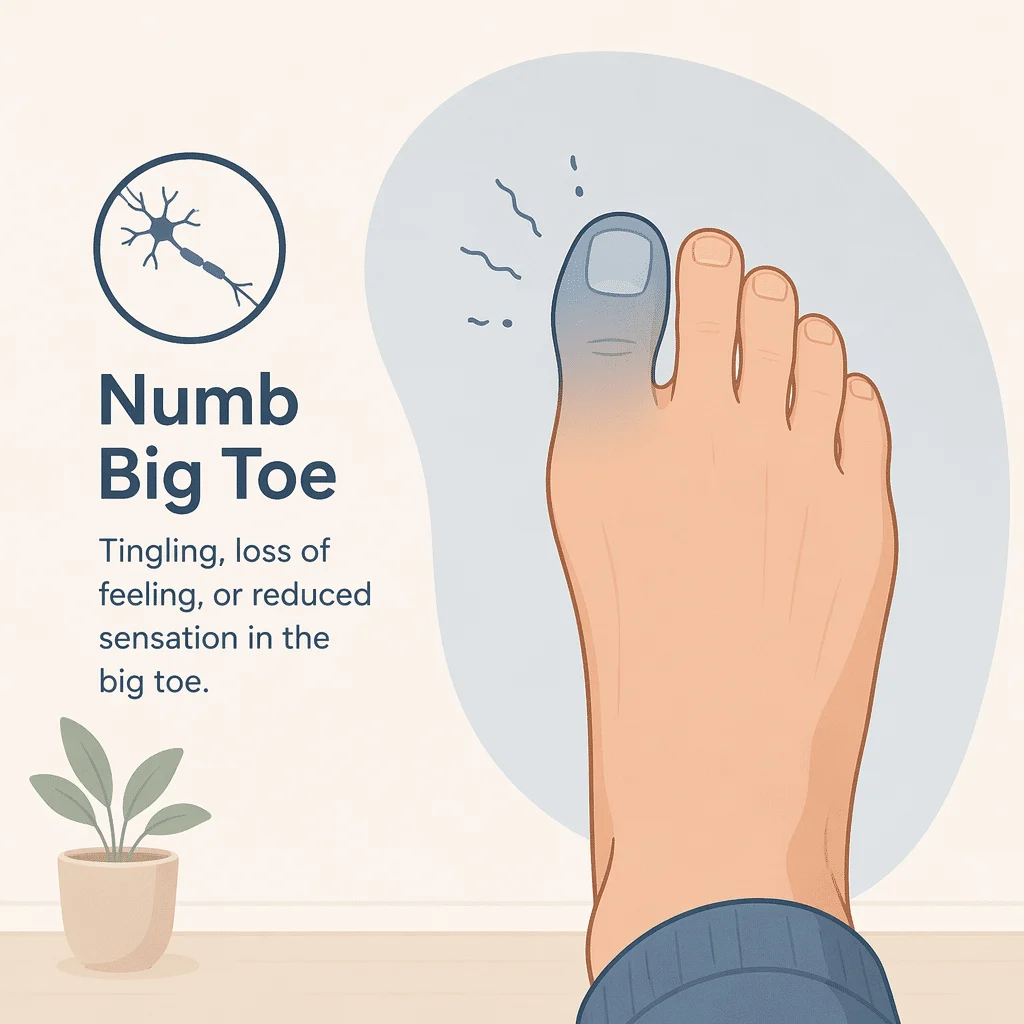
En følelsesløs storetå er let at ignorere og lejlighedsvis meget vigtig. De fleste gange skyldes det tryk på en nerve og forsvinder, når trykket fjernes. Nogle gange er det det første synlige tegn på, at nerverne i dine fødder er ved at blive beskadiget, og det ændrer, hvad du bør gøre som det næste.
I denne artikel lærer du, hvilke nerver der forsyner storetåen, hvordan du skelner en klemt nerve i ryggen fra en nerve, der er klemt af dine snørebånd, hvorfor følelsesløshed i begge storetæer bør give anledning til en diabetestjek, hvordan kredsløbsproblemer ser ud i en fod, og hvad en læge vil undersøge.
Inden du læser videre, bør du se på boksen med advarselstegn længere nede: visse kombinationer af symptomer kræver samme dag eller akut behandling.
Hvad en følelsesløs storetå egentlig betyder
Følelsesløshed betyder, at en nerve ikke sender sanseindtryk korrekt: nedsat følelse, et dødt område, en prikkende fornemmelse eller hud, der føles som om den er pakket ind i husholdningsfilm. Alt dette tæller med.
Tre nerveområder mødes omkring storetåen. Huden på oversiden af tåen og oversiden af foden forsynes primært af peronæusnerven, også kaldet fibularnerven. Det smalle mellemrum mellem første og anden tå forsynes specifikt af den dybe peronæusnerv. Undersiden og puden af tåen forsynes af grene fra tibialnerven. Højere oppe passerer al denne trafik gennem den femte lændenerverod, kendt som L5, når den forlader den nedre del af rygsøjlen.
Mønsteret for din følelsesløshed er derfor vigtigere end dens intensitet. Tabellen nedenfor matcher de fem mest almindelige mønstre med deres sandsynlige årsag. Det er et udgangspunkt for samtalen med din læge – ikke en diagnose.
| Mønster du bemærker | Sandsynlig årsag | Hvad du bør gøre |
|---|---|---|
| Følelsesløshed på oversiden af storetåen med rygsmerter, der stråler ned i ét ben, nogle gange med svaghed ved løft af storetåen | L5-nerveroden irriteret af en lændediskus | Gå til lægen inden for få dage. Forsøg ikke at strække eller manipulere det selv |
| Følelsesløshed i mellemrummet mellem første og anden tå efter stramme støvler, snørebånd eller skibindinger | Den dybe peronæusnerv komprimeret foran på anklen | Løsn eller skift fodtøj. Gå til lægen, hvis det ikke bedres inden for et par uger |
| Gradvis følelsesløshed i begge fødder, der starter ved tæerne og langsomt bevæger sig opad, ofte værre om natten | Perifer neuropati, oftest relateret til diabetes | Book en lægetid og bed om en fodundersøgelse og blodsukkermåling |
| Pludselig følelsesløshed med en kold, bleg eller blålig, smertefuld fod | Akut iskæmi i lemmet – en blokeret arterie | Nødsituation. Ring til alarmtjenesten eller tag på skadestuen nu |
| Følelsesløshed ved siden af en hallux valgus, i smalle eller stive sko, som aftager, når du går barfodet | Lokalt tryk på en lille hudnerve i tåen | Skift til bredere, blødere sko. Kontakt en fodterapeut, hvis ledets form er ved at ændre sig |
Årsager til nerveindklemning, og hvordan du skelner imellem dem
Nerver kan blive klemt overalt fra rygsøjlen til skoen, og niveauet for indklemningen giver et genkendelig mønster. Vores oversigt over nerveindklemningssyndromer gennemgår principperne; nedenfor er de tre, der er vigtigst for storetåen.
L5-radikulopati fra en lændediskus
Når en diskus i lænderyggen buler ind mod L5-nerveroden, opstår følelsesløsheden på toppen af foden og storetåen, som regel kun på den ene side.
To ekstra tegn gør dette karakteristisk. Det første er ryg- eller ballesmerter, der stråler ned langs bagsiden eller siden af benet, og som ofte forværres ved hoste, nys eller siddestilling. Det andet er særligt sigende, og du kan selv tjekke det: svaghed ved strækning af storetåen. Sæt dig ned, læg hånden oven på storetåen, og forsøg at løfte den mod dette modtryk. Hvis den berørte side giver efter meget lettere, er det et motorisk tegn snarere end et rent sensorisk, og det bør undersøges hurtigt.
Undlad at strække, dreje eller manipulere et mistænkt diskusproblem selv, særligt hvis der er opstået ny svaghed i benet. Få det undersøgt, ligesom du ville gøre ved nerveirritation længere nede på lemmet, f.eks. en indklemt nerve ved knæet.
Kompression af den dybe peronæusnerve og anteriort tarsaltunnelsyndrom
Den dybe peronæusnerve løber ned langs forsiden af skinnebenet, krydser anklen under et stramt bånd af væv og ender med at forsyne den lille hudtrekant i mellemrummet mellem første og anden tå. Alt, der presser mod forsiden af anklen, kan klemme den: skistøvler, stive vandrestøvler, løbesko snøret stramt hen over vristen, knogleudvækster på toppen af foden. Når nerven klemes på dette sted, kaldes tilstanden anteriort tarsaltunnelsyndrom.
Det afgørende er placeringen. Følelsesløshed begrænset til dette mellemrum, som opstår efter en lang vandretur eller en dag på pisterne og aftager, når støvlen tages af, er mekanisk snarere end systemisk. At løsne snørebåndene, springe et hul over det ømme sted eller skifte til en blødere sko løser det ofte. Hvis det varer ved i uger efter, at trykket er fjernet, bør det undersøges.
Hvorfor Mortons neurom som regel rammer en anden tå
Mortons neurom er en fortykkelse af en nerve mellem mellemfodens lange knogler. Det er en almindelig årsag til følelsesløshed i forfoden, og derfor støder folk på det i søgninger – men det sidder det forkerte sted i forhold til storetåen. Det rammer typisk mellemrummet mellem tredje og fjerde tå og giver brændende smerter i fodballen, følelsesløshed i de tilstødende tæer og en fornemmelse af at stå på en sten. Hvis din følelsesløshed er præcis i storetåen, er Mortons neurom sandsynligvis ikke forklaringen.
Diabetes og foden i risikozone: den vigtigste årsag
Dette er det afsnit, du bør læse grundigt, for det er det, der har størst betydning for forløbet.
Diabetisk perifer neuropati er nerveskade forårsaget af langvarigt forhøjet blodsukker, og National Institute of Diabetes and Digestive and Kidney Diseases bemærker, at op til halvdelen af alle med diabetes har det. Det er længdeafhængigt: det starter i nerveenderne længst fra rygsøjlen, som sidder i tæerne. Følelsesløshed, der begynder i tæerne, er derfor ofte det allerførste tegn.
Mønsteret er karakteristisk: som regel symmetrisk, med begge fødder ramt, og langsomt fremadskridende – det kryber fra tæerne mod anklerne over måneder og år. Symptomerne er ofte værst om natten. Nogle mærker en brændende eller prikkende fornemmelse; andre opdager blot, at følelsen er væk.
Her er det afgørende punkt. En følelsesløs fod er en fod i risikozone, fordi fornemmelsen er dit alarmsystem. Når den beskyttende følsomhed er væk, lægger man ikke mærke til en vabel fra en ny sko, en sten i sålen eller et snitsår fra negleklipning. Skaden hviler ikke ud – man går videre på den, og den udvikler sig til et sår. Fordi diabetes også svækker blodgennemstrømningen og heling, kan det sår blive inficeret og i de værste tilfælde føre til amputation. Centers for Disease Control and Prevention siger det klart: nerveskade fra diabetes øger risikoen for fodsår, og tidlig behandling nedsætter risikoen for amputation betydeligt.
Den opmuntrende del er, at det meste af dette kan forebygges. Hvis du har diabetes og opdager ny følelsesløshed, så bestil en fodkontrol frem for at vente til dit næste rutinetjek, bed om at blive vist, hvordan du dagligt undersøger dine fødder med et spejl eller med hjælp fra et familiemedlem, og sørg for at møde op til de årlige fodundersøgelser. Negleforandringer har også betydning, som vores guide til diabetiske tånegle explains.
What never to do to a numb diabetic foot
These prohibitions are not fussiness. Each causes documented, avoidable harm in people who cannot feel their feet.
Do not soak your feet. Soaking macerates the skin and gives bacteria an easy route in. Wash with warm water, never hot, and dry thoroughly between the toes.
Do not use heat pads, hot water bottles, electric blankets or radiators to warm a numb foot. If you cannot feel temperature, you cannot feel a burn happening. Serious burns this way are common and entirely preventable.
Do not cut, shave or pare corns and calluses yourself, and do not use over-the-counter corn removers, medicated pads or acid plasters. Those products destroy tissue and cannot distinguish a callus from healthy skin. On an insensate foot they can burn a hole that becomes an ulcer. Leave corns and calluses to a podiatrist.
Do not walk barefoot, even indoors, and check inside your shoes by hand before putting them on. Do not ignore a blister, crack, color change or wound because it does not hurt. On a numb foot, the absence of pain tells you nothing about how serious something is.
Footwear, bunions and mechanical causes
Plenty of numb big toes have a purely mechanical explanation, and these are the most satisfying to fix. A bunion, medically called hallux valgus, is a deviation of the big toe joint that pushes a bony prominence outward. That prominence rubs the inside of the shoe and compresses the small skin nerves running over the toe, producing numbness along its inner border. Narrow toe boxes, pointed shoes and high heels make it worse. Hallux rigidus, a stiff arthritic big toe joint, does something similar: bony spurs form on the upper surface and press against both shoe and nerve.
Prolonged kneeling or squatting compresses nerves below the knee and can leave a toe numb for minutes to hours. Running is a frequent trigger: laces tied tightly over the instep, feet that swell during a long run, and shoes half a size too small combine to squash the deep peroneal nerve where it is most vulnerable.
The practical test is simple. Mechanical numbness tracks a shoe or a position: it arrives during the activity and fades afterward. If yours does not follow that rhythm, look elsewhere, as with other persistent foot symptoms such as itchy feet at night.
Circulation problems and the numb toe
Nerves need a blood supply. When the arteries feeding the leg narrow, nerve tissue is starved of oxygen and sensation fades. Peripheral artery disease is the slow version, and according to the National Heart, Lung, and Blood Institute more than 8 million people in the United States aged 40 and over have it.
The signature symptom is claudication: cramping pain in the calf, thigh or buttock that begins reliably after a certain walking distance and stops within minutes of resting. Other signs are a foot that feels cold or looks pale, hair loss on the toes and lower legs, shiny thin skin, thickened toenails, and cuts that heal slowly. Color changes can point either way, which is why we cover red feet separately.
Then there is the fast version, and it is an emergency. Acute limb ischemia happens when an artery blocks suddenly, usually by a clot. The foot becomes cold, pale or mottled blue, severely painful and numb within hours, and tissue starts to die. This needs an emergency department immediately.
Nutritional, metabolic and other whole-body causes
Several conditions damage peripheral nerves in the same length-dependent way as diabetes, producing the same symmetrical, toes-first numbness.
Vitamin B12 deficiency is the best known. B12 maintains the insulating sheath around nerves, and a shortage produces numbness, tingling and unsteadiness, sometimes before any anemia appears. It is treatable, but long-standing deficiency can leave permanent damage; our guide to low vitamin B12 covers the causes. Do not start supplements before the level is measured, because that masks the picture. Dosing is a decision for your doctor.
Regular heavy alcohol use damages peripheral nerves directly and through poor nutrition, producing a burning, numb pattern in both feet. Several chemotherapy drugs, particularly platinum agents and taxanes, cause chemotherapy-induced peripheral neuropathy, which begins in the fingertips and toes and can persist after treatment. Tell your oncology team about new numbness rather than waiting.
An underactive thyroid causes nerve symptoms and swelling that compresses nerves at tight points; TSH testing is the usual first step. Advanced kidney disease allows nerve-damaging toxins to accumulate, which is why high BUN and creatinine matter here. Low magnesium contributes to nerve excitability, covered in our article on magnesium deficiency.
Finally, in older adults, lumbar spinal stenosis squeezes several nerve roots at once, producing numbness and heaviness in the legs on walking that eases on sitting or leaning forward. That relief-on-bending pattern separates it from artery disease.
What a doctor will check
Assessment is usually straightforward and mostly done in the consulting room. The foot examination comes first: your doctor will map where sensation is reduced, which narrows the nerve territory. Monofilament testing is the standard screen for protective sensation, using a calibrated nylon filament pressed against points on the sole until it just bends. A tuning fork tests vibration sense, often the earliest thing to go. They will also test big-toe extension strength, check reflexes, feel the pulses in your foot and ankle, look at skin color and temperature, and inspect between the toes for wounds you may not have felt.
Blood tests look for treatable systemic causes. The usual panel includes fasting glucose and HbA1c, as covered in our guide to the diabetes blood test, plus vitamin B12, thyroid function and kidney function.
Further testing is selective. An ankle-brachial index compares blood pressure at the ankle with the arm and is the first test when peripheral artery disease is suspected. An MRI of the lumbar spine is ordered when the pattern and weakness suggest a nerve root problem. Nerve conduction studies and electromyography are used when the diagnosis is unclear or a trapped nerve needs locating precisely.
Red flags: when a numb big toe needs urgent care
Most numb toes are not emergencies. These are.
Seek emergency care immediately if you have:
- Sudden numbness with a cold, pale or blue, painful foot. This may be acute limb ischemia, a blocked artery, and the limb is at risk within hours.
- Numbness together with loss of bladder or bowel control, numbness in the saddle area between the legs, or severe or worsening weakness in one or both legs. This may be cauda equina syndrome, a compression of the nerves at the base of the spine that causes permanent damage if not decompressed urgently.
- Numbness or weakness that is spreading rapidly over hours to a day.
Seek same-day medical care if you have:
- Diabetes and any wound, blister, ulcer, crack or color change on a numb foot. This needs urgent foot care, not a wait-and-see approach, however small it looks and however little it hurts.
- Numbness with fever, spreading redness, swelling or warmth, which suggests infection.
Book a routine appointment for numbness that is gradual, painless and present in both feet, or numbness that persists for more than two or three weeks after you have changed your footwear.
Latest scientific advances in diagnosing toe numbness
Research since 2023 has sharpened how clinicians detect a foot that has lost protective sensation, and how early they act.
A German study by Trocha and colleagues in Diabetic Medicine in 2023 followed people with diabetes who had lost protective sensation but never had a foot ulcer. Over about four years, those who had also lost the ability to feel a pinprick developed a first ulcer more often, and sooner. What this means for you: the degree of sensory loss matters, so ask your clinician to test pain sensation as well as touch.
The tools themselves are being tested. Chatzistergos and colleagues, in Diabetes Research and Clinical Practice in 2023, compared two bedside screens in an outpatient diabetes clinic in India. The Ipswich touch test, in which an examiner lightly touches the tips of specific toes with a fingertip, performed well enough to serve as a screening tool, while a handheld vibration device did not. What this means for you: a reliable check needs no expensive equipment, so the examination should never be skipped.
How often it happens is the weak link. A Polish screening study by Cwajda-Białasik and colleagues in Medical Science Monitor in 2024 examined the feet of adults with diabetes or prediabetes using pulse checks, ankle-brachial index and sensation testing. Foot problems were common, and many turned up in people who did not know they had any. What this means for you: do not assume your feet have been checked because you attend appointments. Take your shoes and socks off and ask.
On the nutritional side, a review by Atkinson, Gharti and Min in touchREVIEWS in Endocrinology in 2024 pooled studies on metformin and vitamin B12. Most found metformin use associated with lower B12 levels, with higher doses and longer treatment carrying more risk, and the authors recommend routine B12 screening. What this means for you: if you take metformin and develop numb toes, ask for a B12 level. Metformin is not usually stopped for this reason.
For circulation, the 2024 multi-society guideline on lower extremity peripheral artery disease led by Gornik and colleagues in Circulation covers the whole spectrum, from no symptoms through to acute limb ischemia, with the ankle-brachial index as the cornerstone test. What this means for you: with numbness plus cold feet, leg cramping on walking or a wound that will not heal, that test is inexpensive, non-invasive and reasonable to ask about.
Ofte stillede spørgsmål
Why is my big toe numb after running?
Usually pressure, not damage. Feet swell during a run, and laces tied firmly across the instep then compress the deep peroneal nerve where it crosses the front of the ankle. That nerve supplies the web space between the first and second toes and contributes to sensation on the top of the big toe, so numbness there is the classic result. Try loosening the laces, skipping the eyelet over the sore spot, and checking that your running shoes are half a size larger than your street shoes. If the numbness lingers for weeks after you stop running, or you notice weakness lifting the toe, get it examined.
Should I worry about a numb toe?
Honest answer: usually no, sometimes yes. Numbness that clearly follows a shoe, a boot or a long period of kneeling and settles within hours is rarely serious. Numbness that is gradual, painless and present in both feet is worth a medical appointment, because that is the pattern of peripheral neuropathy. Numbness with back pain going down the leg needs assessment within days. And numbness with a cold, pale or painful foot, or with any bladder or bowel change, is an emergency. Duration matters too: anything lasting more than two or three weeks deserves a look.
Can a numb toe be diabetes?
Yes, and it is one of the more important possibilities. Numbness beginning in the toes is frequently the first sign of diabetic peripheral neuropathy, and it can appear before someone knows they have diabetes at all. The suggestive pattern is numbness in both feet that starts at the toes and slowly moves upward. If you have diabetes or risk factors for it and your toes have gone numb, book a foot check and ask for blood glucose testing. Then start inspecting your feet daily, because reduced sensation is what turns a small injury into an ulcer.
Can a bunion make my big toe numb?
It can. The bony prominence of a bunion rubs against the shoe and compresses the small sensory nerves running over the joint, producing numbness or a tingling patch along the inner border of the toe. The clue is that symptoms are worse in narrow, pointed or high-heeled shoes and better barefoot or in wide, soft footwear. Changing shoe shape is the first step. If the joint is deforming, becoming painful or stiffening, see a podiatrist or foot surgeon, because the underlying alignment problem may need addressing rather than just the pressure.
Why is only my left or right big toe numb?
One-sided numbness points toward a local or single-nerve cause rather than a whole-body one. The usual candidates are an L5 nerve root irritated by a disc on that side, a nerve compressed by footwear on that foot, a bunion, or an old injury. Systemic causes such as diabetes, vitamin B12 deficiency and alcohol-related nerve damage almost always affect both feet, though one side can be noticeably worse. Circulation problems can also be one-sided. If a single numb toe comes with a cold or discolored foot, treat that as urgent.
Will the feeling in my numb toe come back?
It depends entirely on the cause and how long it has been going on. Numbness from footwear or a temporary posture usually recovers fully once the pressure is removed. Numbness from a compressed nerve often improves when the compression is treated, though recovery can take weeks or months because nerves regrow slowly. Numbness from long-standing neuropathy may not fully reverse, which is why early identification matters: treating the underlying cause, such as blood glucose control or a vitamin B12 deficiency, is aimed at stopping further damage even when it cannot undo what has happened.
Ordliste
| Term | Definition |
|---|---|
| Peripheral neuropathy | Damage to the nerves outside the brain and spinal cord, usually affecting the feet first and causing numbness, tingling, burning or weakness |
| Loss of protective sensation | Reduced feeling in the foot to the point where an injury would not be noticed, which is the main risk factor for foot ulcers |
| L5 radiculopathy | Irritation or compression of the fifth lumbar nerve root in the lower back, causing numbness over the top of the foot and big toe and sometimes weak big-toe lifting |
| Deep peroneal nerve | A nerve running down the front of the leg that supplies the web space between the first and second toes and can be pinched by tight footwear |
| Anterior tarsal tunnel syndrome | Compression of the deep peroneal nerve where it crosses the front of the ankle, often caused by boots, laces or bone spurs |
| Morton’s neuroma | A thickened nerve in the forefoot, usually between the third and fourth toes, causing burning pain and numbness in those toes rather than the big toe |
| Hallux valgus | The medical name for a bunion, a deviation of the big toe joint that creates a bony prominence on the inner edge of the foot |
| Monofilament test | A screening check in which a calibrated nylon filament is pressed against the sole until it bends, to see whether protective sensation is intact |
| Ankle-brachial index | A simple test comparing blood pressure at the ankle with blood pressure in the arm, used to detect narrowed leg arteries |
| Acute limb ischemia | Sudden loss of blood supply to a limb, causing a cold, pale, painful and numb foot, and requiring emergency treatment |
Forstå dine laboratoriesvar med AI DiagMe
Working out why a toe has gone numb often involves a handful of blood tests: glucose and HbA1c for diabetes, vitamin B12, thyroid function and kidney function. Those results arrive as numbers on a page without much explanation. AI DiagMe translates them into plain language and highlights what is worth raising with your doctor. It helps you understand your results; it does not diagnose neuropathy or any other condition, and it does not replace your doctor.
Get your results interpreted in minutes
Further reading
- Red feet: causes, symptoms and treatments
- Low vitamin B12: symptoms, causes and treatments
- Diabetic toenails: symptoms, causes and treatments
- Nerve compression syndrome: symptoms and treatments
- Magnesium deficiency: symptoms, causes and treatments
Kilder
- National Institute of Diabetes and Digestive and Kidney Diseases. Peripheral Neuropathy
- Centers for Disease Control and Prevention. Your Feet and Diabetes
- National Institute of Neurological Disorders and Stroke. Peripheral Neuropathy
- National Heart, Lung, and Blood Institute. What Is Peripheral Artery Disease?
- Trocha A, Gontscharuk V, Icks A, Jeffcoate W. The value of loss of protective pain sensation in predicting a first ulceration of the foot in people with diabetes. Diabetic Medicine. 2023. https://doi.org/10.1111/dme.15241
- Chatzistergos PE, Kumar S, Sumathi CS, Mahadevan S, Vas P, Chockalingam N. Screening for the loss of protective sensation in people without a history of diabetic foot ulceration: validation of two simple tests in India. Diabetes Research and Clinical Practice. 2023. https://doi.org/10.1016/j.diabres.2023.110810
- Cwajda-Białasik J, Mościcka P, Szewczyk MT. Undiagnosed and untreated peripheral complications of diabetes: findings from a pilot study on diabetes-related foot diseases in patients with glycemic disorders. Medical Science Monitor. 2024. https://doi.org/10.12659/MSM.944239
- Atkinson M, Gharti P, Min T. Metformin use and vitamin B12 deficiency in people with type 2 diabetes: what are the risk factors? A mini-systematic review. touchREVIEWS in Endocrinology. 2024. https://doi.org/10.17925/EE.2024.20.2.7
- Gornik HL, Aronow HD, Goodney PP, et al. 2024 ACC/AHA/AACVPR/APMA/ABC/SCAI/SVM/SVN/SVS/SIR/VESS Guideline for the Management of Lower Extremity Peripheral Artery Disease. Circulation. 2024. https://doi.org/10.1161/CIR.0000000000001251