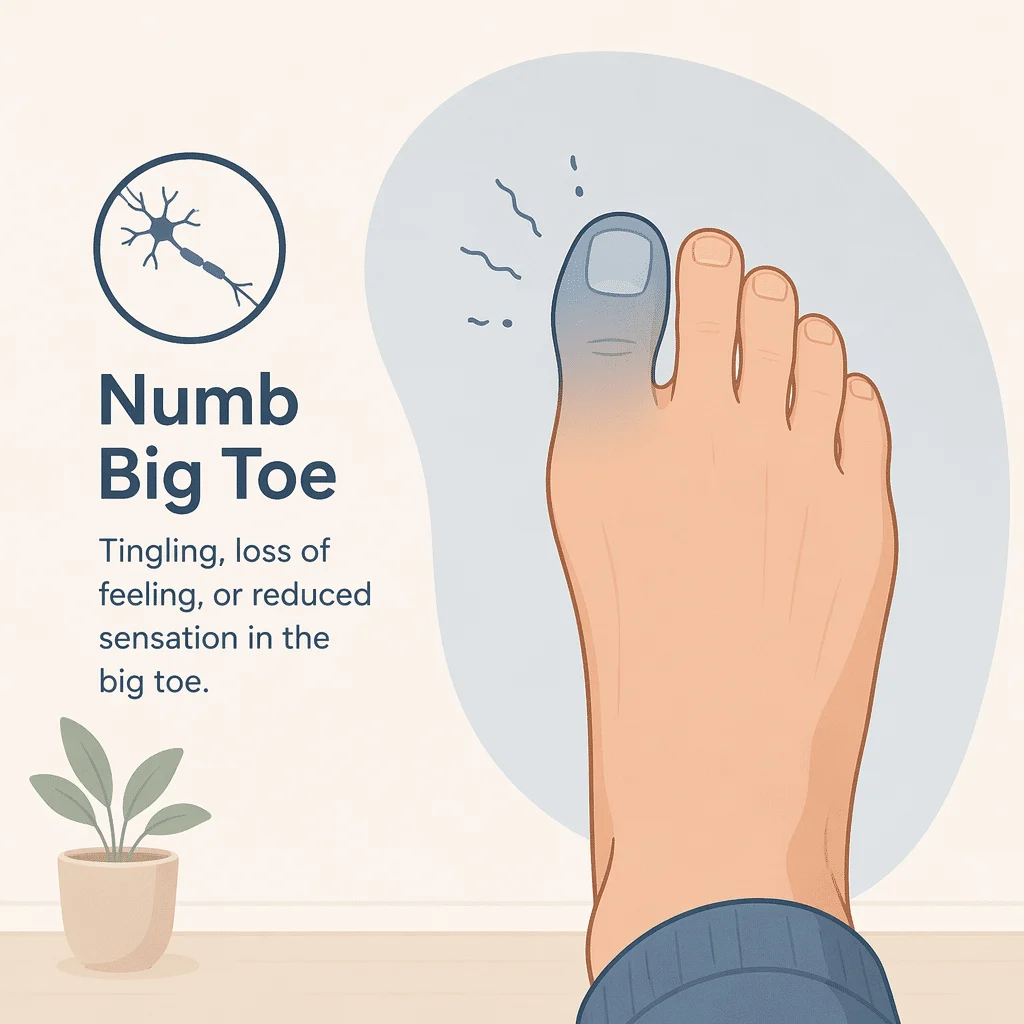
En domnad stortå är lätt att vifta bort – men kan ibland vara viktig att ta på allvar. Oftast beror det på tryck mot en nerv och försvinner när trycket tas bort. Ibland är det det första synliga tecknet på att nerverna i fötterna håller på att skadas, och då förändras vad du bör göra härnäst.
I den här artikeln får du lära dig vilka nerver som försörjer stortån, hur du skiljer en inklämd nerv i ryggen från en som klämts av skosnörena, varför domningar som börjar i båda stortårna bör leda till ett diabetestest, hur cirkulationsproblem i foten kan se ut, och vad en läkare undersöker.
Innan du läser vidare – titta på rutan med varningssignaler längre ned: vissa kombinationer av symtom kräver akut vård samma dag eller på akutmottagning.
Vad ett domnat stortå egentligen betyder
Domning innebär att en nerv inte förmedlar känsel ordentligt: nedsatt känsla, ett dött område, en stickande pirrning, eller hud som känns inlindad i plastfolie. Allt detta räknas.
Tre nervområden möts kring stortån. Huden på tåns ovansida och fotryggen försörjs till stor del av peroneusnerven, även kallad fibularisnerven. Det smala hudvecket mellan stor- och lilltå försörjs specifikt av den djupa peroneusnerven. Tåns undersida och kudde försörjs av grenar från tibialnerven. Högre upp passerar all denna trafik genom det femte ländryggsnervrotet, känt som L5, när det lämnar nedre delen av ryggraden.
Mönstret på din domning är alltså viktigare än dess intensitet. Tabellen nedan kopplar de fem vanligaste mönstren till deras troliga orsak. Det är en utgångspunkt för samtalet med din läkare, inte en diagnos.
| Mönster du märker | Trolig mekanism | Vad man ska göra |
|---|---|---|
| Domning på stortåns ovansida med ryggsmärta som strålar ner längs ett ben, ibland med svaghet vid lyft av stortån | L5-nervrot irriterad av en ländryggsbrockskiva | Sök läkare inom några dagar. Försök inte stretcha eller manipulera det själv |
| Domning i hudvecket mellan första och andra tån efter tighta stövlar, skosnören eller skidpjäxor | Djupa peroneusnerven klämd vid framsidan av ankeln | Lossa eller byt skor. Sök läkare om besvären inte ger med sig inom några veckor |
| Gradvis domning i båda fötterna, som börjar i tårna och långsamt kryper uppåt, ofta värre på natten | Perifer neuropati, oftast kopplad till diabetes | Boka ett läkarbesök och be om en fotundersökning och blodglukosmätning |
| Plötslig domning med en kall, blek eller blåaktig, smärtsam fot | Akut extremitetsischemi – en tilltäppt artär | Akut. Ring 112 eller åk till akutmottagningen omedelbart |
| Domning vid en hallux valgus (knuta), i trånga eller stela skor, som lättar när du går barfota | Lokalt tryck på en liten hudnerv i tån | Byt till bredare och mjukare skor. Kontakta en fotvårdsspecialist om ledformen förändras |
Nervkompression – orsaker och hur du skiljer dem åt
Nerver kan klämmas var som helst från ryggraden till skon, och var klämningen sitter ger ett igenkännbart mönster. Vår översikt om nervkompressionssyndrom tar upp grundprinciperna; nedan beskrivs de tre som är viktigast för stortån.
L5-radikulopati orsakad av en ländryggsbrockskiva
När en disk i ländryggen buktar ut mot L5-nervrotet hamnar domningen på fotrygggen och stortån, vanligtvis bara på ena sidan.
Två extra ledtrådar gör detta karakteristiskt. Den första är rygg- eller sätessmärta som strålar ner längs baksidan eller sidan av benet, ofta förvärrad av hosta, nysning eller sittande. Den andra är verkligt vägledande och du kan kontrollera den själv: svaghet vid lyft av stortån. Sätt dig ner, lägg handen ovanpå stortån och försök lyfta den mot det motståndet. Om den drabbade sidan ger vika mycket lättare är det ett motoriskt tecken snarare än ett rent sensoriskt, och det förtjänar en snabb bedömning.
Stretcha, vrid eller manipulera inte ett misstänkt diskproblem på egen hand, särskilt inte om du fått ny svaghet i benet. Låt det undersökas av läkare, precis som du skulle göra vid nervirritation längre ned i benet, till exempel en klämd nerv vid knäet.
Djup peroneuskompression och anteriort tarsaltunnelsyndrom
Den djupa peroneusnerven löper ner längs framsidan av skenbenet, passerar vristen under ett stramt vävnadsband och slutar med att försörja den lilla hudtriangeln i hudvecket mellan stor- och lilltå. Allt som trycker mot framsidan av vristen kan klämma den: skidpjäxor, stela vandringskängor, löparskor snörda hårt över fotrygggen, bensporrar på fotryggen. Klämd vid den punkten kallas tillståndet anterior tarsaltunnelsyndrom.
Det avslöjande är platsen. Domningar begränsade till just det mellanrummet, som uppstår efter en lång vandring eller en dag på slalombacken och lättar när stöveln tas av, är mekaniska snarare än systemiska. Att lossa snörningen, hoppa över ett hål ovanför det ömma stället eller byta till en mjukare sko löser ofta problemet. Om det kvarstår i veckor efter att trycket tagits bort bör du låta undersöka det.
Varför Mortons neurom vanligtvis sitter i en annan tå
Mortons neurom är en förtjockning av en nerv mellan de långa benen i framfoten. Det är en vanlig orsak till domningar i framfoten, vilket är varför många söker på det, men det sitter på fel ställe för stortån. Det drabbar vanligtvis utrymmet mellan tredje och fjärde tån och ger brännande smärta i fotbollen, domningar i de angränsande tårna och en känsla av att stå på en sten. Om din domning sitter precis i stortån är Mortons neurom troligtvis inte din förklaring.
Diabetes och foten i riskzonen: den viktigaste orsaken
Det här är avsnittet du bör läsa noga, eftersom det är det som påverkar utfallet mest.
Diabetisk perifer neuropati är nervskada orsakad av långvarigt högt blodsocker, och National Institute of Diabetes and Digestive and Kidney Diseases uppger att upp till hälften av alla med diabetes drabbas. Den är längdberoende: den börjar i nervändarna längst bort från ryggraden, det vill säga i tårna. Domningar som börjar i tårna är därför ofta det allra första tecknet.
Mönstret är karakteristiskt: vanligtvis symmetriskt, drabbar båda fötterna och är långsamt fortskridande – det kryper från tårna mot anklarna under månader och år. Symtomen är ofta värre på natten. En del känner brännande eller stickande känsla; andra märker helt enkelt att känseln försvinner.
Här är det avgörande. En fot med domningar är en fot i riskzonen, eftersom känseln är ditt larmsystem. När skyddsförmågan i känseln är borta märker du inte en blåsa från en ny sko, en sten i sulan eller ett snitt från nagelklippning. Skadan vilas inte ut – du går på den – och den utvecklas till ett sår. Eftersom diabetes också försämrar blodflödet och läkningsförmågan kan det såret bli infekterat och i värsta fall leda till amputation. Centers for Disease Control and Prevention uttrycker det tydligt: nervskada från diabetes utsätter dig för fotsår, och tidig behandling minskar risken för amputation avsevärt.
Den uppmuntrande delen är att det mesta av detta går att förebygga. Om du har diabetes och märker ny domning, boka en fotkontroll i stället för att vänta till ditt nästa rutinbesök, be att få lära dig hur du undersöker dina fötter dagligen med hjälp av en spegel eller en familjemedlem, och fortsätt att gå på årliga fotundersökningar. Nagelförändringar spelar också roll, som vår guide till diabetesnaglar på tårna förklarar.
Vad du aldrig ska göra med en domnad diabetesfot
Dessa förbud handlar inte om överdrivet försiktighet. Var och en av dem orsakar dokumenterad, undvikbar skada hos personer som inte kan känna sina fötter.
Blötlägg inte dina fötter. Blötläggning macererar huden och ger bakterier en enkel ingång. Tvätta med ljummet vatten – aldrig hett – och torka noga mellan tårna.
Använd inte värmekuddar, varmvattenflaskor, elvärmefiltar eller element för att värma en fot med domningar. Om du inte kan känna temperatur kan du inte heller känna att du bränner dig. Allvarliga brännskador på detta sätt är vanliga och helt möjliga att förebygga.
Skär, raka eller skär inte bort liktornar och förhårdnader själv, och använd inte receptfria liktornsmedel, medicinska plåster eller syraförband. Sådana produkter förstör vävnad och kan inte skilja en förhårdnad från frisk hud. På en okänslig fot kan de bränna ett hål som blir ett sår. Låt en fotvårdsspecialist ta hand om liktornar och förhårdnader.
Gå inte barfota, inte ens inomhus, och känn med handen inuti skorna innan du tar på dem. Ignorera inte en blåsa, spricka, färgförändring eller ett sår bara för att det inte gör ont. På en domnad fot säger frånvaron av smärta ingenting om hur allvarligt något är.
Skodon, hallux valgus och mekaniska orsaker
Många domnade stortår har en rent mekanisk förklaring, och dessa är de mest tillfredsställande att åtgärda. En hallux valgus, i dagligt tal kallad bunion, är en felställning i stortåns led som skjuter ut ett benigt utskott utåt. Det utskottet gnider mot insidan av skon och trycker på de små hudnerverna som löper över tån, vilket ger domningar längs dess inre kant. Smala tåboxar, spetsiga skor och höga klackar förvärrar tillståndet. Hallux rigidus, ett styvt och artritiskt stortåled, ger liknande besvär: beniga utskott bildas på ledens ovansida och trycker mot både sko och nerv.
Långvarigt knäfall eller huksittande komprimerar nerverna nedanför knät och kan lämna en tå domnad i minuter till timmar. Löpning är en vanlig utlösande faktor: hårt snörda skosnören över fotryggsbågen, fötter som svullnar under ett långt lopp och skor en halv storlek för små samverkar för att klämma åt den djupa peroneusnerven där den är som mest sårbar.
Det praktiska testet är enkelt. Mekanisk domning hänger ihop med en sko eller en ställning: den uppstår under aktiviteten och försvinner efteråt. Om din domning inte följer det mönstret bör du leta efter andra orsaker, precis som med andra ihållande fotsymtom som klåda i fötterna på natten.
Cirkulationsproblem och den domnade tån
Nerver behöver blodförsörjning. När artärerna som försörjer benet förtransas svälter nervvävnaden på syre och känseln avtar. Perifer artärsjukdom är den långsamma varianten, och enligt National Heart, Lung, and Blood Institute har mer än 8 miljoner personer i USA som är 40 år och äldre den.
Det typiska symtomet är claudicatio: krampartad smärta i vaden, låret eller skinkan som tillförlitligt uppstår efter ett visst gångavstånd och försvinner inom några minuter av vila. Andra tecken är en fot som känns kall eller ser blek ut, håravfall på tårna och underbenen, blank och tunn hud, förtjockade tånaglar samt sår som läker långsamt. Färgförändringar kan peka åt båda håll, vilket är anledningen till att vi tar upp röda fötter separat.
Sedan finns det den snabba varianten, och den är ett nödläge. Akut extremitetsischemi uppstår när en artär plötsligt blockeras, vanligtvis av en blodpropp. Foten blir kall, blek eller marmorerat blå, kraftigt smärtsam och domnad inom några timmar, och vävnaden börjar dö. Det här kräver omedelbar akutvård.
Nutritionella, metabola och andra systemiska orsaker
Flera tillstånd skadar perifera nerver på samma längdberoende sätt som diabetes, och ger samma symmetriska domning som börjar i tårna.
Vitamin B12-brist är den mest välkända. B12 upprätthåller den isolerande myelinskidan runt nerverna, och en brist ger domningar, stickningar och ostadighet – ibland innan någon anemi uppträder. Det går att behandla, men en långvarig brist kan ge bestående skador; vår guide om lågt vitamin B12 täcker orsakerna. Börja inte med kosttillskott innan nivån har mätts, eftersom det döljer bilden. Dosering är ett beslut för din läkare.
Regelbunden hög alkoholkonsumtion skadar perifera nerver direkt och via bristfällig näring, vilket ger ett brännande och domnat mönster i båda fötterna. Flera cytostatika, särskilt platinumpreparat och taxaner, orsakar kemoterapi-inducerad perifer neuropati, som börjar i fingertopparna och tårna och kan kvarstå efter avslutad behandling. Berätta för ditt onkologteam om nya domningar i stället för att vänta.
En underaktiv sköldkörtel orsakar nervsymtom och svullnad som trycker på nerver vid trånga punkter; TSH-testning är vanligtvis det första steget. Avancerad njursjukdom låter nervskadliga gifter ansamlas, vilket är varför högt BUN och kreatinin spelar roll här. Lågt magnesium bidrar till nervretbarhet, vilket behandlas i vår artikel om magnesiumbrist.
Slutligen, hos äldre vuxna, klämer lumbal spinalstenos ihop flera nervrötter på en gång och ger domningar och tyngdkänsla i benen vid gång som lättar när man sitter eller lutar sig framåt. Det mönstret – att det lättar vid framåtböjning – skiljer det från artärsjukdom.
Vad en läkare undersöker
Bedömningen är vanligtvis enkel och görs till stor del på mottagningen. Fotundersökningen kommer först: din läkare kartlägger var känseln är nedsatt, vilket avgränsar nervterritoriet. Monofilamenttestning är standardscreening för skyddskänsel och använder ett kalibrerat nylonfilament som trycks mot punkter på fotsulan tills det precis böjer sig. En stämgaffel testar vibrationskänseln, som ofta är det första som försämras. Läkaren testar också styrkan i stortåns sträckning, kontrollerar reflexer, känner på pulsen i foten och ankeln, tittar på hudfärg och temperatur samt undersöker mellan tårna efter sår som du kanske inte har känt.
Blodprov letar efter behandlingsbara systemiska orsaker. Det vanliga provpaketet inkluderar fasteglukos och HbA1c, som beskrivs i vår guide till diabetesblodprov, plus vitamin B12, sköldkörtelfunktion och njurfunktion.
Ytterligare undersökningar görs selektivt. Ett ankel-brachialindex jämför blodtrycket vid ankeln med blodtrycket i armen och är det första testet när perifer artärsjukdom misstänks. MRT av ländryggen beställs när symtommönstret och muskelsvaghet tyder på ett nervrotsproblem. Nervledningsstudier och elektromyografi används när diagnosen är oklar eller när en inklämd nerv behöver lokaliseras exakt.
Varningssignaler: när domning i stortån kräver akut vård
De flesta fall av domna tår är inte akuta. Men dessa är det.
Sök akutvård omedelbart om du har:
- Plötslig domning med en kall, blek eller blå, smärtsam fot. Det kan vara akut extremitetsischemi – en blockerad artär – och extremiteten riskerar att ta skada inom några timmar.
- Domning tillsammans med förlust av kontroll över blåsa eller tarm, domning i sadelområdet mellan benen, eller kraftig eller tilltagande svaghet i ett eller båda benen. Det kan vara cauda equina-syndrom, en kompression av nerverna i nedre delen av ryggraden som orsakar bestående skador om den inte avlastas akut.
- Domning eller svaghet som sprider sig snabbt under loppet av timmar till ett dygn.
Sök läkarvård samma dag om du har:
- Diabetes i kombination med ett sår, blåsa, böld, spricka eller färgförändring på en domnad fot. Det kräver omedelbar fotvård – inte ett avvaktande förhållningssätt – oavsett hur litet det ser ut och hur lite det gör ont.
- Domning med feber, spridande rodnad, svullnad eller värme, vilket tyder på infektion.
Boka ett vanligt läkarbesök om domningen kommer gradvis, är smärtfri och finns i båda fötterna, eller om domningen kvarstår i mer än två till tre veckor efter att du har bytt skor.
Senaste vetenskapliga framsteg inom diagnostik av domna tår
Forskning sedan 2023 har skärpt hur kliniker upptäcker en fot som förlorat skyddande känsel, och hur tidigt de agerar.
En tysk studie av Trocha och kollegor i Diabetic Medicine 2023 följde personer med diabetes som hade förlorat skyddande känsel men aldrig haft ett fotsår. Under ungefär fyra år utvecklade de som dessutom hade förlorat förmågan att känna ett nålstick ett fotsår för första gången oftare, och tidigare. Vad detta innebär för dig: graden av känselbortfall spelar roll, så be din läkare testa smärtkänsel utöver beröringskänsel.
Verktygen i sig testas. Chatzistergos och kollegor jämförde 2023 i Diabetes Research and Clinical Practice två screeningmetoder vid en öppenvårdsklinik för diabetes i Indien. Ipswich touch test, där en undersökare lätt rör vid spetsarna på specifika tår med ett finger, fungerade tillräckligt bra för att användas som screeningverktyg, medan en handhållen vibrationsenhet inte gjorde det. Vad detta innebär för dig: en tillförlitlig kontroll kräver ingen dyr utrustning, så undersökningen bör aldrig hoppas över.
Hur ofta det förekommer är den svaga länken. En polsk screeningstudie av Cwajda-Białasik och kollegor i Medical Science Monitor 2024 undersökte fötterna hos vuxna med diabetes eller prediabetes med hjälp av pulskontroller, ankel-brachialindex och känseltestning. Fotproblem var vanliga, och många hittades hos personer som inte visste om att de hade några. Vad detta innebär för dig: anta inte att dina fötter har kontrollerats bara för att du går på återbesök. Ta av dig skor och strumpor och be om en undersökning.
På nutritionssidan sammanställde Atkinson, Gharti och Min i touchREVIEWS in Endocrinology 2024 studier om metformin och vitamin B12. De flesta fann att metforminanvändning var kopplad till lägre B12-nivåer, där högre doser och längre behandling innebar större risk, och författarna rekommenderar regelbunden B12-screening. Vad detta innebär för dig: om du tar metformin och får domningar i tårna, be om att få kontrollera ditt B12-värde. Metformin brukar inte sättas ut av den anledningen.
För cirkulationen täcker 2024 års multisällskapsriktlinje om perifer artärsjukdom i nedre extremiteterna, ledd av Gornik och kollegor i Circulation, hela spektrumet – från inga symtom till akut extremitetsischemi – med ankel-brachialindex som hörnstenstest. Vad detta innebär för dig: vid domning i kombination med kalla fötter, kramp i benen vid promenad eller ett sår som inte läker är det testet billigt, icke-invasivt och rimligt att fråga om.
Vanliga frågor
Varför är min stortå domnad efter löpning?
Vanligtvis handlar det om tryck, inte skada. Fötterna svullnar under ett löppass, och skor som är hårt snörda över fotryggsbågen trycker då ihop nervus peroneus profundus där den löper över framsidan av ankeln. Den nerven försörjer hudvecket mellan stortån och den andra tån och bidrar till känseln på ovansidan av stortån, så domningar där är det klassiska resultatet. Prova att lossa snörningen, hoppa över ett snörhål vid det ömma stället och kontrollera att dina löparskor är en halv storlek större än dina vardagsskor. Om domningarna kvarstår i veckor efter att du slutat springa, eller om du märker att du har svårt att lyfta tån, bör du låta undersöka den.
Ska jag oroa mig för en domnad tå?
Ärligt svar: vanligtvis inte, men ibland ja. Domningar som tydligt beror på en sko, en stövel eller en lång stund på knä och försvinner inom några timmar är sällan allvarliga. Domningar som kommer gradvis, är smärtfria och finns i båda fötterna är värda ett läkarbesök, eftersom det är mönstret vid perifer neuropati. Domningar tillsammans med ryggsmärta som strålar ner i benet behöver bedömas inom några dagar. Och domningar med en kall, blek eller smärtande fot, eller med någon förändring i blås- eller tarmfunktion, är ett akut tillstånd. Hur länge besvären pågår spelar också roll: allt som varar mer än två till tre veckor bör undersökas.
Kan ett domnat tå vara diabetes?
Ja, och det är en av de viktigare möjligheterna. Domningar som börjar i tårna är ofta det första tecknet på diabetisk perifer neuropati, och det kan uppstå innan man ens vet att man har diabetes. Det typiska mönstret är domningar i båda fötterna som börjar i tårna och långsamt rör sig uppåt. Om du har diabetes eller riskfaktorer för det och dina tår har blivit domna, boka en fotkontroll och be om att få testa ditt blodsocker. Börja sedan inspektera dina fötter dagligen, eftersom nedsatt känsel är det som gör att en liten skada kan utvecklas till ett sår.
Kan en hallux valgus göra min stortå domnad?
Det kan hända. Det benpålägg som bildas vid hallux valgus gnider mot skon och trycker på de små sensoriska nerverna som löper över leden, vilket ger domningar eller en stickande känsla längs tåns inre kant. Tecknet är att besvären förvärras i smala, spetsiga eller högklackade skor och minskar barfota eller i vida, mjuka skor. Att byta skomodell är det första steget. Om leden deformeras, blir smärtsam eller stel bör du kontakta en fotterapeut eller fotkirurg, eftersom det underliggande felinriktningsproblemet kan behöva åtgärdas snarare än bara trycket.
Varför är bara min vänstra eller högra stortå domnad?
Domningar på ena sidan tyder på en lokal orsak eller en enskild nerv snarare än en systemisk orsak. De vanligaste orsakerna är en L5-nervrot som irriteras av ett diskbråck på den sidan, en nerv som kläms av skor, en hallux valgus (knuta på stortån) eller en gammal skada. Systemiska orsaker som diabetes, B12-vitaminbrist och alkoholrelaterad nervskada drabbar nästan alltid båda fötterna, även om ena sidan kan vara märkbart värre. Cirkulationsproblem kan också vara ensidiga. Om en enstaka domnad tå åtföljs av en kall eller missfärgad fot bör du söka vård omedelbart.
Kommer känseln i min domnade tå att komma tillbaka?
Det beror helt på orsaken och hur länge besvären har pågått. Domningar orsakade av skodon eller en tillfällig ställning brukar försvinna helt när trycket tas bort. Domningar från en klämd nerv förbättras ofta när klämningen behandlas, men återhämtningen kan ta veckor eller månader eftersom nerver läker långsamt. Domningar vid långvarig neuropati kanske inte försvinner helt, vilket är anledningen till att tidig diagnos är viktig: att behandla den bakomliggande orsaken, till exempel reglera blodsockret eller åtgärda brist på vitamin B12, syftar till att stoppa ytterligare skada även när det inte går att återställa det som redan hänt.
Ordlista
| Kalla | Definition |
|---|---|
| Perifer neuropati | Skada på nerverna utanför hjärnan och ryggmärgen, som vanligtvis drabbar fötterna först och orsakar domningar, stickningar, brännande känsla eller svaghet |
| Förlust av skyddande känsel | Nedsatt känsel i foten i den grad att en skada inte skulle märkas – vilket är den viktigaste riskfaktorn för fotsår |
| L5-radikulopati | Irritation eller kompression av det femte ländkotans nervrot i nedre ryggen, vilket orsakar domningar på fotryggen och stortån samt ibland svaghet vid lyft av stortån |
| Nervus peroneus profundus | En nerv som löper längs framsidan av underbenet och försörjer hudvecket mellan första och andra tån, och som kan klämmas av åtsittande skodon |
| Anteriort tarsaltunnelsyndrom | Kompression av nervus peroneus profundus där den korsar framsidan av fotleden, ofta orsakad av stövlar, skosnören eller bensporrar |
| Mortons neurom | En förtjockad nerv i framfoten, vanligtvis mellan tredje och fjärde tån, som orsakar brännande smärta och domningar i dessa tår snarare än i stortån |
| Hallux valgus | Det medicinska namnet för hallux valgus, en felställning av stortåns led som skapar ett benfremspring på fotens inre kant |
| Monofilamenttest | Ett screeningtest där ett kalibrerat nylonfilament trycks mot fotsulan tills det böjer sig, för att kontrollera om det skyddande känselsinnet är intakt |
| Ankel-brachialindex | Ett enkelt test som jämför blodtrycket vid ankeln med blodtrycket i armen, och som används för att upptäcka förträngda benartärer |
| Akut extremitetsischemi | Plötsligt avbrott i blodtillförseln till en extremitet, vilket orsakar en kall, blek, smärtsam och domnad fot och kräver akut behandling |
Förstå dina labresultat med AI DiagMe
Att ta reda på varför en tå har blivit domnad innebär ofta ett antal blodprover: glukos och HbA1c för diabetes, B12-vitamin, sköldkörtelfunktion och njurfunktion. Dessa resultat presenteras som siffror på ett papper utan mycket förklaring. AI DiagMe översätter dem till ett enkelt språk och lyfter fram vad som är värt att ta upp med din läkare. Det hjälper dig att förstå dina provsvar – det diagnostiserar inte neuropati eller något annat tillstånd, och det ersätter inte din läkare.
Få dina resultat tolkade på några minuter
Vidare läsning
- Röda fötter: orsaker, symtom och behandlingar
- Lågt vitamin B12: symtom, orsaker och behandling
- Diabetestånaglar: symtom, orsaker och behandlingar
- Nervkompressionsyndrom: symtom och behandlingar
- Magnesiumbrist: symtom, orsaker och behandlingar
Källor
- National Institute of Diabetes and Digestive and Kidney Diseases. Peripheral Neuropathy
- Centers for Disease Control and Prevention. Your Feet and Diabetes
- National Institute of Neurological Disorders and Stroke. Peripheral Neuropathy
- National Heart, Lung, and Blood Institute. What Is Peripheral Artery Disease?
- Trocha A, Gontscharuk V, Icks A, Jeffcoate W. The value of loss of protective pain sensation in predicting a first ulceration of the foot in people with diabetes. Diabetic Medicine. 2023. https://doi.org/10.1111/dme.15241
- Chatzistergos PE, Kumar S, Sumathi CS, Mahadevan S, Vas P, Chockalingam N. Screening for the loss of protective sensation in people without a history of diabetic foot ulceration: validation of two simple tests in India. Diabetes Research and Clinical Practice. 2023. https://doi.org/10.1016/j.diabres.2023.110810
- Cwajda-Białasik J, Mościcka P, Szewczyk MT. Undiagnosed and untreated peripheral complications of diabetes: findings from a pilot study on diabetes-related foot diseases in patients with glycemic disorders. Medical Science Monitor. 2024. https://doi.org/10.12659/MSM.944239
- Atkinson M, Gharti P, Min T. Metformin use and vitamin B12 deficiency in people with type 2 diabetes: what are the risk factors? A mini-systematic review. touchREVIEWS in Endocrinology. 2024. https://doi.org/10.17925/EE.2024.20.2.7
- Gornik HL, Aronow HD, Goodney PP, et al. 2024 ACC/AHA/AACVPR/APMA/ABC/SCAI/SVM/SVN/SVS/SIR/VESS Guideline for the Management of Lower Extremity Peripheral Artery Disease. Circulation. 2024. https://doi.org/10.1161/CIR.0000000000001251