
































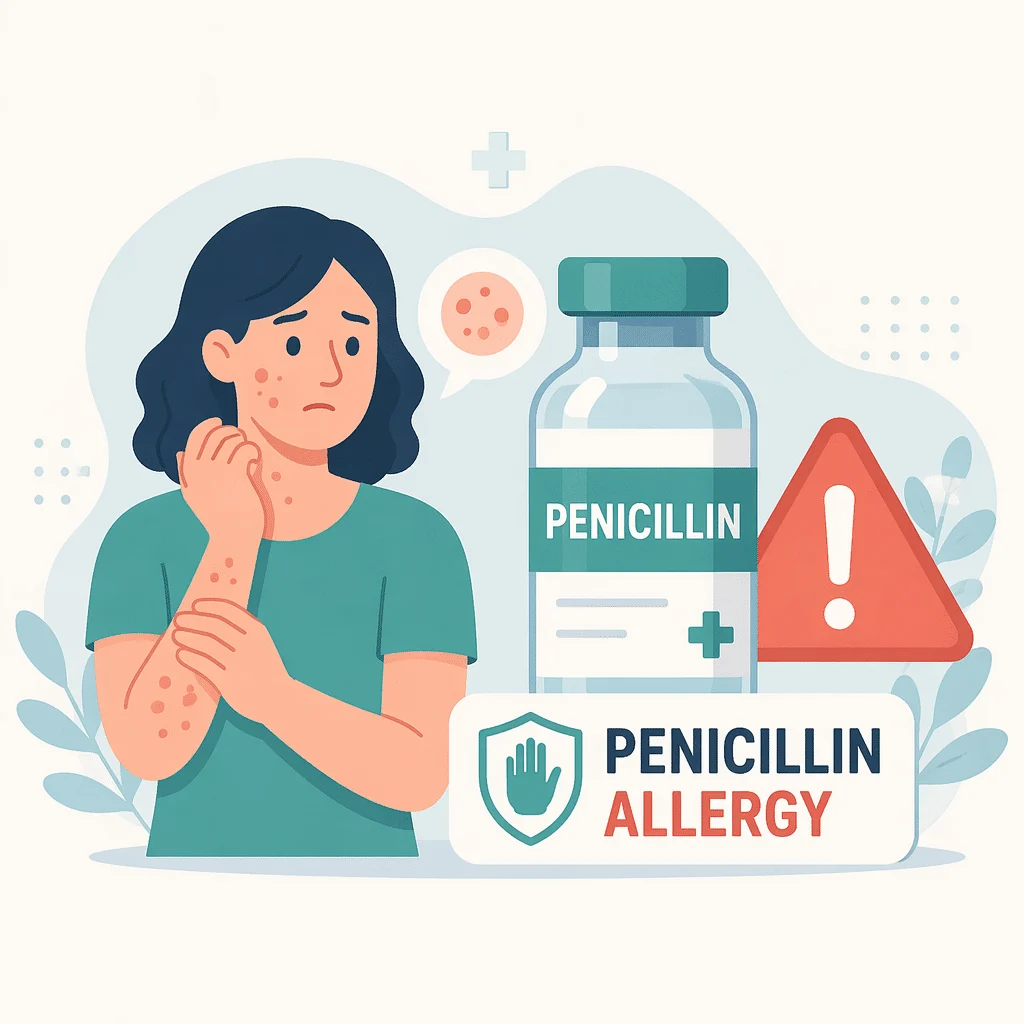
About one in ten people carry a penicillin allergy label, and when those labels are formally checked, roughly 90 to 95 percent of them turn out to be wrong. The US Centers for Disease Control and Prevention states it plainly: around 10% of American patients report an allergy to a penicillin-class antibiotic, yet fewer than 1% are truly allergic. That gap matters, because an inaccurate label quietly pushes you toward second-choice antibiotics that often work less well and carry more risk.
In this article you’ll learn what a genuine penicillin allergy looks like, why so many labels are inaccurate, the documented harm an incorrect label causes, how allergy fades over time, what cephalosporin cross-reactivity really means, and how allergy is properly assessed. If you are reacting right now, go straight to the emergency box below.
What a penicillin allergy is, and what it is not
A penicillin allergy is an immune reaction to penicillin or a closely related antibiotic. Your immune system misreads the drug as a threat and mounts a defense against it. That is not the same as a side effect. Nausea, stomach cramps, loose stools, thrush or a headache after antibiotics are genuinely unpleasant, but they do not involve the immune system and they are not an allergy. Many people who avoid penicillins for life are avoiding a side effect they had decades ago.
Penicillins sit inside a wider family called beta-lactam antibiotics, which also includes amoxicillin, cephalosporins and carbapenems. These drugs share a chemical core known as the beta-lactam ring, but each one carries different side chains attached to that core. Those side chains turn out to matter far more than the shared ring when clinicians work out which other antibiotics are safe for you.
The three very different reactions that all get called “allergy”
Immediate reactions are driven by IgE antibodies. They usually begin within an hour of a dose and look like hives, swelling of the lips or eyelids, wheeze, vomiting, or in the worst case anaphylaxis, a whole-body reaction that affects breathing and blood pressure. These are the reactions penicillin skin testing is designed to detect.
Delayed reactions are driven by T cells rather than antibodies. They typically appear several days into a course and usually take the form of a flat, blotchy, pink rash over the trunk and limbs. Most are mild, self-limiting, and are the single most common reason a childhood skin rash gets written into a medical record as a lifelong allergy.
Severe cutaneous adverse reactions are a different category altogether. Stevens-Johnson syndrome, toxic epidermal necrolysis and DRESS (drug reaction with eosinophilia and systemic symptoms) involve blistering skin, mucous membrane ulceration, fever and organ involvement. The CDC is explicit that patients with this history should never undergo skin testing or an oral challenge with the drug. Unlike a benign childhood rash, these reactions are an absolute, permanent reason never to take that antibiotic again.
Emergency: get help immediately
Call 911 (or your local emergency number) and use an epinephrine (adrenaline) autoinjector if one has been prescribed to you, if after taking any antibiotic you have:
- Difficulty breathing, chest tightness, wheeze or noisy breathing (stridor)
- Swelling of the throat, tongue, lips or face
- Widespread hives together with faintness, collapse or a racing heart
- Vomiting or severe abdominal pain alongside a rash
- A sudden sense of impending doom, confusion or extreme weakness
Stop the drug and seek urgent medical care the same day if you develop:
- A rash that blisters, peels or is painful rather than itchy
- Ulcers or rawness in the mouth, eyes or genitals
- Fever with a widespread rash, or swollen glands with a rash
- Facial swelling with fever, feeling very unwell or yellowing of the eyes
Why most penicillin allergy labels turn out to be wrong
Penicillin allergy labels are rarely deliberate mistakes. They accumulate through ordinary clinical caution. A child develops a rash on day four of an antibiotic course, the antibiotic is blamed, the word “allergy” enters the chart, and nobody revisits it for forty years. The CDC lists three recurring sources of inaccurate labels: past viral rashes, a family history of penicillin allergy rather than a personal one, and intolerance such as diarrhea being recorded as allergy.
The viral rash problem deserves a specific mention, because it is the most common single cause. Children get frequent viral infections, those infections often cause rashes, and children with them are often prescribed antibiotics. The rash that follows is frequently the virus, not the drug. This is best known with amoxicillin given during glandular fever, and our companion guide on amoxicillin allergy covers that specific pattern and how a childhood amoxicillin rash should be handled.
The other silent contributor is that nobody is responsible for removing a label once it is added. Antibiotic allergies are copied faithfully from record to record. Removing one requires somebody to question it, and until recently few systems made that anybody’s job.
What your reaction probably means
The table below is a rough guide to how clinicians think about a reaction history. It is not a substitute for assessment, and you should not use it to decide to take a drug you are labeled allergic to.
| What happened when you took it | What it usually means | What to do |
|---|---|---|
| Nausea, stomach upset, diarrhea or thrush | A side effect, not an allergy. No immune reaction is involved | Ask your doctor to reclassify it as an intolerance rather than an allergy |
| A flat blotchy rash days into a course as a child, during an illness | Very often the infection rather than the drug, or a mild delayed reaction | Typically low risk. Ask to be formally assessed for delabeling |
| Hives or swelling within an hour of a dose | Possible immediate, IgE-mediated allergy | Needs specialist assessment, usually with skin testing before any challenge |
| Breathing difficulty, collapse, or you needed emergency treatment | Possible anaphylaxis, treated as a high-risk history | Keep avoiding the drug. Ask for referral to a drug allergy specialist |
| Blistering or peeling rash, mouth ulcers, fever, or organ problems | A severe cutaneous adverse reaction such as SJS, TEN or DRESS | Never rechallenge. This is a permanent contraindication. Carry documentation |
Why an incorrect penicillin allergy label causes real harm
It is tempting to think that avoiding penicillin “just in case” is the cautious choice. The evidence says otherwise. When a penicillin allergy is on the chart, prescribers reach for alternatives such as clindamycin, vancomycin, fluoroquinolones or macrolides. Those drugs are often broader in spectrum, less effective for the specific infection being treated, and carry their own toxicity.
The measured consequences are consistent across studies. People with a penicillin allergy label have a higher rate of surgical site infection after operations, more infections with Clostridioides difficile, more infections with resistant organisms such as MRSA and vancomycin-resistant enterococci, and longer hospital stays. The NIH has quoted allergists describing more outpatient visits, more emergency room visits and higher mortality among patients carrying the label.
This is why removing inaccurate labels, a process clinicians call delabeling, has become a public health priority rather than a niche allergy interest. It improves the individual’s care and it reduces the broad-spectrum antibiotic use that drives resistance across the whole population. It also matters before planned surgery, when the standard preventive antibiotic is usually a beta-lactam. If you have an operation coming up, it is worth raising alongside your routine blood work before surgery.
Penicillin allergy usually fades over time
A genuine immediate penicillin allergy is not necessarily permanent. The IgE antibodies responsible for immediate reactions decline over the years. According to the NIH, nearly half of people with a confirmed penicillin allergy lose it within five years, and after about ten years roughly 80% no longer react. The CDC makes the same point: allergy-specific IgE may decrease over time, so patients can end up tolerating penicillin-related antibiotics later in life.
The practical consequence is direct. If your label dates from childhood, or from an event more than a decade ago, it deserves to be re-examined rather than assumed. An old label is the single strongest argument for asking to be assessed, not for continuing to avoid the drug indefinitely. This does not apply to severe cutaneous adverse reactions, which do not wane and are never retested.
Cephalosporins and cross-reactivity: the honest picture
Generations of clinicians were taught that around 10% of penicillin-allergic patients also react to cephalosporins. That figure came from older studies using cephalosporin preparations contaminated with traces of penicillin, and it is now considered a substantial overestimate.
The modern understanding is that cross-reactivity is driven by similarity of the side chains, not by the shared beta-lactam ring. Cephalosporins whose side chains resemble those of penicillin or amoxicillin carry a meaningful cross-reactivity risk. Cephalosporins with structurally different side chains carry very little. This is why blanket avoidance of every beta-lactam after a penicillin reaction is no longer standard practice, and why a pharmacist or allergist can often identify perfectly safe alternatives within the same broad family.
None of this means you should experiment. It means that “penicillin allergy, therefore avoid all related antibiotics forever” is an outdated instruction, and that the specific drug and the specific side chain are the questions worth asking your prescriber.
How a penicillin allergy is actually assessed
Assessment happens in stages, and for most people it is quicker than expected.
Step one: risk stratification from your history
A clinician asks structured questions: how long ago the reaction happened, what the symptoms actually were, how many doses you had taken, whether you needed treatment or hospital care, and whether you have taken any penicillin since. Validated scoring tools exist for exactly this purpose. The answers place you in a low, moderate or high risk group, and that grouping determines everything that follows. A meaningful number of people are delabeled at this stage alone, on history, without any test.
Step two: skin testing where it is indicated
Penicillin skin testing introduces dilute penicillin reagents into the skin in two steps, alongside a saline negative control and a histamine positive control. Performed correctly it is highly specific for detecting IgE-mediated reactions. It is used for moderate and high-risk histories, and a negative skin test is normally confirmed with an oral dose afterwards. Blood tests measuring drug-specific IgE exist but are far less reliable for penicillin and do not replace skin testing. A doctor may also check serum tryptase, a marker that rises briefly during severe allergic reactions.
Step three: supervised oral challenge for low-risk patients
For patients assessed as low risk, a direct oral challenge means taking a single controlled dose of amoxicillin under medical supervision and being observed for a set period afterward. The setting has rescue medication and trained staff available. This approach has moved out of specialist allergy clinics into hospital wards, preoperative clinics and primary care, which is what has made large-scale delabeling realistic.
The rule that matters most: never test it yourself
Do not take a penicillin, or any antibiotic you are labeled allergic to, at home to find out what happens. Not a small dose, not an old leftover tablet, not “just to see”. A drug challenge is only safe because it takes place in a supervised medical setting with resuscitation facilities and staff who can treat anaphylaxis within seconds. Removing that setting removes the entire safety margin. Ask to be assessed. Do not self-test.
What to do if you carry a penicillin allergy label
Start by writing down what you remember: your age at the time, the drug name if you know it, what the reaction looked like, how long after the dose it started, and whether you needed treatment. That short history is the most useful thing you can bring to an appointment, and it drives the risk assessment.
Then ask your primary care doctor directly whether you can be assessed for penicillin allergy, or referred to an allergy service. Good moments to raise it include before planned surgery, before dental work, and any time you are prescribed a second-line antibiotic for a common infection such as an ear infection or a sinus infection.
In the meantime, keep the label. Do not remove it yourself from pharmacy records or medical apps until a clinician has formally cleared you, and keep telling every new doctor, dentist and pharmacist about it. If you have had anaphylaxis, carry documentation and any prescribed autoinjector. Avoiding the drug while you wait for assessment is correct. Avoiding it forever without ever asking the question is not.
Latest scientific advances in penicillin allergy testing
Research since 2023 has focused less on how allergy happens and more on how to safely undo inaccurate labels at scale.
A 2025 systematic review and meta-analysis in The Journal of Infection pooled results from dozens of countries to measure how common reported penicillin allergy actually is. It found the label is carried by close to one in ten adults worldwide, is far more often recorded in high-income countries, and that the large majority of those labels do not reflect true allergy. What this means for you: the label is common, and being labeled tells you very little about whether you are actually allergic.
A 2023 systematic review in The Journal of Allergy and Clinical Immunology: In Practice examined a very large pooled patient population to quantify the burden of self-reported antibiotic allergy. It found that labeled patients frequently receive antibiotics that depart from prescribing guidelines, with more use of quinolones, macrolides and carbapenems and less use of beta-lactams, and that this translates into worse clinical outcomes. What this means for you: the label changes what you get prescribed, and not in your favor.
The PALACE randomized trial, published in JAMA Internal Medicine in 2023, tested whether adults with a low-risk history could skip skin testing entirely. Participants in North America and Australia were randomly assigned to a direct oral penicillin challenge or to the standard skin-test-then-challenge pathway. Reactions were rare and equally uncommon in both groups, and no serious adverse events occurred. What this means for you: if your history is low risk, a single supervised dose may be all that is needed.
A systematic review commissioned for a World Health Organization guideline, published in Clinical Reviews in Allergy and Immunology in 2024, pooled studies comparing direct oral challenge against skin testing followed by drug administration. Minor immediate reactions occurred in a small minority and were actually less frequent in the direct challenge group, with no anaphylaxis and no deaths recorded. What this means for you: supervised assessment is safe, and the fear of testing is generally larger than the risk.
The PREPARE pilot randomized trial, published in JAMA Surgery in 2025, moved assessment into anesthesiologist-led preoperative clinics rather than allergy clinics. Most low-risk patients were successfully assessed and delabeled before surgery, no severe adverse events occurred, and surgery was not delayed. What this means for you: your preoperative appointment may be a practical place to get this resolved, without a separate specialist referral.
Frequently asked questions about penicillin allergy
Can you outgrow a penicillin allergy?
Yes, and most people do. The IgE antibodies behind immediate reactions fade over the years. The NIH reports that nearly half of people with a confirmed penicillin allergy lose it within five years, and after about ten years roughly 80% no longer react. This is why a label from childhood, or from an event more than a decade ago, deserves to be reassessed rather than assumed permanent. The exception is a severe cutaneous adverse reaction such as Stevens-Johnson syndrome, toxic epidermal necrolysis or DRESS. Those do not fade, are never retested, and remain a lifelong reason to avoid the drug.
How do I get tested for a penicillin allergy?
Ask your primary care doctor to assess your penicillin allergy label or refer you to an allergy service. The first step is a structured history: how long ago the reaction was, what happened, how soon after the dose, and whether you needed treatment. That places you in a risk category. Low-risk histories may be delabeled on history alone or with a single supervised oral dose. Moderate and high-risk histories are usually offered penicillin skin testing first, followed by an oral dose if the skin test is negative. Increasingly this is done in hospital wards, preoperative clinics and primary care rather than only in specialist allergy clinics.
Is it safe to just try penicillin at home to see whether I react?
No. Absolutely not, under any circumstances. A drug challenge is only safe because it happens in a supervised medical setting where staff can recognize anaphylaxis and treat it within seconds, with rescue medication and resuscitation equipment on hand. Taking a dose at home strips away every part of that safety net, and anaphylaxis can progress from the first symptom to a life-threatening state in minutes. This applies to a small “test” dose and to leftover tablets just as much as to a full course. The correct action is to ask to be formally assessed, not to experiment.
I only had diarrhea and stomach upset. Is that a penicillin allergy?
Almost certainly not. Gastrointestinal upset, thrush, headache and a metallic taste are side effects of antibiotics, not immune reactions, and the CDC specifically lists intolerance such as diarrhea as a common source of inaccurate allergy labels. It is still worth mentioning to your doctor, because it may change which antibiotic they choose for comfort reasons, but it should be recorded as an intolerance rather than an allergy. Ask for your record to be corrected. Keeping a side effect filed as an allergy will restrict your future treatment options for no clinical benefit.
Can I take a cephalosporin if I am labeled allergic to penicillin?
Often yes, but that is a decision for your prescriber rather than for you. The old teaching that around 10% of penicillin-allergic patients cross-react to cephalosporins is now considered a substantial overestimate. Modern understanding is that cross-reactivity depends on how similar the drug’s side chain is to penicillin or amoxicillin, not on the shared beta-lactam ring. Cephalosporins with dissimilar side chains carry very little risk. A pharmacist or allergist can look at the specific drug you have been offered and advise. Never make that substitution yourself, and never take a leftover antibiotic on the assumption that it is fine.
What are the alternative antibiotics for penicillin allergy, and are they as good?
Alternatives commonly used include macrolides, clindamycin, doxycycline, fluoroquinolones and vancomycin. They are effective for many infections, but for some conditions a penicillin genuinely is the better drug, and the alternatives tend to be broader in spectrum with more side effects. Research links penicillin allergy labels to more surgical site infections, more Clostridioides difficile infection, more resistant organisms and longer hospital stays. That is not an argument for taking a penicillin you may be allergic to. It is an argument for finding out whether you actually are, so that the best drug is available to you when it matters.
Glossary of key terms
| Term | Definition |
|---|---|
| Anaphylaxis | A sudden, whole-body allergic reaction affecting breathing and blood pressure that needs emergency treatment |
| Beta-lactam | The chemical core shared by penicillins, cephalosporins and carbapenems, which gives the family its name |
| Side chain | The variable chemical group attached to the beta-lactam core, and the main driver of cross-reactivity between drugs |
| IgE | The antibody responsible for immediate allergic reactions, which typically appear within an hour of a dose |
| Delabeling | The formal medical process of assessing an allergy label and removing it from the record when it is not accurate |
| Risk stratification | Sorting patients into low, moderate or high risk using their reaction history, to decide what testing is appropriate |
| Penicillin skin testing | A two-step test placing dilute penicillin reagents into the skin to detect immediate, IgE-mediated allergy |
| Direct oral challenge | A single controlled dose of amoxicillin given under medical supervision to confirm a low-risk patient is not allergic |
| DRESS | Drug reaction with eosinophilia and systemic symptoms: a severe delayed reaction with fever, rash and organ involvement |
| Stevens-Johnson syndrome | A rare, severe reaction causing blistering skin and ulceration of the mouth, eyes and genitals; a permanent contraindication |
Understand your lab results with AI DiagMe
A penicillin allergy is diagnosed clinically, through your reaction history and supervised testing, not by a routine blood test. If a doctor does investigate, they may order tests such as drug-specific IgE, serum tryptase after a severe reaction, or a full blood count to look at eosinophils. AI DiagMe helps you understand what those numbers mean so you can have a better conversation with your clinician. It does not diagnose or rule out an allergy, and it must never be used in an emergency.
Get your results interpreted in minutes
Further reading
- Allergy blood test: what specific IgE results show
- Serum tryptase blood test explained
- Complete blood count: reading your results
- CRP, the C-reactive protein inflammation marker
- Antibiotics and constipation: causes and management
Sources
- Centers for Disease Control and Prevention. Clinical Features of Penicillin Allergy. cdc.gov
- National Institutes of Health, NIH News in Health. Drug Allergies: What to Look Out For. newsinhealth.nih.gov
- MedlinePlus, US National Library of Medicine. Drug allergies. medlineplus.gov
- Luintel A, Healy J, Blank M, et al. The global prevalence of reported penicillin allergy: a systematic review and meta-analysis. The Journal of Infection, 2025. doi.org/10.1016/j.jinf.2025.106429
- Arnold A, Coventry LL, Foster MJ, Koplin JJ, Lucas M. The burden of self-reported antibiotic allergies in health care and how to address it: a systematic review of the evidence. The Journal of Allergy and Clinical Immunology: In Practice, 2023. doi.org/10.1016/j.jaip.2023.06.025
- Copaescu AM, Vogrin S, James F, et al. Efficacy of a clinical decision rule to enable direct oral challenge in patients with low-risk penicillin allergy: the PALACE randomized clinical trial. JAMA Internal Medicine, 2023. doi.org/10.1001/jamainternmed.2023.2986
- Providencia R, Aali G, Zhu F, et al. Penicillin allergy testing and delabeling for patients who are prescribed penicillin: a systematic review for a World Health Organization guideline. Clinical Reviews in Allergy and Immunology, 2024. doi.org/10.1007/s12016-024-08988-2
- De Luca JF, Vogrin S, Holmes NE, et al. Perioperative penicillin and cephalosporin antibiotic allergy assessment and testing: the PREPARE pilot randomized clinical trial. JAMA Surgery, 2025. doi.org/10.1001/jamasurg.2025.0279