



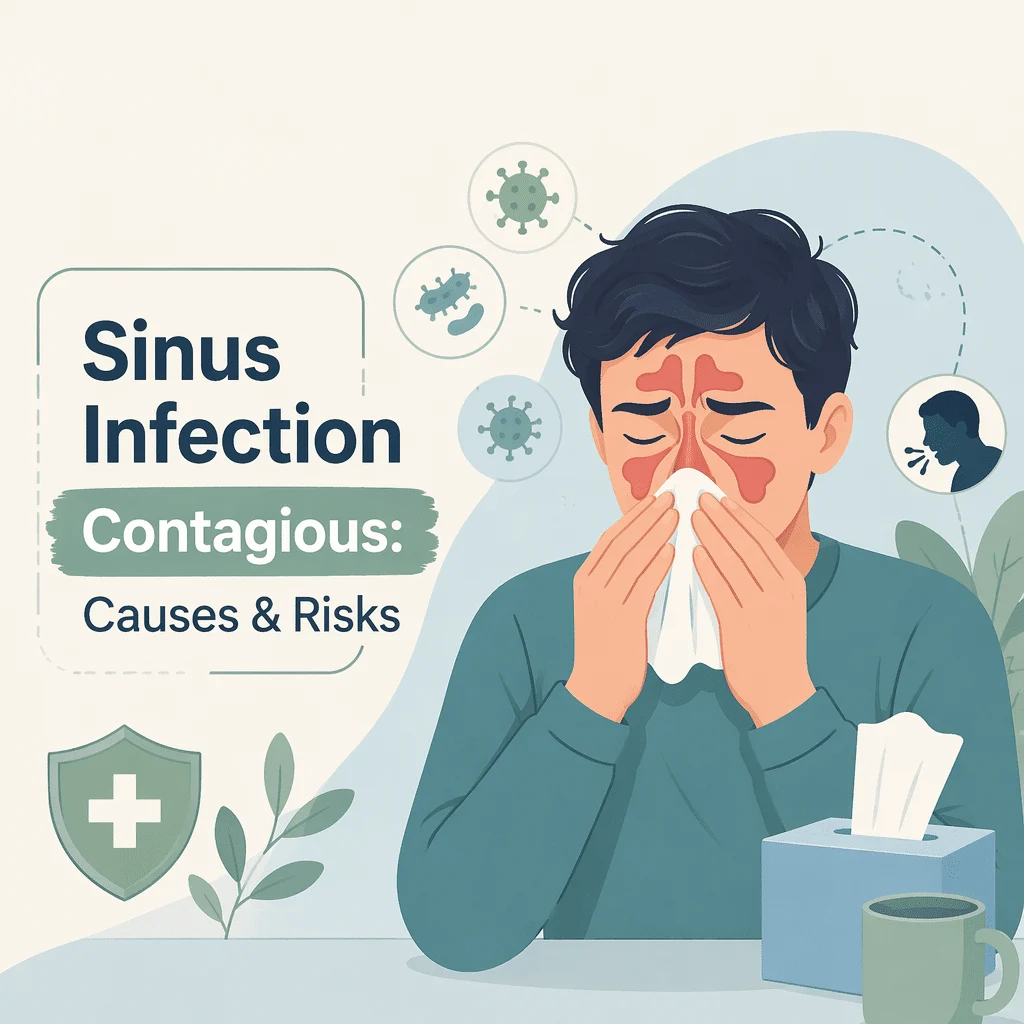
Is a sinus infection contagious? Here is the honest answer: the sinusitis itself is not handed from one person to another, but the viruses that trigger most cases certainly are. You cannot catch someone else’s blocked, aching sinuses. You can catch the cold virus that produced them — and in you, that same virus may cause nothing worse than a runny nose.
That distinction explains almost everything confusing you have read on this subject. In this article you’ll learn what is and is not transmissible, how viral, bacterial and fungal sinusitis differ, how long the underlying virus spreads, how clinicians decide whether an infection has turned bacterial, why the color of your mucus settles nothing, what the evidence says about antibiotics, and which warning signs need urgent assessment.
Is a sinus infection contagious? The short, accurate answer
Sinusitis means inflammation of the sinuses — the air-filled cavities in the bones around your nose and eyes. Inflammation is your body’s reaction, and reactions are not transmissible. What can be transmitted is the germ that provoked it. Most acute sinus infections begin as an ordinary upper respiratory infection: a cold virus reaches the nose, the lining swells, the narrow channels that drain the sinuses close off, and mucus that would normally flow away sits still instead. The Centers for Disease Control and Prevention describes this fluid buildup as the core mechanism, and notes that viruses cause most sinus infections.
So when a colleague has a sinus infection, the accurate way to think about it is this: they are carrying a respiratory virus, and you may pick it up. Your own illness could then be a three-day cold, a week of fatigue, or — if your sinuses block up the way theirs did — sinusitis. You caught the virus, not their sinus infection, and your body wrote its own ending.
Viral, bacterial and fungal sinusitis: what can and cannot spread
Sinusitis is a location, not a single disease. Grouping every case together is what creates the myth that sinus infections are simply contagious or simply not contagious. The truthful answer depends on what is driving the inflammation.
| Type | Is it contagious? | Typical course | What usually helps |
|---|---|---|---|
| Viral sinusitis (the large majority of acute cases) | The sinusitis is not, but the virus behind it is readily passed on | Peaks in the first few days and improves within about ten days | Time, rest, fluids and comfort measures; CDC notes most cases resolve without antibiotics |
| Bacterial sinusitis | Not usually transmitted as such; it develops from bacteria already living in the nose | Follows a viral illness that fails to improve, or clearly worsens after improving | Clinical assessment; a clinician weighs whether antibiotics are justified |
| Fungal sinusitis | Not contagious | Ranges from harmless fungal debris to invasive disease in people with weakened immunity | Specialist ENT assessment; the invasive form is a medical emergency |
| Chronic sinusitis (12 weeks or more) | Not contagious | Persistent congestion, drainage and pressure with flare-ups on top | Investigation of the underlying cause: allergy, polyps, structural or inflammatory problems |
Bacterial sinusitis is almost always a secondary event. A virus disrupts the lining and the drainage, and bacteria that already live quietly in your own nose take advantage of the standing mucus. You are not receiving someone else’s bacterial sinusitis the way you might receive strep throat. You are hosting an overgrowth of your own resident flora in a space that has stopped clearing itself.
Fungal sinusitis is a different category again. The American Academy of Otolaryngology–Head and Neck Surgery describes several forms, from fungus simply growing on nasal crusts to allergic fungal sinusitis to invasive disease. None of them pass from person to person.
One qualification should not be softened. Invasive fungal sinusitis is a serious risk for people whose immune systems are suppressed — those on chemotherapy, transplant recipients, people with poorly controlled diabetes or advanced blood cancers. In that group, facial pain, numbness, dark or pale patches inside the nose, or swelling of the cheek or eyelid should prompt urgent assessment rather than watchful waiting.
How long are you contagious with the virus behind a sinus infection?
Because the transmissible part is the virus, the honest way to answer this is to ask how long the underlying respiratory virus spreads — not how long your face hurts. For common cold viruses, shedding generally begins shortly before symptoms appear and is heaviest in the first two to three days. It then tapers, though smaller amounts can persist for a week or more, and longer in young children. The period when your sinuses feel worst is usually several days behind the period when you were most infectious.
This creates an awkward mismatch. By day eight, when facial pressure and thick discolored mucus have you convinced you are a walking biohazard, you are usually far less infectious than on day two when you thought it was just allergies. And if bacteria have taken hold on top, that part is not being passed to anyone.
Antibiotics also have no defined “no longer contagious” window for sinusitis the way they do for strep throat, because whatever you may have shared was viral. And a lingering cough or unpleasant-tasting phlegm afterwards usually reflects irritated, still-healing airways rather than ongoing contagion.
How a clinician tells viral sinusitis from bacterial sinusitis
There is no bedside test that separates the two. No swab, no blood test, no scan settles it in routine practice. What clinicians use instead is the shape of the illness over time. Guidance from the Infectious Diseases Society of America and the American Academy of Otolaryngology–Head and Neck Surgery converges on three patterns that shift the balance toward a bacterial cause:
- Symptoms that persist beyond about ten days with no improvement at all — not ten days of gradual recovery, but ten days of standing still.
- Severe symptoms from the outset: high fever together with thick, purulent nasal discharge for three to four consecutive days at the start of the illness.
- “Double worsening” — you were clearly getting better, and then you clearly got worse again. This second dip is the pattern clinicians find most persuasive.
The AAO-HNS puts this plainly in its patient guidance: acute viral sinusitis is likely if you have been unwell for fewer than ten days and are not getting worse; acute bacterial sinusitis is likely when you do not improve at all within ten days, or when you get worse after starting to improve.
These are patterns clinicians weigh alongside your examination, history and risk factors. They are not a self-assessment tool, and meeting one does not automatically mean an antibiotic is right — that judgement belongs to the person examining you.
Why mucus color does not settle the question
This is the single most persistent misconception in the whole subject, so it is worth being blunt. Green or yellow nasal discharge does not indicate a bacterial infection.
The color comes from your own immune cells. Neutrophils, the white cells that arrive first at an infection site, contain a green-tinged enzyme called myeloperoxidase; when large numbers accumulate and break down in mucus, it turns yellow then green. That happens in ordinary viral colds just as reliably as in bacterial infections. It signals that your immune system is working, not a verdict on what it is working against.
What carries information is duration and trajectory — the ten-day rule, the severe onset, the double worsening — not the shade in the tissue. Streaks of blood usually reflect dry, irritated nasal lining rather than severity; our guide to bloody boogers covers when that pattern warrants a look.
Why antibiotics are usually not the answer, honestly
The CDC is unambiguous: you do not need antibiotics for many sinus infections, and most get better on their own. Its guidance describes two strategies clinicians use to avoid unnecessary prescriptions — watchful waiting, where you and your clinician observe for a couple of days, and delayed prescribing, where a prescription is written but held in reserve.
This matters for two concrete reasons. Antibiotics are not free of consequence: side effects range from rash and gut upset through to serious allergic reactions and Clostridioides difficile infection, which can cause severe colon damage. If you have dealt with digestive disruption after antibiotics, or carry a documented penicillin allergy, you know the calculation is not one-sided. And antimicrobial resistance is driven partly by exactly this kind of prescribing — broad use for a condition that is usually viral and self-limiting.
None of this means antibiotics are never appropriate. Genuine acute bacterial rhinosinusitis exists, complications exist, and some people clearly need prompt treatment. The point is narrower: the decision requires clinical assessment and cannot be reached from symptoms and mucus color alone. If you have been prescribed antibiotics, take them as directed and raise any concerns with the prescriber. If you have not, that is frequently the more evidence-aligned outcome rather than a case of being fobbed off.
Practical steps to avoid passing the virus on
Since the transmissible element is the respiratory virus, the measures that work are the ordinary ones — applied when they actually matter, which is early.
- Wash your hands properly and often, especially after blowing your nose, coughing or sneezing.
- Cover coughs and sneezes with a tissue or your elbow, and dispose of tissues straight away.
- Avoid sharing cups, cutlery, towels and pillows during the first several days, when viral shedding is highest.
- Wipe down high-touch surfaces: door handles, taps, keyboards, phones.
- Keep your distance from newborns, elderly relatives and anyone immunosuppressed in the early, symptomatic phase.
- Stay current with recommended vaccines, including influenza and pneumococcal vaccination where advised, which the CDC lists among its prevention measures.
For comfort, warm compresses over the face, steam inhalation, saline nasal rinses, rest and fluids are commonly advised by the CDC as ways to feel better while the illness runs its course. Some people find soothing throat products helpful for post-nasal irritation; our overview of cough drops sets out where they help and where they do not. Any medicine, including over-the-counter products, should be used according to its label and discussed with a pharmacist or clinician if you are unsure.
Acute, recurrent and chronic sinusitis are not the same problem
Duration changes the diagnosis, and it changes the question of contagion completely. Acute sinusitis lasts up to four weeks; subacute runs from four to twelve weeks; chronic rhinosinusitis means symptoms lasting more than twelve weeks; and recurrent acute sinusitis means several distinct episodes within a year with a return to normal in between. MedlinePlus and the AAO-HNS both use these thresholds.
Chronic rhinosinusitis is not an infection that refused to leave. It is a persistent inflammatory condition of the sinus lining, often bound up with allergy, nasal polyps, structural narrowing or asthma. It is not contagious, and people living with it pose no risk to those around them — worth stating plainly, because the misunderstanding is socially corrosive.
If symptoms run past twelve weeks, or you are having several acute episodes a year, that is a signal to look for the underlying reason rather than treat each flare as a fresh infection. An allergy blood test is one investigation a clinician may consider when allergic triggers seem involved, alongside examination of the nose and sometimes imaging.
Sinusitis also sits close to problems people confuse with it: ear infections, which share the drainage anatomy, and cobblestone throat from post-nasal drip.
Warning signs that need urgent medical assessment
Complications of sinusitis are rare but serious, because the sinuses sit immediately beside the eye sockets and the brain, and infection can occasionally spread into those spaces.
Seek emergency medical care if you or someone you are caring for develops any of the following alongside sinus symptoms:
- Swelling, redness or puffiness around the eye or eyelid
- Pain when moving the eye, bulging of the eye, double vision or any change in vision
- A severe headache, particularly a new or unusually intense one
- Neck stiffness
- Confusion, drowsiness or altered consciousness
- High fever, especially with any of the above
- Swelling of the forehead
These can indicate spread of infection into the eye socket or inside the skull and need same-day emergency assessment, not a routine appointment.
Arrange a medical review, though not necessarily emergency care, if symptoms worsen after an initial improvement, if they persist beyond ten days without any improvement, or if you have a weakened immune system and develop facial pain, facial numbness or facial swelling.
The CDC lists a similar set of triggers for seeking care, including fever lasting longer than three to four days and repeated sinus infections within a year.
Latest scientific advances in sinus infection care
According to PubMed, recent studies have sharpened the picture of who benefits from treatment, how often prescribing matches guidance, and how acute and chronic disease differ.
Antibiotic benefit in adults could not be predicted from symptoms
An individual participant data meta-analysis pooled nine double-blind, placebo-controlled trials of antibiotics in adults with clinically diagnosed acute rhinosinusitis in primary care, then tested whether demographic details, signs and symptoms could identify who would benefit (Hoogland and colleagues, Diagnostic and Prognostic Research, 2023; DOI). What was found: the overall effect of antibiotics was marginal, and the models could not reliably distinguish patients who benefited from those who did not. What this means for you: no symptom checklist identifies who needs an antibiotic for acute sinusitis. The assessment stays with a clinician who examines you.
Real-world prescribing often diverged from guidelines
A study of more than eighty thousand adults diagnosed with acute rhinosinusitis in one US state between 2015 and 2022 compared what was prescribed against AAO-HNS guidance (Dhar and colleagues, American Journal of Rhinology & Allergy, 2024; DOI). What was found: most patients received an antibiotic within a day of diagnosis, fewer than half of prescriptions matched the guideline-preferred first-line agent, and macrolides — specifically advised against because of resistance — were among the most commonly chosen. What this means for you: receiving an antibiotic prescription quickly does not confirm that your infection was bacterial. Prescribing patterns reflect habit and pressure as well as evidence.
A pediatric consensus reaffirmed that diagnosis is clinical
An Italian intersociety consensus, built on a systematic review with GRADE appraisal and a Delphi process, addressed sinusitis management in otherwise healthy children (Venturini and colleagues, Italian Journal of Pediatrics, 2025; DOI). What was found: bacterial sinusitis usually arises as a complication of a viral upper respiratory infection and most commonly presents as illness persisting beyond ten days without clinical improvement; diagnosis is primarily clinical; systemic antibiotics were not recommended for chronic sinusitis in children; and the panel flagged antibiotic misuse in upper respiratory infections as an ongoing problem. What this means for you: the ten-day rule is not folklore. It is the criterion expert panels build recommendations around.
Acute and chronic sinusitis are microbiologically distinct
A systematic review and meta-analysis pooled fifty-seven studies reporting sinus bacteriology to compare acute rhinosinusitis with chronic rhinosinusitis (Kim and colleagues, International Journal of Infectious Diseases, 2026; DOI). What was found: the two carry different bacterial profiles, with staphylococcal species figuring more prominently than classic teaching suggests, particularly in chronic disease; the authors concluded the two warrant distinct management. What this means for you: chronic sinusitis is a different problem, not a long acute one, and needs its own assessment.
A rare frontal complication remains a real emergency
A systematic review and meta-analysis of published adult cases examined Pott’s puffy tumor, an uncommon infection of the frontal sinus that can extend to the bone and beyond (Kokot and colleagues, Journal of Clinical Medicine, 2025; DOI). What was found: forehead swelling, frontal headache and fever were the leading features, sinusitis was the commonest predisposing condition, a substantial share had intracranial involvement, and most required surgery. What this means for you: this is rare and is not what an ordinary sinus infection is doing. But forehead swelling after sinusitis, especially with headache and fever, belongs in an emergency department the same day.
Frequently asked questions
How long is a sinus infection contagious?
Strictly speaking, the sinus infection is not contagious at all — the respiratory virus that triggered it is. Cold viruses are typically shed from shortly before symptoms begin through the first two to three days of illness, with smaller amounts continuing for a week or more, and longer in young children. That means you were probably most infectious before you realized you were unwell, and you are usually less infectious by the time facial pressure peaks. If bacteria have taken over on top of the viral illness, that bacterial part is not being passed to others.
Can I go to work or school with a sinus infection?
There is no fixed exclusion rule for sinusitis the way there is for some infections. In practice, the questions are how you feel and how early you are. If you have a fever, feel genuinely unwell, or are in the first two or three days of a cold-like illness, staying home reduces the chance of passing the virus to colleagues or classmates. If you are past the acute phase, improving, and mainly dealing with congestion and pressure, returning with good hand hygiene and covered coughs is usually reasonable. Workplaces with newborns, elderly or immunosuppressed people warrant more caution.
Does green or yellow mucus mean I need antibiotics?
No. Discharge color reflects immune cells, not the type of germ. Neutrophils contain a green-tinged enzyme, and when they accumulate and break down in mucus the color deepens — which happens in ordinary viral colds as much as in bacterial infections. Colored mucus in the first days of a cold is expected and tells a clinician very little. What carries information is duration and trajectory: no improvement past about ten days, a severe start with high fever and purulent discharge for three to four days, or clear worsening after an initial improvement. Only a clinician can weigh those against your examination.
Can I catch a sinus infection from kissing?
You cannot catch the sinusitis, but kissing is an efficient way to transfer respiratory viruses in saliva and nasal secretions — and those viruses are what start most sinus infections. Whether the person you catch them from ends up with sinusitis and you end up with a mild cold, or the reverse, depends on your own anatomy, immunity and luck rather than on what their illness was labeled. Close contact of any kind carries the same principle: the virus travels, the sinusitis does not.
Am I still contagious after starting antibiotics?
Sinusitis does not have a clear “no longer contagious after X hours of antibiotics” rule of the kind that applies to strep throat, and the reason is instructive. If antibiotics were prescribed, the presumption is a bacterial infection arising from your own resident nasal flora — which was not what you were passing to others anyway. Any transmissible element was the earlier viral illness, and that timeline is governed by the virus, not by the antibiotic. Whether you feel well enough to be around others is a separate and more useful question.
Can a sinus infection spread to a newborn or baby?
The sinusitis cannot, but the respiratory virus certainly can, and infants are more vulnerable to respiratory infections than adults. Common cold viruses that cause a nuisance illness in an adult can cause significant breathing difficulty in a very young baby. If you are unwell with an early cold-like illness, limiting close contact, washing hands before handling the baby, and avoiding coughing or sneezing nearby are sensible precautions. Any newborn with fever, feeding difficulty or labored breathing needs prompt medical assessment regardless of who they caught it from.
Glossary of key terms
| Term | Definition |
|---|---|
| Sinusitis (rhinosinusitis) | Inflammation of the lining of the sinuses, the air-filled cavities in the bones around the nose and eyes. |
| Acute rhinosinusitis | Sinus inflammation lasting up to four weeks, most often triggered by a respiratory virus. |
| Acute bacterial rhinosinusitis | Sinusitis in which bacteria have become the main driver, usually as a secondary event after a viral illness. |
| Double worsening | A pattern in which symptoms clearly improve and then clearly deteriorate again, which clinicians treat as suggestive of bacterial infection. |
| Purulent discharge | Thick, opaque, pus-like nasal drainage; a description of appearance, not proof of a bacterial cause. |
| Chronic rhinosinusitis | Sinus inflammation with symptoms lasting more than twelve weeks, usually an inflammatory rather than infectious problem. |
| Invasive fungal sinusitis | A rare, serious fungal infection that invades sinus tissue, occurring mainly in people with weakened immune systems. |
| Orbital cellulitis | Infection spreading into the eye socket, causing eyelid swelling, eye pain and vision changes; a medical emergency. |
| Post-nasal drip | Mucus running from the back of the nose down the throat, causing throat irritation and cough. |
| Antibiotic stewardship | The practice of using antibiotics only when they are likely to help, to limit harm and slow antimicrobial resistance. |
Sources
- Centers for Disease Control and Prevention — Sinus Infection Basics
- MedlinePlus, US National Library of Medicine — Sinusitis
- American Academy of Otolaryngology–Head and Neck Surgery, ENT Health — Diagnosis of Acute Sinusitis
- American Academy of Otolaryngology–Head and Neck Surgery, ENT Health — Fungal Sinusitis
- Hoogland J, Takada T, van Smeden M, et al. Prognosis and prediction of antibiotic benefit in adults with clinically diagnosed acute rhinosinusitis: an individual participant data meta-analysis. Diagnostic and Prognostic Research, 2023
- Dhar S, Kothari DS, Tomescu AL, et al. Antimicrobial Prescription Patterns for Acute Sinusitis 2015-2022: A Comparison to Published Guidelines. American Journal of Rhinology & Allergy, 2024
- Venturini E, Del Bene M, Fusani L, et al. Treatment of sinusitis in children: an Italian intersociety consensus. Italian Journal of Pediatrics, 2025
- Kim HO, Ha S, Shim JJ, et al. A Systematic Review and Meta-Analysis of Bacterial Pathogen Prevalence in Acute and Chronic Rhinosinusitis. International Journal of Infectious Diseases, 2026
- Kokot K, Fercho JM, Duszynski K, et al. Pott’s Puffy Tumor in the Adult Population: Systematic Review and Meta-Analysis of Case Reports. Journal of Clinical Medicine, 2025
Further reading
- Bad tasting phlegm: causes and treatments
- White mucus: causes, symptoms and treatments
- Bloody boogers: causes, symptoms and risks
- Cough drops: benefits, uses and risks
- Ear infection: symptoms, causes and treatments
Understand your lab results with AI DiagMe
Sinusitis is diagnosed clinically — from your symptoms, their timing and an examination — not from a blood test. There is no laboratory value that says “sinus infection.”
Where laboratory results do appear is around the edges: if a doctor is investigating an infection that has dragged on, behaved unusually, or occurred in someone with a weakened immune system, they may look at inflammatory markers such as C-reactive protein, at a complete blood count, or at a marker like procalcitonin. If you are handed results like these and cannot make sense of them, AI DiagMe explains what each value measures and what makes it move.
AI DiagMe does not diagnose anything, does not rule anything out, and does not replace your doctor. It helps you read your own results and arrive at your appointment with better questions.
Get your results interpreted in minutes