











An allergy blood test can feel confusing the first time you see one, with rows of allergens, numbers in kU/L, and a column labelled “class.” This guide explains, in plain language, what an allergy blood test actually measures, how total and specific IgE differ, and how to make sense of your results. You will learn how blood testing compares with skin testing and food challenges, what a “positive” result does and does not mean, when component (molecular) testing is useful, and the warning signs that should prompt a visit to a doctor or allergist. The aim is to help you read your report with more confidence, not to diagnose yourself.
Food sensitivity kits that measure IgG rather than IgE work very differently, and our guide explains what food intolerance tests actually measure.
What is an allergy blood test?
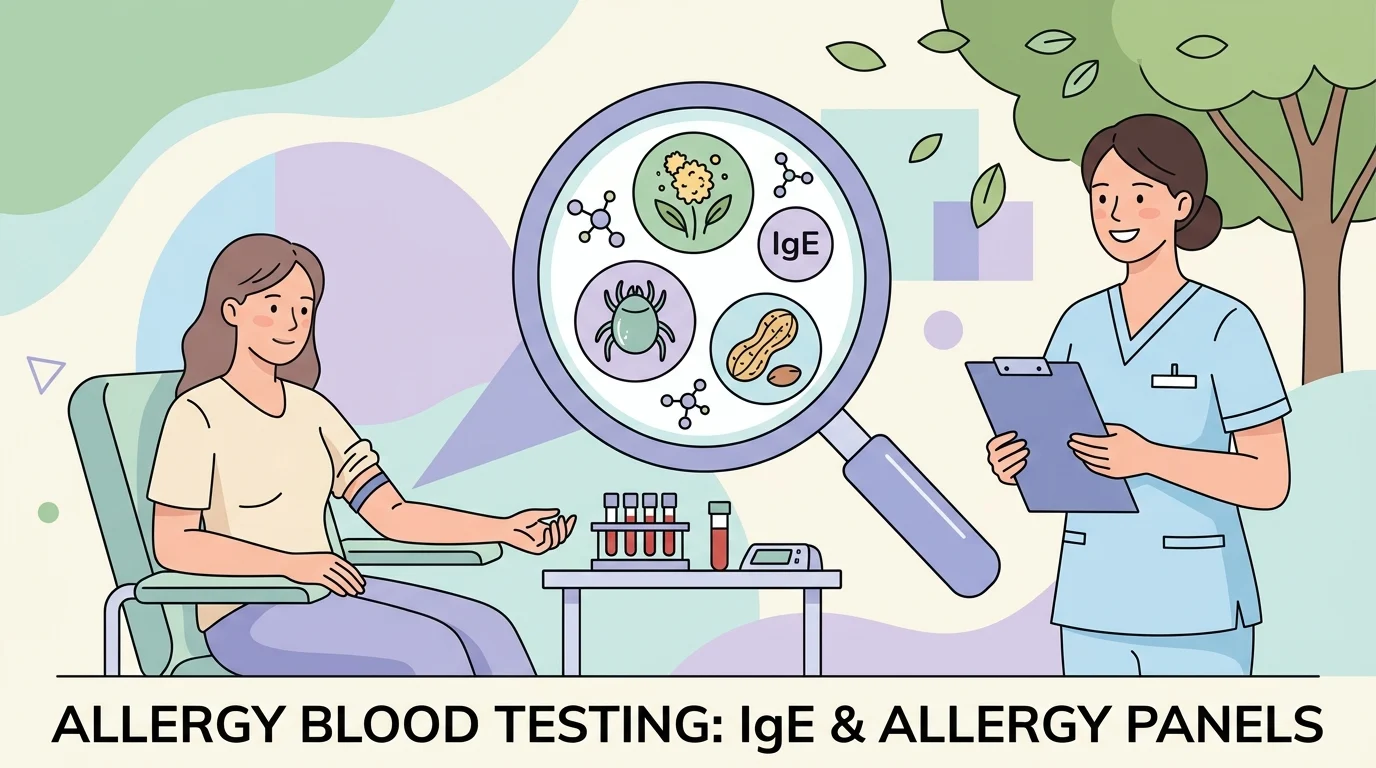
An allergy blood test is a laboratory test that measures immunoglobulin E (IgE), an antibody your immune system makes. Antibodies are proteins that normally help you fight infections. In people prone to allergies, the immune system also makes IgE against harmless substances such as pollen, peanuts, or animal dander. A blood test detects and quantifies that IgE.
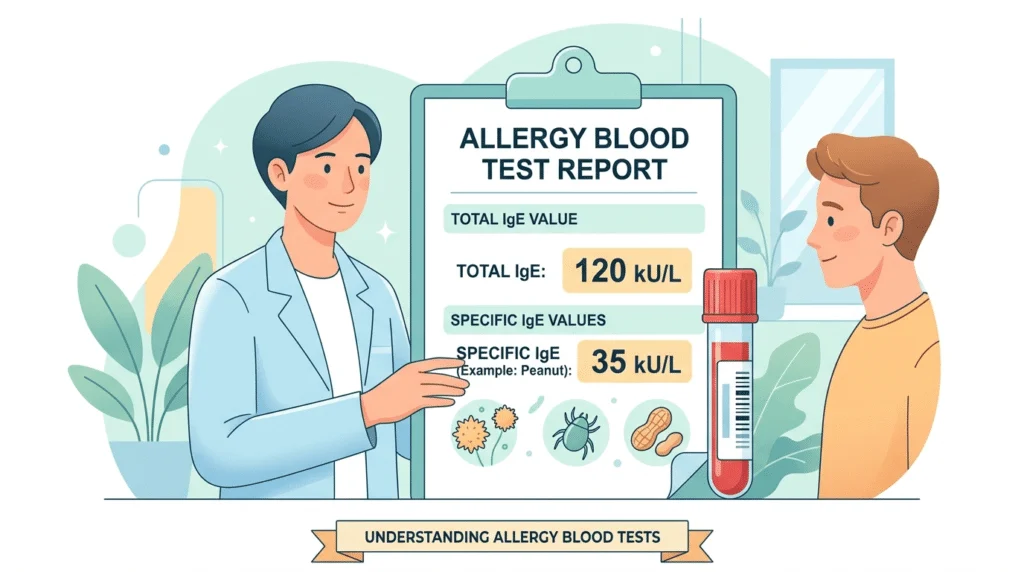
There are two broad types. A total IgE test measures the overall amount of IgE in your blood. A specific IgE test measures how much IgE you make against one particular allergen, and a separate measurement is run for each allergen tested.
Doctors usually order an allergy blood test when symptoms point to an allergy: recurrent sneezing and a runny nose (hay fever), itchy eyes, hives, eczema flares, breathing difficulties, or a reaction after a particular food or medicine. The goal is to identify likely triggers so they can be managed or avoided.
Only a small amount of blood is needed, drawn from a vein in your arm, and you do not need special preparation. According to MedlinePlus, an allergy blood test is often chosen when skin testing is not suitable, which makes it a flexible first step for many people.
Understanding IgE: the antibody behind allergic reactions
IgE is the key molecule in immediate allergic reactions. When someone sensitive to an allergen meets it, IgE attached to immune cells triggers the release of histamine and other chemicals, producing symptoms such as sneezing, hives, or itchy eyes.
IgE belongs to a family of antibodies that includes IgG and IgA, but only IgE is directly tied to classic, fast-onset allergy. That distinction matters when you interpret a report, because not every immune antibody signals an allergy.
Total IgE versus specific IgE
These two numbers answer different questions. A total IgE result reflects all the IgE in your blood added together. A raised total IgE suggests your immune system is making more allergy-type antibodies than usual, but it does not tell you what you are reacting to. Total IgE can also rise for reasons unrelated to allergy, such as certain parasitic infections or some immune conditions.
A specific IgE result is allergen-by-allergen. It can show, for example, that you make IgE against cat dander but not against dust mites. This is why doctors usually rely on specific IgE, guided by your symptoms, rather than total IgE alone.
What “sensitization” really means
This is the single most misunderstood point on an allergy report. A positive specific IgE result shows sensitization: your body has made IgE to that allergen. It does not, on its own, confirm that you will have symptoms when exposed.
Many people have detectable IgE to a food or pollen yet tolerate it with no reaction at all. The American College of Allergy, Asthma and Immunology stresses that a test result is only meaningful alongside your clinical history. In practice, a negative result is often the more reliable signal, because it helps rule allergy out.
Types of allergy blood tests and allergy panels
Blood testing is not one single test but a menu of options, and choosing the right one depends on your symptoms.
Single-allergen specific IgE tests
Here the laboratory measures IgE to one carefully chosen allergen, such as peanut, egg white, birch pollen, or a specific antibiotic. This targeted approach works best when your history already points to a likely culprit, for instance breathing trouble or a rash after a particular food or a drug such as penicillin.
Allergy panels
An allergy panel bundles several related allergens into one request. Common groupings include food panels (for example milk, egg, peanut, soy, wheat, and fish) and environmental or “inhalant” panels (pollens, dust mites, moulds, and animal dander). Panels are efficient and use a single blood sample, but they have a trade-off: testing for allergens that your history does not suggest raises the chance of a positive result that has no clinical meaning. That is one reason allergists discourage screening “everything at once.”
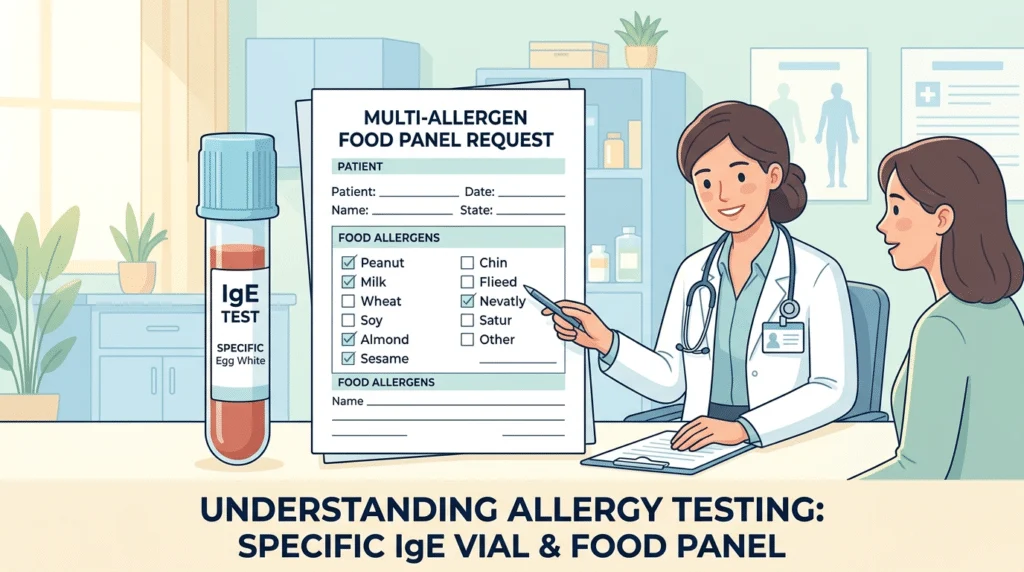
Component-resolved (molecular) testing
A newer option, component-resolved diagnostics, looks beyond the whole allergen to the individual proteins inside it. A peanut, for example, contains several proteins, and IgE to some of them (such as the storage protein Ara h 2) is more closely linked to serious reactions than IgE to others. Component testing can therefore help refine risk and is increasingly used for complex cases, though it is interpreted by a specialist rather than read off a panel. A common use is to separate a genuine, potentially serious food allergy from a milder cross-reaction, where IgE raised against pollen also reacts to a related protein in a fruit or nut and produces only mild, local symptoms.
You may also see the older term RAST on some reports. Modern laboratories use methods such as ImmunoCAP, which are more standardised; RAST simply refers to the original technique and no longer involves radioactivity.
How to read your allergy blood test results
Specific IgE is usually reported as a number in kU/L (kilo-units per litre) and grouped into a class from 0 to 6. Higher numbers mean more IgE was detected. The table below shows a commonly used laboratory scale, though exact cut-offs vary between laboratories and methods, so always read your result against the reference range printed on your own report.
| Class | Specific IgE (kU/L) | Typical interpretation |
|---|---|---|
| 0 | Less than 0.35 | None detected |
| 1 | 0.35 – 0.69 | Low / borderline |
| 2 | 0.70 – 3.49 | Moderate |
| 3 | 3.50 – 17.4 | High |
| 4 | 17.5 – 49.9 | Very high |
| 5 | 50.0 – 99.9 | Very high |
| 6 | 100 or more | Extremely high |
One crucial caveat: a higher class signals a higher chance that you are sensitised, but it does not predict how severe a reaction would be. Someone with a class 2 result can react more strongly than someone with a class 5 result. Severity depends on many factors, not the number alone.
Borderline results, often class 1, sit in a grey zone. A low-positive figure may reflect mild sensitisation, a fading old allergy, or simply a value close to the detection threshold, and it carries the most weight when it lines up with your symptoms. Your total IgE can add context here: a very low total IgE alongside a low specific result makes a meaningful allergy less likely, while a high total IgE can lift many specific values at once and occasionally produce weak positives that are not clinically relevant. This is another reason the numbers are read together, and with your history, rather than in isolation.
If your report also shows an “H” or “L” beside other values, our guide on how to read blood test results explains the general layout. Wondering about timing? See how long blood test results take for typical turnaround.
A related clue can appear on a standard complete blood count: a raised eosinophil count (a type of white blood cell) is sometimes seen in allergic conditions, although it is not specific to allergy.
Allergy blood test versus skin prick test versus oral food challenge
Blood testing is one of three main ways to investigate allergy, and each has a clear role. The table compares them.
| Feature | Allergy blood test (specific IgE) | Skin prick test | Oral food challenge |
|---|---|---|---|
| What it measures | IgE antibodies in your blood | A skin reaction (a small raised bump) | Your actual response to eating the food |
| Where it is done | Blood drawn, sent to a lab | In a clinic, on the forearm or back | In a clinic or hospital, under supervision |
| Time to result | Usually a few days | About 15 – 20 minutes | Several hours |
| Affected by antihistamines | No | Yes — usually stopped several days before | Not applicable |
| Suitable with eczema or widespread rash | Yes | Often difficult | Depends |
| Suitable in pregnancy | Yes | Often avoided | Only if clearly safe |
| Main role | Flexible first-line option | Fast, preferred by many allergists | Most definitive for confirming food allergy |
The practical takeaways are well established. A blood test is convenient because it is not disturbed by allergy medicines and can be performed at any age, including in people with extensive eczema or a widespread skin rash where skin testing is hard. The oral food challenge remains the most accurate way to confirm or exclude a true food allergy, which is why it is reserved for supervised settings.
After your results: a simple framework
A result on its own rarely settles the question. The following steps reflect how clinicians actually use these tests.
- Start with the story, not the number. What symptoms did you have, how soon after exposure, and were they reproducible? A positive test that matches a clear reaction is far more telling than an isolated number.
- Match results to symptoms. A positive result to a food you eat happily, with no symptoms, usually means sensitisation without allergy. A clear reaction history plus positive IgE points more firmly toward allergy.
- Treat a negative result as reassuring but not absolute. Negative specific IgE is good evidence against allergy, yet rare reactions can occur with undetectable IgE, so an unconvincing result deserves follow-up.
- Ask whether confirmation is needed. For foods, a supervised oral challenge may be the next step. For some triggers, component testing refines the picture.
- Bring it to a professional. An allergist combines history, examination, and the right tests to reach a diagnosis and a management plan.
Why IgG “food sensitivity” tests are not recommended
You may see direct-to-consumer kits that measure IgG to foods and market the results as “food sensitivities” or “delayed allergies.” Leading allergy organisations advise against using IgG food testing to diagnose food allergy or intolerance. IgG to foods is generally a normal sign of exposure, not of disease, and a positive panel can lead to unnecessary food avoidance. If you are weighing one of these tests, discuss it with a clinician first.
When to see a doctor or allergist
An allergy blood test is a tool for planning, not a substitute for medical care. You should seek professional advice if your symptoms are persistent, are getting worse, or interfere with sleep, school, work, or daily life. Speak to a doctor before changing your diet based on a test result, especially for children, so that you avoid cutting out foods unnecessarily.
Some situations are urgent. Symptoms such as a shortness of breath after eating, swelling of the lips or throat, widespread hives, dizziness, or collapse can signal anaphylaxis, a severe whole-body reaction that needs emergency treatment with adrenaline (epinephrine) and a call for emergency help. After a suspected severe reaction, a clinician may check a serum tryptase level, a marker that rises when allergy cells are strongly activated.
It also helps to remember that allergy rarely travels alone. Conditions such as asthma, eczema, and allergic conjunctivitis (red, itchy eyes) often overlap, and a fuller assessment looks at the whole picture rather than one number.
Glossary
- Allergen: A normally harmless substance, such as pollen, peanut, or pet dander, that triggers an allergic reaction in sensitive people.
- Allergy panel: A grouped blood test that measures specific IgE to several related allergens at once, such as a food panel or an environmental panel.
- Anaphylaxis: A severe, rapid, whole-body allergic reaction that can affect breathing and blood pressure and requires emergency treatment.
- Atopy: An inherited tendency to develop allergic conditions such as hay fever, asthma, and eczema.
- Component-resolved diagnostics (CRD): A type of testing that measures IgE to individual proteins within an allergen to refine the assessment of risk.
- Eosinophils: A type of white blood cell, counted on a complete blood count, that can be raised in some allergic conditions.
- ImmunoCAP: A widely used modern laboratory method for measuring specific IgE; it replaced the older RAST technique.
- Immunoglobulin E (IgE): The antibody central to immediate allergic reactions, measured by an allergy blood test.
- Sensitization: The presence of IgE to an allergen, which shows immune recognition but does not by itself confirm clinical allergy.
- Total IgE: A measurement of all IgE in the blood combined, which can suggest an allergic tendency without identifying the trigger.
Frequently asked questions
Do I need to fast or stop my allergy medicines before an allergy blood test?
For most allergy blood tests you do not need to fast, and you usually do not need to stop antihistamines or other allergy medicines. This is a key difference from skin prick testing, where antihistamines are typically paused for several days because they can mask the skin reaction. A blood test measures IgE in a sample sent to a laboratory, so your medicines do not change the result. Always follow the specific instructions from your clinic or laboratory, as some combined appointments or specialised tests may have their own requirements.
How long does an allergy blood test take, and when will I get the results?
The blood draw itself usually takes only a few minutes. The laboratory analysis is what takes time: results are commonly ready within a few days, though this varies with the laboratory, the number of allergens tested, and how your results are returned to you. Panels and specialised component testing can take a little longer. If your results are slow to arrive or you do not understand them, contact the clinic that ordered the test rather than waiting in uncertainty.
Are high IgE levels dangerous?
A high IgE level is not a disease in itself and is not “dangerous” on its own. It indicates that your immune system is producing more allergy-type antibodies, which can reflect allergies, eczema, asthma, or sometimes non-allergic causes such as certain infections. Importantly, the size of the number does not predict how severe an allergic reaction would be. What matters is the full picture: your symptoms, your history, and which specific allergens are involved. A clinician interprets a high IgE level in that context rather than treating the number alone.
Can an allergy blood test give a false result?
Yes, like any test it is not perfect. A false positive means IgE is detected without any real-world allergy, which is why a positive result to a food you eat without trouble is common and usually harmless. A false negative, though less frequent, can occur, so a convincing reaction history may still warrant further assessment even after a negative result. This is exactly why a blood test is interpreted alongside your symptoms and, when needed, confirmed with skin testing or a supervised food challenge rather than used in isolation.
Can you lower your IgE levels?
There is no quick home remedy that reliably lowers IgE. Over time, consistently avoiding a confirmed allergen can reduce specific IgE to it, and allergen immunotherapy (allergy shots or drops) can change the immune response under specialist supervision. For certain conditions, doctors may prescribe a medicine that targets IgE directly. Any plan to influence IgE should be guided by a clinician, because the goal is to manage symptoms safely, not to chase a particular number on a report.
Can children have an allergy blood test?
Yes. Allergy blood tests can be performed at any age, and they are often chosen for young children because a single blood draw may be easier than skin testing, particularly if a child cannot stay still or has widespread eczema. Results are interpreted in the same careful way as for adults, always alongside the child’s symptoms and history. Parents should not remove foods from a child’s diet based on a test result alone, as unnecessary restriction can affect nutrition and growth; discuss any changes with a paediatrician or allergist first.
Sources
- Allergy Blood Test — MedlinePlus (National Library of Medicine, NIH)
- Allergy Blood Tests — Cleveland Clinic
- Testing and Diagnosis — American College of Allergy, Asthma and Immunology (ACAAI)
Further reading
- How to read your blood test results
- Complete blood count: how to read your results
- Serum tryptase: understanding this blood test
- Asthma: understanding this chronic respiratory disease
- Eczema: everything you need to know
Understand your lab results with AI DiagMe
Once you have your report in hand, the hard part is making sense of it. AI DiagMe helps you understand lab results in plain language, whether you are looking at specific IgE values, your total IgE, eosinophils on a complete blood count, or a serum tryptase reading after a reaction. It is built to help you grasp what each value means and what questions to ask, not to diagnose you or replace your doctor. If you have an allergy blood test or other results you would like clarified, try it today.
➡️ Get your results interpreted in minutes