
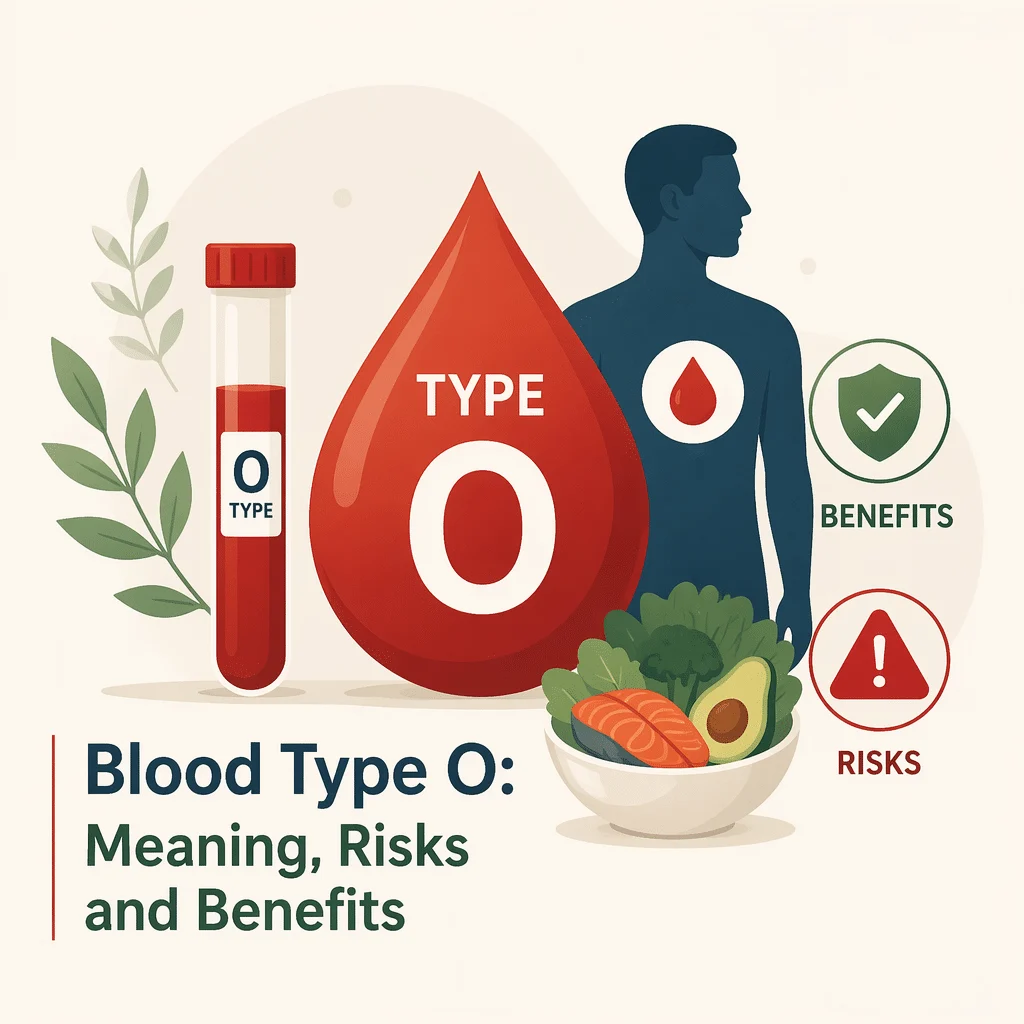
Blood type O is the most common blood group in the United States, yet many people are unsure what it really means for their health. If your lab report says O positive or O negative, your red blood cells carry no A or B antigens — the surface markers that define a blood group — and that small biological detail has real consequences for transfusions, pregnancy, and emergency care. In this article you will learn what defines blood type O, how you inherit it, who you can safely donate to and receive from, the modest health links researchers have found, and how to confirm your type and keep it on record. The aim is to explain the medical facts in plain language so you can act on accurate information rather than myths.
Most people with type O are Rh positive: see what O positive blood means in practice.
What does blood type O mean?
Blood type O means your red blood cells carry neither the A antigen nor the B antigen on their surface. Antigens are tiny markers that the immune system reads like name tags, deciding what belongs in your body and what does not. With no A or B markers to show, type O red cells look “blank” to other people’s immune systems.
There is a second, important half to type O. Your plasma — the liquid part of blood — contains both anti-A and anti-B antibodies. These are defensive proteins that would immediately attack any A or B red cells entering your bloodstream. This is the core reason transfusions for people with type O have to be matched so carefully, and it shapes nearly everything else about the group.
Type O is the most common ABO group in the United States, which is part of why it is so central to the blood supply. To see how it sits next to the other groups, our overview of the blood groups explained compares A, B, AB, and O in one place.
O positive vs O negative: what’s the difference?
Knowing you are “type O” is only half the label. The other half is the Rh factor, a separate protein on red blood cells. If your cells carry it, you are O positive (O+). If they do not, you are O negative (O−). The ABO and Rh systems are inherited independently, so they are reported together, for example as “O Rh positive.”
O positive is one of the most common blood types of all, while O negative is comparatively scarce: only about 7% of people in the United States have it. That rarity is exactly what makes O negative so valuable. Because O-negative red cells can be given to patients of any group, they are the first choice in emergencies and for fragile newborns when there is no time to confirm a type, and O-negative donors are encouraged to give regularly.
For you as a patient, the practical difference is mostly about transfusion and pregnancy. An O-positive person can receive O-positive or O-negative red cells, while an O-negative person can receive only O-negative. In pregnancy, being Rh negative is the detail that triggers extra screening and preventive treatment, regardless of your ABO group.
How the ABO blood group system works
The ABO blood group system classifies blood using two linked features: the antigens on your red cells and the antibodies in your plasma. Three gene versions, called alleles — A, B, and O — control the pattern. The A and B alleles each add a specific sugar structure to the red cell surface. The O allele makes an inactive version that adds nothing, so type O cells display neither sugar.
Your immune system learns early to tolerate your own antigens and to make antibodies against the ones you lack. Someone with type A makes anti-B antibodies, someone with type B makes anti-A, and someone with type O makes both. If incompatible red cells are transfused, those antibodies can trigger hemolysis — the rapid destruction of red cells — which is dangerous. To prevent this, laboratories type your ABO group and Rh factor, then often run an antibody screen and a crossmatch (mixing donor and recipient blood) before releasing blood for transfusion.
How you inherit blood type O
You inherit one ABO allele from each parent. The O allele is recessive, which means it only appears when you receive it from both sides — a genotype written as OO. Because A and B are dominant, a single A or B allele will mask an inherited O.
In practice, this is why two parents who are both type O will almost always have type O children, while parents who carry A or B can have children across several groups. Uncommon variants and weak subgroups exist and occasionally make a result harder to interpret, which is when a specialist or genetic testing helps. The same inheritance rules explain the profiles of type A, type B, and type AB.
Who blood type O can give to and receive from
Compatibility is the most practical reason to understand your blood type, and type O behaves very differently as a donor than as a recipient. The table below covers red blood cell transfusions, the most common type.
| If your blood type is | You can donate red cells to | You can receive red cells from |
|---|---|---|
| O negative (O−) | Every blood type (the universal red cell donor) | O negative only |
| O positive (O+) | O+, A+, B+, and AB+ | O+ and O− |
O-negative red cells can be transfused to almost anyone, which is why hospitals keep them on hand for emergencies and for newborns when there is no time to confirm a patient’s type. The trade-off is strict: people with type O can receive only type O red cells, so both O− and O+ units are in constant demand and often in short supply.
Plasma works in the opposite direction. Because type O plasma contains both anti-A and anti-B antibodies, it can be given only to other type O recipients. At the same time, a person with type O can receive plasma from any ABO group. In short, type O is the universal donor for red cells and the universal recipient for plasma. One caveat worth remembering: “universal donor” refers to red cells specifically, not to whole blood, and hospitals still cross-check whenever time allows.
Blood type O and your health: what the associations really mean
Researchers have connected ABO type to several health outcomes, but the differences are small for any individual and rarely change medical decisions on their own. The most consistent finding involves blood clotting. People with type O tend to have lower levels of von Willebrand factor and factor VIII, two proteins that help blood clot.
That pattern cuts both ways. On the benefit side, type O is associated with a modestly lower risk of venous thromboembolism — a clot forming in a vein — and, in some studies, a slightly lower risk of certain heart and vascular conditions compared with non-O groups. On the other side, lower clotting-protein levels can mean a marginally greater tendency to bleed in some situations. It is important to keep this in perspective: doctors assess clotting with a coagulation panel and a full clinical picture, not from your blood type, and a very low von Willebrand factor is the hallmark of von Willebrand disease rather than a normal type O result.
Blood group antigens also appear on cells beyond red blood cells, so they can interact with infections. ABO type shows up in research on stomach ulcers tied to H. pylori bacteria, on severe malaria, and on a few gut infections, with type O sometimes carrying higher and sometimes lower risk. These associations help scientists study populations, but they are not personal predictions and are not a reason for worry.
Blood type O in pregnancy and newborns
During pregnancy, the Rh factor usually matters more than ABO type. The well-known concern is an Rh-negative parent carrying an Rh-positive baby; this is screened for routinely and managed with a preventive injection (Rh immunoglobulin) that stops the parent’s immune system from reacting.
ABO type can play a smaller role. If a parent has type O and the baby inherits type A or B, the parent’s anti-A or anti-B antibodies can cross the placenta and break down some of the baby’s red cells. This causes ABO hemolytic disease of the newborn, which is usually mild — often appearing as jaundice in the first days of life — and far less serious than Rh disease. Most affected babies need only monitoring or light treatment such as phototherapy.
Routine blood tests during pregnancy include ABO and Rh typing plus an antibody screen, so any incompatibility is identified early and watched. If you are planning a pregnancy and do not know your type or Rh status, it is a reasonable thing to confirm with your clinician.
The blood type O diet: what the evidence says
You may have seen claims that people with type O should follow a high-protein, low-grain, “ancestral” diet. This comes from the popular “blood type diet,” which assigns a different eating plan to each ABO group and suggests that matching food to type improves health.
Scientific reviews have not found reliable evidence to support it. Studies do not show that your ABO type predicts which diet suits you best, or that eating “for your blood type” produces benefits beyond those of healthy eating in general. When people on these plans do feel better, the improvement usually traces back to eating more whole foods and less processed food — changes that help most people regardless of blood group.
A more dependable approach is a balanced diet tailored to your medical conditions, nutritional needs, and personal preferences. If you are considering a major change, or you live with a condition such as diabetes or high cholesterol, it is worth discussing it first with a doctor or a registered dietitian who can personalize the advice.
How to find out (and record) your blood type
Your blood type is confirmed with a quick laboratory test on a small sample drawn from a vein. Technicians mix your red cells with anti-A and anti-B reagents and watch for clumping, then double-check by testing your plasma against known A and B cells — a built-in cross-check sometimes called forward and reverse typing. A separate step identifies the Rh factor. When a result is unclear, modern labs can use molecular (DNA-based) methods to resolve it.
A typical report simply lists your ABO group and Rh status, for example “O Rh negative.” If the rest of your results look like a wall of abbreviations, our guide on how to read blood test results explains the layout, and you can see what the visit itself involves in our walkthrough of the blood test process. Because your type is verified before transfusions and operations, it commonly appears in blood work before surgery.
Keeping a record — on a wallet card or in your patient portal — is convenient, particularly for regular donors. Even so, hospitals always re-test before a transfusion rather than relying on a card, a note, or a tattoo, because the stakes of an error are high.
When your blood type matters most — and when to see a doctor
For day-to-day life, your blood type has little effect on your health. It becomes genuinely important in a handful of situations:
- Before and during surgery, when a transfusion may be required
- Throughout pregnancy, for ABO and Rh screening
- In emergencies and major trauma, when fast, safe transfusion can be lifesaving
- For organ, bone marrow, or stem cell transplants, where compatibility is essential
- For regular blood donors, especially those who are O negative
Knowing your type is helpful for planning and for your records, but it is not something you need to act on every day, and it does not replace medical care. Consider talking with a doctor if you are planning a pregnancy and are unsure of your or your partner’s Rh status, if you or close relatives have a history of unexplained bleeding or clotting, or if a lab result leaves you confused. A clinician can interpret your blood type alongside your symptoms, history, and other tests — which is always more meaningful than the type alone.
Glossary
| Term | Definition |
|---|---|
| ABO system | The main way blood is grouped — into A, B, AB, or O — based on antigens on red blood cells. |
| Antibody | A protein the immune system makes to find and attack substances it sees as foreign, such as unfamiliar blood antigens. |
| Antigen | A marker on the surface of a cell that the immune system can recognize as belonging or not belonging. |
| Crossmatch | A lab test that mixes a donor’s and a recipient’s blood to confirm they are compatible before transfusion. |
| Hemolytic disease of the newborn | A condition in which a parent’s antibodies attack a baby’s red blood cells; the ABO form is usually mild. |
| Rh factor | A separate blood protein (the D antigen); having it makes you Rh positive, lacking it makes you Rh negative. |
| Universal donor | A person whose red cells (O negative) can be given safely to almost any recipient in an emergency. |
| Von Willebrand factor | A protein that helps blood clot; people with type O tend to have lower levels of it. |
Frequently asked questions
Is blood type O the rarest blood type?
No. O positive is one of the most common blood types in the United States, so most people with type O are far from rare. O negative is a different story: only a small share of people have it, and because it can be transfused to almost anyone, it is in constant demand. So “type O” covers both a very common type (O+) and a scarcer, highly valued one (O−).
Does my blood type ever change?
For almost everyone, no. Your ABO and Rh type is set by the genes you inherited and stays the same for life. Very rare exceptions exist: a bone marrow or stem cell transplant from a donor with a different type can change it, and some cancers or infections may temporarily alter how a type reads in the lab. If a new result surprises you, it is worth asking your doctor to confirm it rather than assuming your type has truly changed.
Can two parents with blood type O have a child who is not type O?
In nearly all cases, no. Type O is recessive, so a type O parent carries two O alleles and can normally pass on only O. When both parents are type O, their children are almost always type O as well. The very rare exceptions involve unusual genetic variants, such as the Bombay phenotype, where standard testing can be misleading. If inheritance ever seems not to add up, a specialist can look more closely.
Is one blood type “healthier” than another?
Not in any meaningful way. Researchers have found small differences in average risk between blood groups — for example, type O is linked to a slightly lower chance of certain clots — but these effects are minor and do not predict any individual’s health. Lifestyle, family history, and standard risk factors matter far more. There is no “best” or “worst” blood type to have, and your group alone is not a reason to worry or to feel reassured.
Do I need to memorize my blood type for an emergency?
It is useful to know and to have written down, but you do not need to rely on memory. Hospitals always re-test a patient’s blood type before a transfusion rather than trusting a card, a tattoo, or a phone note, because a mistake could be dangerous. Knowing your type can still help with planning, donation, and your own records. The safest approach is to have it confirmed by a lab and noted in your medical file.
Can infections be influenced by blood type O?
To a small degree, yes. Blood group antigens sit on many cells, and some bacteria, viruses, and parasites interact with them, which can nudge the risk or severity of a few infections up or down. Type O appears in research on stomach ulcers linked to H. pylori and on severe malaria, among others. These links are modest and population-level, not personal predictions, so type O is not a reason to expect more or fewer infections in everyday life.
Sources
- MedlinePlus (National Institutes of Health): Blood typing
- Cleveland Clinic: Blood Types
- American Red Cross: Blood Types Explained
Further reading
- Blood Groups Explained: Types, Risks, and Testing
- Understanding the Rh System: Causes & Risks
- Blood Group A+: Health Guide, Risks & Benefits
- Blood Group B+: Meaning and Health Guide
- Blood Type AB: Meaning, Traits and Health Risks
Understand your lab results with AI DiagMe
Your blood type is only one line on a lab report, and the rest — from a blood typing (ABO and Rh grouping) result to a complete blood count or clotting tests — can be just as confusing. AI DiagMe is a tool that helps you understand what your lab results mean in clear, everyday language, so you can ask better questions and feel more prepared. It is designed to support the conversation with your healthcare team, not to diagnose or replace your doctor.
➡️ Get your results interpreted in minutes