



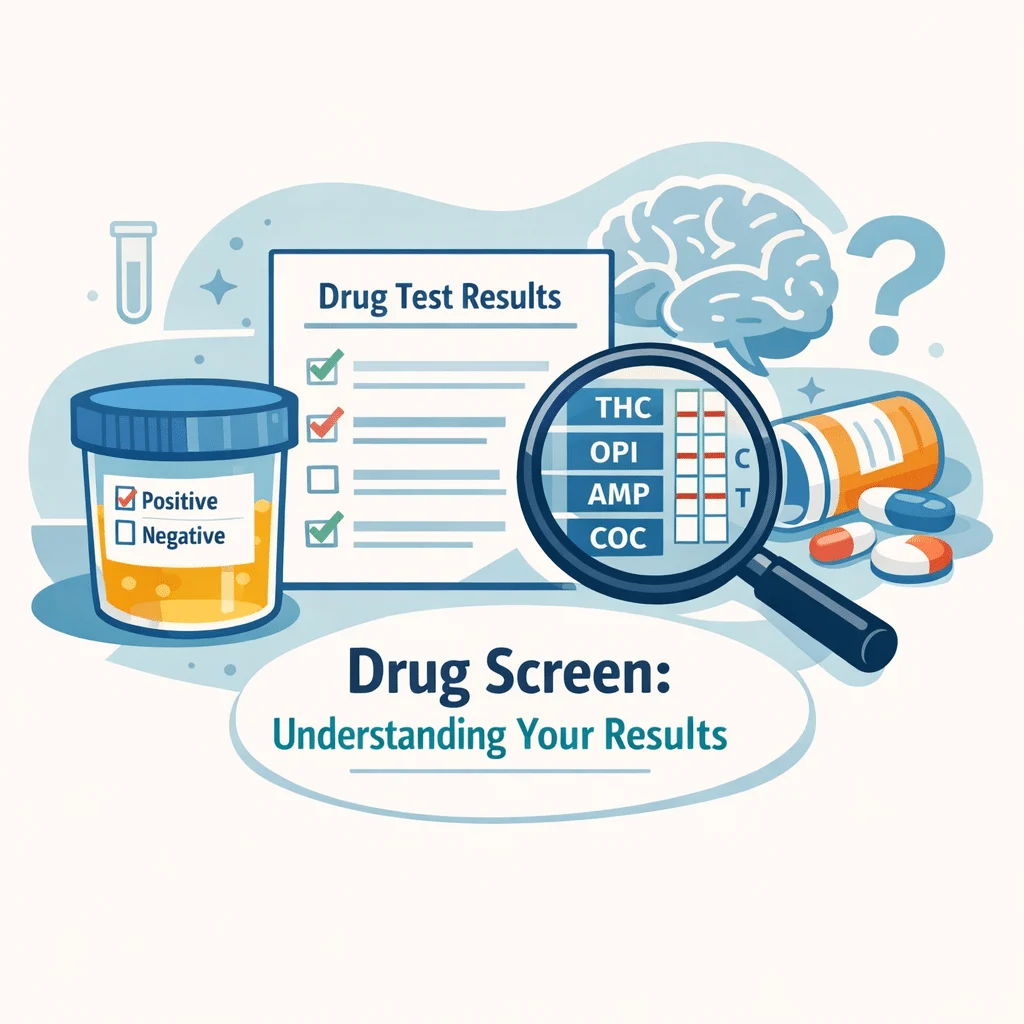
A urine drug screen is a first-pass laboratory test, not a verdict. It answers one narrow question: did this sample contain a substance or its breakdown product above a set concentration? It does not say how much was taken, when, or whether anyone was affected at the time of collection. That gap between what the test measures and what people assume it proves causes most of the distress. In this article you’ll learn how the screening step on a urine drug screen differs from confirmation, what a presumptive positive really is, why cutoffs and detection windows vary, which medicines and products trip the test, and what a dilute or invalid report means for you.
What a urine drug screen measures and how it works
A urine drug screen looks for drugs and, more often, for the compounds your body turns them into. Those breakdown products, called metabolites, persist in urine longer than the parent drug. It is why cocaine exposure is flagged by benzoylecgonine, and cannabis by a carboxy-THC metabolite rather than active THC.
The screening step: an immunoassay
Almost every urine drug screen starts with an immunoassay. Antibodies engineered to stick to a drug class produce a signal when they bind. The method is fast, cheap and easy to automate, so laboratories use it first. The trade-off is specificity: an antibody raised against amphetamine also grabs molecules that merely resemble amphetamine. That is the origin of most false positives: a documented limitation, not a laboratory error.
The confirmation step: mass spectrometry
A reacting urine drug screen is meant to be confirmed by a second, fundamentally different method. Gas chromatography-mass spectrometry (GC-MS) and liquid chromatography-tandem mass spectrometry (LC-MS-MS) separate the compounds in a sample and identify each by its molecular fingerprint. Confirmation names the exact substance rather than the class, so it distinguishes codeine from morphine, or one cannabinoid isomer from another.
Why the answer is yes or no, not a quantity
A urine drug screen reports against a threshold called a cutoff: above it, positive or non-negative; below it, negative. Urine concentration swings with how much you drink, so any number reflects hydration as much as dose. The result is a threshold crossing, not a measure of how much anyone took.
What each result status on a urine drug screen means
Result language is where readers get lost, because laboratories use different words for the same finding. The table below decodes the statuses you are most likely to see on a urine drug screen.
| Result status | What the lab saw | What it does NOT mean | Usual next step |
|---|---|---|---|
| Negative | No signal above the cutoff for any substance on the panel | Not proof that nothing was ever used; substances outside the panel, or below the cutoff, are invisible | Reported as negative; no confirmation performed |
| Presumptive positive or non-negative | The antibody reacted above the cutoff for one drug class | Not a confirmed finding, not an identified substance, not evidence by itself | Reflex confirmation by GC-MS or LC-MS-MS on the same sample |
| Confirmed positive | Mass spectrometry identified a specific compound above the confirmation cutoff | Not a dose, not a date of use, not proof of impairment or of a substance use disorder | Review with the ordering clinician or a Medical Review Officer, who checks for a prescription |
| Dilute | Creatinine and specific gravity both fell below the expected range for human urine | Not an accusation; heavy fluid intake and some medical conditions produce the same picture | Reported as dilute negative, or a fresh collection is requested |
| Adulterated or substituted | Values incompatible with human urine: an extreme pH, an added oxidizing agent, or absent biological markers | Not a drug-positive result; it is a statement about the sample, not a substance | Handled under the ordering program’s own rules, usually with a new, directly observed collection |
| Invalid or unsuitable | Interference, an unexplained result, or a sample that could not be tested | Not positive and not negative; the laboratory is declining to report, not making a finding | Recollection, often with an explanation requested from the donor |
Presumptive means presumptive
If your report says presumptive positive, screen only, or non-negative, the laboratory has not identified anything yet. Many reports now use non-negative deliberately, to stop readers treating a screening reaction as a finished result. Until confirmation runs, that urine drug screen result is only a flag.
Cutoffs and detection windows on a urine drug screen
Two numbers govern whether a urine drug screen comes back positive: the cutoff the laboratory set, and how long the substance stays detectable. Neither is fixed across laboratories, so the same sample can be positive at one lab and negative at another.
What a cutoff actually does
A cutoff is a deliberate compromise. Set it low and the test catches more genuine exposure but also more interference. Set it high and it is harder to trip in error but misses real, low-level exposure. Confirmation cutoffs are usually lower, because mass spectrometry is more specific.
Detection windows are ranges, not guarantees
Detection windows on a urine drug screen describe roughly how long a substance or its metabolite stays above a typical cutoff. They shift with dose, frequency of use, body composition, kidney function and the cutoff in force. Treat the figures below as commonly cited ranges, never as a personal schedule.
| Substance class | Commonly cited urine detection range | What widens or narrows it |
|---|---|---|
| Amphetamines and methamphetamine | Around 1 to 3 days | Urine pH and dose; heavy repeated use extends it |
| Cocaine (as benzoylecgonine) | Around 2 to 4 days | Heavy use can push detection to a week or more |
| Cannabis (as carboxy-THC) | Around 1 to 3 days after a single use; up to several weeks with daily use | THC is stored in fat, so frequency and body composition matter most here |
| Opiates such as codeine and morphine | Around 1 to 3 days | Some opioids are not detected by an opiate assay |
| Fentanyl | Often 1 to 3 days, longer after sustained use | Fentanyl is fat-soluble and can leach out of tissue for weeks |
| Benzodiazepines | Around 1 to 3 days for short-acting agents; weeks for long-acting ones | Half-life of the specific drug, and whether the assay handles glucuronide metabolites |
| Methadone | Around 3 to 7 days | Requires a dedicated assay; not covered by a generic opiate screen |
Alcohol sits outside this table: it is assessed through different markers of its own, covered in a separate guide to alcohol and EtG detection in urine. Sustained heavy drinking is also tracked indirectly by a blood enzyme described in our guide to the GGT enzyme and what raises it.
Why a urine drug screen can flag the wrong substance
Cross-reactivity is the technical name for an antibody binding something it was not designed to detect. It is common enough that laboratories publish interference lists, and it is why confirmation exists.
Prescription and over-the-counter medicines
Many ordinary medicines have been reported to trigger a presumptive positive on a urine drug screen. Decongestants containing pseudoephedrine, several antidepressants, certain quinolone antibiotics, some anti-inflammatory drugs, dextromethorphan in cough preparations and older heartburn medicines such as ranitidine all appear in the interference literature. Which ones matter depends on the assay your laboratory uses.
If you take a prescribed medicine, the correct action is never to stop or change it. Tell the collector, the Medical Review Officer or the ordering clinician what you take, and bring the prescription details. Disclosure resolves these results.
Foods and hemp-derived products
Poppy seeds contain small amounts of morphine and can raise an opiate screen, which is why federal opiate cutoffs were raised. Hemp and CBD products are the newer problem: many contain measurable THC despite being sold as THC-free, and some are used to make delta-8-THC, a close relative of the delta-9-THC in cannabis.
A urine drug screen is not part of a routine urinalysis
People often assume drug testing is included in the standard urine panel. It is not. That panel looks at chemistry and cells, and we cover it in a guide to reading a routine urinalysis report and an overview of the chemistry results on a standard urine panel. A urine drug screen must be ordered specifically, and it finds only what its panel includes.
Specimen validity: dilute, adulterated and invalid results
Before interpreting drugs, a laboratory checks whether the sample looks like fresh human urine. Specimen validity testing on a urine drug screen produces most of the non-drug language on a report.
Temperature, appearance and the chain of custody
Collection sites read the temperature of the cup within about four minutes, because urine leaves the body warm. Color and clarity are noted too. The sample then travels under a chain of custody: a signed, unbroken trail recording who held it at every point. If that trail breaks, the result is unusable whatever the chemistry shows, which is also why it helps to know how hydration and diet change the color of urine from day to day.
Creatinine and specific gravity as concentration checks
Creatinine is produced by muscle at a steady rate, so it is a reliable yardstick for how concentrated a sample is; specific gravity measures the same by density. When both fall below the expected range, the sample is reported as dilute: a statement about water content, nothing more. We explain the wider role of urine creatinine as a concentration reference and what a high or low reading means for urine specific gravity in a lab report.
What dilute, adulterated and invalid actually signal
A dilute urine drug screen result is not a positive result and not an admission of anything. Heavy fluid intake, working outdoors in heat, diuretics and conditions that increase urine output all produce it, and programs generally request another sample.
Adulterated and substituted are different findings: the chemistry is not compatible with fresh human urine, whether through an extreme pH, an added oxidizing agent, or missing biological markers. Laboratories check pH here too, and everyday factors move it, as we describe in an article on the things that shift urine pH. In regulated programs these findings follow the program’s own rules rather than drug-result rules, so ask the ordering party, or a qualified professional, what applies to you.
Most collections are unobserved, in a prepared restroom. Directly observed collection, where a same-gender observer watches the void, is reserved for defined circumstances such as a prior invalid or substituted result.
Panels, the Medical Review Officer and the limits of a urine drug screen
5-panel, 10-panel and expanded panels
Panels are menus, and a urine drug screen finds only what its menu includes. A classic 5-panel covers cannabis, cocaine, amphetamines, opiates and phencyclidine. A 10-panel typically adds benzodiazepines, barbiturates, methadone, propoxyphene and methaqualone. Expanded panels add fentanyl, buprenorphine, tramadol or synthetic cannabinoids. Many substances in circulation are not on standard menus, so a negative screen never means nothing was present.
What a Medical Review Officer does
In regulated workplace testing, a confirmed positive does not go straight to the employer. It goes first to a Medical Review Officer, a licensed physician trained in toxicology interpretation. The MRO contacts the donor privately, asks whether there is a legitimate medical explanation, and can report the result as negative if the explanation holds. That is the designed route when a prescribed medicine explains a finding.
A positive result is not proof of impairment
A urine drug screen detects a substance or its metabolite over a window that may stretch for days or weeks. It cannot establish that anyone was affected at the moment of collection. Cannabis shows the gap most sharply: carboxy-THC can persist for weeks after any psychoactive effect has passed. A positive result documents exposure within a window, not impairment, dependence or wrongdoing.
What recent research shows about urine drug screen accuracy
Here is what studies of urine drug screen accuracy from the past three years found, and what each changes for you.
False positives span nearly every drug class
A 2026 review in the Journal of Analytical Toxicology gathered 61 published reports of substances that tripped an immunoassay screen between 2013 and 2024, spanning opioid, amphetamine, benzodiazepine, cannabinoid and cocaine assays. Its authors concluded that despite better antibodies, screening results remain presumptive and need confirmation. What this means for you: a screening reaction is an expected event, and asking whether confirmation was performed is reasonable. A 2025 review in Clinics in Laboratory Medicine agreed.
An antidepressant can trip an amphetamine screen
Researchers tested medicines against a widely used amphetamine immunoassay in 2024 and showed that m-chlorophenylpiperazine, the main breakdown product of the antidepressant trazodone, and the wakefulness drug solriamfetol both produced positive amphetamine readings. What this means for you: if either could explain a presumptive positive, there is published evidence to raise with the Medical Review Officer. It is a reason to disclose a prescription, never a reason to stop it.
Delta-8 hemp products react with cannabis assays
A 2023 study run with the national workplace testing certification program found that the delta-8-THC metabolite cross-reacted with cannabinoid immunoassay kits from three manufacturers about as strongly as the delta-9 metabolite. When certified laboratories analyzed the same samples by mass spectrometry, none reported a false delta-9 positive. What this means for you: a legally bought hemp product can explain a cannabinoid reaction, and confirmation sorts it out. A 2024 review added that THC concentrations do not track with impairment.
Dilute samples are uncommon, not evidence of tampering
A 2026 analysis of just over 24,000 urine records found roughly one specimen in 200 adjudicated as dilute, and its authors were explicit that this does not establish manipulation. What this means for you: a dilute report is uncommon and carries no inference about intent. A 2025 review of specimen validity testing explains why laboratories combine temperature, appearance, pH, specific gravity and creatinine rather than one check.
Rapid test strips are unreliable on their own
A 2025 evaluation of xylazine test strips from seven manufacturers found that lidocaine, ketamine, diphenhydramine and cetirizine produced false positives, with performance differing between products. What this means for you: rapid strips carry the same presumptive status as any other immunoassay and need laboratory confirmation.
When to talk to a clinician
Contact the ordering clinician or the Medical Review Officer promptly if a urine drug screen returns a presumptive positive you cannot account for, and ask whether confirmation by mass spectrometry was performed and what it showed. Bring a written list of every prescription, over-the-counter medicine, supplement and hemp or CBD product you use.
Seek advice sooner if a result conflicts with what you know to be true, or if you must explain a dilute or invalid finding. If a report arrives alongside symptoms such as confusion, breathing difficulty, chest pain or a suspected overdose, that is an emergency. For questions about employment, custody or court programs, ask the ordering party and a qualified professional. Where a clinician is investigating something other than drug exposure, different urine tests apply, such as the examination of cells shed into urine or the 24-hour urine cortisol measurement.
Frequently asked questions
What does non-negative mean on a urine drug screen?
Non-negative means the initial immunoassay reacted above the cutoff, but nothing has been identified yet. Laboratories increasingly prefer this wording over presumptive positive because it discourages readers from treating a screening reaction as a finished result. The sample is then sent for confirmation by mass spectrometry, which either identifies a specific compound above the confirmation cutoff or does not. Until that second test is complete, non-negative is best understood as a flag requiring verification, not a finding about you.
Can a urine drug test show how much someone took?
No. A urine result reflects the concentration in that particular sample, and urine concentration depends heavily on hydration, kidney function and how long it has been since the last void. Two people who took an identical amount can produce very different numbers, and the same person can produce different numbers hours apart. Even confirmation by mass spectrometry, which is quantitative, cannot be back-calculated to a dose or a time of use in any reliable way. Testing establishes presence above a threshold, not quantity.
How long does a urine drug screen detect drugs?
It depends on the substance, the dose, how frequently it was used, body composition, kidney function and the cutoff the laboratory applies. Typical ranges run from about one to three days for stimulants and short-acting opiates, two to four days for cocaine metabolites, and up to several weeks for cannabis in people who use daily. Long-acting benzodiazepines and fentanyl after sustained use can also remain detectable well beyond a few days. These are population ranges for orientation and cannot be applied to any individual with confidence.
Does a negative result mean no drug use?
Not necessarily. A negative result means nothing on the ordered panel exceeded its cutoff in that sample. Substances that were not on the panel are invisible, however much was present. Use that fell outside the detection window, or exposure too small to reach the cutoff, also produces a negative. Many newer synthetic compounds are not covered by standard panels at all. A negative is genuinely reassuring within the panel’s limits, but it is not a statement that nothing was used.
What happens if my sample comes back dilute?
A dilute result means creatinine and specific gravity both fell below the range expected for human urine, indicating a watery sample. It is not a positive result and carries no inference about intent. Drinking large volumes of fluid, hot working conditions, diuretic medicines and several medical conditions all produce it. Most programs simply ask for a repeat collection, sometimes with guidance on fluid intake beforehand. If you receive one, ask the ordering party what their procedure is rather than assuming a consequence.
Should I stop my medication before a drug test?
No. Never stop, start or adjust a prescribed medicine because of a test. The correct step is disclosure: tell the collector, the Medical Review Officer or the ordering clinician exactly what you take, and provide prescription documentation. The MRO process exists specifically to identify legitimate medical explanations and can report a confirmed result as negative when a valid prescription accounts for it. Stopping a medicine risks your health and does not improve the accuracy of the test.
Glossary of key terms
| Term | Definition |
|---|---|
| Immunoassay | A fast test that uses antibodies to detect a class of drugs. It is the screening step, and it is presumptive rather than definitive. |
| Metabolite | A compound the body produces when it breaks a drug down. Many urine tests detect the metabolite rather than the original drug. |
| Cutoff | The concentration at or above which a sample is reported positive. Below it, the sample is reported negative even if a trace is present. |
| Cross-reactivity | An antibody binding a compound it was not designed to detect, because the molecules resemble one another. It is the main cause of false positives. |
| GC-MS and LC-MS-MS | Gas chromatography-mass spectrometry and liquid chromatography-tandem mass spectrometry: confirmation methods that identify a specific compound by its molecular fingerprint. |
| Detection window | The approximate period during which a substance or its metabolite stays detectable above the cutoff. It varies widely between individuals. |
| Specimen validity testing | Checks that confirm a sample is fresh human urine, using temperature, appearance, pH, specific gravity and creatinine. |
| Chain of custody | The documented, unbroken record of who handled a sample from collection to result. A break in it invalidates the report. |
| Medical Review Officer (MRO) | A licensed physician trained in toxicology who reviews confirmed positive results, contacts the donor and checks for a legitimate medical explanation. |
| Panel | The defined list of drug classes a given test looks for, such as a 5-panel or 10-panel. Anything outside the panel is not detected. |
Sources
- MedlinePlus, National Library of Medicine — Drug Testing: MedlinePlus Medical Test, 2025. MedlinePlus
- National Institute on Drug Abuse (NIDA), National Institutes of Health — What do drug tests really tell us?, 2024. NIDA
- Substance Abuse and Mental Health Services Administration (SAMHSA) — Frequently Asked Questions About Federal Workplace Drug Testing, 2025. SAMHSA
- U.S. Food and Drug Administration — Drugs of Abuse Tests, 2024. FDA
- Saitman A, Fitzgerald RL, Lund K, Suhandynata RT, Menlyadiev M — False positive urine drug screens — Journal of Analytical Toxicology, 2026. PubMed · DOI
- Altawallbeh G — Practical Considerations for Implementing Immunoassays for Urine Drug Testing in Clinical Laboratories — Clinics in Laboratory Medicine, 2025. PubMed · DOI
- Rackow AR, Knezevic CE — Solriamfetol and m-chlorophenylpiperazine cause false positive amphetamine results on urine drug screening — Journal of Analytical Toxicology, 2024. PubMed · DOI
- Mullen LD, Hart ED, Vikingsson S, Winecker RE, Hayes E, Flegel R — Δ8-THC-COOH cross-reactivity with cannabinoid immunoassay kits and interference in chromatographic testing methods — Journal of Analytical Toxicology, 2023. PubMed · DOI
- DeGregorio MW, Kao CJ, Wurz GT — Complexity of Translating Analytics to Recent Cannabis Use and Impairment — Journal of AOAC International, 2024. PubMed · DOI
- Fyffe-Freil RC, Omosule CL — Specimen Validity Testing in the Toxicology Laboratory — Clinics in Laboratory Medicine, 2025. PubMed · DOI
- Bozdayi MA, Çakırca G, Bozdayi İG — Application-related patterns of diluted urine specimens in routine urine drug testing — Clinica Chimica Acta, 2026. PubMed · DOI
- Scott L, Davis K, Park JN, Majeed S — Evaluating the Sensitivity, Selectivity, and Cross-Reactivity of Lateral Flow Immunoassay Xylazine Test Strips — The Journal of Applied Laboratory Medicine, 2025. PubMed · DOI
Further reading
- Casts found in a urine sample and what they indicate
- Epithelial cells reported on a urine test
- Bacteria in urine and when it signals an infection
- Yeast in a urine sample: contamination or infection
- Sodium and potassium measured in urine
Understand your lab results with AI DiagMe
A urine drug screen is one of many reports that arrive full of threshold language and abbreviations with no explanation attached. AI DiagMe reads your laboratory results and translates them into plain language, whether that is a urine creatinine and specific gravity panel, a routine urine analysis, a kidney panel or a liver panel. It helps you understand what was measured and what the numbers describe, so you can ask better questions. It does not diagnose, and it does not replace your doctor or a Medical Review Officer.
Get your results interpreted in minutes