













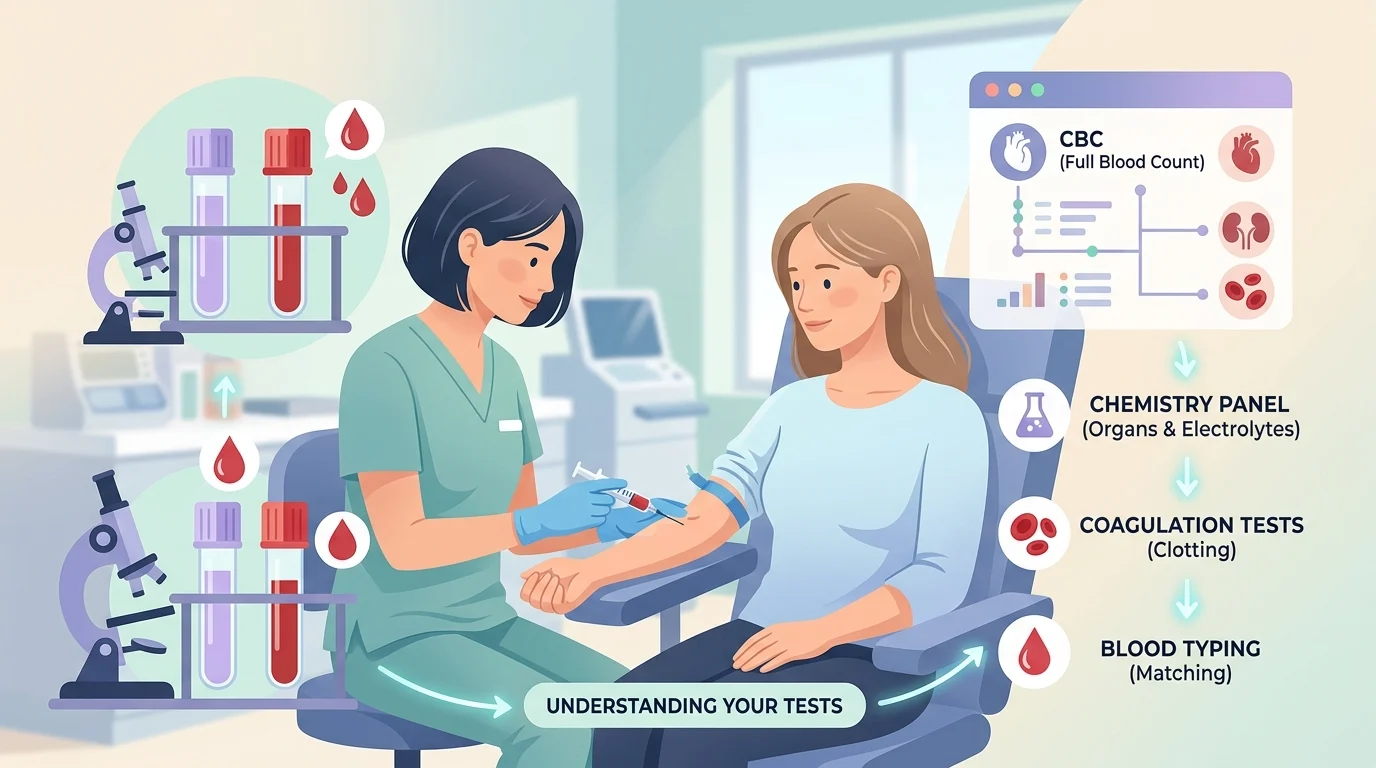
If you have an operation scheduled, blood work before surgery is one of the first things your care team may arrange. These are simple blood tests, taken from a sample drawn from a vein in your arm, that help your surgeon and anesthesia team check that your body is ready for the procedure. Not everyone needs the same tests, and some healthy people having minor surgery may need none at all. This guide explains, in plain language, which tests are commonly done, what doctors look for, when the blood is usually drawn, and what an unexpected result can mean. You will also find a clear comparison table, a guide to which tests fit which situation, and answers to common questions about fasting, drugs, and timing.

What is blood work before surgery?
Blood work before surgery is a set of laboratory tests run on a small blood sample before an operation. It is usually arranged during a preoperative assessment (a check-up before surgery), sometimes at your doctor’s office and sometimes at the hospital.
The goal is not to diagnose new diseases in everyone. It is to spot specific issues that could change how your surgery or anesthesia is handled, such as a low blood count or a clotting problem. If you want a refresher on the numbers and reference ranges these tests produce, our guide on how to read your blood test results breaks it down step by step.
An important point sets the tone for the rest of this guide: modern practice favors selective testing. Tests are matched to the size of your operation and your health, rather than ordering the same panel for everyone.
Blood work is only one part of a preoperative assessment. Depending on your age, your health, and the operation, your team may also arrange a heart tracing (ECG), a chest X-ray, or a urine test. Blood tests answer questions those other checks cannot, which is why they are so common before surgery.
Why are blood tests done before surgery?
Doctors order these tests for a few clear reasons. Each one is about keeping your surgery as safe and smooth as possible.
- Check for anemia or bleeding risk. A low red blood cell count (anemia) can affect how well you tolerate surgery, and a low platelet count can affect bleeding.
- Confirm your organs are working well. Your kidneys and liver process medicines and anesthesia, so doctors want to see how they are functioning.
- Balance your body chemistry. Salts called electrolytes need to be in a safe range for your heart and fluids during the operation.
- Set a baseline. Having “before” numbers makes it easier to spot meaningful changes afterward.
- Plan for transfusion if needed. For operations where notable blood loss is possible, the team prepares matched blood in advance.
In short, the tests give your team information they cannot get from a conversation and a physical exam alone.
What do they look for in blood work before surgery?
This is the most common question people ask, and the honest answer is: a handful of specific things rather than “everything.” The table below summarizes the tests you are most likely to see, what each one measures, and why it matters before an operation.

Common pre-op blood tests at a glance
| Test | What it measures | Why it matters before surgery |
|---|---|---|
| Complete blood count (CBC) | Red cells, white cells, and platelets | Flags anemia (low red cells), possible infection, or a low platelet count that could affect bleeding |
| Metabolic panel (BMP or CMP) | Blood sugar, electrolytes, and kidney and liver markers | Shows how your kidneys and liver are working and whether your body chemistry is balanced for anesthesia |
| Electrolytes (sodium, potassium, and others) | Mineral balance in the blood | Abnormal potassium or sodium can affect heart rhythm and fluid management during surgery |
| Kidney markers (creatinine, eGFR, urea) | How well the kidneys filter waste | Helps the team dose medicines safely and predict how you handle fluids |
| Blood sugar and HbA1c | Current glucose and a 3-month average | Important if you have diabetes or are at risk; high sugar can slow healing and raise infection risk |
| Coagulation panel (PT, INR, aPTT) | How quickly your blood clots | Identifies bleeding risk, especially if you take blood thinners |
| Blood type and screen | Your blood group and certain antibodies | Lets the lab prepare matched blood in case a transfusion is needed |
| Pregnancy test (often urine) | Whether you might be pregnant | A safety step for anyone who could be pregnant, since surgery and anesthesia carry risks to a pregnancy |
| Infection screening (case by case) | Markers such as hepatitis or HIV | Ordered only when it is clinically relevant, not as a routine test for everyone |
A few of these deserve a closer look. The complete blood count is the workhorse of pre-op testing, while the comprehensive metabolic panel bundles together your blood sugar, electrolytes, and signals of kidney and liver health.
If anemia is found, doctors often look at iron stores too, because low ferritin is a common and treatable cause. For people with diabetes, a diabetes blood test that includes HbA1c helps the team manage blood sugar around the operation.
Clotting is checked with a coagulation panel, which is especially relevant if you take anticoagulant medicines. When a transfusion is a real possibility, a “type and screen” is done; you can read more about what your result means in our overview of blood groups and testing. Screening for infections such as HIV is not universal; it is offered only when there is a clear medical reason and with your knowledge.
Doctors rarely act on a single number in isolation. They read your results as a pattern and compare them with your symptoms, your medical history, and any earlier tests. A small change on its own often matters less than a clear trend or a value that fits with how you feel. This is one reason two people with the same result can be advised differently.
Which tests will you actually need?
Here is where the selective approach matters most. National guidance from NICE (the UK’s National Institute for Health and Care Excellence) recommends matching tests to the type of operation and your health, rather than testing everyone the same way. Research summarized by Michigan Medicine points in the same direction: routine tests before low-risk surgery are common, but they often add little and can even cause delays or lead to extra, unnecessary tests.
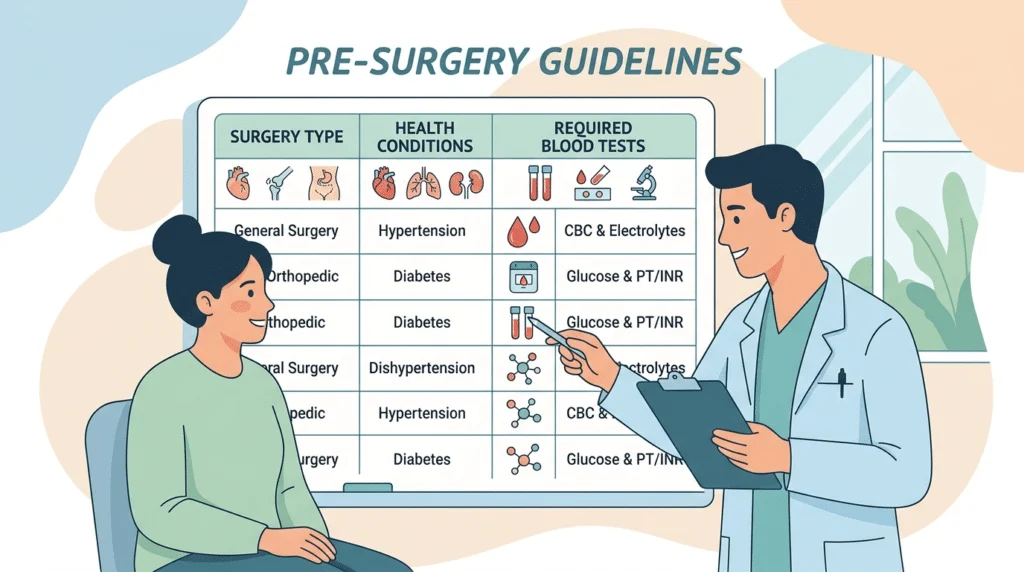
In practice, your test list grows with the size of the surgery and the number of health factors you have. The guide below shows the general pattern. Your own team decides the final list.
| Your situation | Tests often added |
|---|---|
| Minor surgery, otherwise healthy adult | Often few or no routine blood tests |
| Intermediate or major surgery | CBC and a kidney or metabolic panel are common |
| Taking blood thinners (anticoagulants) | Coagulation panel (PT, INR, aPTT) |
| Diabetes or high blood sugar risk | Blood sugar and HbA1c |
| Known kidney, liver, or heart disease | Metabolic panel, kidney markers, sometimes more |
| Significant blood loss expected | Blood type and screen |
| Could be pregnant | Pregnancy test |
If you are young, healthy, and having a small procedure, do not be surprised if your surgeon orders little or nothing. That is modern, evidence-based care, not a shortcut. Age by itself is no longer treated as an automatic reason for a full panel; your overall health and the type of operation matter more. If you are unsure why a test was or was not ordered, asking your team is always reasonable.
How soon before surgery is the blood drawn?
Timing depends on the test and the operation, but a few general rules help. Many routine pre-op blood tests are valid for a window of weeks; in a lot of centers, results within roughly the last month are accepted for stable patients. Your team will tell you the exact timing for your case.
There are two practical exceptions. A blood type and screen is usually valid for a much shorter time, often only a few days, because it must reflect your current blood for a safe transfusion match. And a pregnancy test is frequently done on or near the day of surgery.
The takeaway is to complete your tests on the schedule your team gives you, so nothing delays your surgery date. If a test is done close to your operation and comes back unexpected, your team may run a quick repeat or a short follow-up check. Leaving enough time between testing and surgery gives room to sort out anything that needs attention, without a last-minute scramble. If you are curious about turnaround time in general, our article on how long blood test results take explains what affects the wait.
How should you prepare for blood work before surgery?
Preparing for blood work before surgery is usually simple. Still, a short checklist helps you avoid surprises and repeat visits.
- Ask whether you need to fast. Most pre-op blood tests do not require fasting, but a few, such as a glucose or cholesterol test, sometimes do. Follow the instructions you are given rather than guessing.
- Stay hydrated. Unless you have been told not to drink, normal water intake makes the blood draw easier.
- Bring an up-to-date medication list. Include prescriptions, over-the-counter products, and supplements, since some affect bleeding or test results.
- Mention blood thinners early. Do not stop any medicine on your own; your team will tell you whether and when to pause it.
- Note any recent tests. If your regular doctor ran similar tests recently, that may save a repeat draw.
A small bruise at the needle site is normal and fades within a few days. If you feel faint during blood draws, tell the staff so you can lie down.
What happens if a result is abnormal?
An unexpected result rarely means your surgery is canceled. More often, it leads to one of three calm next steps.
First, the team may simply proceed if the finding is minor and does not affect safety. Second, they may optimize you before the operation, for example by treating anemia from low iron or adjusting a medicine. Third, for a more significant issue, they may postpone surgery briefly so it can be addressed, then reschedule.
Abnormal numbers are also read in context. A slightly out-of-range value in an otherwise well person is interpreted differently from the same value in someone with symptoms. The final judgment always belongs to your surgeon and anesthesia team, who weigh the result against your full health picture and the operation planned.
When to talk to your surgical team
You are an active partner in this process. A few questions and signals are worth raising before your operation.
Helpful questions to ask:
- Which blood tests do I need, and why these in particular?
- Should I pause any medicines, especially blood thinners, and when?
- Where and when should I have my blood drawn so results are ready in time?
- How and when will I get my results, and who explains them?
Tell your team promptly if, in the days before surgery, you develop a new illness such as a fever or infection, notice unusual bruising or bleeding, or are unsure whether you could be pregnant. These do not automatically stop surgery, but your team needs to know so they can keep you safe.
Glossary
| Term | Plain-language meaning |
|---|---|
| Anesthesia | Medicines used to block pain and, for many operations, to keep you asleep during surgery. |
| Coagulation panel (PT, INR, aPTT) | Blood tests that measure how quickly your blood clots. |
| Complete blood count (CBC) | A common test of your red cells, white cells, and platelets. |
| Comprehensive metabolic panel (CMP) | A group of tests covering blood sugar, salts, and kidney and liver markers. |
| Creatinine | A waste product in the blood used to estimate how well the kidneys filter. |
| eGFR (estimated glomerular filtration rate) | A calculated score showing kidney filtering ability. |
| Electrolytes | Minerals such as sodium and potassium that keep your heart and fluids balanced. |
| HbA1c (glycated hemoglobin) | A blood marker that reflects your average blood sugar over about three months. |
| Platelets | Tiny blood cells that help you form clots and stop bleeding. |
| Type and screen | A test that identifies your blood group and antibodies to prepare matched blood. |
Frequently asked questions
Do pre-surgery blood tests check for illegal drugs?
Standard pre-op blood work is not a forensic drug screen. The tests look at things like your blood count, body chemistry, and clotting, not recreational drug use. In some settings a urine test may be used to check kidney health or to look for substances that affect anesthesia, but this is part of medical care, not a legal investigation. If you have used any substance, including alcohol or cannabis, it is safest to tell your anesthesia team, because it can interact with anesthesia and pain medicines.
Do they test for nicotine before surgery?
Sometimes, but not for everyone. A nicotine or cotinine test is mainly used before certain procedures where smoking strongly affects healing, such as some plastic, reconstructive, or orthopedic surgeries. The aim is your safety, since smoking and nicotine can slow wound healing and raise the risk of complications. Many surgeons ask you to stop smoking for a set period beforehand. If a test applies to you, your team will explain why and what they need.
Do blood tests before surgery check for HIV or hepatitis?
Screening for HIV or hepatitis is not a routine, automatic test for every patient. It is offered when there is a clear clinical reason, and it is done with your knowledge. The purpose is to plan safe care, not to judge. If you have questions about infection testing or want screening, you can raise this with your doctor at any point in your preparation.
Is blood work always required before surgery?
No. Whether you need blood tests depends on the operation and your health. Healthy adults having minor surgery may need few tests or none at all, which reflects current, evidence-based guidance. People having larger operations, or who have conditions such as diabetes, kidney disease, or a bleeding tendency, are more likely to need tests. You can always ask your team why a particular test is, or is not, on your list.
Will a pregnancy test be done?
If you could be pregnant, a pregnancy test is a standard safety step, often done close to the day of surgery. This is because anesthesia, some medicines, and the operation itself can pose risks to a pregnancy, especially in the early weeks. It is not meant to pry; it protects you and a possible pregnancy. Let your team know the date of your last period and any chance you might be pregnant.
Can recent blood tests from my regular doctor count?
Often, yes. If your primary care doctor or specialist ran the same tests recently, those results may be accepted, which can save you an extra blood draw. This usually works when the tests are recent enough and relevant to your operation. Bring copies or make sure the results can be shared with your surgical team, and ask whether anything needs to be repeated closer to your surgery date.
Sources
- Tests and visits before surgery — MedlinePlus (U.S. National Library of Medicine, NIH)
- Routine preoperative tests for elective surgery (NG45) — NICE
- Routine testing before surgery remains common despite low value — Michigan Medicine
Further reading
- How to read your blood test results
- How long do blood test results take?
- Complete blood count (CBC): how to read your results
- Comprehensive metabolic panel (CMP) explained
- Coagulation panel: PT, PTT, and INR
Understand your lab results with AI DiagMe
Once your pre-op tests come back, the printout can be hard to read. AI DiagMe helps you make sense of common results, including your complete blood count (CBC), kidney and liver tests, blood sugar (glucose and HbA1c), and clotting tests, all explained in clear, everyday language. It is designed to help you understand your numbers and prepare better questions for your team, not to diagnose you or replace your surgeon’s and anesthesiologist’s advice. Upload your results and get a plain-language interpretation in minutes.
➡️ Get your results interpreted in minutes