If your child has come out in a blotchy rash on day six of an antibiotic course, you are probably reading this at an inconvenient hour. Here is the reassuring part, stated plainly: most of the time an amoxicillin rash is not an allergic reaction at all. It is a delayed, self-limiting skin response that often has more to do with the virus behind the illness than with the medicine.
Here is the honest part. Some reactions are genuinely allergic, a small number are dangerous, and no web page can examine skin.
In this article you’ll learn how an immediate allergic reaction differs from a delayed rash, why glandular fever changes the picture, what to do the moment a rash appears, and which warning signs mean emergency care rather than a phone call.
EMERGENCY: call 911 (or your local emergency number) now if any of these appear
- Difficulty breathing, wheezing, or noisy or croaky breathing
- Swelling of the lips, tongue or throat, or a hoarse or whispery voice
- Hives together with faintness, floppiness, pallor or collapse
- Vomiting alongside a spreading rash
- A sudden sense that something is very badly wrong
If an epinephrine (adrenaline) auto-injector has been prescribed, use it first, then call for help.
Seek urgent, same-day medical care if you see any of these instead
- Skin that blisters, peels or sloughs, or is painful rather than itchy
- Ulcers or raw sores in the mouth, eyes or genital area
- Fever together with a widespread rash
- Swelling of the face or puffy eyelids
These features are not the harmless rash described on this page. They can signal a severe reaction such as Stevens-Johnson syndrome, toxic epidermal necrolysis or DRESS, and they need to be seen the same day.
What amoxicillin is, and why rashes are so common with it
Amoxicillin belongs to a family of antibiotics called aminopenicillins, a branch of the penicillin group. It is one of the most prescribed medicines in the United States and the usual first choice in children for an ear infection, bacterial sinus infection or strep throat.
Sheer volume is part of the answer to why rashes turn up so often: when millions of courses are dispensed every year, even an uncommon skin reaction is seen constantly. But there is a second reason specific to this drug family. Aminopenicillins are unusually likely to produce a widespread flat rash in someone whose immune system is already busy fighting a virus, and viral illness is exactly the setting in which children are most often prescribed antibiotics.
The result is a genuine knot. A child with a cough and a sore throat gets an antibiotic, a rash appears a few days later, and there is no easy way to know whether it came from the drug, the virus, or the two together.
Immediate reactions: the allergy that announces itself fast
A true immediate allergy to amoxicillin is driven by IgE, an antibody that primes the body to release histamine and related chemicals within minutes. Because the mechanism is fast, the timing is the single most useful clue you can give a clinician.
An immediate reaction typically begins within an hour of a dose, and often within minutes. It looks and behaves quite differently from a slow-blooming blotchy rash:
- Hives (urticaria): raised, intensely itchy welts that look like nettle stings, often pale in the center, that come and go and move around the body over minutes to hours
- Swelling of soft tissues, especially the eyelids, lips, tongue or throat
- Wheezing, coughing, a tight chest or trouble swallowing
- Sudden vomiting, cramping abdominal pain or diarrhea
- Dizziness, pallor, collapse or, in a small child, unusual floppiness
When skin symptoms combine with breathing, gut or circulation symptoms, that pattern is anaphylaxis and it is a medical emergency. It is uncommon with amoxicillin, but it is the reason the emergency box above sits at the top of this page rather than the bottom.
A crucial distinction: fast-appearing hives on their own warrant a same-day call to the prescriber. Hives with any breathing or circulation symptom warrant 911.
The delayed maculopapular rash: the one most families actually see
This is the rash that brings most people to this page, and it is a completely different animal.
What it looks like and when it starts
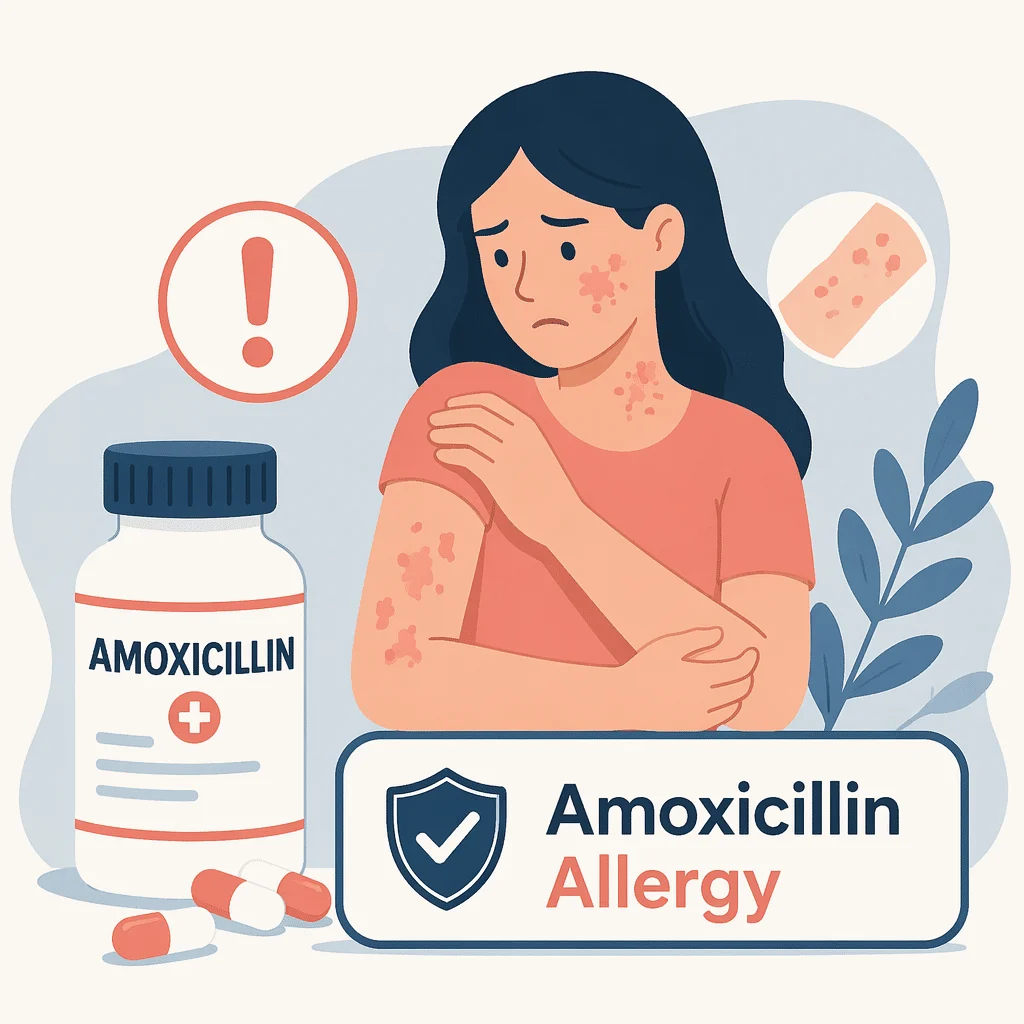
The delayed rash is described in medical notes as maculopapular, which simply means a mixture of flat discolored patches (macules) and small raised bumps (papules). Typical features are:
- Timing: it appears late in the course, classically between day five and day ten, not within the first hours
- Appearance: flat or slightly raised pink-to-red spots that merge into blotchy sheets, often symmetrical on both sides of the body
- Distribution: it usually starts on the trunk and spreads outward toward the limbs and sometimes the face
- Sensation: little or no itch, or only mild itch, and the skin is not painful or tender
- Behavior: individual spots stay put for days rather than shifting around the body within hours the way hives do
- Recovery: it typically fades over roughly three to seven days, sometimes with mild flaking, and it does not scar
On brown and black skin the same rash can look violet, gray-brown or simply darker than the surrounding skin rather than red, so it is easier to miss; running a hand over the skin to feel the fine bumpiness is often more informative than looking. Our guide to skin rash causes and patterns goes further.
Why it is usually not an allergy
The delayed rash is not driven by IgE. When it is drug-related at all, it involves T cells, a slower arm of the immune system, which is why it takes days rather than minutes to appear. And in a large share of cases it is not about the drug in isolation: it reflects an interaction between the medicine and an immune system already activated by a viral infection.
That is why clinicians so often call it a viral-drug rash, and why a child who develops it during one illness may tolerate amoxicillin perfectly well later in life. A delayed blotchy rash is not, by itself, evidence of a lifelong allergy.
None of which means the rash can be ignored, or that you can decide on your own which category it falls into. The odds are reassuring; the decision still belongs to a clinician who can see the skin.
Mono, Epstein-Barr virus and the classic amoxicillin rash
The best-known version of this story involves infectious mononucleosis, known as mono or glandular fever and usually caused by the Epstein-Barr virus. It produces a sore throat, swollen neck glands, fever and deep fatigue, a picture that overlaps closely with bacterial tonsillitis, so a course of amoxicillin is a natural thing to reach for.
When someone with mono takes an aminopenicillin, a widespread blotchy rash frequently follows. This has been taught for decades as the textbook example of a drug rash that is not an allergy, and the US National Library of Medicine notes that a measles-like rash in mono is more likely if ampicillin or amoxicillin has been given for a throat infection.
Two practical points follow from this. First, if a sore throat has been treated with amoxicillin and a rash then appears, mono is worth raising with the prescriber; a full blood count often shows a rise in lymphocytes with atypical forms, and specific antibody tests can confirm it. Second, other viral causes of sore throat can create similar confusion; our guide to throat herpes symptoms covers one of the look-alikes.
What this does not mean is that a rash during mono can be dismissed without thought. Modern research has softened both halves of the old teaching, as the studies below explain.
Three rashes side by side
This table is a way of organizing what you are seeing before you speak to a clinician, not a way of diagnosing yourself.
| Feature | Delayed maculopapular rash | Immediate allergic reaction | Severe skin reaction |
|---|---|---|---|
| When it starts | Late in the course, classically day five to ten | Minutes to about an hour after a dose | Usually after several days to several weeks |
| What it looks like | Flat blotchy patches and small bumps, symmetrical, starting on the trunk, spots stay put | Raised itchy welts that move and change within hours, often with soft-tissue swelling | Blistering, peeling or sloughing skin, target-shaped lesions, painful or tender skin |
| Other features | Little or no itch, child otherwise improving, no breathing or circulation symptoms | May include wheeze, throat tightness, vomiting, dizziness or collapse | Fever, facial swelling, sores in the mouth, eyes or genitals, feeling systemically unwell |
| What to do | Contact the prescriber promptly for advice before changing anything | Same-day contact for skin-only hives; 911 if breathing, gut or circulation symptoms appear | Seek urgent care the same day; these reactions are treated as emergencies |
What to do when a rash appears mid-course
The single most important thing to know is what this page will not tell you. It will not tell you to keep giving the antibiotic, and it will not tell you to stop it. Both decisions carry real consequences, depend on things only an examination can establish, and belong to the person who wrote the prescription.
What you can do is make that conversation as useful as possible. A practical sequence:
- Check first for the emergency features listed at the top of this page. If any are present, act on those rather than reading on.
- Contact the prescriber, the practice’s out-of-hours line, or a pharmacist promptly. Describe the rash and ask what to do about the remaining doses.
- Photograph the rash in good natural light, close up and from a distance, including the trunk and limbs. Rashes change fast, and a photograph taken tonight may be the only record of what it looked like.
- Note the timing precisely: which day of the course this is, how many hours after the most recent dose the rash appeared, and how fast it spread.
- Write down the rest of the picture: temperature, whether the child is drinking and playing normally, whether the spots itch or blanch when pressed, and any other medicines started recently.
- Keep watching. A rash that is settling and a child who is brightening up is a different situation from a rash that is spreading while the child becomes more unwell.
A useful check while you wait: press a clear glass firmly against the rash. Most drug rashes fade under pressure. Spots that do not fade need urgent assessment, because they can indicate bleeding into the skin.
If a reaction is recorded, ask for the specific description to go into the notes rather than the single word “allergy”. The difference between “flat blotchy rash on day seven, no other symptoms” and “allergy” is enormous for every prescriber your child ever sees.
Side effects that get mislabeled as an amoxicillin allergy
A large proportion of the reactions recorded as antibiotic allergies were never immune reactions at all. Common examples with amoxicillin include nausea, loose stools, thrush, a furred tongue, headache and, in children, an unhappy stomach that resolves as soon as the course ends. None of these involve the immune system, and constipation or altered bowel habit after antibiotics has its own explanation and management.
Amoxicillin-clavulanate deserves a paragraph of its own. Clavulanate, sometimes called clavulanic acid, is added to protect amoxicillin from bacterial enzymes. It is also responsible for a good deal of the trouble that gets blamed on the amoxicillin. Diarrhea and stomach upset are markedly more common with the combination, and rare cases of liver injury are linked mainly to the clavulanate component rather than to amoxicillin itself.
Drug-related liver injury typically shows up as nausea, itching without a rash, dark urine, pale stools or yellowing of the eyes and skin, sometimes weeks after the course has finished. It is picked up on liver function tests rather than by looking at skin, and it is a side effect rather than an allergy, though it still needs medical attention.
None of this makes these problems trivial. It makes them a different problem. A stomach upset noted as “penicillin allergy” can close off a whole family of effective antibiotics for life.
What a childhood amoxicillin rash label means for you now
Very large numbers of adults carry an antibiotic allergy label dating back to a rash they had as a small child and cannot remember. Most people with a penicillin allergy label turn out, when formally assessed, not to be allergic; our companion guide to penicillin allergy covers what that label means, how the assessment works and why it is worth doing.
What belongs on this page is narrower. If the story behind your label is a flat, blotchy, non-itchy rash that appeared several days into a course of amoxicillin during a childhood illness, that history is precisely the one that most often turns out not to be an allergy. It is a good candidate for reassessment, and the conversation starts with your primary care clinician, who can refer you to an allergy service.
Do not test this at home, and do not remove a documented allergy from your own records. Assessment is done in a supervised setting for good reasons, which the companion guide explains.
If blood tests form part of the picture, the two you are most likely to see are a specific IgE allergy blood test and a count of eosinophils, a white cell that rises in some drug reactions. Neither settles the question alone.
Latest scientific advances in amoxicillin allergy assessment
Research published since 2023 has reshaped several long-standing assumptions about this rash. Five findings are worth knowing.
A 2025 systematic review and meta-analysis in the European Journal of Clinical Microbiology and Infectious Diseases pooled decades of studies on rash after antibiotics in infectious mononucleosis. What was found: the proportion of people with mono who develop a rash after an aminopenicillin is considerably lower than the near-universal figure repeated in textbooks, though still clearly higher than without the antibiotic; studies from the 1960s and 1970s reported far higher rates than recent ones. What this means for you: the mono rash is real, but “everyone with mono reacts” overstates it.
A 2025 pediatric case series in Cureus followed three adolescents who developed widespread rashes on amoxicillin during confirmed Epstein-Barr virus infection. What was found: when they were formally assessed months later, all three turned out to have genuine delayed hypersensitivity, a real immune reaction to the drug. What this means for you: assuming a rash during mono is always harmless is not safe as a blanket rule, which is why the call belongs with a clinician rather than a web page.
A 2024 study in Allergologia et Immunopathologia looked at 151 infants referred after mild delayed skin reactions to penicillin-family antibiotics, mostly maculopapular rashes on amoxicillin or amoxicillin-clavulanate. What was found: when re-tested under supervision, the overwhelming majority tolerated the antibiotic, and the few reactions were mild and easily managed. What this means for you: a mild rash in a toddler rarely turns out to be a lasting allergy.
A 2025 study in Pediatric Allergy and Immunology re-tested children whose delayed reactions to amoxicillin or amoxicillin-clavulanate had actually been confirmed, roughly five years later. What was found: a substantial share had lost their sensitivity, and those who were younger at the original reaction were more likely to have outgrown it. What this means for you: even a confirmed reaction is not automatically permanent.
A 2025 pharmacovigilance analysis in Molecules examined European side-effect reports for amoxicillin and amoxicillin-clavulanate. What was found: skin problems were the most reported category for both, but liver and biliary problems were reported disproportionately more often with the clavulanate combination. What this means for you: if you were told to avoid “amoxicillin” after stomach upset or an abnormal liver test on the combination product, the clavulanate may well have been the culprit, and that is a side effect rather than an allergy.
Glossary of key terms
| Term | Definition |
|---|---|
| Aminopenicillin | The branch of the penicillin family that includes amoxicillin and ampicillin, known for causing delayed rashes during viral illness. |
| Maculopapular rash | A rash made of flat discolored patches mixed with small raised bumps, usually widespread and symmetrical. |
| Urticaria (hives) | Raised, itchy welts that appear and disappear within hours and typically move around the body. |
| IgE | The antibody behind immediate allergic reactions, which is why those reactions start within minutes to an hour. |
| Delayed hypersensitivity | A slower immune reaction driven by T cells rather than antibodies, appearing days after a drug is started. |
| Anaphylaxis | A sudden, severe allergic reaction affecting breathing or circulation as well as skin, requiring emergency treatment. |
| Infectious mononucleosis | Glandular fever, usually caused by the Epstein-Barr virus, producing sore throat, swollen glands and fatigue. |
| Clavulanate | A compound combined with amoxicillin to widen its effect, responsible for much of the stomach upset and rare liver injury. |
| DRESS | A severe delayed drug reaction with fever, widespread rash, facial swelling and internal organ involvement. |
| Stevens-Johnson syndrome | A rare, serious reaction in which skin blisters and peels and sores form in the mouth, eyes or genitals. |
Frequently asked questions
My child has a rash on amoxicillin. Is it an allergy?
Probably not, and that is an honest answer rather than a reassuring one. Most rashes that appear several days into an amoxicillin course are delayed, flat and blotchy, and are not allergic. But probability is not diagnosis. You cannot tell from a photograph on a screen whether your child’s rash belongs to the common harmless group or the uncommon serious one, and the difference matters enormously. Check the emergency features listed near the top of this page first. If none are present, contact the prescriber or an out-of-hours service promptly, describe the rash and its timing, and ask what to do about the remaining doses. Do not make that call yourself in either direction.
How long does an amoxicillin rash last?
A typical delayed maculopapular rash reaches its peak over a day or two and then fades over roughly three to seven days, sometimes leaving mild flaking or a slight change in skin tone that settles over a few weeks. It usually does not scar. Hives from an immediate reaction behave differently: individual welts come and go within hours, though new crops can keep appearing for a day or more. A rash that is still spreading after a week, that becomes painful, that blisters, or that comes with fever or facial swelling is not following the benign pattern and needs to be reviewed rather than waited out.
Can my child ever have amoxicillin again?
In many cases yes, but that decision needs a proper assessment rather than a guess. A childhood rash label often turns out, on formal evaluation, not to reflect a true allergy, and even confirmed delayed reactions can fade over the years. Start by asking your primary care clinician about referral to an allergy service. Our guide to penicillin allergy explains how that assessment works and why it matters. In the meantime, keep the label in place and mention it to every clinician, dentist and pharmacist until a specialist advises otherwise.
Is an amoxicillin rash contagious?
The rash itself is not contagious. It is a reaction happening in your child’s own skin, not an infection that can be passed on. The underlying illness may be a different matter: mono, chickenpox, hand-foot-and-mouth and many other viral infections spread easily, and a rash that turns out to be viral rather than drug-related may come with its own advice about school and contact with others. If you are unsure which you are dealing with, that is another good reason to speak to the prescriber.
Does a rash mean the infection is getting worse?
Usually not. The delayed rash tends to appear while a child is already improving, which is one of the clues that points away from a worsening infection. Watch the whole child rather than the skin alone. A child who is drinking, playing and settling to sleep with a spreading blotchy rash is in a very different position from a child who is becoming drowsy, breathless, feverish again, or unwilling to drink. Any of those changes is a reason to be seen the same day, whatever the rash is doing.
What if the rash appeared after amoxicillin-clavulanate rather than plain amoxicillin?
Tell the prescriber exactly which product was taken, because the two are not interchangeable in this conversation. The clavulanate component accounts for much of the stomach upset and, rarely, the liver injury associated with the combination, and those are side effects rather than allergy. A rash could still be linked to either component. Naming the exact product, the strength on the box and the day the rash started gives your clinician far more to work with than “an antibiotic”.
Sources
- MedlinePlus, US National Library of Medicine: Mononucleosis
- MedlinePlus, US National Library of Medicine: Allergic reactions
- MedlinePlus, US National Library of Medicine: Erythema multiforme
- Centers for Disease Control and Prevention: About Epstein-Barr Virus (EBV)
- LiverTox, National Institute of Diabetes and Digestive and Kidney Diseases: Amoxicillin
- Vrysis C, Katsarou A, Lytras T, Katsikas K, Falagas ME. Rash associated with antibiotic administration in patients with infectious mononucleosis: a systematic review and meta-analysis. European Journal of Clinical Microbiology and Infectious Diseases, 2025
- Viegas M, Mendes J, Lemos S, Maia E, Rubino G. Amoxicillin-induced hypersensitivity versus viral exanthem in Epstein-Barr virus infection: a paediatric case series. Cureus, 2025
- Cunha F, Cunha I, Gomes E. Safety of direct oral provocation test to delabel reported mild beta-lactam allergy in infants. Allergologia et Immunopathologia, 2024
- Torres-Rojas I, Vazquez De La Torre M, Perez-Alzate D, et al. Children with confirmed nonimmediate allergic reactions to beta-lactam antibiotics can develop tolerance after a long period of drug avoidance. Pediatric Allergy and Immunology, 2025
- Ammendolia I, Mannucci C, Esposito E, et al. Hepatotoxicity and antimicrobial resistance to amoxicillin and amoxicillin/clavulanic acid: data analysis from EudraVigilance. Molecules, 2025
Further reading
- Penicillin allergy: symptoms, causes, treatments
- Skin rash: causes, symptoms and treatments
- Ear infection: symptoms, causes and treatments
- Allergy blood test: what it measures
- Liver function tests explained
Understand your lab results with AI DiagMe
A drug rash is assessed by examination and history, not by a blood test, and no online tool can look at skin. What your doctor may order around it is different: a full blood count if mono is suspected, liver tests after amoxicillin-clavulanate, or a specific IgE test as part of an allergy assessment.
AI DiagMe helps you understand those results in plain language before your appointment. It does not diagnose or rule out an allergy, it cannot see a rash, and it is not for emergencies.
Get your results interpreted in minutes