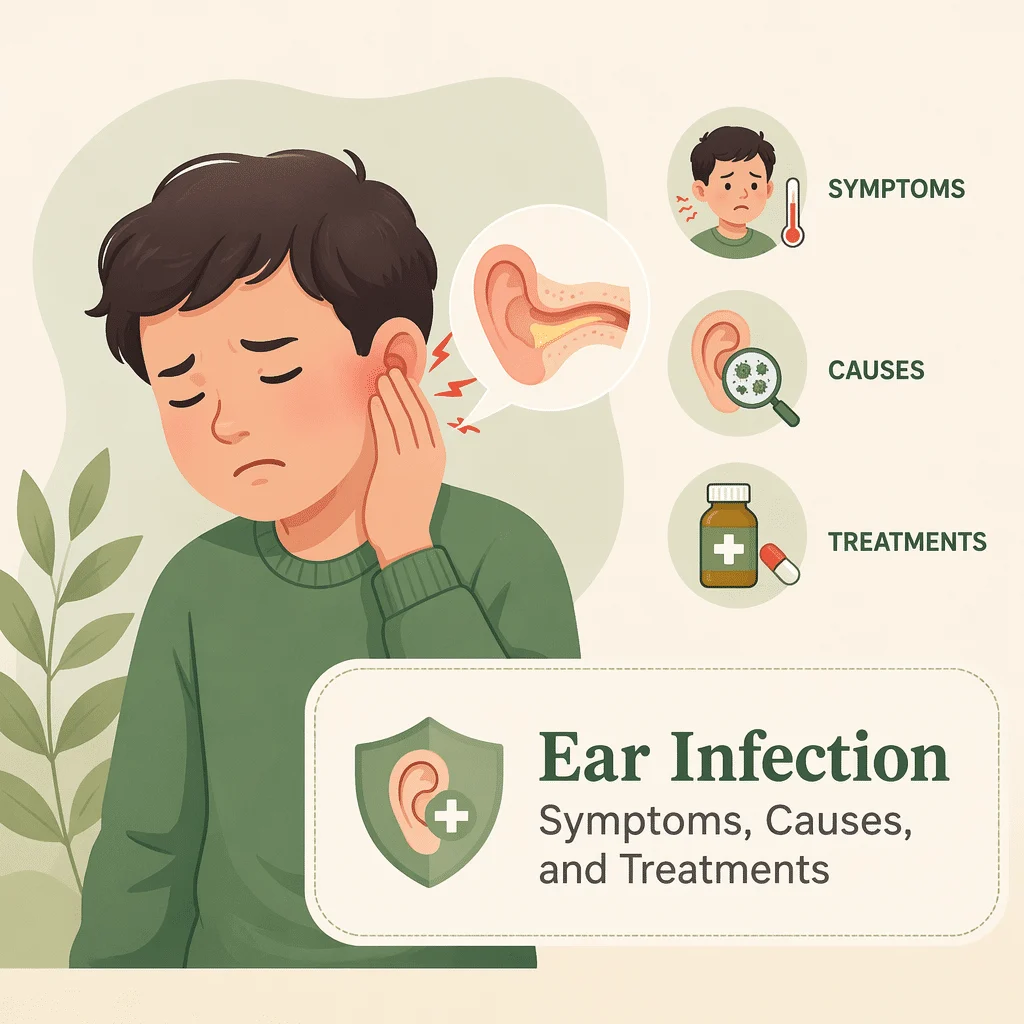
An ear infection is one of the most common reasons parents take a child to a doctor, and adults get them too. The phrase actually covers three problems that behave very differently: an infection of the middle ear behind the eardrum, an infection of the ear canal known as swimmer’s ear, and fluid sitting behind the eardrum with no infection at all.
Telling them apart matters, because they are managed in completely different ways, and because most middle ear infections in otherwise healthy children improve on their own.
In this article you’ll learn how to recognize each type, what causes them, how a clinician actually makes the diagnosis, what United States guidance says about antibiotics versus watchful waiting, which comfort measures are recommended, what to avoid, and how to lower the risk of another episode. If you are worried right now, go straight to the red-flag box further down this page.
Middle ear infection, swimmer’s ear and glue ear: how they differ
The outer ear includes the visible flap and the ear canal, which ends at the eardrum. The middle ear is the air-filled space just behind it. The inner ear, deeper still, handles hearing and balance.
Acute otitis media is an infection of that middle ear space. Fluid and pus build up behind the eardrum, which bulges, and the pressure causes a deep, throbbing earache that is often worse lying down. This is the classic childhood ear infection.
Otitis externa, better known as swimmer’s ear, is an infection of the skin lining the ear canal. Water, humidity, scratching or eczema break down the canal’s protective barrier and bacteria move in. The pain is superficial rather than deep, and the canal becomes swollen and itchy.
One discriminator is worth knowing, because clinicians use it every day. In swimmer’s ear, pulling gently on the outer ear or pressing the small cartilage flap in front of the canal opening reproduces or sharply worsens the pain. In a middle ear infection it usually does not, because the problem sits behind the eardrum.
Otitis media with effusion, or glue ear, is different again. Fluid remains in the middle ear after an infection settles, or builds up because the eustachian tube is not ventilating properly, but there is no active infection. It causes muffled hearing and a blocked sensation rather than pain or fever.
| Feature | Middle ear infection (acute otitis media) | Swimmer’s ear (otitis externa) | Glue ear (otitis media with effusion) |
|---|---|---|---|
| Where it hurts | Deep inside the ear, often worse lying flat | In the canal and around the ear opening | Usually no pain, just fullness |
| What triggers the pain | Pressure behind the eardrum; often follows a cold | Pulling the outer ear or pressing the tragus; chewing | Not applicable |
| Discharge | Only if the eardrum perforates, which often relieves the pain suddenly | Common: watery, milky or foul-smelling debris in the canal | None |
| Hearing | Temporarily muffled | Muffled if the canal swells shut | Persistently muffled; the main symptom |
| Fever | Common in children | Usually absent | Absent |
| Usual management | Pain relief first; oral antibiotics only for selected children, per guidance | Antibiotic ear drops, sometimes with a steroid, prescribed after examination | Observation and hearing checks; ventilation tubes if it persists |
Ear infection symptoms in adults and children
In anyone old enough to describe it, a middle ear infection announces itself as ear pain building over hours, fullness or pressure, muffled hearing on that side, and sometimes a low fever. It often arrives a few days into a cold.
Adults get middle ear infections less often than children but are not immune, and they are relatively more likely to get swimmer’s ear. In an adult, persistent one-sided middle ear fluid that does not clear deserves proper assessment rather than a wait-and-see approach.
What an ear infection looks like in a toddler
Most ear infections happen before a child can say “my ear hurts”. The National Institute on Deafness and Other Communication Disorders lists the signs: tugging or pulling at the ear, unusual fussiness and crying, trouble sleeping, fever, fluid draining from the ear, clumsiness or balance problems, and not responding to quiet sounds.
Two cautions. Ear tugging alone is a weak sign: babies pull at their ears to self-soothe, when tired, or because something else in the head and neck hurts, including teething. And sudden discharge in a child who was screaming an hour earlier often means the eardrum has perforated and released the pressure. Not an emergency in itself, but it needs examining.
Glue ear and hearing
Glue ear rarely hurts, which is why it is missed. The fluid dampens sound, so the child hears as though through a wall: they seem not to listen, turn the television up, mishear instructions, or withdraw in noisy places such as a classroom. Hearing and speech development are why clinicians take it seriously, and hearing tests rather than antibiotics are the next step.
What causes ear infections
Middle ear infections start upstream, in the nose and throat. A cold, flu or sinus infection swells the lining of the eustachian tube, the channel that ventilates the middle ear into the back of the nose. Once it is blocked, fluid collects and bacteria that normally live in the nose, chiefly Streptococcus pneumoniae and non-typeable Haemophilus influenzae, multiply in it. Viruses alone can also do it. That congested phase, sometimes with bad-tasting phlegm or blood-streaked mucus from nose blowing, is when ears block up.
Children are more susceptible because their eustachian tubes are shorter, narrower and more horizontal, so they drain poorly, and because their immune systems are still learning.
Swimmer’s ear is a skin infection with a different mechanism. Water trapped in the canal after swimming or a hot shower, humid weather, earbuds or hearing aids worn for hours, and anything that scratches the lining remove the canal’s natural wax barrier and let bacteria take hold. Skin conditions causing dry, crusty or itchy ears are a common set-up.
Risk factors supported by evidence
The Centers for Disease Control and Prevention and the American Academy of Pediatrics point to a consistent set of modifiable risk factors in children: tobacco smoke exposure, including secondhand smoke; bottle-feeding while lying flat, especially going down for a nap or the night with a bottle; regular pacifier use in older infants; and group child care, which means more colds. Breastfeeding is protective, as is being up to date with recommended vaccines.
How a clinician diagnoses an ear infection
There is no blood test and no app for this. The diagnosis is made by looking, and it cannot be done at home.
A clinician uses an otoscope, a lighted magnifying instrument, to see the eardrum. A middle ear infection shows a red, bulging, dull drum with fluid or pus behind it. Swimmer’s ear shows a normal drum with a red, swollen, debris-filled canal. Glue ear shows a retracted or amber-looking drum with a visible fluid level and no inflammation.
Two extra tools are common. A pneumatic otoscope puffs air at the eardrum; a drum with fluid behind it moves poorly. Tympanometry measures eardrum stiffness across a range of pressures and helps confirm and follow glue ear. If hearing seems affected, an audiologist can test it.
Blood tests do not diagnose ear infections. Inflammatory markers such as C-reactive protein or procalcitonin, or a complete blood count, are sometimes requested when a doctor is investigating a severe, complicated or unusually persistent infection. They support a wider assessment; they never replace looking in the ear.
Antibiotics or watchful waiting: what guidance actually says
This is where practice has changed most, and where the advice online is most often out of date. A large share of middle ear infections are viral, or bacterial but self-limiting, and settle without any antibiotic. Antibiotics shorten symptoms modestly at best in uncomplicated cases, while reliably causing side effects such as diarrhea and rash, and driving antibiotic resistance across the population.
The American Academy of Pediatrics and the American Academy of Family Physicians therefore support an observation option for selected children. A clinician weighs the child’s age, whether one ear or both are involved, the severity of pain and fever, and how certain the diagnosis is. Broadly, immediate antibiotics are recommended for infants under 6 months, for severe illness at any age, and for children under 2 with both ears infected; watchful waiting or a delayed prescription is accepted for older children with mild, one-sided disease and reliable follow-up.
The CDC describes both versions on its ear infection page: watchful waiting, where you and the clinician review in two to three days before deciding; and delayed prescribing, where you hold a prescription and only fill it if your child is not improving.
None of this is a decision to make alone. It is shared, made after an examination, and it carries a safety net: if symptoms are not improving after 48 to 72 hours, or worsen at any point, go back.
When antibiotics are indicated, a doctor may prescribe an oral antibiotic from the penicillin family, or another class if there is a documented allergy. Tell the prescriber about any previous reaction; a reported penicillin allergy or amoxicillin allergy is often worth re-evaluating, because an unconfirmed label pushes people towards broader, less suitable drugs for years. Swimmer’s ear is usually treated topically instead, with antibiotic ear drops sometimes combined with a steroid, prescribed only after a clinician confirms the eardrum is intact.
What helps, what to avoid, and how to prevent the next one
Pain relief is the priority, whether or not an antibiotic is used. The CDC advises rest, extra fluids, and over-the-counter pain or fever medicine used exactly as the label directs, with dosing checked against the child’s age and weight by a pharmacist or clinician. Aspirin should never be given to children, because of the risk of Reye’s syndrome. A warm compress against the ear is a reasonable comfort measure, and for older children and adults cough drops may ease the throat irritation of the cold behind it.
Some popular remedies are worth naming as things not to do:
- Ear candling. The US Food and Drug Administration has warned against ear candles, which have caused burns to the face, ear canal and eardrum, and perforations, with no benefit to offset that.
- Cotton buds and Q-tips in the canal. They push wax inwards and scratch the skin that keeps swimmer’s ear out.
- Oil, garlic drops, hydrogen peroxide or any liquid poured into an ear that might have a perforated eardrum or discharge. Drops go in only after a clinician confirms the drum is intact.
- Leftover antibiotics from a previous illness. Wrong drug, wrong situation, and it worsens resistance.
Preventing ear infections
Most prevention is unglamorous. For children, the CDC and NIDCD recommend staying up to date with the pneumococcal conjugate vaccine and the annual influenza vaccine, since both target organisms behind ear infections; breastfeeding where possible; handwashing; never putting a baby down with a bottle; and keeping children away from tobacco smoke.
For swimmer’s ear, the aim is a dry, undamaged canal. Tip the head to each side and dry the outer ear after swimming, use a towel corner rather than a cotton bud, consider well-fitted swim plugs if you are prone to it, avoid visibly polluted water, and clean earbuds and hearing aids. If episodes recur, ask a clinician whether a drying preparation suits you; do not improvise one if your eardrum has ever been perforated or you have tubes in place.
Red flags: when an ear problem needs urgent assessment
Seek urgent medical care if any of these apply
- Swelling, redness or tenderness of the bone behind the ear, or the ear looks pushed forward or outward. This can indicate mastoiditis, an infection spreading into the mastoid bone, and needs urgent assessment.
- A stiff neck, severe headache, confusion, drowsiness that is hard to rouse, or a seizure.
- Weakness or drooping of one side of the face.
- A child who looks very unwell, is not drinking, or is unusually floppy or unresponsive.
- Ear pain with dizziness, a spinning sensation, or sudden hearing loss.
- Any fever in an infant under 3 months old. The CDC and the American Academy of Pediatrics advise contacting a healthcare provider right away for a temperature of 100.4°F (38°C) or higher, measured rectally, in a baby this young. Treat it as a medical emergency.
- Symptoms that are not improving after 48 to 72 hours, or that get worse at any point.
If you have diabetes or a weakened immune system
Ear canal infections carry an extra risk in people with diabetes, older adults, and anyone immunocompromised, including those on chemotherapy. In this group, otitis externa can occasionally spread from the canal into the bone at the base of the skull, a serious condition called necrotizing or malignant otitis externa. Warning signs are severe, deep ear pain out of proportion to what is visible, especially at night, persistent foul-smelling discharge, and facial weakness. It needs prompt assessment, so do not wait out an ear canal infection that is not settling.
Latest scientific advances in ear infection care
According to research indexed in PubMed, recent work has focused less on new drugs than on using existing ones better. Full references and DOI links are in the Sources section.
Watchful waiting holds up in everyday practice
What was found: a 2025 analysis of a very large set of real-world US pediatric visits for acute otitis media (Jenkins and colleagues) reported that watchful waiting was used in only a minority of visits, but that where it was used, treatment failure and adverse events were about as uncommon as with immediate antibiotics. What this means for you: the observation option does not trade safety for stewardship, and when it is offered for an older child with a mild, one-sided infection, it is backed by outcomes in ordinary clinics.
How much antibiotic use could be avoided
What was found: a 2025 meta-analysis by Morin and colleagues modelled United States prescribing for childhood ear infections and estimated that following existing pediatric guidance, mainly through watchful waiting and shorter courses, could avoid a very large volume of unnecessary antibiotic days each year. What this means for you: a shorter course or a delayed prescription reflects current evidence, not a doctor being stingy.
Antibiotics prevent some rare complications, at a cost
What was found: a 2024 meta-analysis by Smolinski and colleagues, including observational studies as well as trials, found that prompt antibiotics reduced the risk of acute mastoiditis, but that a very large number of children would need treating to prevent one case, while side effects were far more frequent. What this means for you: this is the trade-off a clinician weighs, and it explains why age, severity and whether both ears are involved change the answer.
Antibiotics are not the answer for glue ear
What was found: a 2023 Cochrane systematic review by Mulvaney and colleagues examined oral antibiotics for otitis media with effusion in children and rated the evidence low to very low certainty, with any short-term benefit on fluid clearance not translating into a lasting hearing benefit. What this means for you: for fluid behind the eardrum without infection, expect a hearing assessment and monitoring rather than a prescription.
Decongestants and antihistamines remain unproven
What was found: a 2025 Cochrane systematic review by Darlison and colleagues concluded that the evidence for oral or nasal decongestants and antihistamines in children with acute otitis media is very uncertain for both benefits and harms, with no new trials in over two decades. What this means for you: these products are unlikely to shorten an ear infection, and some carry real risks in young children, so they are no substitute for pain relief and review.
Glossary of key terms
| Term | Definition |
|---|---|
| Acute otitis media | An infection of the middle ear, the air space behind the eardrum, with fluid or pus under pressure. |
| Otitis externa | An infection of the skin lining the ear canal, commonly called swimmer’s ear. |
| Otitis media with effusion | Fluid in the middle ear without active infection, often called glue ear; causes muffled hearing rather than pain. |
| Eustachian tube | The narrow channel connecting the middle ear to the back of the nose, which ventilates and drains the middle ear. |
| Tympanic membrane | The eardrum, the thin membrane separating the ear canal from the middle ear. |
| Tragus | The small cartilage flap in front of the ear canal opening; pressing it hurts in swimmer’s ear. |
| Otoscope | The lighted magnifying instrument a clinician uses to examine the ear canal and eardrum. |
| Tympanometry | A test that measures how the eardrum moves under changing pressure, used to detect fluid behind it. |
| Tympanostomy tube | A tiny ventilation tube placed through the eardrum to drain fluid and aerate the middle ear. |
| Mastoiditis | Infection spreading into the mastoid bone behind the ear; an uncommon but urgent complication. |
Frequently asked questions
Do I need antibiotics for an ear infection?
That is a decision for a clinician after examining the ear, not something to judge from symptoms alone. The criteria they weigh are age, severity, whether one or both ears are affected, and how certain the diagnosis is. United States guidance supports immediate antibiotics for infants under 6 months, for severe illness, and for children under 2 with both ears involved, while watchful waiting or a delayed prescription is an accepted option for older children with mild, one-sided infection. Swimmer’s ear is usually treated with prescription ear drops rather than tablets. Whichever route is chosen, go back if things are not improving in 48 to 72 hours.
How long does an ear infection last?
Pain from a middle ear infection usually eases within two to three days, with or without antibiotics, and most people feel substantially better within a week. Fluid behind the eardrum is slower: it commonly takes several weeks to clear after the infection itself has gone, and during that time hearing can stay slightly muffled. Swimmer’s ear typically improves within a few days of starting prescribed drops. If pain, discharge or hearing loss is still there beyond these rough timelines, that is a reason to be re-examined rather than to wait longer.
Can adults get ear infections?
Yes. Middle ear infections are less common in adults because the eustachian tube is longer and better angled, but they still happen, usually after a cold, flu or sinus infection, and they tend to be more painful. Adults are relatively more likely than children to get swimmer’s ear, particularly swimmers, earbud users and hearing aid wearers. One important difference: fluid that sits behind one eardrum in an adult and does not clear should always be assessed properly, because in adults a blocked eustachian tube occasionally has a cause other than a cold.
Can I swim with an ear infection, and how do I stop getting swimmer’s ear?
Ask the clinician who examined you, because the answer depends on the diagnosis. With active swimmer’s ear, or with a perforated eardrum or ventilation tubes, water in the canal is usually best avoided until you are cleared. To reduce the risk, dry your ears after swimming or showering by tipping your head to each side and drying the outer ear, skip cotton buds entirely, use well-fitting swim plugs if you are prone to episodes, avoid swimming in visibly polluted water, and keep earbuds clean. Do not make up your own alcohol or vinegar drops without checking first.
Are ear infections contagious?
The infection inside the ear is not passed from person to person. What does spread are the colds, flu and other respiratory viruses that so often precede a middle ear infection, which is why handwashing, staying home when unwell and vaccination all reduce ear infections indirectly. A child with an ear infection does not need to be isolated and can return to school or child care once they feel well enough. Swimmer’s ear is not contagious either; it comes from the environment and the state of the canal skin.
Can ear infections cause lasting hearing loss?
Temporary muffled hearing during and after an infection is normal and usually resolves as the fluid clears. Lasting hearing loss from an ordinary, treated ear infection is uncommon. The situations that need attention are fluid that persists for months, repeated infections in a young child during the years when speech is developing, and any sudden hearing loss, which is always urgent. If you or your child seem not to be hearing normally several weeks after an infection, ask for a hearing test rather than assuming it will sort itself out.
Sources
- Ear Infections in Children — National Institute on Deafness and Other Communication Disorders (NIDCD), NIH
- Ear Infection Basics — Centers for Disease Control and Prevention (CDC)
- Ear Infections — MedlinePlus, US National Library of Medicine
- Malignant otitis externa — MedlinePlus Medical Encyclopedia
- Ear Infections in Children: Information for Parents — American Academy of Pediatrics, HealthyChildren.org
- Jenkins TC, Hersh AL, Stein AB, Narayan R, Eggleston A, Frost HM. Watchful Waiting for Children With Acute Otitis Media: Frequency of Use and Outcomes in Clinical Practice. J Pediatric Infect Dis Soc. 2025
- Morin TL, Stein AB, El Feghaly RE, Nedved AC, Katz SE, Keith A, Laferriere HE, Jenkins TC, Frost HM. Interventions to Minimize Unnecessary Antibiotic Use for Acute Otitis Media: A Meta-Analysis. Children (Basel). 2025
- Smolinski NE, Djabali EJ, Al-Bahou J, Pomputius A, Antonelli PJ, Winterstein AG. Antibiotic treatment to prevent pediatric acute otitis media infectious complications: A meta-analysis. PLoS One. 2024
- Mulvaney CA, Galbraith K, Webster KE, et al. Antibiotics for otitis media with effusion (OME) in children. Cochrane Database of Systematic Reviews. 2023
- Darlison P, Moresco L, Nussbaumer-Streit B, Bruschettini M, Gisselsson-Solen M. Decongestants and antihistamines for acute otitis media in children. Cochrane Database of Systematic Reviews. 2025
Further reading
- Dry, crusty ears: symptoms, causes and treatments
- Is a sinus infection contagious? Causes and risks
- Bad-tasting phlegm: causes and treatments
- Cough drops: benefits, uses and risks
- Bloody boogers: causes, symptoms and risks
Understand your lab results with AI DiagMe
An ear infection is diagnosed by examining the ear, not by a blood test, and AI DiagMe cannot look in an ear or make that diagnosis.
What it can do is help afterwards. If a doctor investigates a severe, recurrent or complicated infection and orders inflammatory markers or a full blood count, AI DiagMe explains what those numbers mean in plain language so you can ask better questions at your next appointment. It does not diagnose and it does not replace your doctor.
Get your results interpreted in minutes