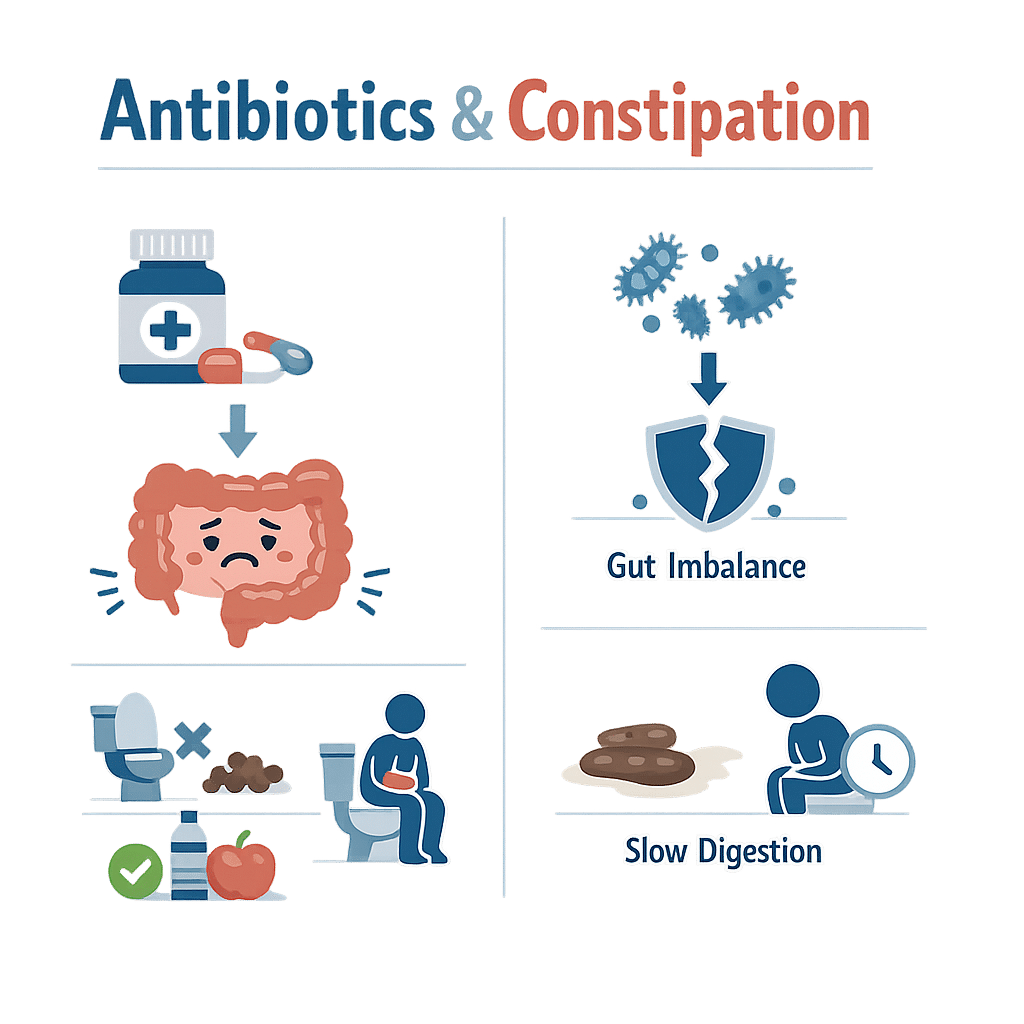
The link between antibiotics and constipation is one of the most searched questions about these medicines, and the honest answer is more nuanced than most pages admit. The bowel effect that antibiotics are firmly known to cause is diarrhea, not constipation. Slower, harder stools are reported after antibiotic courses too, but far less often, and the pattern has never been well characterized in the medical literature. That does not make your symptom imaginary. It usually means the explanation sits somewhere else: the infection itself, eating and drinking less, moving less, or another medicine started at the same time.
In this article you’ll learn what the evidence actually supports, how to judge whether your antibiotic is the likely culprit, what relieves constipation safely while you finish your course, which warning signs need same-day attention, and which lab tests are worth considering if the problem outlasts the treatment.
What we really know about antibiotics and constipation
Antibiotics change the bacteria that live in your intestine. That much is beyond dispute. What follows from it, in the published evidence, points overwhelmingly in one direction.
The documented bowel effect is diarrhea
Loose, frequent stools during or shortly after a course are common and well studied. A 2024 review of antibiotic-associated dysbiosis described this kind of diarrhea as the usual and, in practice, the only visible outward sign that the balance of gut bacteria has been disturbed. Reviews, guidelines and drug labels all treat diarrhea as the expected bowel side effect.
Constipation is reported, but poorly characterized
People do report harder or less frequent stools while taking antibiotics, and clinicians hear it regularly. What does not exist is a solid body of research establishing how often it happens, which antibiotics do it, or by what mechanism. Some pages online describe confident-sounding explanations. Those explanations are plausible reasoning rather than demonstrated fact, and it is more useful to know that than to be handed a mechanism the literature does not support.
What counts as constipation in the first place
Medically, constipation usually means fewer than three bowel movements a week, with stools that are hard, dry and sometimes painful to pass. One slow day during an illness is not constipation. Our team also describes the normal and abnormal changes in stool consistency, which helps you judge whether what you are seeing is a genuine shift or ordinary variation.
What usually explains constipation during an antibiotic course
In most cases, several ordinary factors line up at the same time as the prescription. They are easier to act on than the antibiotic, and they are far more likely to be the real cause.
Being ill slows everything down
An infection that keeps you in bed with a poor appetite is itself a strong reason for the bowel to slow. You eat less, so there is less material moving through. Fever, sweating and reduced drinking leave you short of fluid, and the colon responds by drawing more water out of stool, making it harder.
Eating and drinking differently
Appetite drops during infection, and what people do manage to eat tends to be plain and low in fiber: toast, rice, broth, crackers. A few days of that pattern reliably produces firmer, less frequent stools in people whose bowels were working normally the week before.
Moving less
Physical activity stimulates bowel movement. Several days on the sofa or in bed removes that stimulus. Low physical activity is listed by the National Institute of Diabetes and Digestive and Kidney Diseases among the everyday causes of constipation, alongside not enough fluid and not enough fiber.
The other things you started at the same time
This is the factor most often missed. Antibiotics rarely arrive alone. Opioid painkillers, some antinausea medicines, iron supplements and antacids containing aluminum or calcium are all recognized causes of constipation, and all of them are commonly started during the same illness. When the timing of the constipation matches one of those rather than the antibiotic, the antibiotic is usually not the problem.
What changed while you were on antibiotics
The table below is a practical way to attribute a symptom rather than guess at it. Find the pattern that matches what you noticed, and read across.
| What changed while you were on antibiotics | How likely is it the antibiotic itself | What usually helps |
|---|---|---|
| Looser or more frequent stools that began during the course | Likely: this is the best-documented antibiotic effect | Keep drinking, finish the course as prescribed, and call the prescriber if stools become severe, bloody or come with fever |
| Harder, less frequent stools during several days spent unwell and in bed | Unlikely: reduced eating, drinking and movement explain most of these cases | Fluid spread through the day, a gradual return to fiber and walking, and a regular unhurried toilet routine |
| Constipation that started the same day as a strong painkiller | Unlikely: opioid painkillers are a well-established cause | Ask the prescriber whether a laxative should be taken alongside the painkiller |
| Constipation after starting an iron supplement, or an antacid containing aluminum or calcium | Unlikely: both are listed causes of constipation | Review the dose, the timing and whether the product is still needed with your pharmacist or doctor |
| Constipation after an antinausea medicine was added | Unlikely: several antinausea drugs slow bowel transit | Ask whether the antinausea medicine is still necessary now that symptoms have settled |
| Bloating and hard stools with no other new medicine and a normal appetite | Possible, but poorly documented | Hydration, fiber and movement first; an osmotic laxative if simple measures are not enough |
| No stool and no gas at all, with a swollen painful abdomen and vomiting | Not a side effect to manage at home | Seek urgent medical care the same day |
What actually helps
The measures that work for constipation during an antibiotic course are the same ones that work for constipation generally. None of them requires stopping your treatment.
Finish the course: this part is not negotiable
Never stop a prescribed antibiotic because of a change in your bowel habit without speaking to the person who prescribed it. Stopping early can leave the infection incompletely treated and contributes to bacterial resistance. If a bowel symptom is severe enough to make you want to stop, that is a reason to call the prescriber, not a reason to decide alone.
The simple measures, in order
- Drink steadily through the day rather than in one large amount, especially if you have had fever, vomiting or sweating.
- Return to fiber gradually as appetite comes back: fruit, vegetables, whole grains and legumes rather than a sudden large dose of bran.
- Walk, even briefly and indoors, as soon as you feel able.
- Give yourself unhurried time on the toilet, ideally after a meal, and do not ignore the urge when it comes.
Laxatives: what guidelines put first
The chronic constipation guidelines published by the Japan Gastroenterological Association place osmotic laxatives first among drug treatments and reserve stimulant laxatives for occasional, as-needed use rather than daily use. An osmotic laxative works by keeping water in the stool, which softens it; a stimulant makes the bowel wall contract more forcefully. If you are already on several medicines, ask a pharmacist before adding anything, since some laxatives and antacids interfere with the absorption of certain antibiotics.
Probiotics: what reviews actually show
Probiotics are heavily marketed around antibiotic courses, so it is worth being precise. Recent reviews are consistent on two points. First, for constipation specifically, the evidence does not support them: a 2025 update on probiotics in children states plainly that no probiotic is recommended for constipation, and a 2024 review of probiotics in pediatric digestive disorders described the benefit in constipation with no underlying disease as questionable, absent or marginal. Second, for antibiotic-associated diarrhea the picture is more favorable but still uncertain, and probiotics are not recommended for everyone. Anyone whose immune defenses are weakened by illness or treatment should ask a doctor before starting one.
Red flags that need medical attention
Most constipation during an antibiotic course is uncomfortable rather than dangerous. A small number of situations are different, and one of them involves the opposite symptom.
Severe or bloody diarrhea after antibiotics
This is the genuinely dangerous pattern, and it belongs in any honest article about antibiotics and bowel changes. Antibiotics can allow the bacterium Clostridioides difficile to overgrow in the colon. According to the Centers for Disease Control and Prevention, most cases occur while taking an antibiotic or soon afterward, and the risk is substantially raised during the course and for about a month after it. Warning signs are watery diarrhea, fever, abdominal tenderness or pain, loss of appetite and nausea. This needs prompt medical assessment, not home treatment. This guide explains how to read a C. diff toxin test result.
No stool and no gas, with a swollen abdomen
Passing neither stool nor gas, with a distended painful abdomen and vomiting, can indicate a bowel obstruction. This is a same-day emergency, whatever medicines you are taking.
Other signs worth a call
- Fever alongside abdominal pain.
- Blood in the stool, or black tarry stools.
- Weight loss you cannot explain.
- Constipation that is new, persistent and unlike your usual pattern, particularly after the age of 50.
- Vomiting that prevents you from keeping fluids down.
When constipation outlasts the course: which tests to consider
If bowel habit has not returned to normal several weeks after the antibiotics finished, the antibiotic is an increasingly unlikely explanation and it becomes reasonable to look for a cause that was there all along. A doctor decides what to request, but these are the usual candidates.
Thyroid function
An underactive thyroid slows digestive transit and is a classic, easily missed cause of persistent constipation, usually with fatigue, cold intolerance and dry skin. Our library covers the normal ranges for thyroid hormones, and we also detail the symptoms of a high TSH result.
Calcium and potassium
A raised blood calcium level and a low potassium level both reduce the strength of the muscular contractions that move stool along. Our team explains the calcium blood test and the bone and mineral panel, and a separate article describes the electrolyte panel and its main results.
Blood count and, in the right context, celiac testing
A blood count can reveal anemia that changes how urgently a change in bowel habit is investigated. We also explain how to read a complete blood count. Where symptoms fit, celiac serology is worth considering: celiac disease is more often associated with diarrhea, but constipation is a recognized presentation. Our library covers celiac disease and gluten intolerance. If symptoms alternate between constipation and looser stools with cramping over months, our team also describes the management of irritable bowel syndrome.
Latest scientific advances
Research from the last three years has not produced a new mechanism tying antibiotics to constipation. What it has clarified is the surrounding picture: how the gut recovers, how thin the support for probiotics in constipation really is, and how guidelines now handle constipation caused by medicines.
Gut disruption is real, and diarrhea is its visible sign
A 2024 review of antibiotic-associated dysbiosis, dysbiosis meaning an unbalanced mix of gut bacteria, described loose stools during or after a course as the common and effectively the only outward sign of that imbalance. In most people the bacterial mix drifts back toward its usual state once the course is over. What this means for you: a temporary change in bowel habit during antibiotics is expected, and it usually settles on its own without any intervention.
Guidelines now ask about your medicines first
The chronic constipation guidelines issued by the Japan Gastroenterological Association in 2023, published in English in 2024, put one question at the front of the assessment: is a drug or another condition causing this? Their treatment order puts osmotic laxatives first and keeps stimulant laxatives for occasional use, and they state that the evidence for probiotics in chronic constipation is insufficient. What this means for you: if constipation appeared alongside new prescriptions, reviewing that medicine list with a professional is a more productive first step than buying a supplement.
Probiotics for constipation: reviews remain unconvinced
A 2025 update on probiotics in children, reflecting the position of a European pediatric gastroenterology society, states that no probiotic is recommended for constipation. A 2024 review of probiotics across pediatric digestive disorders reached the same place, describing the benefit in functional constipation, meaning constipation with no underlying disease found, as questionable, absent or marginal. What this means for you: a probiotic is unlikely to be the thing that resolves constipation, and the money is generally better spent on fluid, fiber and routine.
Probiotics after antibiotics: a modest and uncertain effect on diarrhea
A 2025 Cochrane review, Cochrane reviews being analyses that pool many trials under a strict method, examined probiotics for preventing diarrhea caused by Clostridioides difficile after antibiotics. It found a possible reduction but rated the certainty as low, meaning future studies could change the conclusion, and many people would need to take a probiotic for one case to be avoided. The reviewers considered them safe in people receiving antibiotics who are not immunocompromised, that is, whose immune defenses are not weakened by illness or treatment. A 2026 review of one strain used in children concluded that better trials are needed before routine use can be recommended. What this means for you: probiotics are not a reliable shield, they are not aimed at constipation at all, and anyone with a weakened immune system should ask a doctor first.
Glossary
| Term | Definition |
|---|---|
| Antibiotic-associated diarrhea (AAD) | Loose or frequent stools that appear during an antibiotic course or in the weeks after it. It is the best-documented bowel effect of these medicines. |
| Clostridioides difficile (C. difficile) | A bacterium that can overgrow in the colon after antibiotics and cause severe diarrhea, fever and abdominal pain. It needs medical treatment. |
| Gut microbiome | The community of bacteria and other microbes living in the intestine. Antibiotics temporarily change its composition. |
| Dysbiosis | An unbalanced mix of gut microbes compared with a person’s usual state. It is a description, not a diagnosis on its own. |
| Motility | The muscular movement that pushes contents along the digestive tract. Slower motility means stool spends longer in the colon and loses more water. |
| Drug-induced constipation | Constipation caused by a medicine rather than by a disease of the bowel. Opioid painkillers, iron supplements and some antacids are common examples. |
| Osmotic laxative | A laxative that keeps water inside the stool so it stays soft and easier to pass. Guidelines generally place this class first. |
| Stimulant laxative | A laxative that makes the bowel wall contract more strongly. It is usually intended for occasional rather than daily use. |
| Probiotic | A live microorganism taken as a supplement or in food, intended to influence the gut flora. Effects depend on the specific strain and the situation. |
| Celiac serology | Blood tests that look for antibodies linked to celiac disease, an immune reaction to gluten. They are done while gluten is still being eaten. |
Frequently asked questions
Can amoxicillin make you constipated?
Amoxicillin is the antibiotic most often named in this question, largely because it is prescribed so widely. Its documented digestive side effects are nausea, vomiting and diarrhea; constipation is not among the effects established for it. That does not mean nobody becomes constipated while taking it, but in most cases the illness, reduced eating and drinking, or another medicine started at the same time is the better explanation. If constipation began on the same day as a painkiller, an iron supplement or an antacid, look there first.
Which antibiotics are most often blamed for constipation?
There is no antibiotic class with a demonstrated tendency to cause constipation. Reports circulate about several commonly used families, but they are anecdotal rather than established, and the same families are far better known for causing the opposite effect. A more reliable approach is to review everything you started around the same time, because the recognized culprits for constipation are usually found outside the antibiotic prescription.
How long can constipation last after antibiotics?
When bowel habit changes because you were ill, immobile and eating little, it typically returns to normal within a few days to about two weeks of resuming your usual food, fluid and activity. Constipation that persists beyond three or four weeks after the course has finished is unlikely to be explained by the antibiotic and deserves a proper assessment, including a look at thyroid function, calcium, potassium and a blood count.
Do antibiotics cause constipation or diarrhea?
Diarrhea, by a wide margin. It is the recognized bowel effect, it appears on drug labels, and it is the subject of a large body of research. Constipation during a course is reported but not well characterized, and it is usually traceable to the surrounding circumstances rather than to the drug. This asymmetry matters: severe diarrhea after antibiotics can signal a serious infection and needs medical attention, while ordinary constipation rarely does.
Can antibiotics cause constipation and bloating at the same time?
Bloating alongside harder stools is a common combination during and after an infection. Gas builds up when transit slows, and changes in gut bacteria can alter how food is fermented in the colon, which produces more gas for a while. It is usually temporary and improves as eating, drinking and movement return to normal. Bloating with a swollen, painful abdomen and no passage of stool or gas is a different situation and needs urgent assessment.
Can antibiotics for a urinary infection make you constipated?
The antibiotics used for urinary infections have no established constipating effect. What often accompanies a urinary infection, though, does: reduced appetite, painkillers, a couple of days of inactivity and disrupted fluid intake. Keep drinking normally unless you have been told otherwise, return to fiber as appetite recovers, and finish the prescribed course. If constipation persists once the infection has cleared, mention it at your follow-up.
Sources
- National Institute of Diabetes and Digestive and Kidney Diseases — Symptoms and Causes of Constipation — National Institutes of Health — niddk.nih.gov
- Centers for Disease Control and Prevention — About C. diff — CDC — cdc.gov
- MedlinePlus — Constipation — U.S. National Library of Medicine — medlineplus.gov
- Waitzberg D, Guarner F, Hojsak I, Ianiro G, Polk DB, Sokol H — Can the Evidence-Based Use of Probiotics Mitigate the Clinical Effects of Antibiotic-Associated Dysbiosis? — Advances in Therapy, 2024 — doi.org
- Ihara E, Manabe N, Ohkubo H, Ogasawara N, Ogino H, Kakimoto K, et al. — Evidence-Based Clinical Guidelines for Chronic Constipation 2023 — Digestion, 2024 — doi.org
- Zemła M, Kotowska-Bąbol M, Szajewska H — An update on probiotics in paediatrics — Current Opinion in Clinical Nutrition and Metabolic Care, 2025 — doi.org
- Gwee KA, Kashyap PC, Quigley EMM, Salvatore S, Vandenplas Y, Szajewska H — The evidence for probiotics in the treatment of digestive disorders in the pediatric population — Journal of Gastroenterology and Hepatology, 2024 — doi.org
- Esmaeilinezhad Z, Goldenberg JZ, Johnston BC, et al. — Probiotics for the prevention of Clostridioides difficile-associated diarrhea in adults and children — Cochrane Database of Systematic Reviews, 2025 — doi.org
- Szajewska H, Berni Canani R, Dinleyici EC, et al. — Systematic review: Limosilactobacillus reuteri DSM 17938 for preventing antibiotic-associated diarrhoea in children — Journal of Pediatric Gastroenterology and Nutrition, 2026 — doi.org
Further reading
- Fecal calprotectin: understanding test results
- Stool culture test: what it detects and results
- Fecal lactoferrin: what a positive result means
- Ova and parasites stool test: understanding results
- Fatty stool: causes, symptoms and treatment guide
Understand your lab results with AI DiagMe
When constipation continues after an antibiotic course is finished, the answer often lies in a handful of routine blood tests rather than in the prescription. A thyroid panel, a calcium level, an electrolyte panel and a complete blood count together cover most of the treatable causes worth ruling out. AI DiagMe reads your results in plain language so you know what each value means and which ones deserve a conversation. It helps you understand your report; it does not make a diagnosis and does not replace your doctor.
Get your results interpreted in minutes