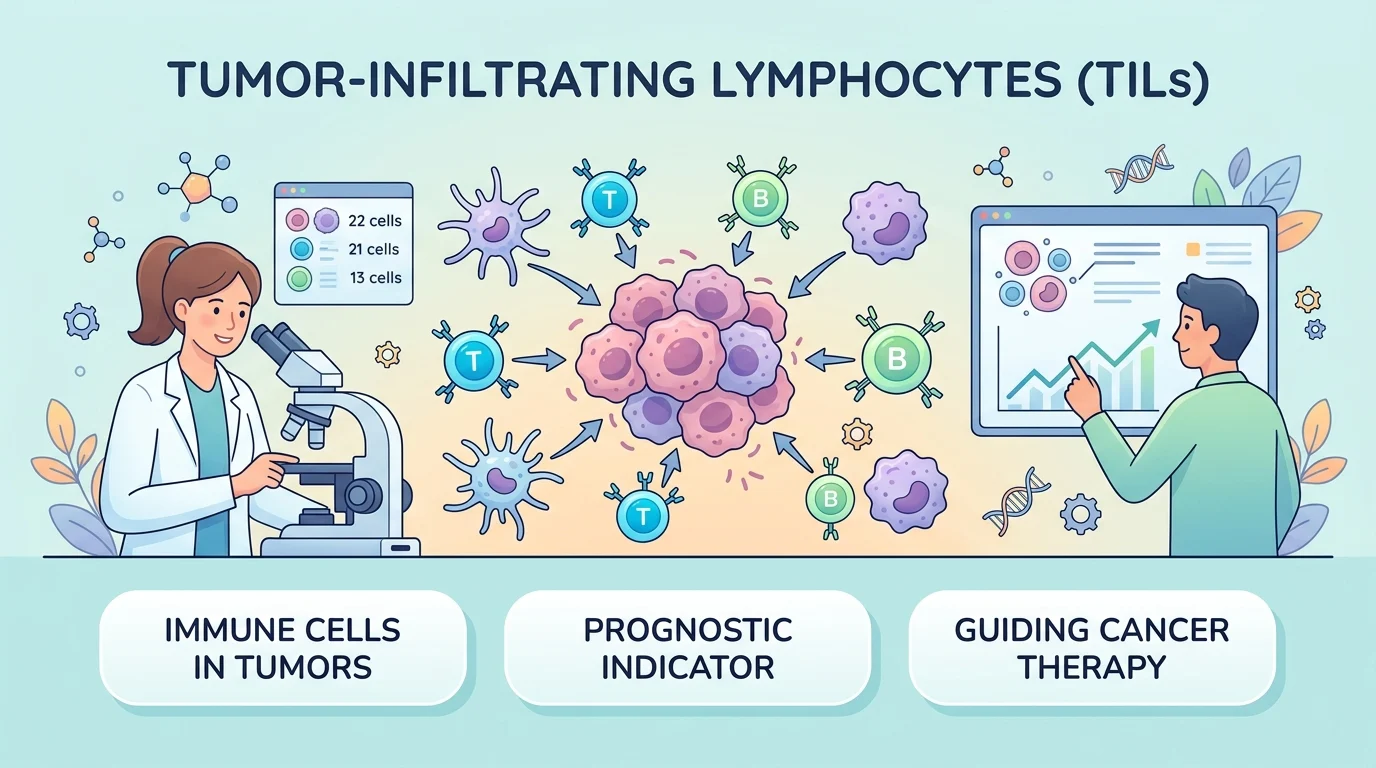
If the phrase tumour-infiltrating lymphocytes has appeared on a pathology report, on a clinical trial page, or in a conversation about immunotherapy, you may have come across two very different ideas sharing the same name. On a biopsy report, TILs are a description: the pathologist is telling you that immune cells were found inside or around the tumour. In an oncology clinic, TIL therapy is a manufactured treatment made from those same cells. One is an observation with no action attached to it. The other is a several-week hospital-based procedure available for one cancer and studied in several others.
This guide separates the two, explains what the words on a report actually mean, and sets out what the evidence does and does not currently support.
What tumour-infiltrating lymphocytes are
Lymphocytes are white blood cells that carry out targeted immune defence. Most of the lymphocytes a blood test counts are circulating in the bloodstream, which is what our guide to lymphocytes and their normal range describes. Tumour-infiltrating lymphocytes are different: they are lymphocytes that have left the bloodstream and moved into the tissue of a tumour itself. A pathologist sees them as small dark cells scattered among, or pressed against, the cancer cells on a stained slide.
Their presence means the immune system has recognised something abnormal and sent cells to investigate. The National Cancer Institute describes the tumour microenvironment as a mixture of cancer cells, immune cells, fibroblasts and blood vessels, and notes that cancer cells can change that environment in ways that affect how the tumour grows. TILs are the immune half of that picture, captured in a single snapshot at the moment the tissue was removed.
TILs are also not a way of telling a harmless growth from a dangerous one. Lymphocytes gather around benign lesions too, and the distinction between the two rests on invasion, as our guide to benign and malignant tumours explains.
Two qualifications matter from the start. First, finding TILs does not mean the immune system is winning. Lymphocytes can be present but exhausted, blocked by inhibitory signals, or outnumbered. Second, TILs are counted in tissue, not in blood. A normal, high or low lymphocyte count on a full blood count says nothing about how many lymphocytes are inside a tumour, and the reverse is equally true.
Two different things are called TILs
This is the distinction that causes most of the confusion, and it is worth stating plainly before anything else.
| Question | TILs as a pathology finding | TIL therapy as a treatment |
|---|---|---|
| What it is | A description of immune cells seen in your tumour tissue | A cell therapy manufactured from your own tumour tissue |
| Where it appears | On the biopsy or surgical pathology report | In a treatment plan, usually at a specialist centre |
| Who it applies to | Anyone whose tumour tissue has been examined | Advanced melanoma after other treatments have failed |
| What it changes | Adds prognostic information; rarely changes treatment | It is the treatment |
| Typical wording | Brisk, non-brisk, absent, or a percentage | Lifileucel, adoptive cell therapy, TIL infusion |
A report that says TILs are present does not mean you are a candidate for TIL therapy, and eligibility for TIL therapy is not decided by the TIL line on an old report. The two share a name and a biology, nothing more.
How TILs appear on a pathology report
The way TILs are recorded depends entirely on the cancer type, because different specialties adopted different scoring systems. The National Cancer Institute’s guidance on reading a pathology report is worth keeping in view: the report is written for the treating physician, and results often appear in a patient portal at the same moment the doctor receives them, before anyone has explained them. Non-cancerous biopsies use a different vocabulary again, which we unpack in our guide to what a spongiotic dermatitis report means.
Melanoma: brisk, non-brisk, or absent
Melanoma reports use descriptive categories rather than numbers. The AIM at Melanoma Foundation sets out the wording used: brisk means a lot of lymphocytes, non-brisk means some, sparse means few, and absent means none were identified. Non-brisk is by far the most common result, which is the first thing to know if that word has appeared on your own report.
| Term on the report | What the pathologist saw | How common |
|---|---|---|
| Brisk | Lymphocytes throughout the tumour or across its whole base | Around one in ten cases with TILs present |
| Non-brisk | Lymphocytes in patches, not throughout | The large majority of cases with TILs present |
| Sparse | Only scattered individual lymphocytes | Used by some laboratories, not all |
| Absent | No lymphocytes interacting with the tumour | Roughly one melanoma in five |
TILs sit alongside several other lines on a melanoma report, including Breslow depth, ulceration, mitotic rate and regression. None of them is read alone, and our guide to melanoma symptoms, diagnosis and treatment explains how the other fields fit together. If you are still at the stage of wondering whether a mark needs examining at all, we also compare a seborrhoeic keratosis and a melanoma.
Breast cancer: stromal TILs as a percentage
Breast pathology took a different route and reports a number. Stromal TILs are expressed as the percentage of the supporting tissue between the cancer cells that is occupied by lymphocytes, assessed on a standard stained slide. A result might read 5 percent, 40 percent, or 70 percent.
The percentage matters most in triple-negative and HER2-positive breast cancer, where the immune component is generally more active. According to a report from the International Immuno-Oncology Biomarker Working Group published in npj Breast Cancer, each 10 percent increase in stromal TILs in triple-negative disease corresponds to a meaningful improvement in invasive disease-free survival, and women with stage I triple-negative tumours and stromal TILs of at least 30 percent had around 98 percent five-year overall survival without chemotherapy. Our overview of breast cancer diagnosis and treatment covers where this sits amongst the other markers on the report.
Other cancers
Outside melanoma and breast cancer, TIL reporting is inconsistent. Colorectal cancer has its own validated immune measure, the Immunoscore, built from the density of specific T cells at the tumour centre and edge rather than a general lymphocyte estimate, and our guide to colorectal cancer screening and treatment covers the tests used in that setting. In bladder, lung, head and neck and kidney cancer, TILs have been studied and repeatedly found to carry prognostic weight, but most laboratories do not report them routinely. If you do not see TILs on your report, the usual explanation is that they were not assessed, not that none were found.
What a TIL result predicts, and what it does not
Across most cancers studied, more TILs is associated with better outcomes. The size of that effect, and how reliably it holds, varies a great deal.
The largest recent melanoma dataset comes from the Sentinel Lymph Node Working Group, which examined 4,957 patients treated between 1993 and 2024. According to PubMed, TILs were present in 80.2 per cent of cases and were prognostic for melanoma-specific survival, overall survival and recurrence-free survival, with brisk TILs more strongly associated with each outcome than non-brisk TILs (DOI). The association held even among patients with a positive sentinel lymph node.
A smaller single-institution study of 1,017 patients treated between 2006 and 2019 gives a more cautious reading. Patients with brisk TILs had a recurrence-free survival advantage and a five-year recurrence-free rate of 84 per cent, against 71.8 per cent for non-brisk and 68.4 per cent for absent TILs, but no association with disease-specific survival was found, and no link emerged between TIL status and how well immune checkpoint treatment worked later (DOI). The authors describe the prognostic significance of TILs in the modern treatment era as complex, which is a fair summary of the evidence as a whole.
Two limits are worth bearing in mind. A TIL score describes a group, not a person: it shifts the odds without predicting any individual outcome. And TILs are weaker than the fields most treatment decisions rest on. In melanoma, depth and ulceration carry far more weight; in breast cancer, receptor status does. TILs refine a picture that other findings have already drawn, in much the same way that the LDH blood test adds context in advanced disease without deciding anything on its own.
Why TILs rarely change treatment yet
A marker that predicts outcome is not automatically a marker that guides treatment. The gap between the two is the central problem for TILs, and it has three parts.
The first is reproducibility. Two pathologists looking at the same slide do not always assign the same score. The International Immuno-Oncology Biomarker Working Group has been explicit that no universally accepted gold standard exists for what counts as a TIL on a standard stained slide, and that this analytical gap, rather than any doubt about the biology, is what has held back clinical adoption.
The second is that most of the evidence is retrospective. Studies have looked back at stored tissue and correlated TIL scores with what happened, rather than prospectively assigning treatment based on the score. Guideline committees treat those two kinds of evidence very differently.
The third is that no one has yet shown clinical utility, meaning proof that acting on a TIL score leads to better outcomes than ignoring it. That question is now being tested directly in de-escalation trials, where patients with high-TIL tumours receive less chemotherapy. Until those results arrive, a high TIL score is reassuring information rather than a reason to change a plan.
TIL therapy: turning the finding into a treatment
The observation that lymphocytes inside a tumour can recognise it led to an obvious question: if those cells are already doing the right job but losing, what happens if you take them out, grow billions of them, and give them back?
In February 2024 the US Food and Drug Administration approved lifileucel, sold as Amtagvi, for adults with unresectable or metastatic melanoma that has progressed after a PD-1 blocking antibody and, for tumours carrying a BRAF V600 mutation, after a BRAF inhibitor. It was the first tumour-derived T cell therapy approved for a solid tumour. Health Canada has since approved it, and decisions in the United Kingdom and Europe were still pending as of early 2026.
How the treatment is made and given
The process is closer to a transplant than to a course of medication, and the American Cancer Society and Cleveland Clinic both describe the same sequence.
| Step | What happens | Roughly how long |
|---|---|---|
| Tumour removal | A surgeon takes a piece of tumour containing your lymphocytes | One procedure |
| Laboratory expansion | The lymphocytes are isolated and grown to very large numbers | About five weeks |
| Lymphodepletion | Chemotherapy clears space by reducing existing immune cells | Five to seven days |
| TIL infusion | The expanded cells are given back through a drip, once | Several hours |
| Interleukin-2 | A signalling protein is given to help the new cells survive | Three to five days |
| Recovery | Close monitoring in hospital whilst blood counts rebuild | Around two weeks in hospital |
The whole path from surgery to discharge runs to roughly ten weeks. TIL therapy is often confused with CAR T-cell therapy, and the National Cancer Institute draws the line clearly: CAR T cells are genetically engineered in the laboratory to make a new receptor, whilst TILs are selected rather than engineered. They are your own unmodified cells, chosen because they already recognised the tumour.
What the results look like
A five-year analysis of the pivotal C-144-01 study was published in the Journal of Clinical Oncology in 2025. According to PubMed, the objective response rate was 31.4 per cent, with 5.9 per cent complete responses, and 79.3 per cent of patients had some reduction in tumour burden. Median duration of response was 36.5 months, median overall survival 13.9 months, and five-year overall survival 19.7 per cent (DOI). Sixteen patients deepened their response over time, four converting from a partial to a complete response more than a year after the infusion.
Those numbers describe a heavily pretreated group whose other options had run out, and they describe a divide rather than an average. Most patients do not respond. Among those who do, the response tends to last, which is unusual in advanced melanoma and is the reason the approach matters. Responders in the trial had lower tumour burden and fewer liver or brain metastases than the study population as a whole.
Side effects
The toxicity comes mainly from the chemotherapy and the interleukin-2 rather than from the lymphocytes themselves. The FDA label carries a boxed warning covering prolonged severe low blood counts, severe infection, cardiac disorder, and worsened breathing or kidney function, including fatal treatment-related complications. Common effects listed by Cleveland Clinic include fever and chills, fatigue, diarrhoea, nausea, low blood pressure, irregular heartbeat and rash. Capillary leak syndrome, in which fluid escapes from small blood vessels, is uncommon but serious.
In the five-year analysis, adverse events were consistent with what lymphodepletion and interleukin-2 are known to cause, declined rapidly within two weeks of the infusion, and most severe low blood counts had improved by day 30. Because blood counts fall so far during this period, the white blood cell count is monitored closely throughout, and a low lymphocyte count is an expected and deliberate part of the treatment rather than a complication.
Latest scientific advances
Research over the past three years has moved on two fronts at once: making the pathology score reliable enough to act on, and making the therapy work for more people.
On the measurement side, computers are closing the reproducibility gap. The TIGER challenge, an international competition to build open-source computational TIL models, was analysed across 3,708 HER2-positive and triple-negative breast cancers from routine practice and phase 3 trials. According to PubMed, the computational scores agreed strongly with pathologists, performed better than visually scored TILs at predicting response to pre-surgical treatment in HER2-positive disease, and added prognostic information beyond clinical variables in triple-negative disease (DOI). A secondary analysis of the phase 3 APHINITY trial, covering 4,262 samples scored manually, digitally and by artificial intelligence, published in The Lancet Oncology in 2026, tested the same question in the context of dual HER2 blockade (DOI).
In melanoma, a deep learning approach produced an electronic TIL score that was prognostic in 321 primary melanomas using a cut-off of 16.6 per cent, and remained significant after adjusting for tumour thickness and ulceration (DOI). The same score showed predictive value for PD-1 checkpoint treatment in metastases, which is exactly the property the descriptive brisk and non-brisk categories lack.
On the therapy side, work has shifted from proving the concept to widening it. A 2025 review in Trends in Cancer examined which immune features predict who benefits, concluding that tumour immunogenicity, the functional state of the lymphocytes themselves and the surrounding microenvironment all contribute, and that single-cell profiling is beginning to allow more precise patient selection (DOI). Reviews in Cancer and in Cytotherapy describe engineered TIL products and new expansion protocols aimed at overcoming resistance and reducing the manufacturing time (DOI, DOI).
The clinical trial landscape reflects that widening. ClinicalTrials.gov lists TILVANCE-301 (NCT05727904), a phase 3 study of 670 participants testing lifileucel with pembrolizumab against pembrolizumab alone as a first treatment for advanced melanoma, which would move the therapy much earlier in the pathway. A phase 2 study is testing TILs in metastatic non-small cell lung cancer (NCT04614103), an area covered in our guide to lung cancer diagnosis and treatment, and another in previously treated advanced endometrial cancer (NCT06481592). A phase 1/2 study is testing TILs with two genes switched off to make them more resistant to the tumour environment (NCT06598371).
Delivery remains the practical constraint. A 2026 perspective in the British Journal of Cancer set out what national adoption requires: surgical procurement, manufacturing logistics, lymphodepletion capacity, interleukin-2 experience and specialist infrastructure, all coordinated, with the cost demanding careful health economic evaluation (DOI). A parallel review traced the same arc from the first human melanoma studies to today (DOI). Approval and availability are not the same thing.
Questions worth asking your doctor
If TILs appear on your report, or if TIL therapy has been mentioned, these questions tend to be the useful ones.
- Were TILs assessed on my sample, and if not, is that because they are not reported for this cancer type?
- Does my TIL result change anything about my treatment plan, or is it background information?
- How much weight does this carry compared with the other findings on my report?
- If my TIL score is high, am I eligible for any trial that uses it to reduce treatment intensity?
- If TIL therapy has been raised, which centre would provide it and what would the timeline look like?
- Is enough tumour tissue available, and what is the plan if manufacturing does not succeed?
Frequently asked questions
Are tumour-infiltrating lymphocytes a good sign?
Generally yes, in the sense that more TILs are associated with better outcomes across most cancers studied. Brisk TILs in melanoma are associated with better recurrence-free survival than non-brisk or absent TILs. The caveat is that this is a group-level association that shifts the odds rather than a prediction about any one person, and it sits well below tumour thickness, ulceration and stage in importance.
What does non-brisk mean on my melanoma report?
Non-brisk means the pathologist saw lymphocytes in patches within the tumour rather than spread throughout it. It is the most common finding by a wide margin amongst melanomas that have TILs at all. It is a better result than absent and a less favourable one than brisk, and it does not on its own change surgical or drug treatment.
Can a blood test measure my tumour-infiltrating lymphocytes?
No. TILs are counted in tumour tissue under a microscope and require a biopsy or surgical specimen. A blood lymphocyte count measures circulating cells and tells you nothing about the tumour. A high lymphocyte count in the blood has entirely separate causes, most of them infections.
Does having TILs on my report mean I can get TIL therapy?
No. Eligibility for lifileucel depends on the cancer type, the stage, which treatments have already been tried and whether suitable tumour tissue can be surgically obtained now. It is not determined by a TIL description on a previous report.
Is TIL therapy the same as CAR T-cell therapy?
No. Both grow your own T cells in a laboratory and infuse them back, but CAR T cells are genetically engineered to carry a new receptor, whereas TILs are selected unmodified cells that already recognised your tumour. CAR T therapies are mainly approved for blood cancers; TIL therapy is approved for advanced melanoma.
Why were TILs not mentioned on my pathology report?
Most likely because they are not routinely reported for your cancer type. TIL reporting is standard in melanoma and increasingly common in breast cancer, and inconsistent almost everywhere else. Their absence from the report is usually an absence of assessment, not a finding.
Key points to remember
- Tumour-infiltrating lymphocytes are immune cells found inside tumour tissue, counted by a pathologist, not by a blood test.
- The same abbreviation covers a descriptive pathology finding and a manufactured cell therapy, which are unrelated in practice.
- Melanoma reports use brisk, non-brisk and absent; breast cancer reports use a stromal TIL percentage; most other cancers do not report TILs routinely.
- More TILs generally means a better outlook, but the effect is modest next to stage, depth and receptor status.
- TIL scores are not yet used to choose treatment, mainly because scoring is not reproducible enough and no trial has shown that acting on the score improves outcomes.
- Lifileucel, approved in 2024 for advanced melanoma, produces a response in roughly three patients in ten, and those responses tend to be durable.
- Computational scoring and wider trials are the two areas moving fastest, and both aim at the same goal of making TILs actionable.
Sources
- US Food and Drug Administration: FDA approves first cellular therapy to treat patients with unresectable or metastatic melanoma
- National Cancer Institute: T-cell transfer therapy
- National Cancer Institute: Pathology reports
- National Cancer Institute: What is cancer
- American Cancer Society: Tumour-infiltrating lymphocyte therapy and its side effects
- Cleveland Clinic: What is tumour-infiltrating lymphocyte (TIL) therapy
- AIM at Melanoma Foundation: About pathology reports
- npj Breast Cancer: The tale of TILs in breast cancer, a report from the International Immuno-Oncology Biomarker Working Group
- PubMed, Medina et al., Journal of Clinical Oncology 2025, five-year analysis of the C-144-01 lifileucel study: DOI
- PubMed, Morrison et al., American Journal of Surgery 2025, TILs in primary melanoma across 4,957 patients: DOI
- PubMed, Straker et al., Annals of Surgical Oncology 2022, prognostic significance of primary TILs: DOI
- PubMed, Nature Communications 2026, computational TILs and the TIGER challenge: DOI
- PubMed, The Lancet Oncology 2026, manual, digital and AI TIL scoring in the APHINITY trial: DOI
- PubMed, EBioMedicine 2023, deep learning TIL scoring in melanoma: DOI
- PubMed, Navarro Rodrigo et al., Trends in Cancer 2025, immune correlates of TIL therapy efficacy: DOI
- PubMed, Li et al., Cancer 2026, TIL therapy historical context and clinical applications: DOI
- PubMed, Woodford et al., British Journal of Cancer 2026, TIL therapy in melanoma and national adoption: DOI
- PubMed, Shoushtari and Powell, Transplantation and Cellular Therapy 2025, TIL therapy for melanoma and other solid tumours: DOI
- PubMed, Amaria et al., Cytotherapy 2024, innovation in TIL cell therapy: DOI
- ClinicalTrials.gov: TILVANCE-301, lifileucel with pembrolizumab in advanced melanoma (NCT05727904)
- ClinicalTrials.gov: Autologous TILs in metastatic non-small cell lung cancer (NCT04614103)
- ClinicalTrials.gov: Lifileucel in previously treated advanced endometrial cancer (NCT06481592)
- ClinicalTrials.gov: KSQ-004EX, gene-edited TILs in advanced solid tumours (NCT06598371)
A pathology report rarely explains itself, and a line about tumour-infiltrating lymphocytes sits amongst a dozen other findings that only make sense together. Understand your lab results with AI DiagMe, which reads your report line by line and explains each value in plain language, with interpretation reviewed by a committee of physicians.