








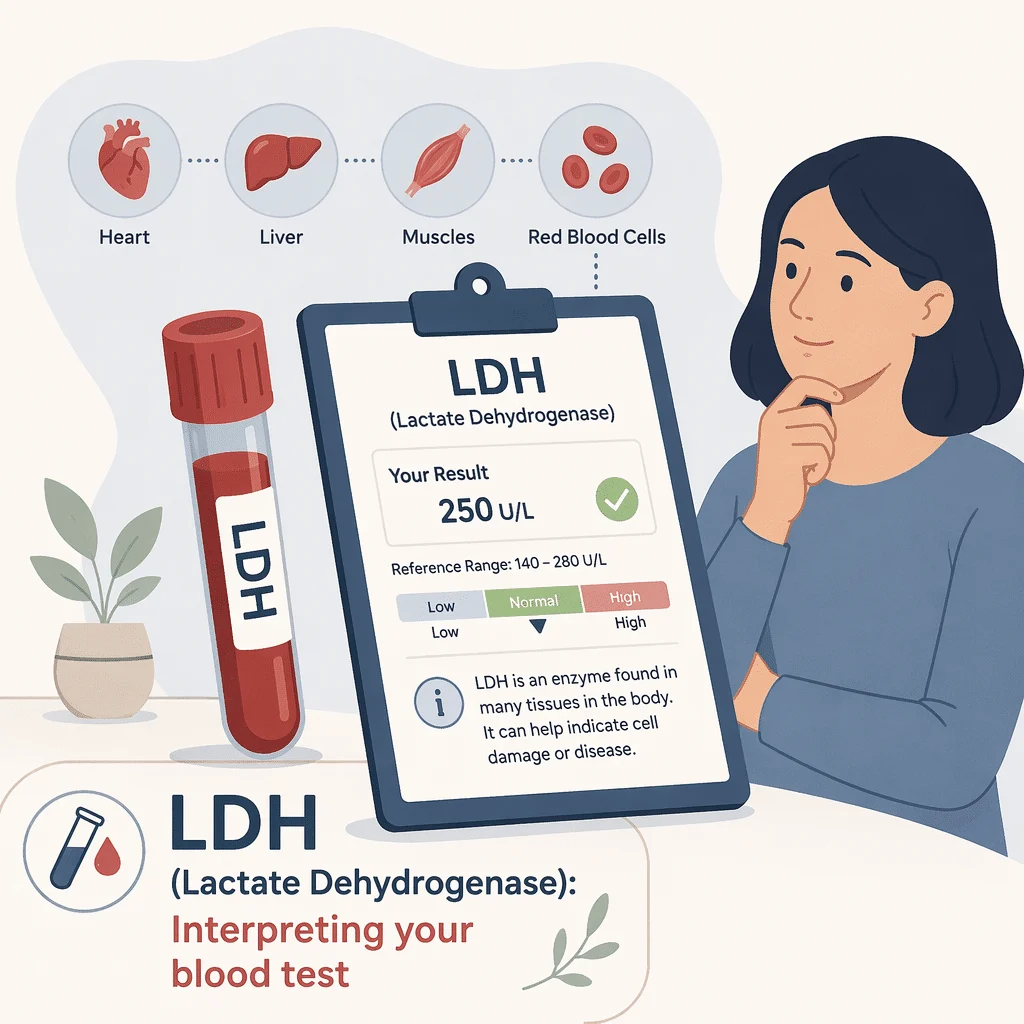
An LDH blood test measures lactate dehydrogenase, an enzyme that sits inside almost every cell in your body. That single fact explains most of what you need to know about your result: because LDH is everywhere, a raised level tells you that cells somewhere have been damaged. It does not tell you where, and it does not tell you why. LDH is one of the least specific tests in common use, and on its own it means very little.
If your mind went straight to cancer, it is worth saying plainly: a raised LDH is not a cancer signal by itself. One of the most frequent explanations is not a disease at all. It is red blood cells breaking open during the blood draw, which pushes the number up artificially.
In this article you’ll learn what LDH is, why haemolysis matters so much, what else lifts the level, how LDH is used in people who already have a lymphoma or melanoma diagnosis, what a normal result means, and when to talk to a doctor.
What LDH is and why it is in almost every cell
Lactate dehydrogenase is an enzyme — a protein that speeds up a chemical reaction. Its job is to help cells turn fuel into energy, particularly when oxygen is in short supply.
Because every cell needs energy, every cell carries LDH. The richest stores sit in muscle, liver, kidney, heart and red blood cells, but no tissue is without it.
Normally LDH stays inside cells, and only a small amount circulates in blood. When a cell is damaged or dies, its membrane gives way and the contents spill into the bloodstream. LDH is part of that spill.
So a raised LDH is a leak detector. It tells you that cells somewhere have released their contents. It cannot tell you which cells, in which organ, or for what reason. That is the whole story of this test, and it is why LDH is almost never interpreted alone.
The five isoenzymes, and why they are now largely historical
LDH exists in five slightly different forms, called isoenzymes and numbered LDH-1 to LDH-5. Different tissues favour different forms: LDH-1 is concentrated in heart muscle and red cells, LDH-5 in liver and skeletal muscle.
In the 1970s and 1980s, measuring these fractions was a genuine way to guess where a leak was coming from. Today it is mostly a footnote. More specific tests have replaced it almost everywhere, and the isoenzyme panel is rarely ordered outside a few niche situations.
Why a doctor orders an LDH blood test, and what it cannot tell you
LDH usually appears on a report for one of three reasons. It may be bundled into a wider panel that was ordered for something else. It may be added when a doctor suspects tissue damage but does not yet know where. Or it may be tracked deliberately over time in someone with a condition already diagnosed.
What LDH can do is flag that something has damaged cells, and give a rough sense of scale — a very high number usually means more damage than a slightly high one.
What it cannot do is locate the problem, name it, or rule it out. The National Library of Medicine puts it plainly: an LDH test alone cannot show what is damaging your tissues or where the damage is. That is why it is ordered with other tests, never instead of them.
It is also not a screening test. LDH is not used to look for cancer, or any other disease, in people without symptoms. On this point the National Cancer Institute is explicit. Its fact sheet examines the evidence behind tumour markers. Studies have generally found that these markers do not work well for screening, because they miss people who do have the disease and flag people who do not. Our own guide explains tumour markers and their limits in more detail.
Haemolysis: the most under-appreciated cause of a high LDH
Red blood cells are packed with LDH. Break them open and LDH floods out. This is called haemolysis, and it is the single most important idea for understanding an unexpected LDH result — because it happens in two completely different places.
When the sample is the problem
Red cells are fragile. They can rupture inside the tube, after the blood has left your arm, without anything at all being wrong with you. Laboratories call this in vitro haemolysis, and it is a lab artefact, not a finding about your body.
It happens for ordinary, mechanical reasons: a difficult venipuncture where the vein was hard to find, a needle that was too narrow, a tourniquet left on too long, blood drawn from a line, a tube shaken rather than gently inverted, or a sample that sat too long or got jolted in transit to the laboratory.
The result is a number that is genuinely high on paper and genuinely meaningless. LDH is one of the tests most vulnerable to this, along with potassium and AST.
Modern laboratories check for it. Analysers measure a haemolysis index on every sample, and if free haemoglobin is above a threshold the result is either flagged with a comment or suppressed entirely.
But flagging is not perfect, and mild haemolysis can lift LDH without tripping the alarm. This is why a raised LDH in someone who feels well, with no symptoms and nothing else abnormal on the report, is very often just a bruised sample. Repeating the draw is a normal, unremarkable next step — not an escalation.
When the red cells are breaking down inside your body
The other kind of haemolysis is real. In haemolytic anaemia, red cells are destroyed faster than the bone marrow can replace them, and the LDH they release is a true signal of what is happening.
The causes are varied: the immune system attacking red cells, inherited conditions of the red cell membrane or its enzymes, mechanical damage from a heart valve, certain infections, and reactions to some medicines.
Crucially, real haemolysis rarely travels alone. It usually comes with tiredness, breathlessness, pale skin, dark urine or a yellow tinge to the eyes, and it leaves fingerprints across the rest of the blood work. To separate the two possibilities, a doctor typically orders a haptoglobin blood test, which falls when free haemoglobin is being mopped up, and requests a reticulocyte count, which rises as the marrow works harder. Breaking down red cells also lifts total bilirubin. The rest of the picture comes from a microscope check of the cells, and doctors also review a complete blood count. Together these tests describe anaemia and its causes.
A high LDH with a low haptoglobin, a high reticulocyte count and a falling haemoglobin is a coherent story. A high LDH on its own, in a well person, usually is not.
Other causes of a raised LDH
Once haemolysis is accounted for, a long list remains — which is exactly the point about specificity. The table below groups the usual explanations and shows what typically happens next.
| Category | Typical examples | What usually happens next |
|---|---|---|
| Sample artefact (haemolysis in the tube) | Difficult blood draw, narrow needle, tube shaken, delay or jolting in transit | The lab flags or suppresses the result, or the doctor simply repeats the draw |
| Red cell breakdown in the body | Haemolytic anaemia, inherited red cell disorders, some drug reactions | Haptoglobin, reticulocyte count, bilirubin, blood film |
| Heart and muscle | Heart attack, hard exercise, injury, surgery, muscle disease | Troponin for the heart, creatine kinase for muscle |
| Liver | Hepatitis, drug-related liver injury, congestion | ALT, AST and the rest of the liver panel |
| Lung | Pneumonia, pulmonary embolism, fluid around the lung | Imaging; for chest fluid, testing the fluid itself |
| Infection and inflammation | Glandular fever, severe infections | Depends entirely on the symptoms and examination |
| Cancer, in people already diagnosed | Lymphoma, melanoma, tumour lysis syndrome during treatment | Used for staging and monitoring, alongside scans and biopsy |
Two entries deserve a note. Hard physical exercise in the two days before a test can lift LDH in a perfectly healthy person, so athletes are often advised to avoid a blood draw straight after a hard session. And a heart attack is no longer investigated with LDH at all — hospitals measure troponin, which is far more specific to heart muscle. For skeletal muscle, doctors order a creatine phosphokinase test instead. If liver damage is the question, they review liver function tests.
LDH in people already diagnosed with lymphoma or melanoma
This is where LDH is genuinely useful — and the qualifier matters more than anything else in this article. LDH is used in cancer care after a diagnosis has been made, never to make one.
Fast-growing tumours burn through fuel quickly and turn over cells rapidly, so more LDH leaks out. A higher level therefore tends to reflect a larger tumour burden or a more active disease.
LDH forms one of the five items in the score used to stage lymphoma, known as the International Prognostic Index. The other four are age, general fitness, how far the disease has spread, and whether it involves sites outside the lymph nodes. No single item decides anything; the score is read as a whole.
Doctors use LDH the same way when they stage and monitor melanoma, where it is built into the staging system for advanced disease.
LDH also has a role in tumour lysis syndrome — a complication in which many cancer cells break apart at once, usually shortly after treatment starts. It is watched for in people receiving chemotherapy, again in a group already known to have cancer.
None of this makes LDH a cancer test. A person with no diagnosis and a mildly raised LDH is not somewhere on the same pathway. The number means something in cancer care only because everything else about the situation is already known.
What a normal LDH means
Reference ranges differ between laboratories because they depend on the method and the equipment, so always read your result against the range printed on your own report rather than one found online. Children and infants normally run higher than adults.
A normal LDH is reassuring in a limited way. It makes widespread, active tissue damage less likely at the moment the blood was taken.
It does not exclude disease. Plenty of serious conditions leave LDH untouched, and a normal result never rules out cancer or anything else. A test this non-specific is weak evidence in both directions.
A low LDH is uncommon and generally not a health problem. Large doses of vitamin C or vitamin E can produce it, and a rare inherited condition called lactate dehydrogenase deficiency can too.
When to see a doctor
An LDH result is not something to act on alone. What matters is the company it keeps.
Book an appointment to discuss your result if:
- the raised LDH comes with symptoms — unusual tiredness, breathlessness, pale skin, dark urine, yellowing of the eyes or skin, unexplained weight loss, fever or night sweats
- other lines on the report are also abnormal, particularly haemoglobin, bilirubin or the liver enzymes
- the level stays high on a repeat sample taken under good conditions
- you are already being treated for a condition that LDH is being used to monitor
Seek urgent care for chest pain, severe breathlessness, or dark red or brown urine after intense exertion — regardless of what any blood test says.
If your LDH is mildly high, you feel well and nothing else is abnormal, a repeat blood draw is a reasonable and common next step. Ask your doctor whether the first sample was haemolysed.
Latest scientific advances in LDH testing
Research on LDH has moved in two directions at once: making laboratories better at spotting damaged samples, and refining how the marker is used in people who already have a cancer diagnosis. The studies summarised here were identified through PubMed.
Laboratories are rewriting the rules on haemolysed samples
A 2023 study from a US hospital laboratory examined how often results are blocked because of haemolysis. What was found: of the three tests examined, LDH was the worst affected. Under blanket rejection rules, roughly 31 of every 100 LDH samples were being discarded. When the laboratory replaced the one-size-fits-all cutoff with limits tuned to the actual result, that fell to about 5 in 100 — without making the reported results less trustworthy.
What this means for you: haemolysis interferes with LDH more than with almost any other routine test, and laboratories know it. If your result carried a comment about sample quality, or you were asked to give blood again, that is a normal and well-recognised part of the process rather than a sign that something was found.
In melanoma, LDH tracks with outlook — after diagnosis
A 2026 systematic review and meta-analysis — a study that pools the results of many earlier studies — looked at what predicts how people with advanced melanoma do on immunotherapy. What was found: a raised LDH before treatment was consistently linked with shorter survival, alongside factors such as age, general fitness and how widely the disease had spread.
What this means for you: LDH earns its place here as a prognostic marker, one that helps estimate the likely course of a disease already known to be present. Every person in those studies had a confirmed melanoma diagnosis before their LDH was read this way. The test played no part in finding the melanoma.
In lymphoma, LDH is one item in a score
A 2024 study of more than 2,500 people newly diagnosed with diffuse large B-cell lymphoma examined the International Prognostic Index — the five-item score used to sort patients into risk groups. What was found: LDH is one of those five items, and the groups the score creates separate clearly, with survival at five years ranging from roughly four in ten in the highest-risk group to roughly nine in ten in the lowest.
A 2025 five-year follow-up of a cell therapy trial pointed the same way. Among people treated for relapsed large B-cell lymphoma, those whose LDH sat at or below the upper limit of normal before treatment tended to live longer.
What this means for you: LDH is doing real work in lymphoma care, but only as one input among five, and only once a diagnosis exists. Notice what all three cancer studies share — everyone in them had already been diagnosed. None of this research supports using LDH to look for cancer in the first place.
Glossary
| Term | Definition |
|---|---|
| Lactate dehydrogenase (LDH) | An enzyme found inside almost every cell in the body, released into the blood when cells are damaged |
| Enzyme | A protein that speeds up a chemical reaction inside the body |
| Haemolysis | The breaking open of red blood cells, releasing their contents including LDH |
| In vitro haemolysis | Red cells damaged in the tube after the blood draw rather than in the body; a lab artefact, not a disease |
| Haemolysis index | An automatic measure of free haemoglobin that tells the laboratory whether a sample was damaged |
| Haptoglobin | A blood protein that binds free haemoglobin; it falls when red cells are breaking down in the body |
| Isoenzyme | One of five slightly different forms of LDH, each more common in certain tissues |
| Non-specific marker | A test that can be abnormal for many unrelated reasons and so cannot point to one cause |
| Prognostic marker | A measurement that helps estimate the likely course of a disease that is already diagnosed |
| Tumour lysis syndrome | A complication in which many cancer cells break apart at once, usually soon after treatment begins |
Frequently asked questions
Does a high LDH mean cancer?
No — not on its own. LDH is one of the least specific tests in medicine, and the list of things that raise it is long: a haemolysed sample, a hard workout, a chest infection, a liver upset, a muscle strain. Cancer sits somewhere on that list, but it is neither the first nor the most likely explanation in a person who feels well. LDH is not a cancer-detection test and is not used to screen for cancer. It is used in cancer care to stage and monitor a disease that has already been diagnosed by biopsy and imaging. If you have symptoms that worry you, those symptoms — not the LDH number — are what to take to your doctor.
What is considered a high LDH level?
Anything above the upper limit printed on your own report. That limit varies between laboratories because it depends on the analyser and method used, so a number that is flagged at one lab may be normal at another. Beyond that, the size of the rise matters more than the fact of it. A level a little above the range in someone with no symptoms is weak evidence of anything and is often repeated. A level several times the upper limit is taken more seriously and prompts a search for a cause. Neither figure means anything until it is read alongside your symptoms and the rest of your results.
Can exercise raise my LDH blood test result?
Yes. Intense or unaccustomed exercise damages small numbers of muscle fibres, and those fibres release LDH into the blood. The effect can persist for a day or two after a hard session, a long run or a competition. It is a normal physiological response, not an injury. If you train hard and are having routine blood work, it is worth mentioning to whoever takes the sample and, where possible, scheduling the draw after a rest day. The same applies to creatine kinase, which rises more dramatically after exercise than LDH does.
What does a low LDH blood test result mean?
Usually nothing worrying. A low LDH is uncommon and is not generally treated as a health problem in its own right. Taking large amounts of vitamin C or vitamin E can produce a low reading, partly by interfering with the assay itself. There is also a rare inherited condition called lactate dehydrogenase deficiency, which can cause muscle symptoms during exertion, but it is genuinely rare. If your LDH is low and you feel well, it is not something that normally needs investigating. Mention any high-dose supplements you take to your doctor, as they can affect several tests.
Why might LDH be high in pregnancy?
LDH rises modestly in a normal pregnancy, so a slightly high number by itself is not unexpected. It is watched more closely in the second half of pregnancy because a marked rise, together with low platelets and abnormal liver enzymes, can form part of a serious complication of pre-eclampsia. That pattern comes with symptoms and abnormalities across several tests at once, and it is picked up during routine antenatal monitoring. An isolated LDH result in an otherwise uneventful pregnancy is not read the same way. Any concern about your result should go to the team looking after your pregnancy.
What does low haptoglobin with high LDH mean?
Together, these two point towards red blood cells breaking down inside the body rather than in the tube. Haptoglobin binds free haemoglobin and is used up when red cells rupture, so it falls exactly when LDH rises. That combination is one of the classic signatures of haemolysis. It becomes more convincing still if the reticulocyte count is high, the bilirubin is up and the haemoglobin is drifting down. It is not a diagnosis by itself — a doctor will look at your symptoms, examine a blood film and work out why the red cells are being destroyed before deciding what, if anything, needs doing.
Sources
- MedlinePlus, U.S. National Library of Medicine. Lactate Dehydrogenase (LDH) Test. Read the source
- National Cancer Institute. Tumor Markers fact sheet. Read the source
- Farhana A, Lappin SL. Biochemistry, Lactate Dehydrogenase. StatPearls, NCBI Bookshelf. Read the source
- Tang NY, Mitchell KR, Groboske SE, Baldwin AD, Lenza M, Yeo KJ, van Wijk XMR. Reducing Specimen Rejection Rates Using Concentration-Dependent Haemolysis Rejection Thresholds. Journal of Applied Laboratory Medicine, 2023. Identified via PubMed. Read the study
- Papazoglou MC, Avgeros C, Sogka E, et al. Clinical, Dermatoscopic, Histological and Molecular Prognostic and Predictive Factors of Metastatic Melanoma Response to Immunotherapy: A Systematic Review and Drug Class Meta-Analysis. Journal of Clinical Medicine, 2026. Identified via PubMed. Read the study
- Wang Y, Shi Q, Shi ZY, et al. Biological signatures of the International Prognostic Index in diffuse large B-cell lymphoma. Blood Advances, 2024. Identified via PubMed. Read the study
- Maziarz RT, Bishop MR, Tam CS, et al. Five-Year Analysis of the JULIET Trial of Tisagenlecleucel in Patients With Relapsed/Refractory Large B-Cell Lymphoma. Journal of Clinical Oncology, 2025. Identified via PubMed. Read the study
Further reading
- Haptoglobin blood test: high and low levels
- Reticulocyte count: how to read your results
- Total bilirubin levels: ranges, causes and care
- Abnormal blood test results: what they mean
- Cardiac markers: troponin, BNP and CK explained
Understand your lab results with AI DiagMe
An LDH result rarely makes sense on its own. Seeing it alongside your haptoglobin, your full blood count and your bilirubin is what turns an isolated number into a picture you can actually discuss. AI DiagMe reads your report and explains what each marker measures and why it might be flagged, in plain language. It helps you understand your results — it does not diagnose anything, and it does not replace your doctor.
Get your results interpreted in minutes